
You are using an out of date browser. It may not display this or other websites correctly.
You should upgrade or use an alternative browser.
You should upgrade or use an alternative browser.
Ceramics in Turbine Development
- Thread starter exclaimedleech8
- Start date
exclaimedleech8
ACCESS: Top Secret
- Joined
- 30 September 2024
- Messages
- 582
- Reaction score
- 633
Moving on: such highly efficient, lightweight, and inexpensive gas turbines wouldn't just have applications in automobiles. Imagine what it would do for the capability of aircraft!
There is no small highly efficient gas turbine.... VW even builded a ceramic gas turbine for cars, but for good reason they didn't proceed with it.
Instead, Volkswagen went on with the Diesel, whch was not only cheaper and more efficient, it also produced much less NOx (sic!) than gas turbines (especially regenerative ones and those with a very high working temperature for high efficiency....).
Instead, Volkswagen went on with the Diesel, whch was not only cheaper and more efficient, it also produced much less NOx (sic!) than gas turbines (especially regenerative ones and those with a very high working temperature for high efficiency....).
exclaimedleech8
ACCESS: Top Secret
- Joined
- 30 September 2024
- Messages
- 582
- Reaction score
- 633
The only reason was ceramics were and still are too brittle.There is no small highly efficient gas turbine.... VW even builded a ceramic gas turbine for cars, but for good reason they didn't proceed with it.
Instead, Volkswagen went on with the Diesel, whch was not only cheaper and more efficient, it also produced much less NOx (sic!) than gas turbines (especially regenerative ones and those with a very high working temperature for high efficiency....).
Internal combustion engines also become less efficient at small sizes.
Also, in this case I was referring to their uses for full size jet engines.
Last edited:
I got a collection with all SAE papers about turbine development for cars (actually, I'm currently about 10.000 km away from it...) and no, I wasn't all about brittleness.
- The fuel consumption, especially at idle and low loads was to high
- the manufacturing cost were to high
- the NOx limitation in California in the 70 th. could only be met with significant reduced combustion temperature and high fuel consumption penalty.
-the slow throttle response was disliked by many drivers
-the vacuum cleaner sound was disliked by many (surly also loved by enthusiasts)
- high investments were necessary without any major breakthrough compared to piston powered cars.
- The fuel consumption, especially at idle and low loads was to high
- the manufacturing cost were to high
- the NOx limitation in California in the 70 th. could only be met with significant reduced combustion temperature and high fuel consumption penalty.
-the slow throttle response was disliked by many drivers
-the vacuum cleaner sound was disliked by many (surly also loved by enthusiasts)
- high investments were necessary without any major breakthrough compared to piston powered cars.
exclaimedleech8
ACCESS: Top Secret
- Joined
- 30 September 2024
- Messages
- 582
- Reaction score
- 633
Part throttle fuel consumption was solved by variable nozzles and regeneratorsI got a collection with all SAE papers about turbine development for cars (actually, I'm currently about 10.000 km away from it...) and no, I wasn't all about brittleness.
- The fuel consumption, especially at idle and low loads was to high
- the manufacturing cost were to high
- the NOx limitation in California in the 70 th. could only be met with significant reduced combustion temperature and high fuel consumption penalty.
-the slow throttle response was disliked by many drivers
-the vacuum cleaner sound was disliked by many (surly also loved by enthusiasts)
- high investments were necessary without any major breakthrough compared to piston powered cars.
Manufacturing costs were high because they were using exotic superalloys. Ceramics would've fixed that problem if they weren't too brittle
They devised numerous combustor designs that got around the NOX problems, and when it came to the other pollutants; CO and HC, the turbine was at an advantage thanks to its continuous combustion nature. That problem was only fixed in piston engines with expensive catalytic converters
Slow throttle response was solved in the KTT design
But the incredible smoothness was beloved
If it were possible to make a turbine engine at the same or lower cost as a piston engine of the same power output, I am sure automakers would've happily retooled their plants, just as they are doing now for battery electric vehicles
Please stay on the facts:
The fuel consumption was never solved, it always remained higher than that of a halfway modern piston engine. That was also true for the very derived Ford truck turbine and Volkswagen ceramic car turbine which still were thirstier than the contemporary modern piston engines.
Even today, NOx regulated aircraft turbines are emitting more NOx per KWh (shaft power) than old an unregulated Diesel engine. Not talking about Euro 6 with emissions equal to the environment.
Even the HC and CO emissions weren't that great which would have become a problem later on, since the low exhaust temperature would have made a catalyst very inefficient. It might have been possible to apply a catalytic coating on the regenerator, but still, reaching the light off temperature soon enough is difficult with that high mass (rotation would have been stopped for cold start).
The NOx emission problem has never been solved for gas turbines, it is just ignored for ideologic reasons.
The fuel consumption was never solved, it always remained higher than that of a halfway modern piston engine. That was also true for the very derived Ford truck turbine and Volkswagen ceramic car turbine which still were thirstier than the contemporary modern piston engines.
Even today, NOx regulated aircraft turbines are emitting more NOx per KWh (shaft power) than old an unregulated Diesel engine. Not talking about Euro 6 with emissions equal to the environment.
Even the HC and CO emissions weren't that great which would have become a problem later on, since the low exhaust temperature would have made a catalyst very inefficient. It might have been possible to apply a catalytic coating on the regenerator, but still, reaching the light off temperature soon enough is difficult with that high mass (rotation would have been stopped for cold start).
The NOx emission problem has never been solved for gas turbines, it is just ignored for ideologic reasons.
exclaimedleech8
ACCESS: Top Secret
- Joined
- 30 September 2024
- Messages
- 582
- Reaction score
- 633
Chrysler's turbine engines managed to achieve fuel economy comparable to the piston engines of the day. You have to remember that Ford's truck turbine engine was going up against diesels which are of course far more efficient than gasoline engines.The fuel consumption was never solved, it always remained higher than that of a halfway modern piston engine. That was also true for the very derived Ford truck turbine and Volkswagen ceramic car turbine which still were thirstier than the contemporary modern piston engines.
Of course, since then, piston engines have grown far more efficient thanks to fuel injection and variable valve timing and are now much more efficient than comparable metal turbine engines, but back then the issue was manufacturing costs due to the expensive superalloys they had to use.
So all those academic papers I've read extolling the low HC and CO emissions from gas turbines were lying?Even the HC and CO emissions weren't that great which would have become a problem later on, since the low exhaust temperature would have made a catalyst very inefficient.
If you compared the Chrysler turbine with a contemporary V8 (with a design from the 50 th), it might have been the same (depending on the driving cycle), but I said this allready before here in this thread.
There was no priority for efficiency in the US back than, it changed after the oil crizis. Chryslers NOx regulated turbine cars developed in the 70 th needed much more fuel and Honda showed at the same time with the astonishing CVCC combustion how emissions could be met with a significantly reduced fuel consumption.
For those enthusiast who wanted something rotating instead of going up and down, the Wankel was a good alternative (with the same fuel consuption problem....).
I linked here a paper (its about a concept for a turbocompound aero Diesel) in which the g/kwh of Diesel engines and modern gas turbines for planes are beeing compared. In fact, the emission regulations for jet engines could be met by Diesel engines easily without any exhaust after treatments.
There was no priority for efficiency in the US back than, it changed after the oil crizis. Chryslers NOx regulated turbine cars developed in the 70 th needed much more fuel and Honda showed at the same time with the astonishing CVCC combustion how emissions could be met with a significantly reduced fuel consumption.
For those enthusiast who wanted something rotating instead of going up and down, the Wankel was a good alternative (with the same fuel consuption problem....).
I linked here a paper (its about a concept for a turbocompound aero Diesel) in which the g/kwh of Diesel engines and modern gas turbines for planes are beeing compared. In fact, the emission regulations for jet engines could be met by Diesel engines easily without any exhaust after treatments.
exclaimedleech8
ACCESS: Top Secret
- Joined
- 30 September 2024
- Messages
- 582
- Reaction score
- 633
It turns out that the Japanese did develop an automotive sized ceramic gas turbine in 1997. Theirs was a single shaft attached to a CVT. They got a thermal efficiency of 35.6% and a power output of 94 KW.If you compared the Chrysler turbine with a contemporary V8 (with a design from the 50 th), it might have been the same (depending on the driving cycle), but I said this allready before here in this thread.
There was no priority for efficiency in the US back than, it changed after the oil crizis. Chryslers NOx regulated turbine cars developed in the 70 th needed much more fuel and Honda showed at the same time with the astonishing CVCC combustion how emissions could be met with a significantly reduced fuel consumption.
For those enthusiast who wanted something rotating instead of going up and down, the Wankel was a good alternative (with the same fuel consuption problem....).
I linked here a paper (its about a concept for a turbocompound aero Diesel) in which the g/kwh of Diesel engines and modern gas turbines for planes are beeing compared. In fact, the emission regulations for jet engines could be met by Diesel engines easily without any exhaust after treatments.
Scott Kenny
ACCESS: USAP
- Joined
- 15 May 2023
- Messages
- 16,973
- Reaction score
- 24,080
Yeah.Chrysler's turbine engines managed to achieve fuel economy comparable to the piston engines of the day.
12-18MPG. which is CRAP!
exclaimedleech8
ACCESS: Top Secret
- Joined
- 30 September 2024
- Messages
- 582
- Reaction score
- 633
Even without ceramics, improvements in regenerator and rotor/stator design, not to mention the availability of automatic transmissions with 8-10 forward speeds instead of 3, would've made it a lot more efficient. But still, given the need for expensive superalloys, it would not have been commercially viable.Yeah.
12-18MPG. which is CRAP!
Eleven years prior, Opel's C20XE engine (110 kW) archieved 37% thermal efficiency as a production engine with a three way catalyst. It didn't even need a power consuming CVT be efficient, so there was a reason that the turbine development ended in Japan jus like everywhere else.It turns out that the Japanese did develop an automotive sized ceramic gas turbine in 1997. Theirs was a single shaft attached to a CVT. They got a thermal efficiency of 35.6% and a power output of 94 KW.
So what is the point, if even after seven years of research, a laboratory ceramic gas turbine with a very high turbine entrance temperature (1350° C) failed to reach the efficiency of gazoline engines which were allready in production since 11 years?
Modern transmissions also made combustion engines much more efficient over the last 20 Years. From the mid 90th to the about 2005, gazoline cars were usually equiped with very short gear ratios to compensate the increasing vehicle weight. This period ended with the introduction of small direct injected turbocharged gazoline engines which were often equiped with automated seven/eight or more gears which allowed very low rpm when cruizing on highways. The typical engine rpm at 100 km/h went down from about 3000 rpm to lower than 2000 rpm.
Last edited:
exclaimedleech8
ACCESS: Top Secret
- Joined
- 30 September 2024
- Messages
- 582
- Reaction score
- 633
The point is that it is possible to create a gas turbine engine competitive with a piston engine in efficiency.Eleven years prior, Opel's C20XE engine (110 kW) archieved 37% thermal efficiency as a production engine with a three way catalyst. It didn't even need a power consuming CVT be efficient, so there was a reason that the turbine development ended in Japan jus like everywhere else.
So what is the point, if even after seven years of research, a laboratory ceramic gas turbine with a very high turbine entrance temperature (1350° C) failed to reach the efficiency of gazoline engines which were allready in production since 11 years?
Modern transmissions also made combustion engines much more efficient over the last 20 Years. From the mid 90th to the about 2005, gazoline cars were usually equiped with very short gear ratios to compensate the increasing vehicle weight. This period ended with the introduction of small direct injected turbocharged gazoline engines which were often equiped with automated seven/eight or more gears which allowed very low rpm when cruizing on highways. The typical engine rpm at 100 km/h went down from about 3000 rpm to lower than 2000 rpm.
Edit: Where are you getting 37% for C20XE from? In 2015, Toyota amazed the world with an engine claiming 36% efficiency
Last edited:
Remember, you said, that fully ceramic gas turbines could be more efficient than combustion engines, which prooved to be not the case. If a fully cramic research turbine with 1350° C turbine inlet temperature only reached 35.6 %, a NOx complient production variant (optimized for cost, emissions, noise, package etc.) would have had barly 32 %.
For road applications, the part load efficiency is more important than peak efficiency, but in this field the turbines never shined, even with a regenerator. Modern turbocharged engines with small displacement are more efficient in real life than the good old C20XE, even with a lower maximum efficiency. T
The C20XE was a long time record holder for lowest specific fuel consumption and highest mean effective pressure of a natural aspirated engine for quite a long time. It took until 2014 until Ferrari finally beated the C20XE (in the south African Super Boss variant with 228 Nm) in effective mean pressure. No doubt, one of the best engines ever made!
There are numerous sources (e.g. Wikipedia) for the 37 % (232 g/kwh) which are easy to find... The C20XE was also used as benchmark engine in many scientific puplications, I don't have easy acsess to them here from China, so I can't provide them.
Meanwhile Toyota is the current record holder with 42 % for the 1.5 L Prius engine and I think it was around 40 % for the non hybrid gazoline, naturally aspirated engines.
The 36 % efficiency which you linked is for a small displacement (1.2 L) turbocharged engine and in this cateory it is really efficient. If both engines, the Opel C20XE and the mentioned Toyota 1.2 would be used in the same car at 100 km/h and about 15 kW power output, the smaller engine would win.
The 1.5L VW engine (turbocharged,.miller cycle with a VTG charger) has 38 % peak efficiency with an exeptional good part load efficiency. Even at 2000/2 it is around 280 g/kwh and thanks to thev long gear ratio of the double clutch gearbox, it is usually operated at much higher mep.
What do you think stopped the gas turbine development for cars, some kind of Mafia?
For road applications, the part load efficiency is more important than peak efficiency, but in this field the turbines never shined, even with a regenerator. Modern turbocharged engines with small displacement are more efficient in real life than the good old C20XE, even with a lower maximum efficiency. T
The C20XE was a long time record holder for lowest specific fuel consumption and highest mean effective pressure of a natural aspirated engine for quite a long time. It took until 2014 until Ferrari finally beated the C20XE (in the south African Super Boss variant with 228 Nm) in effective mean pressure. No doubt, one of the best engines ever made!
There are numerous sources (e.g. Wikipedia) for the 37 % (232 g/kwh) which are easy to find... The C20XE was also used as benchmark engine in many scientific puplications, I don't have easy acsess to them here from China, so I can't provide them.
Meanwhile Toyota is the current record holder with 42 % for the 1.5 L Prius engine and I think it was around 40 % for the non hybrid gazoline, naturally aspirated engines.
The 36 % efficiency which you linked is for a small displacement (1.2 L) turbocharged engine and in this cateory it is really efficient. If both engines, the Opel C20XE and the mentioned Toyota 1.2 would be used in the same car at 100 km/h and about 15 kW power output, the smaller engine would win.
The 1.5L VW engine (turbocharged,.miller cycle with a VTG charger) has 38 % peak efficiency with an exeptional good part load efficiency. Even at 2000/2 it is around 280 g/kwh and thanks to thev long gear ratio of the double clutch gearbox, it is usually operated at much higher mep.
What do you think stopped the gas turbine development for cars, some kind of Mafia?
Last edited:
exclaimedleech8
ACCESS: Top Secret
- Joined
- 30 September 2024
- Messages
- 582
- Reaction score
- 633
I looked on google and the only result I got for 37% thermal efficiency with the C20XE was one comment on a facebook post.Remember, you said, that fully ceramic gas turbines could be more efficient than combustion engines, which prooved to be not the case. If a fully cramic research turbine with 1350° C turbine inlet temperature only reached 35.6 %, a NOx complient production variant (optimized for cost, emissions, noise, package etc.) would have had barly 32 %.
For road applications, the part load efficiency is more important than peak efficiency, but in this field the turbines never shined, even with a regenerator. Modern turbocharged engines with small displacement are more efficient in real life than the good old C20XE, even with a lower maximum efficiency. T
The C20XE was a long time record holder for lowest specific fuel consumption and highest mean effective pressure of a natural aspirated engine for quite a long time. It took until 2014 until Ferrari finally beated the C20XE (in the south African Super Boss variant with 228 Nm) in effective mean pressure. No doubt, one of the best engines ever made!
There are numerous sources (e.g. Wikipedia) for the 37 % (232 g/kwh) which are easy to find... The C20XE was also used as benchmark engine in many scientific puplications, I don't have easy acsess to them here from China, so I can't provide them.
Meanwhile Toyota is the current record holder with 42 % for the 1.5 L Prius engine and I think it was around 40 % for the non hybrid gazoline, naturally aspirated engines.
The 36 % efficiency which you linked is for a small displacement (1.2 L) turbocharged engine and in this cateory it is really efficient. If both engines, the Opel C20XE and the mentioned Toyota 1.2 would be used in the same car at 100 km/h and about 15 kW power output, the smaller engine would win.
The 1.5L VW engine (turbocharged,.miller cycle with a VTG charger) has 38 % peak efficiency with an exeptional good part load efficiency. Even at 2000/2 it is around 280 g/kwh and thanks to thev long gear ratio of the double clutch gearbox, it is usually operated at much higher mep.
What do you think stopped the gas turbine development for cars, some kind of Mafia?
exclaimedleech8
ACCESS: Top Secret
- Joined
- 30 September 2024
- Messages
- 582
- Reaction score
- 633
Just how did they achieve that in the 1980s?
The physics were the same...
The engine had a narrow valve angle, good flowing ports which already look like producing considerable amount of tumble motion, a 4--2-1 exhaust manifold which is not only good for power, but also for low residual gases and low knock, sodium cooled exhaust valves, electronic knock protection and surly a good application.
It’s a bit unclear how much design work was done by Cosworth, but I think they did surly more than just the casting. Later heads were casted by Kolbenschidt/Pierburg, but they couldn’t cast them with the same quality Cosworth did. After having some quality issues, the intake and exhaust port size was slightly reduced, that’s why the older heads are more popular for racing.
I would like to know, ow efficient the engine could be with modern friction optimisation and 98 Octane.
The engine had a narrow valve angle, good flowing ports which already look like producing considerable amount of tumble motion, a 4--2-1 exhaust manifold which is not only good for power, but also for low residual gases and low knock, sodium cooled exhaust valves, electronic knock protection and surly a good application.
It’s a bit unclear how much design work was done by Cosworth, but I think they did surly more than just the casting. Later heads were casted by Kolbenschidt/Pierburg, but they couldn’t cast them with the same quality Cosworth did. After having some quality issues, the intake and exhaust port size was slightly reduced, that’s why the older heads are more popular for racing.
I would like to know, ow efficient the engine could be with modern friction optimisation and 98 Octane.
exclaimedleech8
ACCESS: Top Secret
- Joined
- 30 September 2024
- Messages
- 582
- Reaction score
- 633
I would like to know why other automakers, including GM's other divisions, weren't racing to copy this supposedly miraculous engine.The physics were the same...
The engine had a narrow valve angle, good flowing ports which already look like producing considerable amount of tumble motion, a 4--2-1 exhaust manifold which is not only good for power, but also for low residual gases and low knock, sodium cooled exhaust valves, electronic knock protection and surly a good application.
It’s a bit unclear how much design work was done by Cosworth, but I think they did surly more than just the casting. Later heads were casted by Kolbenschidt/Pierburg, but they couldn’t cast them with the same quality Cosworth did. After having some quality issues, the intake and exhaust port size was slightly reduced, that’s why the older heads are more popular for racing.
I would like to know, ow efficient the engine could be with modern friction optimisation and 98 Octane.
Well, there was nothing completely outstanding in this design, it was simply a good combination with a good detail design. Note, most OEM don't purplish their fuel maps anymore so, that we miss a lot of information on modern engines. Mazda built a natural aspirated engine with a 14:1 compression ratio, but we don't know the max. efficiency of that.
Until the introduction of the WLTP cycle, fuel consumption was mainly optimized for low part loads. The use of downsized turbo engines helps a lot with that, also the introduction of fully variable valve trains and the (now extinct) lean burn combustion.
Until the introduction of the WLTP cycle, fuel consumption was mainly optimized for low part loads. The use of downsized turbo engines helps a lot with that, also the introduction of fully variable valve trains and the (now extinct) lean burn combustion.
Scott Kenny
ACCESS: USAP
- Joined
- 15 May 2023
- Messages
- 16,973
- Reaction score
- 24,080
Well, yeah. Passenger cars spend almost all their time at relatively low load. Even at 100kph, the typical car only needs about 50hp with the Air Conditioning running. Call it 35hp if the AC is off.Well, there was nothing completely outstanding in this design, it was simply a good combination with a good detail design. Note, most OEM don't purplish their fuel maps anymore so, that we miss a lot of information on modern engines. Mazda built a natural aspirated engine with a 14:1 compression ratio, but we don't know the max. efficiency of that.
Until the introduction of the WLTP cycle, fuel consumption was mainly optimized for low part loads. The use of downsized turbo engines helps a lot with that, also the introduction of fully variable valve trains and the (now extinct) lean burn combustion.
If the great majority of your operational model is spent at low loads, you should optimize for that.
It's the reason that there's such a difference between city and highway MPG before start-stop systems were a thing.
exclaimedleech8
ACCESS: Top Secret
- Joined
- 30 September 2024
- Messages
- 582
- Reaction score
- 633
I'm calling BS on this whole thing. You simply cannot get 37% thermal efficiency out of a gasoline engine with 1980s technology, unless maybe you're using 120 octane racing fuel.Well, there was nothing completely outstanding in this design, it was simply a good combination with a good detail design. Note, most OEM don't purplish their fuel maps anymore so, that we miss a lot of information on modern engines. Mazda built a natural aspirated engine with a 14:1 compression ratio, but we don't know the max. efficiency of that.
Until the introduction of the WLTP cycle, fuel consumption was mainly optimized for low part loads. The use of downsized turbo engines helps a lot with that, also the introduction of fully variable valve trains and the (now extinct) lean burn combustion.
Scott Kenny
ACCESS: USAP
- Joined
- 15 May 2023
- Messages
- 16,973
- Reaction score
- 24,080
14:1 compression suggests 102 octane or better fuel. Or maybe E85.I'm calling BS on this whole thing. You simply cannot get 37% thermal efficiency out of a gasoline engine with 1980s technology, unless maybe you're using 120 octane racing fuel.
I'm calling BS on this whole thing. You simply cannot get 37% thermal efficiency out of a gasoline engine with 1980s technology, unless maybe you're using 120 octane racing fuel.
This book here is written by Fritz Indra (Chief of pre development of Opel at the time) and contains a map of the C20XE
Last edited by a moderator:
This remarkable engine runs in Europe with 95 Octane.14:1 compression suggests 102 octane or better fuel. Or maybe E85.
This engine is the first production engine with a spark assisted CAI combustion. To make it work, it needs a high compression ratio and an aftertreatment system which is able to reduce Nox with lean combustion. One very positive side aspect of this after treatment system is, that it allows to scavage the combustion chamber during gas exchange top dead centre. To do so, you also need an efficient exhaust manifold (4-2-1), a variable valve timing for the large overlap and direct injection (fuel injection after the savaging phase). With very low residual gases, the danger of knocking is reduced significantly. The engine will surly have strong tumble motion for a fast combustion with late ignition timing at low rpm.
Mazda invested a lot in the combustion system and the much improved gas exchange is a secondary benefit of it. Without the capability for lean burn aftertreatment it wouldn’t have been possible.
exclaimedleech8
ACCESS: Top Secret
- Joined
- 30 September 2024
- Messages
- 582
- Reaction score
- 633
Moving on; there were quite a few gas turbine concepts in the 1980s designed around the assumption of ceramics

Nissan's NX-21. They took advantage of the turbine's small size by putting it in the back

Toyota's GTV

The Mercedes 2000 concept was designed with 3 different engines in mind, one of them being a turbine

But perhaps the most interesting idea was the Chevrolet Express. With its efficient turbine engine and extremely aerodynamic shape, it was designed to get 25 mpg while travelling at 150 mph on the computer controlled highways of the future
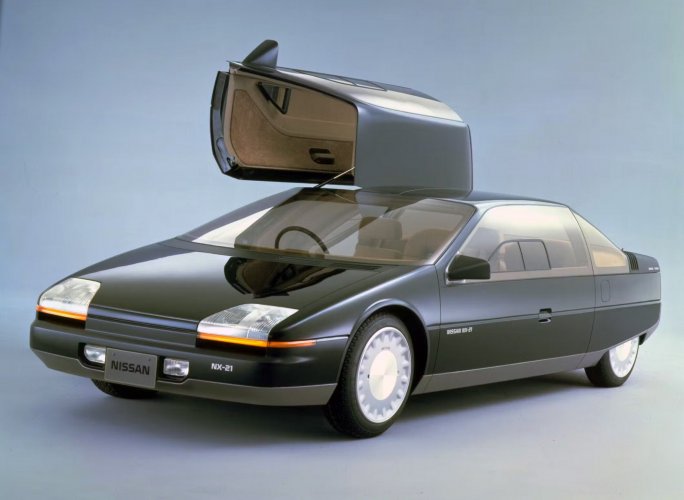
Nissan's NX-21. They took advantage of the turbine's small size by putting it in the back
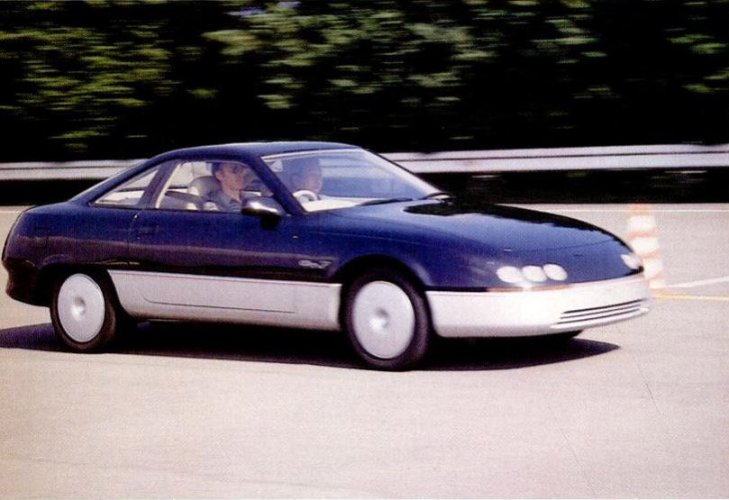
Toyota's GTV
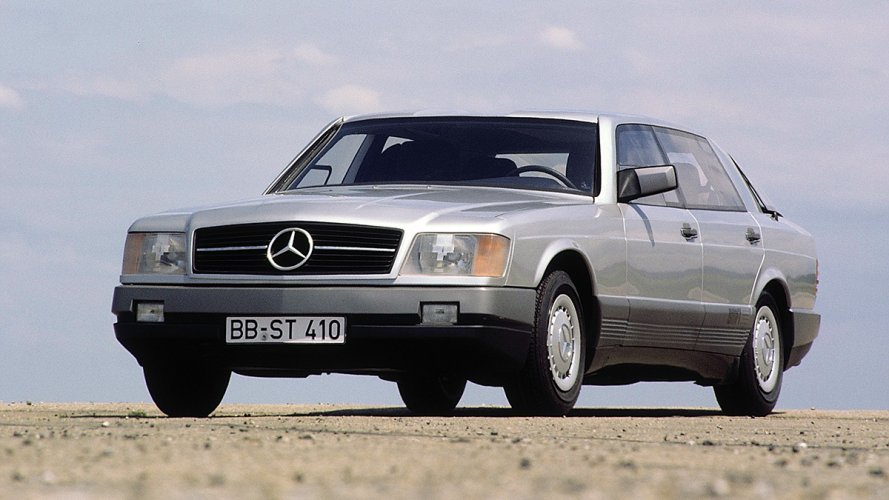
The Mercedes 2000 concept was designed with 3 different engines in mind, one of them being a turbine
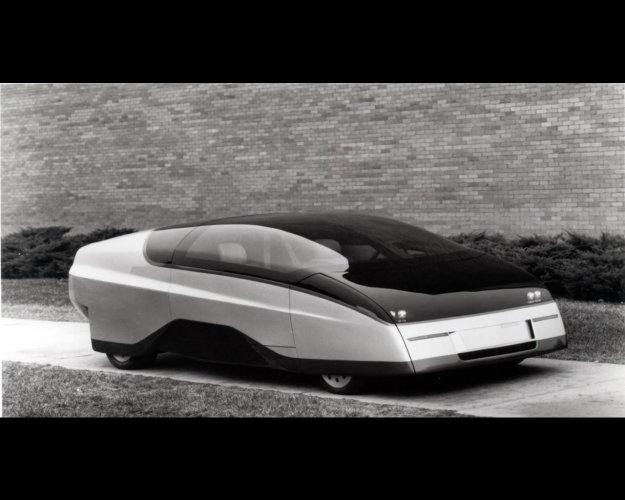
But perhaps the most interesting idea was the Chevrolet Express. With its efficient turbine engine and extremely aerodynamic shape, it was designed to get 25 mpg while travelling at 150 mph on the computer controlled highways of the future
exclaimedleech8
ACCESS: Top Secret
- Joined
- 30 September 2024
- Messages
- 582
- Reaction score
- 633
Do you not understand what a concept car is?There is no small efficient turbine engine....
Good luck finding a highway for 150 mph and the tires which will last longer than 1000 km at that speed....
It's as close to reality as the Ford Nucleon...
It seams like you don't know what a concept car is:
''With its efficient turbine engine and extremely aerodynamic shape, it was designed to get 25 mpg while travelling at 150 mph on the computer controlled highways of the future''
The way you described it, is like it would be reality. This is clearly no evidence for a efficient turbine.
''With its efficient turbine engine and extremely aerodynamic shape, it was designed to get 25 mpg while travelling at 150 mph on the computer controlled highways of the future''
The way you described it, is like it would be reality. This is clearly no evidence for a efficient turbine.
On ceramics

 phys.org
Researchers develop high-entropy ceramic for high-temperature sensors
As aeroengine thrust-to-weight ratios continue to improve, the operating temperature of their hot-end components has risen steadily, placing stricter demands on the performance of temperature sensors. Among potential solutions, negative temperature coefficient (NTC) thermistors—known for their...
exclaimedleech8
ACCESS: Top Secret
- Joined
- 30 September 2024
- Messages
- 582
- Reaction score
- 633
I decided to write up a whole worldbuilding scenario around ceramic gas turbines https://www.secretprojects.co.uk/th...s-turbines-were-available-in-the-1950s.47558/
exclaimedleech8
ACCESS: Top Secret
- Joined
- 30 September 2024
- Messages
- 582
- Reaction score
- 633
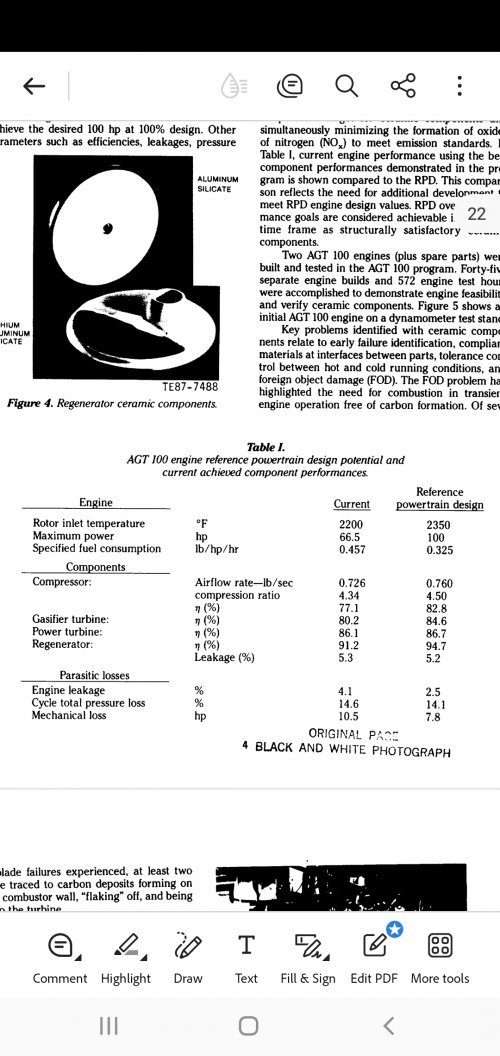
please do the math please do the mass before you write such an nonsense!
If you lack the skill, use this side:
 www.unitconverters.net
Youre value is more than 270 g/kwh! That's really bad, the Prius engine is something like 220 g/kwh!
View attachment 778425
In 1987, GM managed to get bsfc of .457 lbs per hp hour out of a 66 hp gas turbine with a TIT of 2200 F. That's about 270 grams per kwh, about what Toyota managed 10 years later from its 1.8 L 4 cylinder.
If you lack the skill, use this side:
Convert Pound/horsepower/hour to Gram/kilowatt/hour
Instant free online tool for pound/horsepower/hour to gram/kilowatt/hour conversion or vice versa. The pound/horsepower/hour to gram/kilowatt/hour conversion table and conversion steps are also listed. Also, explore tools to convert pound/horsepower/hour or gram/kilowatt/hour to other fuel...
www.unitconverters.net
Youre value is more than 270 g/kwh! That's really bad, the Prius engine is something like 220 g/kwh!
exclaimedleech8
ACCESS: Top Secret
- Joined
- 30 September 2024
- Messages
- 582
- Reaction score
- 633
270 was very impressive in 1987. And they probably could've done a lot better if they didn't have to work around the brittleness of the ceramics they had availableplease do the math please do the mass before you write such an nonsense!
If you lack the skill, use this side:
https://www.unitconverters.net/fuel...epower-hour-to-gram-kilowatt-hour.htm[/QUOTE]Youre value is more than 270 g/kwh! That's really bad, the Prius engine is something like 220 g/kwh!
ass/pound-horsepower-hour-to-gram-kilowatt-hour.htm[/URL]
Youre value is more than 270 g/kwh! That's really bad, the Prius engine is something like 220 g/kwh!
No, it wasn't impresive at all, Opel allready archieved 232 g/kwh and the newly introduced DI Diesels for passenger cars (Fiat in 1987) were much lower. I don't have the actual value for the Fiat, but something in the range of 200 g/kwh is realistic.
exclaimedleech8
ACCESS: Top Secret
- Joined
- 30 September 2024
- Messages
- 582
- Reaction score
- 633
It was above average amongst gasoline engines in 1987No, it wasn't impresive at all, Opel allready archieved 232 g/kwh and the newly introduced DI Diesels for passenger cars (Fiat in 1987) were much lower. I don't have the actual value for the Fiat, but something in the range of 200 g/kwh is realistic.

Turbines may be about to get better
https://techxplore.com/news/2025-09-clever-device-drastically-vibration-rotating.html
An EPFL Ph.D. student in mechanical engineering has developed a device that significantly dampens the flow-induced vibration caused by rotating parts, such as those in boat propellers, turbines and hydraulic pumps. His device can be produced with a 3D printer and has recently been patented.It's a classic case of beginner's luck. Thomas Berger had just started his Ph.D. in mechanical engineering at EPFL's School of Engineering when he made his now-patented discovery, which is published in Scientific Reports. Today, investors are taking an interest in his promising technology. The next step will be to test the gyroid under more complicated conditions, such as those inside turbines.
https://www.nature.com/articles/s41598-025-11199-0
Heat transfer surprises:
https://techxplore.com/news/2025-09-clever-device-drastically-vibration-rotating.html
An EPFL Ph.D. student in mechanical engineering has developed a device that significantly dampens the flow-induced vibration caused by rotating parts, such as those in boat propellers, turbines and hydraulic pumps. His device can be produced with a 3D printer and has recently been patented.It's a classic case of beginner's luck. Thomas Berger had just started his Ph.D. in mechanical engineering at EPFL's School of Engineering when he made his now-patented discovery, which is published in Scientific Reports. Today, investors are taking an interest in his promising technology. The next step will be to test the gyroid under more complicated conditions, such as those inside turbines.
https://www.nature.com/articles/s41598-025-11199-0
Heat transfer surprises:
Last edited:
exclaimedleech8
ACCESS: Top Secret
- Joined
- 30 September 2024
- Messages
- 582
- Reaction score
- 633
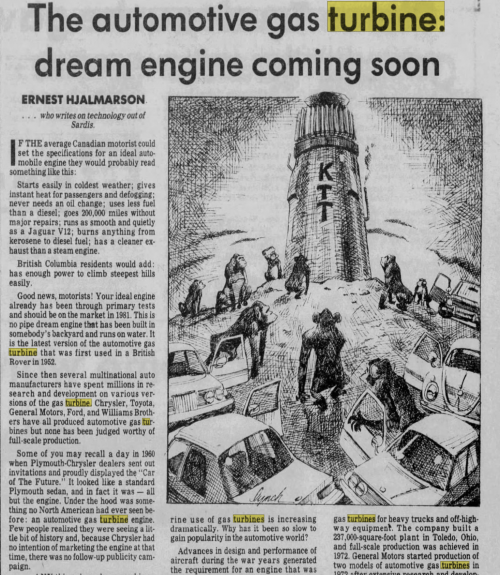
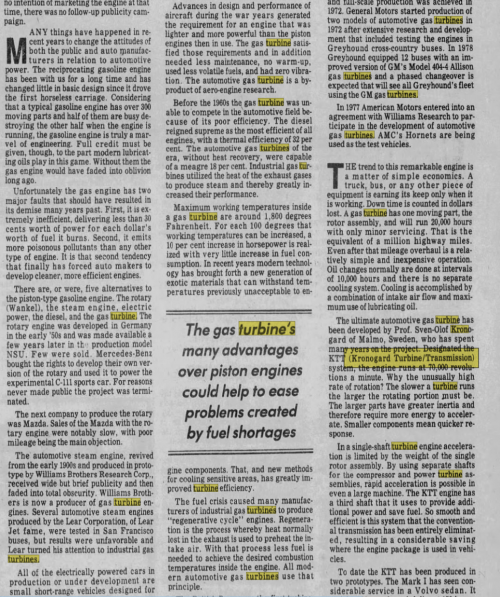
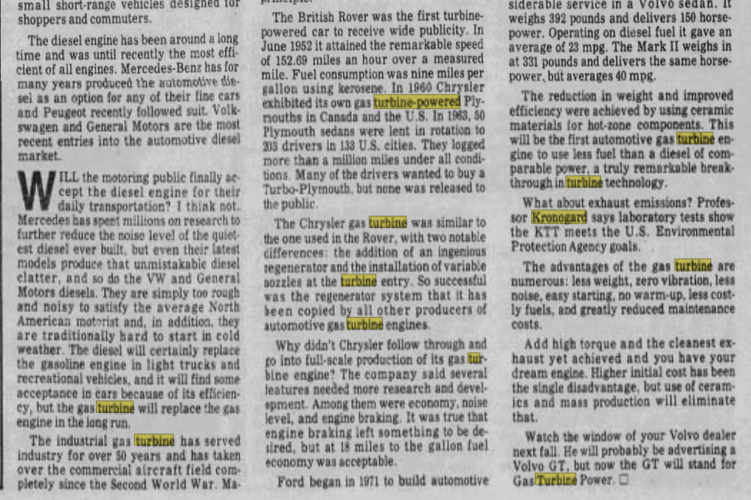
This column from the Vancouver Sun dated November 22, 1979 shows how the Kronogard Turbine truly would've been the perfect way to power a car, if not for the limitations of the materials available (superalloys too expensive and ceramics too brittle). It brings to mind how the steam engine, despite being known in principle shortly after the birth of Christ, took 16 centuries of improvements in metallurgy and machine tooling before it became a useful source of power.
Similar threads
-

-
-

-

-
What if ultra high temperature gas turbines were available in the 1950s?
- Started by exclaimedleech8
- Replies: 32