
You are using an out of date browser. It may not display this or other websites correctly.
You should upgrade or use an alternative browser.
You should upgrade or use an alternative browser.
Ceramics in Turbine Development
- Thread starter exclaimedleech8
- Start date
exclaimedleech8
ACCESS: Top Secret
- Joined
- 30 September 2024
- Messages
- 582
- Reaction score
- 633
From what I've read, the reason why turbine engines take so long to start up is because they need to get sufficient airflow to avoid overheating. Another problem solved by ceramicswatch some youtube videos to see, how long it takes to spool up....
Gas turbines are vulnarable to thermoshocks, I doubt that start stop would be a good idea for turbines (despite it is anoying anyway...)
Scott Kenny
ACCESS: USAP
- Joined
- 15 May 2023
- Messages
- 16,973
- Reaction score
- 24,080
No, start-stop is terrible on a turbine engine.BTW an automatic stop start system is way easier to implement on a turbine engine, because starting the engine takes less torque. There's another boost for efficiency
Starting a turbine also takes a lot of time to get the compressor wound up to adequate speeds/compression/heat. (note that most turbine engines today are counted in terms of start-stop cycles, not hours of operation)
Yes, hot starts are really bad for turbines, but you can still overheat ceramics.From what I've read, the reason why turbine engines take so long to start up is because they need to get sufficient airflow to avoid overheating. Another problem solved by ceramics
exclaimedleech8
ACCESS: Top Secret
- Joined
- 30 September 2024
- Messages
- 582
- Reaction score
- 633
Would it really be possible for the temperature of the turbine blades to exceed 3000 F in the seconds before compressor spools up?No, start-stop is terrible on a turbine engine.
Starting a turbine also takes a lot of time to get the compressor wound up to adequate speeds/compression/heat. (note that most turbine engines today are counted in terms of start-stop cycles, not hours of operation)
Yes, hot starts are really bad for turbines, but you can still overheat ceramics.
And if so, one way around this is water injection.
exclaimedleech8
ACCESS: Top Secret
- Joined
- 30 September 2024
- Messages
- 582
- Reaction score
- 633
Non-rotating recuperators are not nearly as effective as rotating regeneratorsCeramic seals work really well. But I'll admit I'd prefer a non-rotating regenerator.
exclaimedleech8
ACCESS: Top Secret
- Joined
- 30 September 2024
- Messages
- 582
- Reaction score
- 633
The ceramics we have aren't immune, but if you remember, we had been discussing the prospect of new ductile ceramics.ceramics are not imune to thermoshocks, spaying cold water on hot surfaces is not a good idea...
exclaimedleech8
ACCESS: Top Secret
- Joined
- 30 September 2024
- Messages
- 582
- Reaction score
- 633
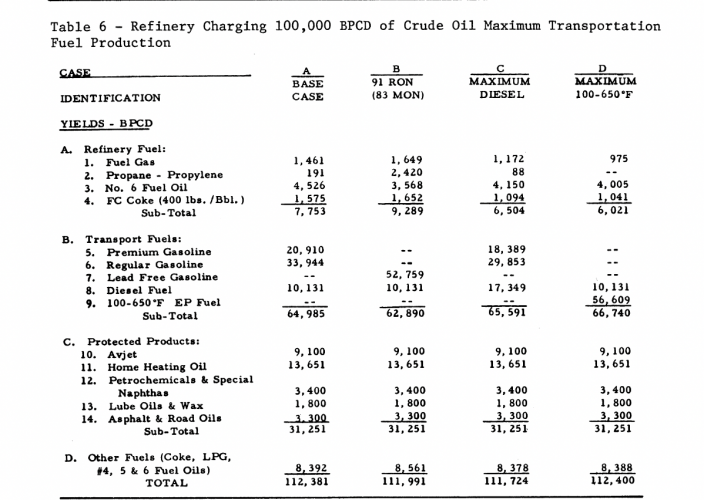
Another thing to consider is that turbines offered the potential to get more transportation fuel out of each barrel of oil because of their ability to burn unrefined fuel. Texaco calculated that if it could bottle up all of the 100-650 F fraction fuel that it was producing and sold it at gas pumps, they'd get 6% more fuel than if they were to produce unleaded gasoline, because they'd use up less oil in the refining process.
Simplified processes would also facilitate the decentralization of oil refining, avoiding disruption from natural disaster or from war, nuclear or otherwise.
Scott Kenny
ACCESS: USAP
- Joined
- 15 May 2023
- Messages
- 16,973
- Reaction score
- 24,080
That's called Bunker Crude.Another thing to consider is that turbines offered the potential to get more transportation fuel out of each barrel of oil because of their ability to burn unrefined fuel. Texaco calculated that if it could bottle up all of the 100-650 F fraction fuel that it was producing and sold it at gas pumps, they'd get 6% more fuel than if they were to produce unleaded gasoline, because they'd use up less oil in the refining process.
It's one of the nastiest things you can burn. Maybe a FADEC unit could do it, I wouldn't want to try it with a mechanical fuel controller. You'd need to use some hardware from naval (well, commercial maritime) diesels, since they run on Bunker C crap.
It'll generate significant pollution.
Yeah, with up to 7% Sulphur and other nasty stuff. Needs to be preheated before beeing able to be pumped. Additionally a very derived filtering system is needed to get the catfins and other hard solid parts (and water) out. A phantastic fuel for passenger cars...
Imagine start/stop with bunker oil C, everytime it would result in a massive cloud of smoke, smelling like hell
Imagine start/stop with bunker oil C, everytime it would result in a massive cloud of smoke, smelling like hell
Last edited:
BTW, there have been turbine driven second generation container vessels which used bunker oil C. The trick was, that they used old jet engines from the 747 after they reached their TBR. The turbine lifetime with bunker C was very short (for marine propulsion), but the engines and fuel were very cheap. They always carried prepared spare engines on the ship and turbine swap could be done very quickly. The ships usually arrived on time, even if a turbine swap had to be done out on the sea. With the oil crisis, this propulsion came to an end, but some of these ships were used by the US military long time afterwards (surly with marine fuel instead of bunker C)
exclaimedleech8
ACCESS: Top Secret
- Joined
- 30 September 2024
- Messages
- 582
- Reaction score
- 633
I guess I should've said *less* refined fuel.That's called Bunker Crude.
It's one of the nastiest things you can burn. Maybe a FADEC unit could do it, I wouldn't want to try it with a mechanical fuel controller. You'd need to use some hardware from naval (well, commercial maritime) diesels, since they run on Bunker C crap.
It'll generate significant pollution.
Scott Kenny
ACCESS: USAP
- Joined
- 15 May 2023
- Messages
- 16,973
- Reaction score
- 24,080
I was thinking about phase-change materials. Melting some eutectic mix that melts at [desired temperature], contained in something that happily handles hotter temperatures. It'll take a while to get those melted, but then it stays molten and transfers heat where you want it to.Non-rotating recuperators are not nearly as effective as rotating regenerators
And/or a thermal superconductor, if someone can identify such a material (they're permitted by the laws of physics, but nobody has found or made one, yet).
This wouldn't really work very well, because you need to do the heat exchange in a counter flow design, otherwise you can only use a fraction of the heat. With a phase changing material you will have only one specific temperature for temperature exchange (for all loads), this doesn't make sense.
exclaimedleech8
ACCESS: Top Secret
- Joined
- 30 September 2024
- Messages
- 582
- Reaction score
- 633
It's fun to imagine how different the auto industry would be with turbine power. Jaguars that don't overheat or leak oil, economy cars made by General Motors that don't vibrate like overloaded washing machines. Clearly Japanese automakers wouldn't be as dominant.
Given how light turbines are, front wheel drive would pose less of a weight distribution problem, perhaps even BMWs and Mustangs will have abandoned rear wheel drive.
Given how light turbines are, front wheel drive would pose less of a weight distribution problem, perhaps even BMWs and Mustangs will have abandoned rear wheel drive.
Scott Kenny
ACCESS: USAP
- Joined
- 15 May 2023
- Messages
- 16,973
- Reaction score
- 24,080
RWD is not solely a static weight distribution choice.It's fun to imagine how different the auto industry would be with turbine power. Jaguars that don't overheat or leak oil, economy cars made by General Motors that don't vibrate like overloaded washing machines. Clearly Japanese automakers wouldn't be as dominant.
Given how light turbines are, front wheel drive would pose less of a weight distribution problem, perhaps even BMWs and Mustangs will have abandoned rear wheel drive.
How the car is intended to be driven also matters. Straight-line acceleration is better in RWD cars because the drive wheels get weight transferred to them under acceleration. IIRC this is why single-motor Teslas are RWD. Almost all race cars are RWD where the rules allow it.
I’m unaware that Jaguars have been prone to overheating, but leaking oil is just part of the British heritage and there is no reason to believe, that turbine powered Jaguars wouldn’t have leaked oil as well. In Europe, I never ever experienced any economy car from GM or any other manufacturer which vibrated like a washing machine. Can you give an example for that?
Japanese automakers aren’t dominant in Europe, it might be different in the US, Asia and Africa. I don’t understand, why Japanese car manufacturer would have less marked share with turbine cars.
Less weight on the front means less traction on the front axle, hence larger advantage for real wheel drive.
Despite that, regenerative turbines are neither very light nor compact. A modern 1.0 L turbocharged three cylinder engine has about the same power output (70- 110 kW) as the ‘typical’’ passenger car turbine development and is lighter and smaller. Of course, there would have been progress in turbines as well, but I don’t see a chance for a significant reduction in the size of the regenerator. The higher fuel consumption (especially at idle and low loads) and the unsuitability for start/stop operation make turbine cars obsolete. I don’t see a point in history, when they could have been a viable alternative.
There is generally no logic in your argumentation, you pic up some information you find anywhere and turn it in your desired outcome without any logic connection in between.
Japanese automakers aren’t dominant in Europe, it might be different in the US, Asia and Africa. I don’t understand, why Japanese car manufacturer would have less marked share with turbine cars.
Less weight on the front means less traction on the front axle, hence larger advantage for real wheel drive.
Despite that, regenerative turbines are neither very light nor compact. A modern 1.0 L turbocharged three cylinder engine has about the same power output (70- 110 kW) as the ‘typical’’ passenger car turbine development and is lighter and smaller. Of course, there would have been progress in turbines as well, but I don’t see a chance for a significant reduction in the size of the regenerator. The higher fuel consumption (especially at idle and low loads) and the unsuitability for start/stop operation make turbine cars obsolete. I don’t see a point in history, when they could have been a viable alternative.
There is generally no logic in your argumentation, you pic up some information you find anywhere and turn it in your desired outcome without any logic connection in between.
Last edited:
Turbines are perhaps best for hybrids?
Big Tesla type battery for quiet starts and driving.
Once on the Autobahn/Interstate, crank up the turbine at speed.
Stop and go driving is best done on battery power. Where kids boom-boxes are obnoxious at stop lights—I prefer quiet at a stop sign so I can listen for the hiss of road traffic.
Big Tesla type battery for quiet starts and driving.
Once on the Autobahn/Interstate, crank up the turbine at speed.
Stop and go driving is best done on battery power. Where kids boom-boxes are obnoxious at stop lights—I prefer quiet at a stop sign so I can listen for the hiss of road traffic.
exclaimedleech8
ACCESS: Top Secret
- Joined
- 30 September 2024
- Messages
- 582
- Reaction score
- 633
So maybe they'll shift to mid engine with the engine under the rear seats.RWD is not solely a static weight distribution choice.
How the car is intended to be driven also matters. Straight-line acceleration is better in RWD cars because the drive wheels get weight transferred to them under acceleration. IIRC this is why single-motor Teslas are RWD. Almost all race cars are RWD where the rules allow it.
In the US, GM's 4 cylinder engines are notorious for their noise, vibration, and harshness.In Europe, I never ever experienced any economy car from GM or any other manufacturer which vibrated like a washing machine.
Because turbines are more reliable since they have fewer parts to go wrong, undercutting the Japanese' big advantage.I don’t understand, why Japanese car manufacturer would have less marked share with turbine cars.
If someone had invented a ductile ceramic, then everything would fall into place.I don’t see a point in history, when they could have been a viable alternative.
Once again, you claim there is no universe in which turbines could power cars while admitting that in this timeline many cars on the road are partially turbine powered.A modern 1.0 L turbocharged three cylinder engine has about the same power output (70- 110 kW) as the ‘typical’’ passenger car turbine development and is lighter and smaller.
exclaimedleech8
ACCESS: Top Secret
- Joined
- 30 September 2024
- Messages
- 582
- Reaction score
- 633
As I explained earlier, even in non-hybrid settings, gas turbines can offer superior efficiency to the otto cycle engine, if only they could be run at high inlet temperatures.Turbines are perhaps best for hybrids?
Big Tesla type battery for quiet starts and driving.
Once on the Autobahn/Interstate, crank up the turbine at speed.
Stop and go driving is best done on battery power. Where kids boom-boxes are obnoxious at stop lights—I prefer quiet at a stop sign so I can listen for the hiss of road traffic.
1. Show me a single example of a small gas turbine which achieved a higher efficiency than a modern Otto engine (Prius 1.5 L: 42 %).
2. show a gas turbine which achieves a lower fuel consumption in the WLTP cycle.
Which car is partially turbine powered? There are only a few trucks which are turbocompounded but no car. Turbocharging doesn't mean partially turbine driven. What does it mean for our discussion??
2. show a gas turbine which achieves a lower fuel consumption in the WLTP cycle.
Which car is partially turbine powered? There are only a few trucks which are turbocompounded but no car. Turbocharging doesn't mean partially turbine driven. What does it mean for our discussion??
Last edited:
A turbine I’d never hook up to a (car) transmission—electric motor/battery only
I’d want a big diesel so I have options…the turbine doesn’t even have to be large—a two-get turbo/supercharger.
I want the ultimate road vehicle that won’t strand me—-what does that look like?
I’d want a big diesel so I have options…the turbine doesn’t even have to be large—a two-get turbo/supercharger.
I want the ultimate road vehicle that won’t strand me—-what does that look like?
Scott Kenny
ACCESS: USAP
- Joined
- 15 May 2023
- Messages
- 16,973
- Reaction score
- 24,080
Pure mechanical (turbo) diesel.I want the ultimate road vehicle that won’t strand me—-what does that look like?
exclaimedleech8
ACCESS: Top Secret
- Joined
- 30 September 2024
- Messages
- 582
- Reaction score
- 633
Yeah it does. A turbocharger contributes to the power produced by an engine to do work.Turbocharging doesn't mean partially turbine driven
Don't knock it till you try itA turbine I’d never hook up to a (car) transmission
exclaimedleech8
ACCESS: Top Secret
- Joined
- 30 September 2024
- Messages
- 582
- Reaction score
- 633
A turbine takes a source of energy (exhaust gas heat) to do mechanical work (compressing intake air). That's the definition of an engine.Almost every part of an engine contributes to the power prouced...
You can do the opposite configuration with a Free Piston, which uses a piston engine to create a stream of compressed air to drive a turbine.
Last edited:
Scott Kenny
ACCESS: USAP
- Joined
- 15 May 2023
- Messages
- 16,973
- Reaction score
- 24,080
A basic turbocharger recovers energy from the exhaust that would otherwise be wasted, and uses that energy to increase the maximum power that the engine produces.The definition of an engine is, that it produces mechanical power, 99.9 % of the turbochargers don't do that.
A turbocharger creates backpressure (the price you have to pay) and creates boost (the gain). When neglecting all secondary effects, a turbocharger increases the efficiency, when the back pressure is lower than the boost pressure and decreases the efficiency otherwise. In vehicle application, the back pressure is usually higher than the boost pressure, thus in an idealized thermodynamic theory, it decreases the efficiency.
It's only function, is to create more power and not to make use of any kind of energy which would otherwise be wasted.
So you might wonder, why are turbo powered cars more efficient despite the negative pressure ratio? It's simply because you can use a smaller engine for the same power and so the secondary losses (friction, throttling, heat losses) are smaller than in a bigger naturally aspirated engine.
With the maximum power output, these advantages are no longer present, but the negative secondary effects (e.g. lower compression ratio to avoid knock) are still there. That's the reason, why turbocharged engines are usually using more fuel at full load than naturally aspirated engines with the same max. power.
Note, the most efficient (42 %) Otto car engine is the naturally aspirated 1.5 L Prius.
It's only function, is to create more power and not to make use of any kind of energy which would otherwise be wasted.
So you might wonder, why are turbo powered cars more efficient despite the negative pressure ratio? It's simply because you can use a smaller engine for the same power and so the secondary losses (friction, throttling, heat losses) are smaller than in a bigger naturally aspirated engine.
With the maximum power output, these advantages are no longer present, but the negative secondary effects (e.g. lower compression ratio to avoid knock) are still there. That's the reason, why turbocharged engines are usually using more fuel at full load than naturally aspirated engines with the same max. power.
Note, the most efficient (42 %) Otto car engine is the naturally aspirated 1.5 L Prius.
Last edited:
Scott Kenny
ACCESS: USAP
- Joined
- 15 May 2023
- Messages
- 16,973
- Reaction score
- 24,080
That's fine, normal driving rarely requires maximum power. Even cruising at 100kph/62mph rarely requires more than about 50hp. And is probably more like 20hp for the car, 25hp for the air conditioning, and 5hp for the stereo (edit) and other electronics.With the maximum power output, these advantages are no longer present, but the negative secondary effects (e.g. lower compression ratio to avoid knock) are still there. That's the reason, why turbocharged engines are usually using more fuel at full load than naturally aspirated engines with the same max. power.
Last edited:

- Joined
- 6 November 2010
- Messages
- 6,019
- Reaction score
- 7,571
That is a 3.6 kW stereo which will cause permanent hearing damage when blasting at max volume in a car's confined interior space.5hp for the stereo
I know there are idiots out there with that kind of car stereo, when I'm waiting for a traffic light I can feel the idiots' thump-thump in my bones.
Scott Kenny
ACCESS: USAP
- Joined
- 15 May 2023
- Messages
- 16,973
- Reaction score
- 24,080
I should amend that to "stereo and all the other electronics".That is a 3.6 kW stereo which will cause permanent hearing damage when blasting at max volume in a car's confined interior space.
I know there are idiots out there with that kind of car stereo, when I'm waiting for a traffic light I can feel the idiots' thump-thump in my bones.
But yes, I did mean a deafening stereo.
That's fine, normal driving rarely requires maximum power. Even cruising at 100kph/62mph rarely requires more than about 50hp. And is probably more like 20hp for the car, 25hp for the air conditioning, and 5hp for the stereo (edit) and other electronics.
Indeed (despite with a stereo with 3000 W average power it would be as loud inside as in the Space Shuttle....). Its exactly the reason, why in everyday cars (talking about Europe) the 1.0L Turbo engines have replaced the 1.6 naturally aspirated ones as most common configuration.
In a full hybrid like the Prius, the engine is operated with much higher average load factors, so that a naturally aspirated with its higher maximum efficiency makes more sense. It also helps to improve the aerodynamics by eliminating the charge air cooler and reduces cost.
exclaimedleech8
ACCESS: Top Secret
- Joined
- 30 September 2024
- Messages
- 582
- Reaction score
- 633
The problem with uneven numbers of cylinders is the vibration.Indeed (despite with a stereo with 3000 W average power it would be as loud inside as in the Space Shuttle....). Its exactly the reason, why in everyday cars (talking about Europe) the 1.0L Turbo engines have replaced the 1.6 naturally aspirated ones as most common configuration.
In a full hybrid like the Prius, the engine is operated with much higher average load factors, so that a naturally aspirated with its higher maximum efficiency makes more sense. It also helps to improve the aerodynamics by eliminating the charge air cooler and reduces cost.

Grey Havoc
ACCESS: USAP
- Joined
- 9 October 2009
- Messages
- 24,413
- Reaction score
- 17,872
I think that he may talking about engines with ceramic components being potentially more susceptible to vibration related issues.
I dont think so....
Despite that, hardly 20 % of the people will be able to distiguish a three cylinder from a four cylinder if you would give them 2 versions of the same car. I drove the moderate priced Ford Focus and Hyundai i30 with three cylinder turbo engines and it felt like six cylinder engines 20 years ago. A lot of torque at low rpm, very quiet and no vibration could be felt at all.
Despite that, hardly 20 % of the people will be able to distiguish a three cylinder from a four cylinder if you would give them 2 versions of the same car. I drove the moderate priced Ford Focus and Hyundai i30 with three cylinder turbo engines and it felt like six cylinder engines 20 years ago. A lot of torque at low rpm, very quiet and no vibration could be felt at all.
Last edited:
Scott Kenny
ACCESS: USAP
- Joined
- 15 May 2023
- Messages
- 16,973
- Reaction score
- 24,080
Not if they're designed correctly.The problem with uneven numbers of cylinders is the vibration.
exclaimedleech8
ACCESS: Top Secret
- Joined
- 30 September 2024
- Messages
- 582
- Reaction score
- 633
I don,t think so, the rotational energy matters, not the torque. Piston engines can run on their own power from 300 rpm onwards, turbines need much more speed and time to spool up.
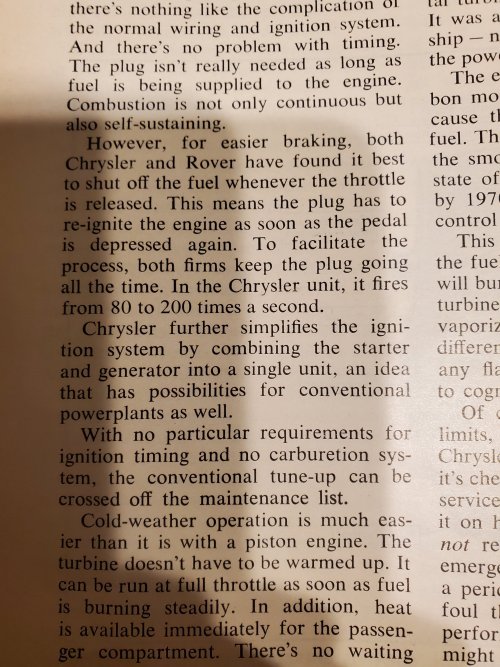
According to Motor Trend from February 1966, Chrysler and Rover had their engines shut off when coasting
Similar threads
-

-
-

-

-
What if ultra high temperature gas turbines were available in the 1950s?
- Started by exclaimedleech8
- Replies: 32