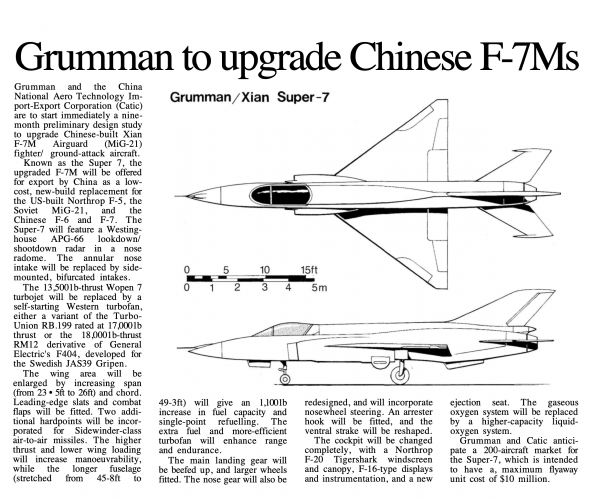
Comparing the two fighters, the Tejas and the FC-1 both have a MTOW of about 13.5 tonnes; both use the same internal gun, the Soviet GSh-23; both use a similar Martin-Baker ejection seat; and both feature computer-controlled relaxed static stability.
Early in the Super 7 program the American F404 engine was considered, but all FC-1s are powered by a variant of the RD-33 (as used in the twin-engined MiG-29), imported from Russia. Although India manufactures the RD-33, after the failure of the Kaveri engine program India has imported a variant of the F404 from the USA for each Tejas. The F404 is about the same weight and thrust as the RD-33, but has lengthier TBO and no soot trail.
While the FC-1 flew 2.5 years later than Tejas, the first Pakistan Air Force squadron (where it's designated JF-17) was operational earlier, and five times as many FC-1s have been built to date, including some modest third-country sales so far. The FC-1 has seen combat; Tejas hasn't. No foreign sales of Tejas are in prospect, and the Indian Navy rejected the planned carrier version after tests.
It's unclear to me why the Tejas has been unsuccessful relative to the FC-1, despite a seemingly more advanced configuration, more advanced airframe materials, and being faster (Mach 1.8 vs 1.6). Indian commentators blame entrenched bureaucratic sloth and wasteful socialist procedures at state-owned Hindustan Aeronautics Limited. And the government's Defence Research and Development Organisation (DRDO) has been faulted for the LCA and other disappointing projects, like the troubled Advanced Light Helicopter program (Dhruv), the unwanted Arjun tank, and the unreliable INSAS assault rifle. Yet Communist China is, well, communist, and its aircraft industry has always been Party-owned. The Chinese nevertheless appear to do better. As does Pakistan Aeronautical Complex, and state-owned ELTA Systems Ltd in Israel, which provides the active electronically scanned array radar for the nose of each Tejas after indigenous efforts were unsuccessful. (The AESA radar in the nose of the latest FC-1 block 3 version is developed in China and assembled in Pakistan, and from published accounts works well.)
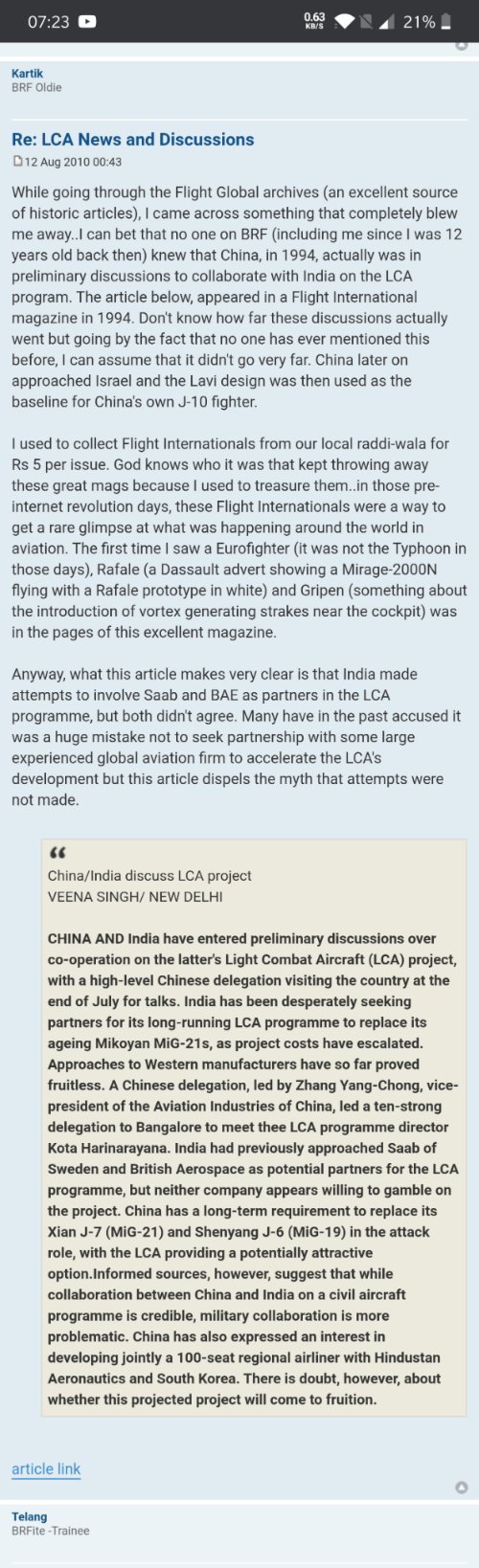
Conspicuously, China does not use the FC-1 in its military. It might be that the two programs for a MiG-21 replacement have been overtaken by events since the 1990s, the original planned in-service date for both. While MiG-21s/J-7s remain flying elsewhere, the People's Liberation Army Air Force retired its J-7s some years ago, and India plans to retire its last MiG-21s next month. In the 21st century the air forces of China and India have instead been concentrating on substantially larger, heavier fighter designs.