HAL LCA Tejas


According to the Alpha Defence YouTube channel, The Aeronautical Development Agency (ADA) of India is set to further refine the design of the Tejas Mk2 fighter jet, following crucial wind tunnel tests conducted by the French National Aerospace Research Center, ONERA (Office National d’Études et de Recherches Aérospatiales). These tests have yielded critical data that will influence the optimization of key components such as the air intake and canards, which will be incorporated into the upcoming prototypes of the Tejas Mk2.
 
Any News on the Mk.2 at the AeroIndia2024?
 
View: https://x.com/VivekSi85847001/status/1888629523442196819
View: https://x.com/ilyushin_76md/status/1888922485808066655


Last edited:
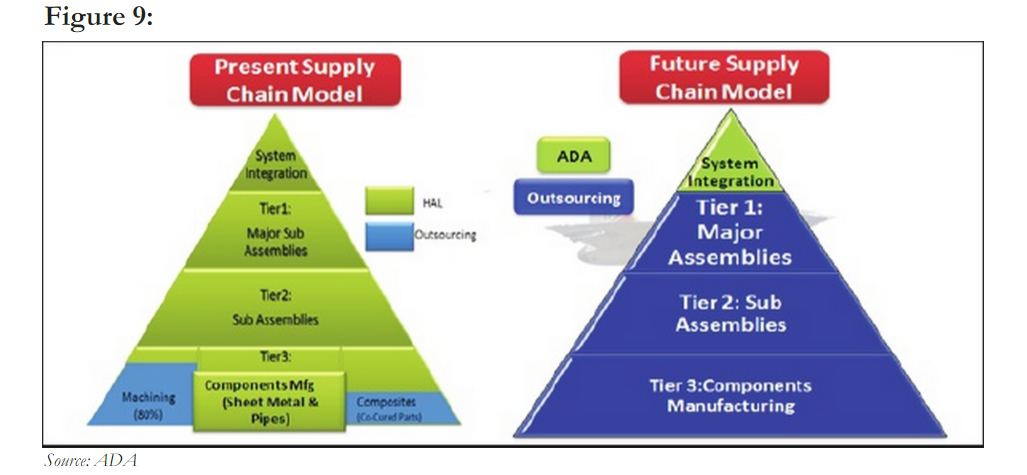
While searching for information concerning AMCA, I've just found that large amount of Tejas Mk.1A airframe manufacturing has been outsourced to external contractors. The front fuselage is manufactured by Dynamitics, centre fuselage by VEM, rear fuselage Alpha Tocol and wings by L&T.

Quite a departure from the long-standing approach of HAL, doing and sourcing everything in house
 

Attachments

  • Fa6UkSe.png
    Fa6UkSe.png
    401 KB · Views: 40
Safran engine - a M88 development - for the Tejas Mk2 instead of F414:


Safran engine - a M88 development - for the Tejas Mk2 instead of F414:


Can we stop posting this IDRW-nonsense?
 
Really guys ... is this now the current level to post? Random stupid click-bait YouTube videos made by fan-boys presented without a comment why they are worth watching or a summary on what's worth to discuss or new?

@overscan ... I suggest to simply forbid to post such videos without any content!
 
First video was content free AI narrated slop - post is deleted. Third video is just some nice footage of Tejas in flight without narration. Second video is okay, but it's not clear what specifically is of interest.

Everyone needs to make an effort to summarise what, exactly, you found interesting about the videos you have posted a link to.
 
First video was content free AI narrated slop - post is deleted. Third video is just some nice footage of Tejas in flight without narration. Second video is okay, but it's not clear what specifically is of interest.

Everyone needs to make an effort to summarise what, exactly, you found interesting about the videos you have posted a link to.
Sorry...it had mention of the RAM material and the stealthiness of the craft....small and painted with RAM...I found it interesting.
 
Certification scheduled 2029, production 2030-31.

Being a project manager at HAL must be soul-destroying.
Apparently from what I know by visiting Indian forums, Indian gov. Refused to release the funds for 3+ years for prototype building and testing, as engine deal with GE for Tejas mk2 was not concluded.
But after 3+ years, they finally succumbed and released the funds, but the engine Deal with GE is STILL ongoing, and there are rumours of back channel talks with Safran now.


The Indian gov. Has paranoia level of conservatism towards monetary risk taking.
Which ironically leads to delays in critical military projects.
 
Last edited:
Honestly, they could have invested a bit of time in automated pre-drilling instead of manual only. It´s not like they had complicated shapes where all those holes have to be placed.
 
Honestly, they could have invested a bit of time in automated pre-drilling instead of manual only. It´s not like they had complicated shapes where all those holes have to be placed.
It's essentially an early '90s plane that hasn't yet been built in the hundreds. The ROI (for such an investment) just isn't there yet.
 
Not quite sure. You can predrill your metal sheet before folding it into shape at no extra cost.
 
In the 1980s India and Communist China independently began programs for a new small, inexpensive, yet capable fighter plane intended to supersede large fleets of aging MiG-21s during the 1990s, and it's instructive and interesting to compare and contrast the eventual results, which (not surprisingly) are similar: India's Tejas versus the Chinese/Pakistani FC-1. Both programs have had lengthy delays, but are flying today. The object of both was "to produce a much improved aircraft to replace the MiG-21, not to build the most operationally and technologically superior aircraft in the world", so in this new thread we will judge on that basis. What do you all think?
 
I have not visited South Asia, but I read with interest the special 25 July 1994 'India issue' of Aviation Week and Space Technology, which I recently re-read. The opening blurb was, "India could become the next economic powerhouse of Asia. It has a huge, cheap, talented manpower pool and has developed centers of world-class technological excellence, such as software engineering. However, realizing its goals, which include expanding its aviation industry, will require a combination of bureaucratic streamlining, technological focus, and foreign investment". The issue went on to engage with the Indian Air Force's 1994 strength and future plans, with special emphasis on the exciting Light Combat Aircraft (LCA) program and its Kaveri low-bypass turbofan. The LCA's first flight was projected for 1996. Dassault was helping the project, but great emphasis was placed on doing as much as possible within India. In general, the 1994 India issue was laudatory and hopeful, but it did report (p41), "Some [Indian Air Force] officials would like to walk away from the heavy investments in the indigenous Light Combat Aircraft, but government and aviation industry officials see it as a political tool to avoid reliance on other countries for military supplies and as a stimulus to India's industry and job base. IAF pilots worry that they will be stuck with an average performance aircraft [emphasis added] that is hard to support logistically because of the limited industrial base in India to provide spares and maintenance". The IAF bluntly and publicly stated similar worries in 2015, in 2017, and again since then.

After repeated delays, the LCA flew in 2001, and the fighter was named Tejas in 2003. It was 2013 before Tejas was issued its Initial Operational Certificate allowing the plane to be flown by IAF pilots rather than just test pilots. The first Tejas squadron became operational in 2016. Production has been slow, with only a few dozen planes completed by 2025.

See < https://www.secretprojects.co.uk/threads/hal-tejas.23825/ >.
 
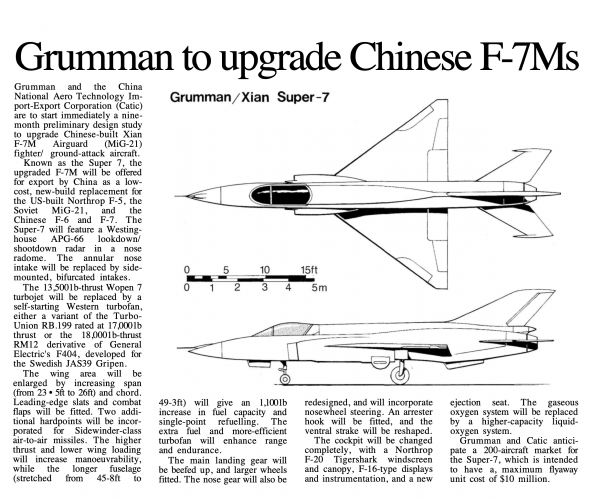
I also remember learning about the contemporary Chinese Super 7 project, intended as a thoroughly updated reimagining of the F-7 (MiG-21 clone), joined by Pakistan with help from Grumman; see the attached short article from the 26 November 1988 issue of Flight International. Grumman withdrew after the 1989 Tiananmen Square massacre, and from 1992 MiG came aboard what had become the FC-1 project. After repeated delays, first flight was in 2003, and Pakistani test pilots flew it the following year. Most parts are made in China, but the planes are assembled at the state-owned Pakistan Aeronautical Complex in Kamra.

See < https://www.secretprojects.co.uk/threads/chengdu-paic-fc-1-jf-17-and-grumman-super-7.1413/ >.
 

Attachments

  • Flt Intl 26 Nov 1988.png
    Flt Intl 26 Nov 1988.png
    1.1 MB · Views: 35
Comparing the two fighters, the Tejas and the FC-1 both have a MTOW of about 13.5 tonnes; both use the same internal gun, the Soviet GSh-23; both use a similar Martin-Baker ejection seat; and both feature computer-controlled relaxed static stability.

Early in the Super 7 program the American F404 engine was considered, but all FC-1s are powered by a variant of the RD-33 (as used in the twin-engined MiG-29), imported from Russia. Although India manufactures the RD-33, after the failure of the Kaveri engine program India has imported a variant of the F404 from the USA for each Tejas. The F404 is about the same weight and thrust as the RD-33, but has lengthier TBO and no soot trail.

While the FC-1 flew 2.5 years later than Tejas, the first Pakistan Air Force squadron (where it's designated JF-17) was operational earlier, and five times as many FC-1s have been built to date, including some modest third-country sales so far. The FC-1 has seen combat; Tejas hasn't. No foreign sales of Tejas are in prospect, and the Indian Navy rejected the planned carrier version after tests.

It's unclear to me why the Tejas has been unsuccessful relative to the FC-1, despite a seemingly more advanced configuration, more advanced airframe materials, and being faster (Mach 1.8 vs 1.6). Indian commentators blame entrenched bureaucratic sloth and wasteful socialist procedures at state-owned Hindustan Aeronautics Limited. And the government's Defence Research and Development Organisation (DRDO) has been faulted for the LCA and other disappointing projects, like the troubled Advanced Light Helicopter program (Dhruv), the unwanted Arjun tank, and the unreliable INSAS assault rifle. Yet Communist China is, well, communist, and its aircraft industry has always been Party-owned. The Chinese nevertheless appear to do better. As does Pakistan Aeronautical Complex, and state-owned ELTA Systems Ltd in Israel, which provides the active electronically scanned array radar for the nose of each Tejas after indigenous efforts were unsuccessful. (The AESA radar in the nose of the latest FC-1 block 3 version is developed in China and assembled in Pakistan, and from published accounts works well.)

Conspicuously, China does not use the FC-1 in its military. It might be that the two programs for a MiG-21 replacement have been overtaken by events since the 1990s, the original planned in-service date for both. While MiG-21s/J-7s remain flying elsewhere, the People's Liberation Army Air Force retired its J-7s some years ago, and India plans to retire its last MiG-21s next month. In the 21st century the air forces of China and India have instead been concentrating on substantially larger, heavier fighter designs.

 
JF-17 and its associated precursor projects like Sabre II was never intended for PLAAF service. PLAAF stopped trying to develop light fighters after the J-12 project.
 
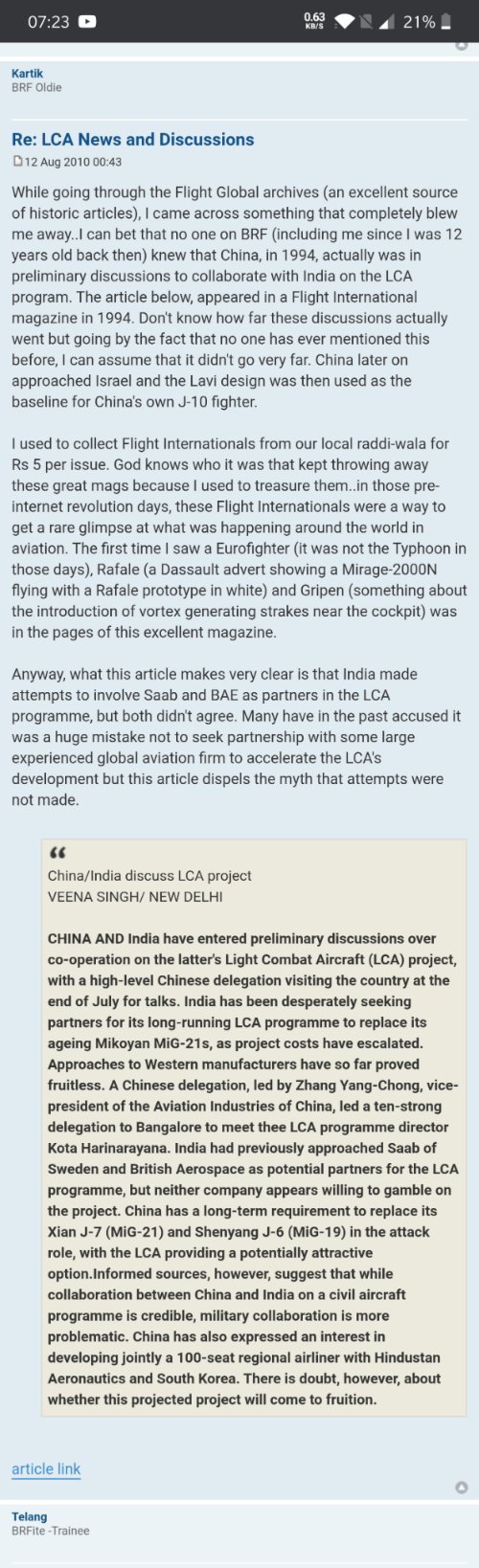
HAL did indeed approach BAe and UK government to collaborate on the LCA circa 1991-93, but there was no RAF need for such an aircraft and so the UK backed away - they could see it was a massive task for India to take on, and quite frankly having been mired in negotiations for Jaguars and Hawks for at least a decade at a time, they had little optimism that it would ever get off the ground.

As to internal doubters - there were Indian officials and IAF staff officers who felt that HAL lacked the competency to build a Jaguar back in the 1980s and wanted to scrub the deal. I always get the feeling that there is a lot of tension between HAL who wants to do things and grow, and officialdom and the IAF who have self-doubt to really back up HALs dreams.
 
This is an interesting old story that is often forgotten ...

Thanks, Deino. This reported interest from Communist China about collaborating with India on a MiG-21 replacement fighter project would have been just about the time of the 25 July 1994 'India issue' of Aviation Week and Space Technology, although there was no mention of such interest therein.
 
JF-17 and its associated precursor projects like Sabre II was never intended for PLAAF service. PLAAF stopped trying to develop light fighters after the J-12 project.

"Never" is a long time, Tomboy. That's not what I remember of Chinese intentions from the news reports of the 1980s. But I agree that in this 21st Century, there has been no apparent interest in the PLAAF of using FC-1s or similar light fighters.
 

Similar threads

Back
Top Bottom