Merged with earlier thread on the same topic.

Relevant to this topic:

https://www.secretprojects.co.uk/threads/fairey-er-103-fighters.3074

Using an online converter, I can't vouch for the accuracy, the fuel weight of the ER.103C is equal to approximately 1,000 imperial gallons, only two-thirds of the P.1121. Perhaps it would have been possible to squeeze some additional fuel into the rear fuselage but there is no evidence for that. The undercarriage arrangement might leave enough room for four underwing pylons in addition to the wingtip Red Tops and there is plenty of room under the fuselage for stores so it feels like something interesting could have been made of it from a tactical fighter perspective. The fighter-bomber variation of the twin engined submission hints to the possible albeit it was more of an OR.339 effort.

It really isn't outlandish to have an AU in which the RAF procured a supersonic tactical fighter-bomber in the late 1950s, it is a shame that the usual suspect was allowed to destroy this thread though.
 
It's notable the AI radar installation is all together in a detachable nose. Not only making maintenance and replacement easy. But logically upgrades or alternative nose packages possible for various mission sets.
A dedicated PR version for example or a version for Ground Attack.
 
Using an online converter, I can't vouch for the accuracy, the fuel weight of the ER.103C is equal to approximately 1,000 imperial gallons, only two-thirds of the P.1121. Perhaps it would have been possible to squeeze some additional fuel into the rear fuselage but there is no evidence for that.

For comparison to ER.103C, the Mirage III only had 646 Imp Gals of internal fuel (121 in a tank fitted when no rocket fitted, 224 in 4 tanks around the intake ducts and 301 in wing tanks).
 

Attachments

  • 1713084649375.png
    1713084649375.png
    446.1 KB · Views: 43
If you truly want to look at a Mirage rival from Britain, a developed Avro 720 is a better starting point. Avro were early adopters of delta wings and area rule, were technically sound with good leadership, and Avro 720 instead of SR.53 could lead to a Mirage-like family.
Avro's metal honeycomb sandwich construction for the 720 was considered to be cheap and easy to manufacture and offered good structural strength combined with low weight. It would have made an interesting alternative to the Lightning for sure.
Using a 10,750lbf Gyron Junior on the two-seat 725 trainer - which retained the 720's fuselage diameter - was estimated to get to Mach 1.15 at 40,000ft. I think something like the Olypmus, Gyron or RB.106 would have been needed to get to Mach 2 (a single Avon might not have enough puff), but the possibilities were certainly there.
 
For comparison to ER.103C, the Mirage III only had 646 Imp Gals of internal fuel (121 in a tank fitted when no rocket fitted, 224 in 4 tanks around the intake ducts and 301 in wing tanks).

Though the ER.103C from the brochure has a full-size Gyron, thats got to be thirstier than an Atar 09C. An RB.128 apparently had better SFC than the Gyron or the RB.122 but these are still monster engines aimed at maximising climb and altitude performance, perhaps not ideal for a multirole type? Again, back to the Hawker view that the Olympus offered the best trade between high and low altitude performance?

Avro's metal honeycomb sandwich construction for the 720 was considered to be cheap and easy to manufacture and offered good structural strength combined with low weight. It would have made an interesting alternative to the Lightning for sure.
Using a 10,750lbf Gyron Junior on the two-seat 725 trainer - which retained the 720's fuselage diameter - was estimated to get to Mach 1.15 at 40,000ft. I think something like the Olypmus, Gyron or RB.106 would have been needed to get to Mach 2 (a single Avon might not have enough puff), but the possibilities were certainly there.

Presumably this is the same construction method Avro proposed for the Vulcan Phase III wing? A scaled-up 720 derivative is exactly what I had in mind earlier in the thread. I'm still not sure any of this offers much advantage over an English Electric P.6 with a fuselage mounted undercarriage or the P.1121 though.
 
It seems a bit of a leap to me to get any of these very old fashioned looking 50s designs (sort of British F102 Delta Daggers) into something useful in 1962
Lightning still seems the best of a bad bunch. It does not use any dodgy fuel/rockets but can fly high very quickly.
Its weakness (sorry fellow Brits) is having only two Firestreak/Red Tops instead of 4 Sidewinders. Genie to hit swarms of Badgers and Bears over the N Sea appeals too as we are still in the era of "massive response".
That Javelins lasted so long into the 60s suggests that having 4 rather than 2 AAM on a fighter with decent range suited the RAF too.
An air defence Buccaneer would give you space for plenty of radar and missiles but I lost that argument some years ago.
 

Attachments

  • Convair_YF-102_FC-782.jpg
    Convair_YF-102_FC-782.jpg
    186.4 KB · Views: 44
For comparison to ER.103C, the Mirage III only had 646 Imp Gals of internal fuel (121 in a tank fitted when no rocket fitted, 224 in 4 tanks around the intake ducts and 301 in wing tanks).
So 1000ImpGal in the ER103C is a pretty massive improvement in fuel capacity.

Does raise a question of wing thickness, though. The F102 had to be significantly redesigned with thinner wings as a result of the area rule.


Avro's metal honeycomb sandwich construction for the 720 was considered to be cheap and easy to manufacture and offered good structural strength combined with low weight. It would have made an interesting alternative to the Lightning for sure.
It's miserable stuff to repair, but great for strength as long as it's intact. The preferred fix is to replace the entire panel, as re-bonding the honeycomb is a nightmare/pain in the ass.


It seems a bit of a leap to me to get any of these very old fashioned looking 50s designs (sort of British F102 Delta Daggers) into something useful in 1962
Lightning still seems the best of a bad bunch. It does not use any dodgy fuel/rockets but can fly high very quickly.
Its weakness (sorry fellow Brits) is having only two Firestreak/Red Tops instead of 4 Sidewinders. Genie to hit swarms of Badgers and Bears over the N Sea appeals too as we are still in the era of "massive response".
That Javelins lasted so long into the 60s suggests that having 4 rather than 2 AAM on a fighter with decent range suited the RAF too.
An air defence Buccaneer would give you space for plenty of radar and missiles but I lost that argument some years ago.
Even the US fighters armed with AIM4s tended to have 4x missiles unless they were packing Genies. And even then, the F101s carried 2x Genies and 2x IR Falcons. (early on the F101 and F102 carried 6x Falcons, but that was reduced to 4x)

The Sparrow fighters tended to pack 3-4 sparrows as well.
 
Even the US fighters armed with AIM4s tended to have 4x missiles unless they were packing Genies. And even then, the F101s carried 2x Genies and 2x IR Falcons. (early on the F101 and F102 carried 6x Falcons, but that was reduced to 4x)

The Sparrow fighters tended to pack 3-4 sparrows as well.

The Gyron powered ER103C and Lightning were certainly powerful enough to carry 4 big British AAMs without loosing too much performance. I don't know how the ER103C would mount another 2 AAM but the Lightning F53 had a pair of underwing pylons able to carry a 1,000lb bomb so on the face of it could carry another 2 AAMs.
 
Though the ER.103C from the brochure has a full-size Gyron, thats got to be thirstier than an Atar 09C. An RB.128 apparently had better SFC than the Gyron or the RB.122 but these are still monster engines aimed at maximising climb and altitude performance, perhaps not ideal for a multirole type? Again, back to the Hawker view that the Olympus offered the best trade between high and low altitude performance?
That's very true, the ER.103C has to cope with a thirstier engine. The Olympus is probably the better choice for an all-round fighter.
Either that or a Series 200 or (even better) Series 300 Avon - the Draken basically had an Avon 301 and achieved Mach 2.3.

Presumably this is the same construction method Avro proposed for the Vulcan Phase III wing? A scaled-up 720 derivative is exactly what I had in mind earlier in the thread. I'm still not sure any of this offers much advantage over an English Electric P.6 with a fuselage mounted undercarriage or the P.1121 though.
I'll have to dig out the BIS booklet on UK rocket fighters, I think it might have more detail on the construction used - presumably the Vulcan Phase III used the same technique.
A slightly scaled 720 might get away with an Avon, the other two would need the larger engine. I'd go for P.6 as my ideal choice, but a 720 development is an interesting alternative path (I'd certainly choose it over the P.177).
 
It's miserable stuff to repair, but great for strength as long as it's intact. The preferred fix is to replace the entire panel, as re-bonding the honeycomb is a nightmare/pain in the ass.
Yes it might have been trickier for the 'erks' to repair and work with. But Avro seemed convinced that it would be robust.
 
Yes it might have been trickier for the 'erks' to repair and work with. But Avro seemed convinced that it would be robust.
Oh, it's quite robust. Basically the entire floor structure of a Huey is metal honeycomb composites!
 
The Olympus is probably the better choice for an all-round fighter.
Damien Burke's TSR.2 book points out that BAC had no end of trouble with the Olympus, the very first problem being that thrust-weight ratio figures turned out to be rather optimistic, and would rather have taken a Rolls-Royce engine (but were overruled).
 
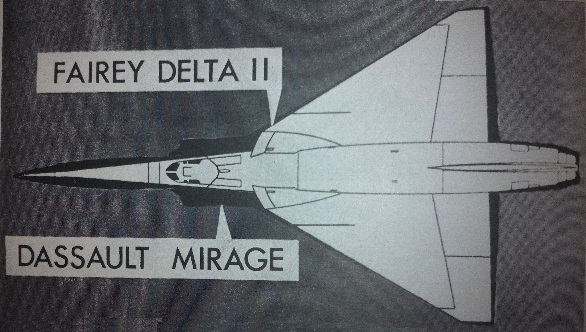
Fairey perhaps could have partnered with Convair to explore common research goals. I cannot help but see superficial similarity between Fairey Delta and the Sea Dart. The US and British just weren't quite as easy at being partners in those days. Its hard to imagine that the need to develop affordable technologies wasn't relevant to US and Commonwealth interests let alone joint partners. This is the era Canada needed shiny new jets for integration with NORAD's SAGE system, and Fairey Delta certainly looked the part of a Cold War supersonic fighter.
 
Despite everything written in this thread about how it couldn't have been done . . . the fact that there wasn't a British equivalent of this film with a Hawk in place of the Alpha Jet and descendents of the Fairey Delta 2 in place of the Mirage 2000s makes me very upset!

View: https://www.youtube.com/watch?v=Pz5SVkkTyfY&t=296s

AFAIK the closest British equivalents to the several iterations of "Chevaliers du Ceil" were "Squadron" (1982) and "Strike Force" (1995). The latter starred Tim Bentnick better known as David Archer in "The Archers".
 
Last edited:
The 60s version of Chevaliers was shown on BBC in English as The Aeronauts.
https://en.m.wikipedia.org/wiki/The_Aeronauts_(TV_series)
French language graphic novels featuring Canadian (Dan Cooper), French (Michel Tanguy) and USN (Buck Danny) pilots have been published since the 60s along with more modern versions involving the French Navy.

The Lightning with its colourful 60s tails and phenomenal climbing ability deserved similar treatment but Britain prefered magazines like Eagle and TV21 to graphic novels. Dan Dare would have made a fine early 60s RAF Squadron Leader on Javelins or Lightnings. Adventures in Gibraltar, Cyprus, and Singapore would have reflected the real world RAF.

Hats off to Belgium and France for their beautiful graphic novels which have no English or US equivalents of such high quality.

Tintin the Belgian boy reporter did get to fly in a BEA Trident but sadly neither Mirages nor Lightnings made it into Herges' books.
 
The 60s version of Chevaliers was shown on BBC in English as The Aeronauts.
https://en.m.wikipedia.org/wiki/The_Aeronauts_(TV_series)
French language graphic novels featuring Canadian (Dan Cooper), French (Michel Tanguy) and USN (Buck Danny) pilots have been published since the 60s along with more modern versions involving the French Navy.

The Lightning with its colourful 60s tails and phenomenal climbing ability deserved similar treatment but Britain prefered magazines like Eagle and TV21 to graphic novels. Dan Dare would have made a fine early 60s RAF Squadron Leader on Javelins or Lightnings. Adventures in Gibraltar, Cyprus, and Singapore would have reflected the real world RAF.

Hats off to Belgium and France for their beautiful graphic novels which have no English or US equivalents of such high quality.

Tintin the Belgian boy reporter did get to fly in a BEA Trident but sadly neither Mirages nor Lightnings made it into Herges' books.
Were the any newspaper strips that were equivalent? IIRC the James Bond one had an aeronautical adventure-or-so, Jeff Hawke was a pilot - but in the future.
 
Newspaper and most childrens' comics had only black and white.strips (Eagle and TV21 in colour).
Not surprisingly WW2 rather than current day heroes were the main stars of war stories (also the dedicated black and white war magazine books still sold at newsagents). Biggles of course.
 
Biggles was updated for the 50s and 60s but he became a private eye rather than a dashing pilot flying Lightnings.

Red Arrow in Thunderbirds was about the closest we got - a Draken with extra B-58 engine pods stuck on the wings and tail.
 
The 60s version of Chevaliers was shown on BBC in English as The Aeronauts.
https://en.m.wikipedia.org/wiki/The_Aeronauts_(TV_series)
French language graphic novels featuring Canadian (Dan Cooper), French (Michel Tanguy) and USN (Buck Danny) pilots have been published since the 60s along with more modern versions involving the French Navy.

The Lightning with its colourful 60s tails and phenomenal climbing ability deserved similar treatment but Britain prefered magazines like Eagle and TV21 to graphic novels. Dan Dare would have made a fine early 60s RAF Squadron Leader on Javelins or Lightnings. Adventures in Gibraltar, Cyprus, and Singapore would have reflected the real world RAF.

Hats off to Belgium and France for their beautiful graphic novels which have no English or US equivalents of such high quality.

Tintin the Belgian boy reporter did get to fly in a BEA Trident but sadly neither Mirages nor Lightnings made it into Herges' books.
For once @uk 75 . . . I couldn't agree with you more! Well done! Keep it up! (And I'm not being sarcastic.)

I watched "The Aeronauts" in the 1970s. The English dub doesn't survive, but this gentlemen's done English subtitles for the original French version.
https://www.youtube.com/channel/UCk3HTY378CNpV4JfLXfcDNQ/playlists
The early 1970s English dub had a different theme tune (presumably so they didn't have to pay Johnny Hallyday royalties) called "The High Flying Aeronauts" sung by the late Rick Jones (better known as Yoffy in "Fingerbobs") which he co-wrote with Jeff Ryan. Here it is with a comment from the man himself.
View: https://www.youtube.com/watch?v=L2ZaeGXYhRY
 
so on the face of it could carry another 2 AAMs.
You'd need to wire them to present coolant and radar information to the missiles, something the detachable belly pack for the Lightning provides. IIRC there were separate ones for Firestreak and Red Top, so wiring the wing hardpoints for AAMs might present interesting challenges.
 
You'd need to wire them to present coolant and radar information to the missiles, something the detachable belly pack for the Lightning provides. IIRC there were separate ones for Firestreak and Red Top, so wiring the wing hardpoints for AAMs might present interesting challenges.

I'm not enough of a missile tech to know the ins and outs.

It appeared as if Firestreak's vacuum tube electronics required active cooling via ammonia, which also provided cooling for the seeker head given that it was available and plumbed to the missile.

The Red Top's electronics didn't require cooling, so the ammonia and plumbing was removed from the missile and weapon pack. The Red Top's Indium antimonide seeker was cooled by compressed air in the weapons pack, apparently there was enough for 30 minutes of cooling and the seeker cooled in 2 seconds.

I don't know how this translates to the wing pylons for a Lightning, but the SR177 which wasn't cancelled until late December 1957 some 6 months into Red Top's development, has AAMs on the wingtips which presumably are early iterations of the Red Top. In addition F155 contenders FD3, P1103 and AW169 appeared to carry Blue Vesta on the wingtips, which apparently was to be more complex than Red Top. If these aircraft can overcome the challenges of wingtip Blue Vesta or Red Top then it seems likely EE/BAC could make these missiles work on the Lightning's wing pylons if required (or more likely, funded).

Another little gem on this site is that the Red Top had to be armed 2 minutes before launch, but this could be automatic. I've heard that R530s had a very long warm-up time which hampered it in closer combat, and I think the AIM7E2 'dogfight' Sparrow specifically improved this parameter so likely the 7E had problems in this area too.
 
Does raise a question of wing thickness, though. The F102 had to be significantly redesigned with thinner wings as a result of the area rule.
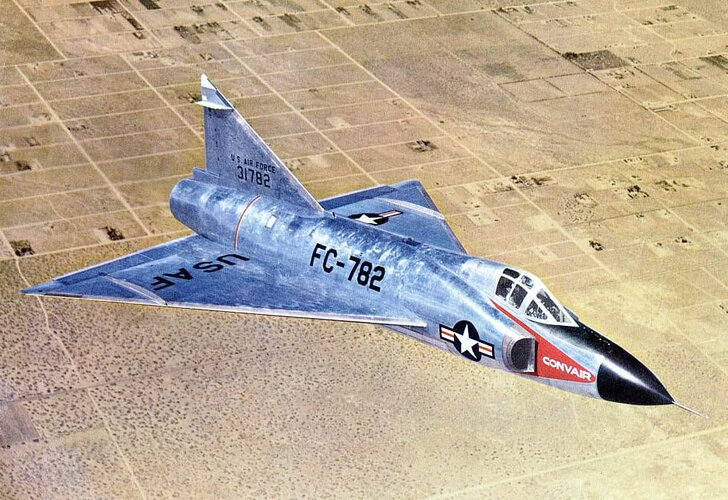
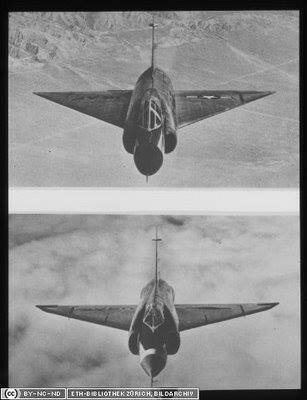
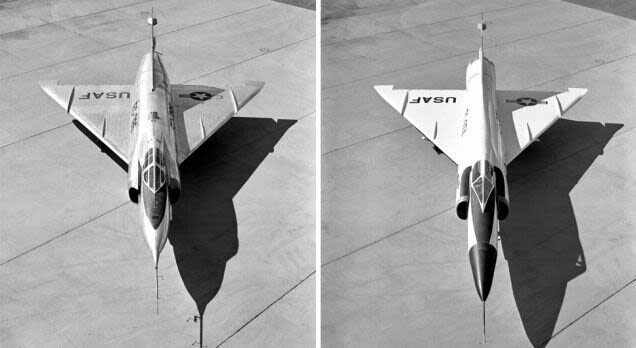
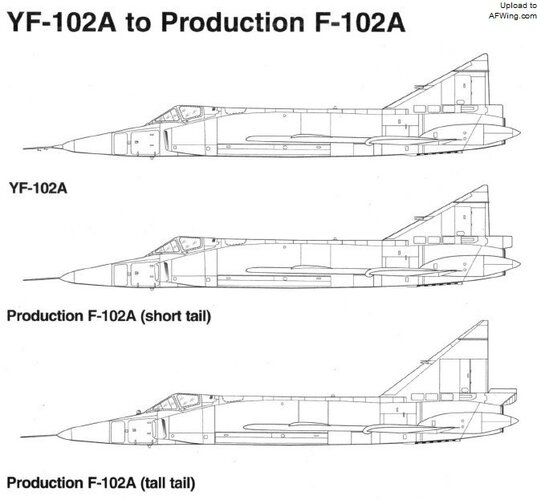
The major change from the YF-102 to the YF-102A was the fuselage, not the wing.

YF-102 top, YF-102A bottom:

YF-102 & YF-102A.jpg

YF-102 left, YF-102A right:

YF-102 left - YF-102A right.jpg

As the USAF had decided to implement a new design>production philosophy (the so-called "Cook-Craigie" program, named for its originators, Generals Laurence C. Craigie and Orval R. Cook) no prototypes ("XF-102") were built - the program went straight to an order for 10 "developmental aircraft" (YF-102) and 8 production aircraft (F-102A) to begin immediately after the "Y" aircraft were complete (boy, sure sounds like the "concurrent production" model of the F-35).

As soon as the first YF-102 began test flights it was clear that something was wrong - confirming the wind tunnel test results from the models that the USAF had claimed were "not valid" - the YF-102 could not break Mach 1!
Unfortunately, this meant that the 10 YF-102s were all built before construction was halted on the 8 production examples.

Here is the corrective action applied to the F-102As (the first 4 were redesignated YF-102A) - note that while some detail changes were done to the wings, changing the wing thickness was NOT among them:

https://www.joebaugher.com/usaf_fighters/f102_1.html
The salvation of the project turned out to be in the "area rule" devised by NACA scientist Richard Whitcomb. According to the area rule, the total cross sectional area along the direction of flight should be a constant in order to achieve minimum transonic drag. In order to achieve this, it was required that the fuselage be narrowed down in the region where the wing roots were attached, then broadened back out again when the wing trailing edge was reached. This gave the aircraft fuselage a characteristic "wasp-waist" or "Coke-bottle" shape. In order to achieve this, the length of the fuselage was increased by 11 feet, and a pair of aerodynamic tail fairings were added aft of the trailing edge, these fairings extending beyond the end of the afterburner tailpipe in a pair of characteristic protrusions. These tail fairings were for purely aerodynamic purposes and had no other function. A new cockpit canopy with a sharper leading edge was fitted, although it had an adverse effect on overall visibility. Cambered leading edges were fitted to the thin delta wings to improve the behavior of the thin airfoil at high angles of attack, and the wingtips were given wash-in.

A J57-P-23 engine was fitted, which was considerably lighter and more powerful than the previous J57-P-11. The J57-P-23 engine was rated at 11,700 lb.s.t. dry and 17,200 lb.s.t. with afterburning. The aircraft was lightened by reducing excess structures no longer required by the lighter engine. The new aircraft was given the designation YF-102A.

Designated Model 8-90, the first of four YF-102As (53-1787/1790) was rolled out at San Diego just 117 days after redesign had started. It was trucked out to Edwards AFB and took off on its maiden flight on December 20, 1954. On the next day, Mach 1 was easily exceeded, fully confirming the predictions of the area rule. It soon reached a top speed of Mach 1.2 in level flight. In addition, the aircraft could still keep on climbing after reaching 51,600 feet.
A milestone was reached on July 8, 1955, when a YF-102A fired six Falcon missiles and 24 unguided rockets in less than 10 seconds.

The retooling required by the changes in the YF-102A played havoc with the Cook-Craigie plan for early production. Fully two-thirds of the 30,000 tools that had been purchased had to be thrown out and new ones acquired. Following the costly re-tooling procedure, full production of the F-102A began at the Convair plant in San Diego. The first production Model 8-10 or F-102A (53-1791) flew on June 24, 1955 and was delivered to the Air Force five days later. It had a J57-P-23 engine.

In the full production F-102A, the wings were moved aft, and fuselage length was increased by more than 16 feet over the original YF-102. The wingspan was increased from 37 feet to 38 feet 1 1/2 inches, the wing area increased from 661 square feet to 695 square feet, and the gross weight increased from 26,404 pounds to 28,150 pounds.

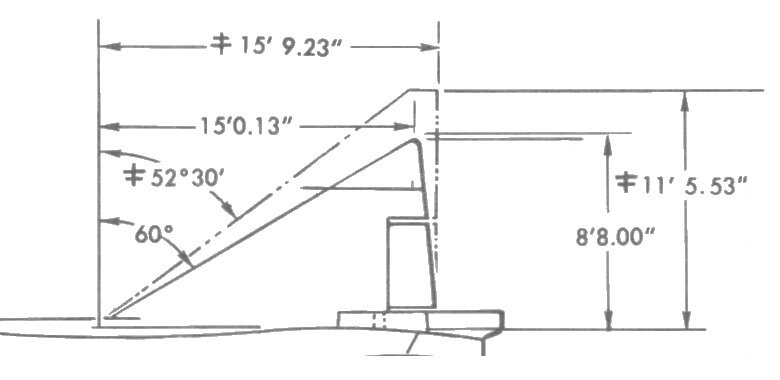
The initial production run of 40 aircraft (production blocks -5 through -25) were all employed in research and development work, and none entered operational service with the USAF. As a result of the tests, some significant airframe changes were made, including a three-foot addition to the height of the tail fin. This new tail fin was devised as a cure for some high-speed instability problems that had turned up during flight testing and was first tested in December of 1955. It was introduced as standard on all F-102As built after the 25th example, and earlier F-102As were retrofitted with this new taller fin.

YF-102A - F-102A.jpg

F-102A fin change.jpg
 
Last edited by a moderator:
Sorry to resurrect this thread, but there was a fair bit of talk about the requirement of the RAF to have supersonic fighter-bombers, because there was no need.

I came across this little nugget of info on Radfan Hunters with regards to the Radfan campaign in Aden in early 1964.

.........the number of incursions by Yemeni aircraft increased and included one raid in which two Migs escorted an armed helicopter on a bombing and machine gun attack on the village of Bulaq near Beihan........

This raid wasn't intercepted and no combat ensued, but the RAF did lay on some hefty strikes from the Wing of Hunters.

Two days later, two FGA.9s .....were scrambled at 12:10 to intercept an unidentified aircraft heading for Mukeiras from the Yemen but it did not cross the border............

One Yemeni faction was supported by Egypt, so those Mig might have been Egyptian and Egypt had Mig 21s. A worthy opponent for Lightning fighter-bombers if they had been adopted instead of Hunter FGA/FRs.
 
Last edited by a moderator:
The 60s version of Chevaliers was shown on BBC in English as The Aeronauts.
https://en.m.wikipedia.org/wiki/The_Aeronauts_(TV_series)
French language graphic novels featuring Canadian (Dan Cooper), French (Michel Tanguy) and USN (Buck Danny) pilots have been published since the 60s along with more modern versions involving the French Navy.

The Lightning with its colourful 60s tails and phenomenal climbing ability deserved similar treatment but Britain prefered magazines like Eagle and TV21 to graphic novels. Dan Dare would have made a fine early 60s RAF Squadron Leader on Javelins or Lightnings. Adventures in Gibraltar, Cyprus, and Singapore would have reflected the real world RAF.

Hats off to Belgium and France for their beautiful graphic novels which have no English or US equivalents of such high quality.

Tintin the Belgian boy reporter did get to fly in a BEA Trident but sadly neither Mirages nor Lightnings made it into Herges' books.
Were the any newspaper strips that were equivalent? IIRC the James Bond one had an aeronautical adventure-or-so, Jeff Hawke was a pilot - but in the future.
Newspaper and most childrens' comics had only black and white.strips (Eagle and TV21 in colour).
Not surprisingly WW2 rather than current day heroes were the main stars of war stories (also the dedicated black and white war magazine books still sold at newsagents). Biggles of course.
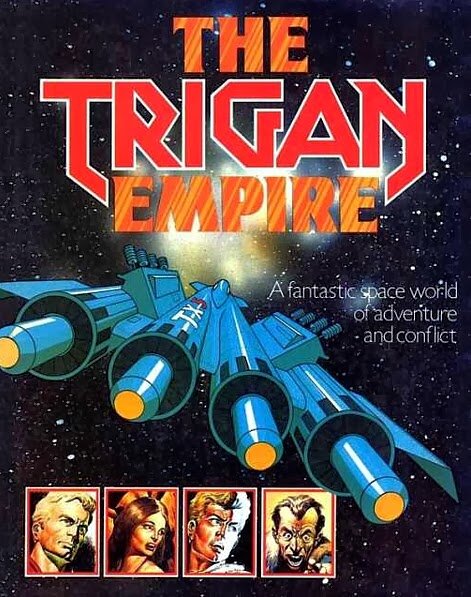
"The Trigan Empire" the only saving grace of "Look & Learn" deserves an honourable mention. "Action" and "2000 AD" were the comics that 14-year-old-boys wanted to read while "Look & Learn" was the comic that mothers of said 14-year-old-boys wanted their sons to read.

I still have a copy of this, which is at the right end of the bottom shelf in the bookcase to my right.

Trigan Empire Book.jpg
 
"The Trigan Empire" the only saving grace of "Look & Learn" deserves an honourable mention. "Action" and "2000 AD" were the comics that 14-year-old-boys wanted to read while "Look & Learn" was the comic that mothers of said 14-year-old-boys wanted their sons to read.

I still have a copy of this, which is at the right end of the bottom shelf in the bookcase to my right.


Great fun! And this coming from a multiple-personality type who loved all of Look and Learn, 2000AD (Starlord too!), and Action.[/I]
 
The only way I can see to save the Fairey Delta programme is:

1) A repudiation of the no-more-manned-fighters doctrine, including the acceptance that not all wars will automatically go nuclear.
2) An acceptance that the nose-intake geometry of the Lightning does not allow for growth in radar fit-outs (including but not limited to SARH illumination, but that in turn means accepting that active homing is as much of a busted flush as the no-fighters doctrine itself).
3) The need to reach for the most immediate existing option, as the basis for development.

In my opinion, the correct decision here is to scrap F.155T but give Fairey authorization to proceed on ER.103C and its own internal SARH development of Fireflash. In the company rationalization frenzy they will be partnered with Gloster, since both firms are fighter companies which are savvy with Deltas. In this way, Gloster will be compensated for the loss of its Javelin developments. DeHavilland might also join in since its offshoot company makes Blue Jay (which the Delta fighter will also need).

Early Lightnings will hold the line until this is ready, and then English Electric will be compensated with a large order for P.17s (as-designed) to replace the Canberra force and run-off work to keep the Lightning squadrons flying until Fairey's developed aircraft takes its place.
 
The only way I can see to save the Fairey Delta programme is:

1) A repudiation of the no-more-manned-fighters doctrine, including the acceptance that not all wars will automatically go nuclear.
2) An acceptance that the nose-intake geometry of the Lightning does not allow for growth in radar fit-outs (including but not limited to SARH illumination, but that in turn means accepting that active homing is as much of a busted flush as the no-fighters doctrine itself).
3) The need to reach for the most immediate existing option, as the basis for development.

Yes, although I think the Lightning's radar space could have fitted a CW emitter for SARH missiles if the production run had been bigger. Apparently improvements in manufacturing techniques and smaller components over time would have freed up space for a CW emitter by about the 200th unit. I can't provide a source, but I think I came across it when down the Radar Red Top rabbit hole.

In my opinion, the correct decision here is to scrap F.155T but give Fairey authorization to proceed on ER.103C and its own internal SARH development of Fireflash. In the company rationalization frenzy they will be partnered with Gloster, since both firms are fighter companies which are savvy with Deltas. In this way, Gloster will be compensated for the loss of its Javelin developments. DeHavilland might also join in since its offshoot company makes Blue Jay (which the Delta fighter will also need).

I think the big disconnect with many FD2 arguments is that it's a similar size to the Mirage III so must have been as capable, whereas the ER.103C is what is required to make the FD2 into a combat aircraft and that will take time and money.

What was Fairey's SARH Fireflash development like?

Given the aviation industry's government directed consolidation had a lot to do with making companies with the market capitalisation to handle the 1958 orders for 25 DH Tridents and 35 Vicker VC10s, and the 1958 Airco partnership of DeHaviland, Fairey and Hunting wasn't what the government wanted how would a Fairey-Gloster merge go?
 
I've learned a couple of things since this thread was active about a year ago.

1) the Lightning's advanced wing and big belly tank that filled-in the Area Rule were designed in detail 1958 (IIUC the kinked wing was flown in 1958) and the ground-attack options were designed in 1958, in the peak Sandys years when all Lightning development was frowned upon.

2) the huge numbers of fighter-bombers in service with RAFG and other out-of-area Air Force Commands were not going to be replaced with mostly fighter-bombers but with Canberra interdictor-bombers. These were nuclear capable, which was important in the late 50s, but in the conventional role had a far greater payload-range than any contemporary fighter that might be converted into a fighter-bomber. The process is a bit like how Bomber Command replaced 64 Canberra B2s in the NATO tactical nuclear role with 24 Valiants in 1960, small numbers of Canberra replaced large numbers of fighter-bombers. This means that the fighter-bomber sqns that did remain and needed to be replaced from 1958 really needed the 'fighter' component as much as if not more than the 'bomber' component.
 
Last edited:
The only way I can see to save the Fairey Delta programme is:

1) A repudiation of the no-more-manned-fighters doctrine, including the acceptance that not all wars will automatically go nuclear.
2) An acceptance that the nose-intake geometry of the Lightning does not allow for growth in radar fit-outs (including but not limited to SARH illumination, but that in turn means accepting that active homing is as much of a busted flush as the no-fighters doctrine itself).
3) The need to reach for the most immediate existing option, as the basis for development.

In my opinion, the correct decision here is to scrap F.155T but give Fairey authorization to proceed on ER.103C and its own internal SARH development of Fireflash. In the company rationalization frenzy they will be partnered with Gloster, since both firms are fighter companies which are savvy with Deltas. In this way, Gloster will be compensated for the loss of its Javelin developments. DeHavilland might also join in since its offshoot company makes Blue Jay (which the Delta fighter will also need).

Early Lightnings will hold the line until this is ready, and then English Electric will be compensated with a large order for P.17s (as-designed) to replace the Canberra force and run-off work to keep the Lightning squadrons flying until Fairey's developed aircraft takes its place.
Blimey that actually works!
Essentially a AH defence review, trims F.155 down to something achievable by the early 60's.

And leaves EE as prime on GOR.339.
 
What was Fairey's SARH Fireflash development like?
My only knowledge (from OG BSP4) is that it existed as a project. Unfortunately, unless somone who worked on it came forth like John Forbat did, we probably won't know any more than that. (And given how long ago it was, I fear that any such book that appeared now would be written by the orphaned offspring of the person concerned.)

trims F.155 down to something achievable
Well no, it kills it completely. The decision AH Sandys makes here is that the manned combat aircraft DOES have a future, but that the F.155T super-interceptor is too over-specialized for what it costs, and must go (and if he cares to reverse that decision, Britain can go halves on the Arrow with Canada). ER-103C Mk 1 will be primarily a short-medium range interceptor and air superiority fighter, but follow-on marks will have the option for air-ground ordnance.

Because ER-103C probably won't be big enough to carry Red Dean without seriously affecting the flight characteristics, the big Vickers missiles will have to go. We're told that Vickers got the size and weight way down in the final iteration, but the figures given seem unrealistic and the resultant missile would have to have been a completely different beast. (Details on this are also lacking.)

And leaves EE as prime on GOR.339.
I know there's a debate over whether EE or Vickers actually "won" the lead-in competition, but my AH gives it to EE because they have a track record of success with the Canberra and then the Lightning. They KNOW what they're doing, and whatever help Vickers gives them, it's their airplane to build and not Vickers' to redesign. Maybe we get an ADV TSR.2 out of that in the long term and maybe we don't.
 
Well no, it kills it completely. The decision AH Sandys makes here is that the manned combat aircraft DOES have a future, but that the F.155T super-interceptor is too over-specialized for what it costs, and must go (and if he cares to reverse that decision, Britain can go halves on the Arrow with Canada). ER-103C Mk 1 will be primarily a short-medium range interceptor and air superiority fighter, but follow-on marks will have the option for air-ground ordnance.

In your scenario the EF.103C c/would replace (1964 sqn strength, establishment with no reserves etc)
  • Javelin, 6 sqns/96 a/c
  • Lightning F1/F1A: 3 sqns/36 a/c
  • Hunter FGA/FR: 9 sqns/99 a/c
That's a pretty strong basis production, probably around 400 for the RAF alone depending what happens with the P.1127 and Lightning F2.

However the ER.103C is a wholly new aircraft, scaled up 50% from the ER.103, so how much would it's development cost? Sandys had to (and did, for 5 years) cut 100 million pounds from the Defence budget.
 
1) the Lightning's advanced wing and big belly tank that filled-in the Area Rule were designed in detail 1958 (IIUC the kinked wing was flown in 1958) and the ground-attack options were designed in 1958, in the peak Sandys years when all Lightning development was frowned upon.
While this one belongs in another thread. I'll just point at it here and highlight.
 
While this one belongs in another thread. I'll just point at it here and highlight.

I raise it in the context of this thread because of the Lightning vs ER.103/C are in a race more or less and the Lightning development being painfully penny-pinching and therefore slow keeps the ER.103/C in the race. However if the 1958-59 order for Lightning F2 included the more efficient wing and big belly tank adding 40% to the Lightning's range and being delivered in 1961 it changes the race completely.

Fairey projected they could have an ER.103/C prototype ready in 30 months from an order. If an order was placed in late 1957/early 1958 that (first) prototype would fly in 1961. This is when the first of 50 Lightning F2s, ordered in late 1959, were delivered.
 
However if the 1958-59 order for Lightning F2 included the more efficient wing and big belly tank adding 40% to the Lightning's range and being delivered in 1961 it changes the race completely.

Fairey projected they could have an ER.103/C prototype ready in 30 months from an order. If an order was placed in late 1957/early 1958 that (first) prototype would fly in 1961. This is when the first of 50 Lightning F2s, ordered in late 1959, were delivered.
In other words, what you're saying is that the variant which is delivered here is the one which was ultimately called F.2A in the real world. However, at this stage the missile armament is still limited to Firestreak, so the aircraft can't make anything other than a stern attack. ER.103C, with the Fairey SARH missile or one of the many stillborn radar Blue Jay (radar Red Top/Blue Dolphin etc.) variants assumed to be fully integrated, can.
 
Firstly for clarity, I'm assuming the ER.103/C has to be built in large numbers in order to be considered successful. If the RAF gets them in less numbers than they got the Lightning then it should be considered a failure, hence it needs to replace Javelins, Hunter FGA/FR and Lightning F1/F1A.

In other words, what you're saying is that the variant which is delivered here is the one which was ultimately called F.2A in the real world. However, at this stage the missile armament is still limited to Firestreak, so the aircraft can't make anything other than a stern attack. ER.103C, with the Fairey SARH missile or one of the many stillborn radar Blue Jay (radar Red Top/Blue Dolphin etc.) variants assumed to be fully integrated, can.

Yes but in 1961 not 1970 and at much lower cost than the retrofit.

Without the Fairey SARH missile is the ER.103/C a dud? The default position is that the ER.103/C will also have the Firestreak and likely that the Red Top would be the next step.

Would the nose of the ER.103/C be big enough to fit a CW emitter from the outset? If so something like the Radar Red Top becomes more feasable. If not the whole exercise is to get a better Lightning F.3 but at higher cost.
 
The only way I can see to save the Fairey Delta programme is:

1) A repudiation of the no-more-manned-fighters doctrine, including the acceptance that not all wars will automatically go nuclear.
2) An acceptance that the nose-intake geometry of the Lightning does not allow for growth in radar fit-outs (including but not limited to SARH illumination, but that in turn means accepting that active homing is as much of a busted flush as the no-fighters doctrine itself).
3) The need to reach for the most immediate existing option, as the basis for development.
Point 1 was no more manned interceptors rather than fighters in the wider combat air roles i.e. more emphasis on range, variety of weapon fits, operability etc.

Point 2 The active homing of Red Dean was well dead by this stage (1956). General point of having a larger radar in the nose for multiple modes and more usefulness in absence of GCI.

Point 3 I think the most immediate option in this case is the Hawker P.1121 though? It's multiple years in front of ER.103C. At least there's the option to have a competition. I'd definitely doubt Fairey's ability to deliver and this also seemed to be in mind during F.155T selection.


For me then the Fairey Delta route is still a scale back in cost / capability aims to something similar to Mirage III / Draken equivalent rather than the Lightning route. In hindsight a more than good enough gap filler until Bloodhound, but cheaper and more flexible for wider roles.
 
Point 1 was no more manned interceptors rather than fighters in the wider combat air roles i.e. more emphasis on range, variety of weapon fits, operability etc.

This is true for the switch from fighter-bombers to nuclear capable interdictor-bombers. However the only fighter procurement during Sandys tenure as MoD was distinctly below the state of the art and reeked of 'interim' to cover the gap to missile deployment.
 

Similar threads

Back
Top Bottom