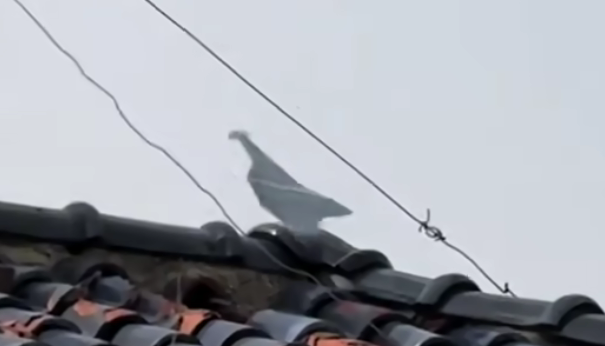
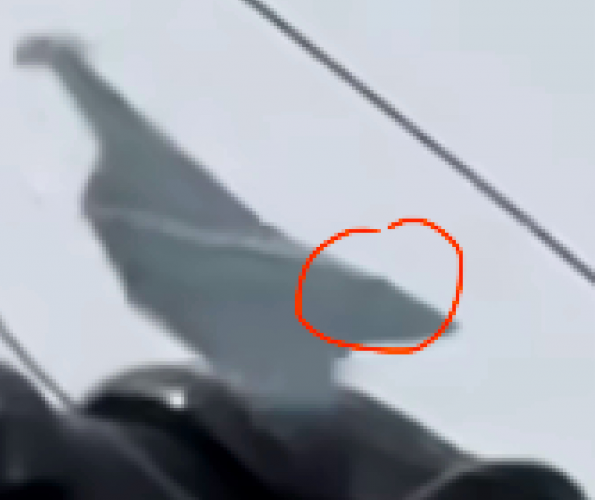
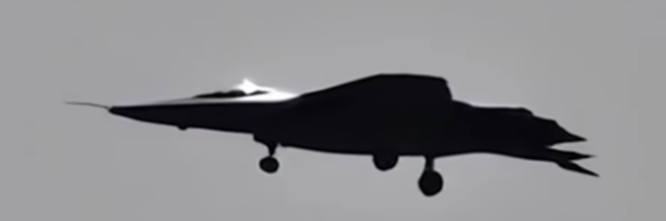
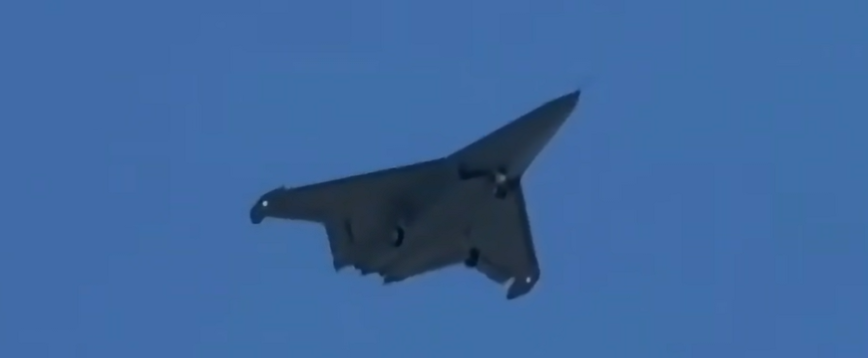
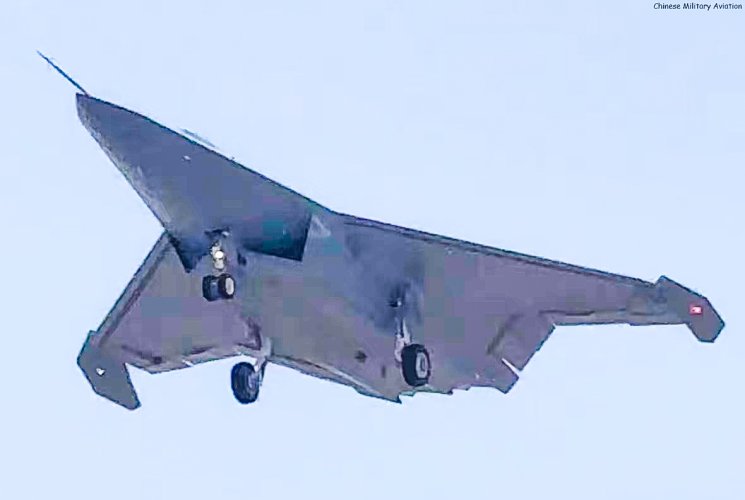
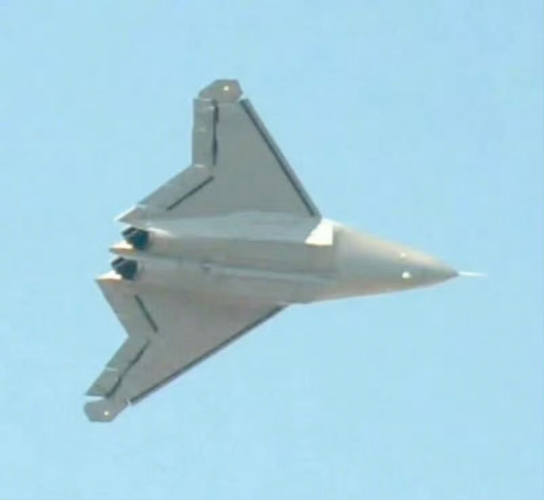
It seems it finish turning only with wingtips (maybe assisted with vectoring), if it do have another four pairs of control surfaces (on it's tail, which showed before), its control performance might be better than I thought.
 
It seems it finish turning only with wingtips (maybe assisted with vectoring), if it do have another four pairs of control surfaces (on it's tail, which showed before), its control performance might be better than I thought.
Way too low resolution to make that claim, you can't see the rest of the control surfaces moving and they don't need much travel.

At the angle the wing tips are they actually push the nose down, so they're countering with other control surfaces in the opposite direction which you also can't see.
 
Way too low resolution to make that claim, you can't see the rest of the control surfaces moving and they don't need much travel.

At the angle the wing tips are they actually push the nose down, so they're countering with other control surfaces in the opposite direction which you also can't see.
Actually, the wing tip is inducing a rolling moment in that position (aircraft attitude). It is fairly obvious given the 60 to 70 deg bank angle. If we could see the other tip, I wouldn't be surprised it is exactly the opposite. If both tip are identical a pitching moment could be expected. And it one tip is rotated and the other neutral a yawing moment could be induced.
 
Actually, the wing tip is inducing a rolling moment in that position (aircraft attitude). It is fairly obvious given the 60 to 70 deg bank angle. If we could see the other tip, I wouldn't be surprised it is exactly the opposite. If both tip are identical a pitching moment could be expected. And it one tip is rotated and the other neutral a yawing moment could be induced.
Yes they're mixed in, my point was it still needs the rest of the control surfaces to counteract the pitch down they create.

Can't wait for proper camera + telephoto lens footage to see it all working together.
 
Can you guys see the anhedral on those? Maybe even the main wing has a slight dihedral too.
 
It's like the F-22, most of the engine is below the "beltline"

F-35, the engine is roughly centered on the "beltline", same as with F-15 and Flankers.
Scott, what are referring to as the "beltline"? I suspect it is a waterline, but which one? - i.e. - through the centroid???
 
So the question arises, what means should we use to counter the threat of these two new types of fighters before the NGAD becomes a reality?
As of now the Chinese military's application of the new aircraft is mainly tilted towards ultra long range spot kills of our support units including but not limited to AWACS, refueling, and carriers.
This is due to the fact that the Chinese Air Force still has less information about air combat that they have experienced themselves, and gathered from allies.
Including the reports that have come out showing that their pilots are still inferior to ours in standoffs near the South China Sea.
View attachment 754022
So they tend to undercut our auxiliary units to get a fair shot.

So can we utilize on the only stealthy large platform available, the B21, or the smaller RQ170/80, and convert it to an air-to-air AWACS and refueling aircraft to reduce the risk of being attacked, and to fundamentally counter the Chinese Air Force's tactics?

Although this reply is a bit late, this image is a photoshopped creation by a notorious anti-China figure on Chinese internet platforms. He even goes so far as to fabricate academic papers to denigrate China's military technology...
 
Scott, what are referring to as the "beltline"? I suspect it is a waterline, but which one? - i.e. - through the centroid???
It's the line of the chine and the wings. F-22 has engines below the wings, YF-23 has the engines above. Flankers have engines roughly centered on the wing line.
 
Although this reply is a bit late, this image is a photoshopped creation by a notorious anti-China figure on Chinese internet platforms. He even goes so far as to fabricate academic papers to denigrate China's military technology...
His Weibo has been awfully quiet of late…
 
Although this reply is a bit late, this image is a photoshopped creation by a notorious anti-China figure on Chinese internet platforms. He even goes so far as to fabricate academic papers to denigrate China's military technology...
His Weibo has been awfully quiet of late…

I'm not familiar with this individual.
 
Are winglets looked down as much as canards for aviation stealth enthusiasts?
It's hard to say, after all, the debate around canards is still ongoing. The aircraft designers know they need to create a fighter jet that meets the requirements, so my thought is that even if canards and small wings do have some impact (not discussing whether this impact is real for now), it is still within an acceptable range.
 
Last edited by a moderator:
It's the line of the chine and the wings. F-22 has engines below the wings, YF-23 has the engines above. Flankers have engines roughly centered on the wing line.
Thanks Scott. I have been in this business over 40 years and never heard the term. I have always used "chine waterline" to describe what you describe as the "beltline".
 
Unless all control is done via thrust vectoring, some control surface deflection is needed. The issue with canards historically was the surface being at the front of the aircraft meant unwanted reflections when it pivoted in the vital frontal quarter. The F-22 places the tail behind the wing, in the same plane, so at rest its basically sitting behind the wing, and its not really contributing to frontal RCS. Pivoting wingtips are new.
 
Unless all control is done via thrust vectoring, some control surface deflection is needed. The issue with canards historically was the surface being at the front of the aircraft meant unwanted reflections when it pivoted in the vital frontal quarter. The F-22 places the tail behind the wing, in the same plane, so at rest its basically sitting behind the wing, and its not really contributing to frontal RCS. Pivoting wingtips are new.
A sufficiently-large canard (think Viggen-or-larger, not Gripen or Typhoon) would reduce the amount of deflection necessary...
 
Actually, the wing tip is inducing a rolling moment in that position (aircraft attitude). It is fairly obvious given the 60 to 70 deg bank angle. If we could see the other tip, I wouldn't be surprised it is exactly the opposite. If both tip are identical a pitching moment could be expected. And it one tip is rotated and the other neutral a yawing moment could be induced.
Any asymmetric control surface movement is going to result in a mix of pitch/roll/yaw. Even if they're both moving in the same direction, if the deflection isn't identical you're going to get multiple axes involved.
 
Any asymmetric control surface movement is going to result in a mix of pitch/roll/yaw. Even if they're both moving in the same direction, if the deflection isn't identical you're going to get multiple axes involved.
I don't disagree. For simplicity sake, I was discussing the dominate moment.
 
I like this angle of the aircraft, I hope we'll get a head on view some day.
View attachment 769658
Also, triangular intakes. Has anyone got any idea what kind of intakes they are using here, DSI intakes have lips that sweep forward and also no bump here neither does it have any splitter plates.
 
Also, triangular intakes. Has anyone got any idea what kind of intakes they are using here, DSI intakes have lips that sweep forward and also no bump here neither does it have any splitter plates.
View attachment 767734View attachment 767735
Well, I think we can put the notion of a DSI on the J-XDS to rest. Looks similar to F22 BLCS on the inside of the intake in lieu of any physical diversion system. YF23 BLCS also uses the same design principle, but is surely less advanced than these two.
 
Although aesthetically I prefer the plan from Shenyang, the fully movable wingtip doesn't seem to be a good idea for the VLO.
Why? It seems fine. The actuator and most of the gap is blocked by the variable leading edge slats.
 
The wingtips that are constantly changing their angles will reflect the radar signals.
That's true for any control surfaces on any aircraft with a relaxed stability design anyways.

As your speed increases, they wouldn't need to deflect as much. Current footages only cover landing/low altitude scenarios with very low airspeed so of course the wingtips have to deflect even more frequently and violently than during crusing, as this design should be very unstable.
 
That's true for any control surfaces on any aircraft with a relaxed stability design anyways.

As your speed increases, they wouldn't need to deflect as much. Current footages only cover landing/low altitude scenarios with very low airspeed so of course the wingtips have to deflect even more frequently and violently than during crusing, as this design should be very unstable.

Indeed.

I've often wondered if fluidic thrust vectoring would work for cruise... it wouldn't need anywhere near the authority as moments would be quite low (usually). In any case, I suspect that this aircraft could rely on thrust vectoring for pitch trim in cruise... the question of dealing with crosswinds is more complicated (as committing to a constant angle of bank could be uncomfortable for the pilot and disadvantageous for stealth)... so presumably one would want some kind of yaw control.
 
The wingtips that are constantly changing their angles will reflect the radar signals.
It still has wing control surfaces - the wingtips could lock in place where high stealth is needed.

Of the two Chinese designs, Shenyang's adheres more closely to the edge alignment principle.
 
It still has wing control surfaces - the wingtips could lock in place where high stealth is needed.

Of the two Chinese designs, Shenyang's adheres more closely to the edge alignment principle.
As I see it, both Shenyang's and Chengdu's have exactly 2 edge alignment angles. J-50 have some shorter edges though, especially at the wingtips, that might be detectable by radars with comparable wavelength, even if the wingtips are locked. And i think they definitely will be locked at cruising speeds.

More interesting to me is how are they going to control yaw without wingtip movement. Engines seem to be quite close to the centerline, so differential thrust will not be very effective. But I think I can see something on the "sting" between the engines. It may be a TVC flap or small reaction control nozzle or just a glitch in the photo. Does anybody else see it?
 
As I see it, both Shenyang's and Chengdu's have exactly 2 edge alignment angles. J-50 have some shorter edges though, especially at the wingtips, that might be detectable by radars with comparable wavelength, even if the wingtips are locked. And i think they definitely will be locked at cruising speeds.

More interesting to me is how are they going to control yaw without wingtip movement. Engines seem to be quite close to the centerline, so differential thrust will not be very effective. But I think I can see something on the "sting" between the engines. It may be a TVC flap or small reaction control nozzle or just a glitch in the photo. Does anybody else see it?

The outer 2 control surfaces can split one up one down to create yaw, maybe we'll be able to see it when we start getting non phone videos. That's my bet anyway.


Similar threads

Back
Top Bottom