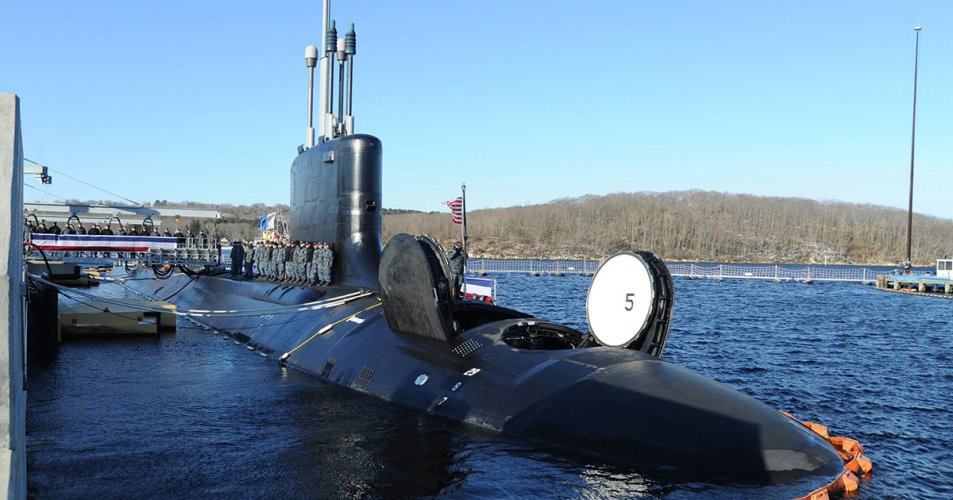
Submarine-Launched Ship-To-Air Missiles

The Russian RBUs throw further, of course, but also throw a much lighter overall load. Even if their charge weight is about the same as the LWTs.
They also throw a lot more projectiles and could be reloaded much faster. Granted, they aren't very useful against modern submarines, but against torpedoes they provide much more robust defense than anti-torpedoes.
 
I think the US tubes throw the torpedoes about as far as the heavyweight depth charge throwers.

The Russian RBUs throw further, of course, but also throw a much lighter overall load. Even if their charge weight is about the same as the LWTs.

It makes one wonder why in the Cold War the US didn't develop a super-VLA which used a Mk-48 ADCAP as its' payload.
 
It makes one wonder why in the Cold War the US didn't develop a super-VLA which used a Mk-48 ADCAP as its' payload.
I suspect that has a lot to do with the MK 41 VLS program's, ah, complicated history. Not to mention certain ill-advised reorganisations within the USN during the 1970s, e.g. NAVORD being merged with NAVSHIPS to create NAVSEA.
 
Last edited:
I wouldn't be surprised if the combination of a Mk 48 plus a large enough rocket motor to get it out to the second or third convergence zone would be too long for the Mk 41 VLS, even if the Mk 48 can fit in terms of diameter.
 
It makes one wonder why in the Cold War the US didn't develop a super-VLA which used a Mk-48 ADCAP as its' payload.
Essentially it was the UGM-89 "Perseus"; a sub-launched rocket, carrying heavyweight torpedo. While the idea was solid, the project fell viction to Rickover's desire to get a new nuclear submarine; from the straightforward super-SUBROC, "Perseus" turned into a whole bunch of unrelated concepts, and eventually got cancelled, when Congress choose the Zumwalt's ideas over Rickover's.
 
European, Japanese, Korean, Canadian and Australian warships are 100% reliant on helicopters to engage submarines. Those lightweight torpedo launchers at the hangars are no credible anti-sub weapons. They're rather interesting for potential torpedo hard kill defence.

Kind of ignoring the European MILAS, South Korean K-ASROC and Japanese Type 07 aren't you? Both have longer range than VL-ASROC and a better payload...
 
It makes one wonder why in the Cold War the US didn't develop a super-VLA which used a Mk-48 ADCAP as its' payload.
Aside from UGM-89 Perseus, because a Mk48 weighs in at 3500lbs all by itself. And is 21ft long. Add probably 500lbs of parachute, and the whole package is just too big to fit into a Mk41 cell.
 
Kind of ignoring the European MILAS, South Korean K-ASROC and Japanese Type 07 aren't you? Both have longer range than VL-ASROC and a better payload...
Fair point, though MILAS isn't exactly widely deployed.
 
Aside from UGM-89 Perseus, because a Mk48 weighs in at 3500lbs all by itself. And is 21ft long. Add probably 500lbs of parachute, and the whole package is just too big to fit into a Mk41 cell.

Such a hypothetical super-VLA would no doubt have had its own dedicated launcher just like the RGM-84 Harpoon.
 
The larger aquatic drones might be the submariner’s loyal wingman, drawing ASW assets off-sides like Ozawa did Halsey.

The first drone is a sonar wild weasel—the second remains quiet and launches anti-aircraft weapons itself.

Then the boomer threads the needle between the other two drones that are intentionally noisy as hell.

Last I heard, listening-device/bugs don’t work so well in Metallica concerts.

Give every biologic a headache so they go to splashing around to get away.

A sub with a couple/three UUVs likely costs less than a carrier group.
 
Last edited:
Why even expose the expensive, man carrying bits to the front in any case? I can see the nukes just doing recharging duty with a fleet of UUVs. Without needing a pressure hull and propulsion being standard Li-ion derived stuff, lots of these can be not much more expensive than a standard heavy torpedo.
 
Why even expose the expensive, man carrying bits to the front in any case? I can see the nukes just doing recharging duty with a fleet of UUVs. Without needing a pressure hull and propulsion being standard Li-ion derived stuff, lots of these can be not much more expensive than a standard heavy torpedo.
Depends on what you want them to do.

If you just want a decoy, then something the size of a torpedo is 100% viable. Crud the US Mk70 MOSS was only 10" diameter!
 
Yeah, that report is some enormous "organic steer manure"

Don't get me wrong, I really wish that IDAS was in use. But nobody has actually bought it in the last what, 15 years?
The website of the company publishing the report seems like "new" to the defense and aerospace business ..... so I guess we need to take the report with a pinch of salt .....

I am more inclined to trust Forecast International more .......
 
The Los Angeles/Virginia class have multiple missiles tubes for larger Tomahawks. Which could accommodate if you try, x4 Sea Sparrows. Modded Cold eject launcher before missile fires. Sacrificing volume for land attack for some modicum of air defense exactly how. The sub would need upgrade anti air warfare suite and better radar to discriminate targets.

1000041539.jpg
 
The Los Angeles/Virginia class have multiple missiles tubes for larger Tomahawks. Which could accommodate if you try, x4 Sea Sparrows. Modded Cold eject launcher before missile fires.
Several problems there. First, the ESSM is not designed to be cold-launched. Second, the ESSM is not designed to survive water pressure. So either you would launch them from surface (which would be a no-go from submariner's point of view), or use some kind of hardened launch capsule to shot missile through the water (with missile motor igniting only after reaching surface). Hardened capsule would likely preclude quad-packing.
 
To use Sea Sparrows they'd need to use the Block 2 ESSM which IIRC has an active radar-seeker based on the AIM-120's seeker.

And some hardened capsule with launch equipment insilde must be developed, because original ESSM could not start through water; the missile radome and wings would be crushed. The size of capsule would likely means no more than one ESSM could fit into single tube.

Which could accommodate if you try, x4 Sea Sparrows.

P.S. Mark 45 launch tube is actually smaller than Mk-41 cell. It's shaped exactly as round 21-inch tube (to accomodate Tomahawk missiles) and ESSM could not be quad-packed in Mk-45 even in theory.
 
Last edited:
And some hardened capsule with launch equipment insilde must be developed, because original ESSM could not start through water; the missile radome and wings would be crushed. The size of capsule would likely means no more than one ESSM could fit into single tube.

What about a modified version of the proposed capsule for the AIM-9X underwater launched variant?
 
What about a modified version of the proposed capsule for the AIM-9X underwater launched variant?
If we would be able to make a version with foldable wings & fins, capable of fitting into 160-mm diameter, then yes, they could be (theoretically) quad-packed inside individual hardened capsules in one Mk-45 tube. The range would be severly limited, though. Likely no more than 10-15 km. Likely even less, since IR-guided missile could not efficiently estimate the distance to the target.
 
If we would be able to make a version with foldable wings & fins, capable of fitting into 160-mm diameter, then yes, they could be (theoretically) quad-packed inside individual hardened capsules in one Mk-45 tube.

I know you're referring to the AIM-9X but I was talking about a scaled up version of the capsule design that could accommodate the 10" diameter ESSM.
 
I know you're referring to the AIM-9X but I was talking about a scaled up version of the capsule design that could accommodate the 10" diameter ESSM.
Its possible, just not very practical. You could fit just one missile per tube, i.e. at most 12 missiles could be fit at the cost of completely dispencing with Tomahawks load. On practice, it would likley be 6-to-6 configuration, with six ESSM and six Tomahawks.
 
The Los Angeles/Virginia class have multiple missiles tubes for larger Tomahawks. Which could accommodate if you try, x4 Sea Sparrows. Modded Cold eject launcher before missile fires. Sacrificing volume for land attack for some modicum of air defense exactly how. The sub would need upgrade anti air warfare suite and better radar to discriminate targets.
Not worth it except in very limited places. Normally you go deep and run like hell after shooting missiles.

Might be worth it in the Baltic Sea, or anywhere else where you can't go deep and also has pretty intensive MPA coverage.


P.S. Mark 45 launch tube is actually smaller than Mk-41 cell. It's shaped exactly as round 21-inch tube (to accomodate Tomahawk missiles) and ESSM could not be quad-packed in Mk-45 even in theory.
Those tubes are actually 25" in diameter, they can just barely fit a slightly-modified ATACMS missile inside (flat-ribbon umbilical instead of round, and a different tail fin system. Details in the PDF). If the Navy would have been cool about much less resistance to shock loads, anyways. Otherwise you need about 2" of space around the outside of the missile for shock absorbtion. Handled via what look like ping-pong balls!
 

Attachments

  • Submarine Launched ATACMS - ADA318774.pdf
    1.6 MB · Views: 17
Yeah, that report is some enormous "organic steer manure"

Don't get me wrong, I really wish that IDAS was in use. But nobody has actually bought it in the last what, 15 years?

'Allegedly'....IDAS is part of the 212CD deal between Germany and Norway....along with Tyrfing (and if they have any sense NSM-SL).
 
There are ways to maintain a radio link without sticking a mast up. Buoyant wire antennas are well known but mostly limited to HF. Newer sorts of radio buoys linked to the sub by fiber optics can cover other frequencies. Obviously, these still impose some maneuver limits and increase detectability somewhat, but a sub on a SAM trap mission will want to be very quiet anyway.

https://www.navalnews.com/naval-new...on-antenna-a-key-system-of-modern-submarines/
 
There are ways to maintain a radio link without sticking a mast up. Buoyant wire antennas are well known but mostly limited to HF. Newer sorts of radio buoys linked to the sub by fiber optics can cover other frequencies. Obviously, these still impose some maneuver limits and increase detectability somewhat, but a sub on a SAM trap mission will want to be very quiet anyway.

https://www.navalnews.com/naval-new...on-antenna-a-key-system-of-modern-submarines/
Yes,the trick is not losing the buoy in high sea states. Kentucky Blue managed to lose one back in 03ish. There's a reward for its return if anyone finds a black float about the size of a VW Bug in the Pacific ocean or coast.

You're not towing the buoy via fiber optics, you're towing it via a pretty good sized steel cable. And those have tensile limits that big waves like to make a mockery of.
 
The Aselemar X-SUB buoy in the article is expendable, deployed from a 3" or 4" countermeasures tube. It has a duration of 30 minutes to an hour (at 4 knots) -- basically, there's a float tethered to the sub by a fairly short wire run, then a fiber spool paying out between the float and the surfaced buoy itself. This means there's little load on the fiber until the spool runs out. (Same idea as the wire spool on a torpedo)

View: https://youtu.be/5JpUA8iT-jk


The USN has had limited versions of this sort of buoy since the early 2000s. Last year, they issued a contract for a more advanced version that sounds very similar to the Aselemar X-SUB.

https://archive.navalsubleague.org/...ome-operational-concepts-for-their-employment

https://gdmissionsystems.com/articl...ituational-awareness-capabilities-for-us-navy

Given the short operational duration of these buoys, you would need a bell ringer to alert the sub to deploy one. Then the sub could download track data from a network like NIFC-CA to launch its missiles.
 

Similar threads

Back
Top Bottom