Boeing unlike Hawker talked to its customers and designed planes for them. That is why 727 sold more than the UKcentric Trident.

Thus is exactly what HS and BAC did, and their launch customers (in the biggest contracts in Britain) told them to shrink their planes. If they had not listened to their customers HS and BAC would have built far more attractive big versions of the Trident and VC10.
 
Secretary of State, why is making civil airliners a worthwhile national goal?

You have to imagine a puzzled Sir Humprey Appleby at this point.

British Aerospace no longer makes any civil airliners. Instead the UK makes a decent living from selling Rolls Royce engines, Airbus wings, various components both physical and virtual.

Brazil and Canada have built decent small airliners/biz jets and subsidise them for regional employment reasons.

Even the mighty US has seen Boeing as its last manufacturer of big airliners. Boeing these days is a far cry from the company which developed the 707 and B52 and seems to have lost its way.

Airbus gambled and lost on the Airbus 380 though like its 300 Airbus may find freight conversions a useful new market.

So Secretary of State do you really want to spend money on white elephants rather than schools and hospitals?

This is projecting a post 1990 Globalization=price stability & peace dividend mindset onto the late 60s Cold War self sufficient=full employment & national security economic and political model. At the time it was seen as natural that if a country could make stuff that was competitive within reason then it should. After all the sale of a batch of home built airliners provides the tax revenue and foreign exchange to pay for the hospital or school.
 
Secretary of State, why is making civil airliners a worthwhile national goal?

You have to imagine a puzzled Sir Humprey Appleby at this point.

British Aerospace no longer makes any civil airliners. Instead the UK makes a decent living from selling Rolls Royce engines, Airbus wings, various components both physical and virtual.

Brazil and Canada have built decent small airliners/biz jets and subsidise them for regional employment reasons.

Even the mighty US has seen Boeing as its last manufacturer of big airliners. Boeing these days is a far cry from the company which developed the 707 and B52 and seems to have lost its way.

Airbus gambled and lost on the Airbus 380 though like its 300 Airbus may find freight conversions a useful new market.

So Secretary of State do you really want to spend money on white elephants rather than schools and hospitals?
That's a 1990s or later outlook.

Building airplanes means people employed, generally making good money, too. Not unemployed people willing to listen to the Communists, Minister.

But I really think the big problem with the British jets was the lack of vision in the British air carriers. BOAC didn't see how they could fill an 80-passenger jet, when TWA and Boeing were planning on filling a 200-passenger plane.
 
To be fair to those I would condemn there were slowings of passenger growth at the times BEA and BOAC recommendations to shrink the Trident and VC10 Super 200. However these recommendations should have been challenged more vigorously.
 
The bloated size of the UK aerospce industry and its demands for public funding were very much on the minds of politicians from 1957 to 1967.
Listening just to BOAC/BEA was not much use if you were hoping to sell airliners to KLM or JAL. Boeing and Douglas did not just talk to Pan American and TWA they also talked and listrned to Lufthansa and BOAC (who chose 707 and 747 rather than VC10 for its Atlantic service).
It took a team effort (Airbus) to provide the products and Europe wide customer base that allowed us (yes we also benefit from Airbus) to compete with the US.
Perhaps if we had been less insular in the 60s and 70s there could have been more UK jobs from Airbus. Instead of the dead end rear engined BAC 311, the twin podded A300 was the key to a future. Even British Airways might have joined Lufthansa in deserting Boeing if Airbus had been more British.
 
After all the sale of a batch of home built airliners provides the tax revenue and foreign exchange to pay for the hospital or school.
The late 60s white heat culminating in MinTech also rapidly led to the realisation that R&D doesn't correlate to economic growth. Better for the economy to not continue massive government funding of Aerospace sector and for those employed to find more productive employment elsewhere (and there were plenty of opportunities).

Best example - Concorde. Beautiful and great engineering achievement, but at what opportunity cost.
 
Most of the problems mentioned stem from a lack of production numbers, the industry mightn't be bloated if it produced hundreds more units. Similarly the R&D bill wouldn't be so bad if hundreds of planes had been delivered.
 
Producing hundreds more units sounds good but you have to have buyers for them.

Most airlines outside the USA were state owned enterprises or very much leaning towards their national flag carrier duties. So the number of buying airlines was quite small to make large profitable production runs. Also the market was more volatile and nobody could accurately predict what market evolutions were likely. We still can't today (see A380) despite 60 years of hindsight but in the 1960s this was new territory. Plenty of bean counters felt supersonic airliners would be the main market, they were proved wrong, others felt VTOL airlines would replace intercity rail and road traffic, they too got it wrong. BEA got spooked by a blimp in passenger numbers and wrecked the Trident, the 737 was a massive gamble that Lufthansa took on to launch it.

Dassault tried the Mercure and flopped badly.

Breaking into America like the Beatles? About 21% of Viscounts were sold to US airlines/corporate owners. Had Bristol been able to accommodate Hughes' Britannia order for TWA, that aircraft might have achieved 26% of sales to US airlines. It looks likely that 25% would be the upper practical limit of US market penetration in the late 50s/early 60s. The 1-11 and 146 did achieve sales in the US despite strong home-grown opposition in the late 60s/70s/80s (not done the maths to work out the % share yet).

Best example - Concorde. Beautiful and great engineering achievement, but at what opportunity cost.
Indeed, NOMISYRRUC ferreted out the ultimate R&D cost of £1,134 million (no recovery) and production costs of £654 million (£278 million recovered from the state owned airlines - so in reality still state-supplied cash from another pot). Given that these costs were shared, imagine what Britain and France could each have done with their £894 million share saved. BAC was quoting a measly £60 million to get the 2-11 off the ground....
 
We can discuss Civil on-thread as Sandys as Min of Aviation (employment sponsor) 14/10/59-27/7/60 arranged Treasury Launch Aid which endured into the Airbus era: Sovereign-class Loans repayable by Sales Levy, ceiling on State cost-liability, open-ended on Supplier liability for unrecovered cost. (A later term for this would be market-distorting subsidy). Like Lord Brabazon and 1944/45 Ministers, the intent was to convert an expensive Munitions resource into a civil, profitable employer of high skills/value-added, flying the flag. All...good. Other Nations tried ditto, even unto SST and Very Large (Russia+PRC had a Project until 2023). So, what Sandys tried to do: me too.

One purpose was to reward Industry Coalescence, which it did. So, why did it all go so wrong?​
Vt.Trenchard, Min of State for Defence Procurement, in P.Gummett, Civil & Military A/c in UK, P.211, History & Technology, 92/9: 1945-3/74, Aero Launch Aid, at '74 input prices: State Outlays: £1,505.4Mn.; receipts: £141.9Mn.

Well. it went wrong for others, too, inc for Boeing: Chairman T.Wilson: by ’72 “we had sold c.$20Bn.of commercial airplanes and hadn’t made any money (737) absolute basket case (early 747) difficulties” R.J.Serling,Legend & Legacy, St.Martin’s P, 1992, P385. DC-10/MD11 destroyed Douglas; CV990 took Convair out of civil; F-28/F-100 took Fokker out; Mercure shook AMD...While Dick Evans was boss at BAES he made no pitch for A380 or A350 Prime Contractor, even final assembly, happy to design wings and deliver them to the address on lawyers' Speed-dial. Even that was later sold.

737 got well, commercially when US pols broke Air Carrier Protection, Deregulated, so Herb Kelleher's Southwest's Peanuts Fares (and Hot Pants) disrupted a cosy cartel: only 737, especially with CFM56 (excess power de-rated for unprecedented TBO) offered reliability to sweat the assets to undercut fat incumbents. EEC then took the view that cosy revenue pooling was anti-consumer, so deregulated in Europe. Goodbye Swissair, Sabena...hello Ryanair, Whizz...Unpredictable. When 3 Nations' Govts decided to do A300 their captive fatsos each thought they might be able to use 6.

Douglas on DC-9/10-80, Boeing on 737-100-1000 sank risk-money into Product Devt and Customer Service/Product Support. HSAL/BAC/RR did not. NOM #261 is quite right: BAC's loss of Lufthansa, Viscount User choosing the pain of Launch Customer for Regional Jet entry No.5 (Caravelle, 1-11, DC-9, Tu-134) was devastating. 1-11/500 was not launched until Ministers imposed it on BEAC, who wanted 737.​
 
Last edited:
Producing hundreds more units sounds good but you have to have buyers for them.

Most airlines outside the USA were state owned enterprises or very much leaning towards their national flag carrier duties. So the number of buying airlines was quite small to make large profitable production runs. Also the market was more volatile and nobody could accurately predict what market evolutions were likely. We still can't today (see A380) despite 60 years of hindsight but in the 1960s this was new territory. Plenty of bean counters felt supersonic airliners would be the main market, they were proved wrong, others felt VTOL airlines would replace intercity rail and road traffic, they too got it wrong. BEA got spooked by a blimp in passenger numbers and wrecked the Trident, the 737 was a massive gamble that Lufthansa took on to launch it.

Dassault tried the Mercure and flopped badly.

Breaking into America like the Beatles? About 21% of Viscounts were sold to US airlines/corporate owners. Had Bristol been able to accommodate Hughes' Britannia order for TWA, that aircraft might have achieved 26% of sales to US airlines. It looks likely that 25% would be the upper practical limit of US market penetration in the late 50s/early 60s. The 1-11 and 146 did achieve sales in the US despite strong home-grown opposition in the late 60s/70s/80s (not done the maths to work out the % share yet).


Indeed, NOMISYRRUC ferreted out the ultimate R&D cost of £1,134 million (no recovery) and production costs of £654 million (£278 million recovered from the state owned airlines - so in reality still state-supplied cash from another pot). Given that these costs were shared, imagine what Britain and France could each have done with their £894 million share saved. BAC was quoting a measly £60 million to get the 2-11 off the ground....

As I've stated, I don't expect miracles for the Medway Trident and/or VC10 Super 200, just double and triple actual numbers;117-237 and 54-162. This is in line with the successful Europeans of the era, BAC111 and Fokker F28 at 244 and 241, but dwarfed by the Americans much like their warplane production dwarfed the successful Mirage III. However even these modest (on the world stage) numbers would bring in perhaps a billion pounds in sales, which is significant to Britain and her industry. My attitude to the Lightning is similar, I don't expect miracles like displacing the F104 sales to NATO but a much bigger RAF order and a couple more exports make the bottom line much better as well as getting a more powerful RAF than can take the next step in the 70s with confidence and from a position of strength.

One problem with alternative scenarios for British products is that despite it being well known that their troubles were political there is a suspicion that their problems were technical, that if the Lightning or VC10 had a different engine layout it would magically sell better. The fact of the matter is that the VC10s engine layout was the reason BAC could propose the 212 seat Super 200, with 23 more revenue generating seats than the B707 and DC8. Similarly rear mounted engines don't appear to ave been an impediment to the B727, DC9, BAC111, Fokker F28 and countless business jets yet people seem to think wing mounted engines would generate sales despite the Mystere and VFW 641 tanking.
 
France offers the alternative model. Perhaps if there had been a British De Gaulle or Marcel Dassault?
Petter has the brilliance, but he is too unstable (and the same might be said for Barnes Wallis).
Camm has the breadth of experience, but he is arguably too old.
Mitchell was the stuff of legend who designed Britain's finest hours (the Schneider Trophy winner and the Spitfire), and might have had the necessary clout... but like Roy Chadwick, he is too dead.
Handley-Page has all the answers and knows what's coming, but he wants no part of bashing his head against a brick wall.
 
The VC-10 was, if I remember, quite well liked by travelers during its time in service. Its only real technical problem was, reputedly, that it had too much wing, as it was built on the presumption that people wouldn't want to pave over large chunks of real estate for longer runways. This presumption was incorrect.

I don't know how much of the failure on the British aircraft manufacturers to be more successful in the international market can be placed at the governments' (there were multiple governments involved) feet and how much at the manufacturers. From some of the histories I've read, it seems that the problem was the manufacturers were too driven by demands from one or two customers, in somewhat the same way as was Convair with the CV880 and CV990, which were well-designed, but too influenced by one customer (TWA). The advantage -- although I think Boeing and Douglas (Lockheed was pretty much out of the civil airliner market from the Constellation to the L1011) would have both said it was a problem -- that the US makers had was that they had to satisfy a number of competing (albeit subsidized*) customers. The British makers just looked to either BEA or BOAC, and built aircraft too tailored for them, and occasionally got screwed because they bought Boeing or Douglas anyway.

Could the UK's manufacturers have done better? In the 1950s and 1960s, I suspect the answer is a firm "maybe." One drag was, no doubt, the Comet**.


--------------------
* Please don't say they weren't. I don't want to go digging through congressional hearing transcripts again.

** As an aside, when I was at Sikorsky, one of the engineers I worked with had worked at DeHaviland, and was involved in the fatigue testing of the fuselage. This involved a large tank of water, lots of pumps, and even more hydraulic cylinders. The only problem was that they started after the in-flight airframe failures.
 
Last edited:
I don't know how much of the failure on the British aircraft manufacturers to be more successful in the international market can be placed at the governments' (there were multiple governments involved) feet and how much at the manufacturers.

BOAC and BEA were Government owned and existed at least in part to provide a public service and employment, IIUC BAC wasn't directed by the Government to make money until 1963. The aviation industry operated in an economic environment where full employment was a key goal, thus it was supported and directed by the Government at least indirectly. IIUC the demand by BEA, during an economic and air travel slowdown, that the DH.121 be made smaller was resisted by DH/Airco who thought it wouldn't sell, and they were backed by the Ministry of Supply, but lost out to BEA. So basically, one Government entity (BEA) was opposing another (MoS) with the company in the middle and acting on a government directive to consolidate. Similar happened with BOAC ad Vickers and the enlarged VC10; I don't know if a Government Ministry backed Vickers against BOAC, but Government orders did bail out Vickers in about 1959.

This is not to say that if DH/Airco/HS and Vickers/BAC had gotten their way and built the bigger versions of the Trident and VC10 they would have rivalled the B727/DC9, B707/DC8 in terms of sales. I don't believe that for a second, however I believe that they could be built in double their actual numbers and this would have been a shot in the arm of the British aviation industry and economy.
 
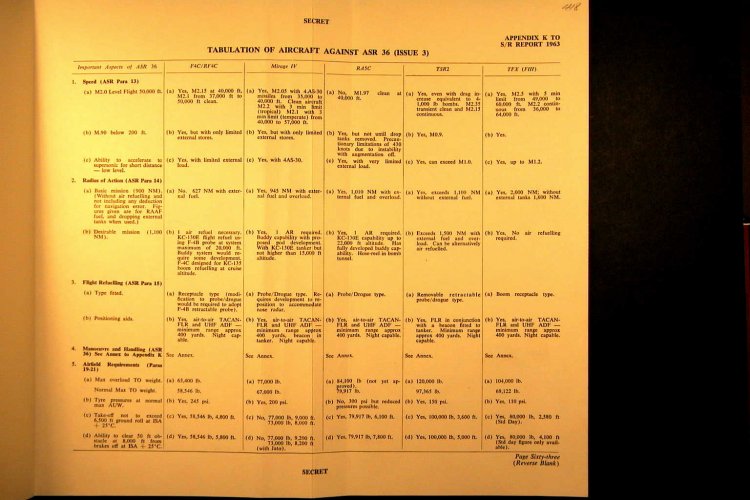
I don't know, but the Buccaneer's problem wasn't on the ground but in the air. It simply lacked the performance required by the mid 60s, performance of the A5, F4, Mirage IV and F111.

Don't get me wrong, I like the Buccaneer and would like it to have achieved greater success, but it isn't in the league of the TSR2.
The A-5 very quickly gets transitioned to recce only, the F-4 has nowhere near the range, the Mirage IV is a strategic bomber with limited tactical use and the F-111 doesn't use supersonic speeds in low level operations. Where it counts, down low, the Buccaneer is faster and longer ranged than any of those bar the F-111, and it's significantly cheaper. The P.108 proposal would have done anything TSR.2 could do except supersonic speed at altitude, and maybe the longest range missions envisioned, while being cheaper and providing much more flexibility as proved by the South Africans who used them for CAS as well as strike missions.

As a part of my defense spending initiative in the thoughts i had i have ultimately come to the conclusion of using an off the shelf engine that can provide me with all the power i coul ever need for m planes and maybe possibly save some engine technology in the process, as the Orenda company had many interesting projects i have come to the conclusion that instead of just reusing the old F-11 i have decided that if i had the opportunity i would attempt to get one F-11-1F for testing, get FIAT Aviazione to work and deisgn what i can best describe as the Fiat G-95 in conventional form, the plane would be a homegrown, effective and multirole single engine fighter with the Orenda Iroquois Engine made by Orenda first and secondly the italian nation, if the Orenda company ever goes bankrupt, the possibilities for the plane would be endless for development, it may be expensive, it maybe complicated but dammit i want it to work, alternatively i can design something after the F-11 as a new plane, in collaboration with Grumman of course
I don't think the Iroquois would work. From what I gather the G-95 is a little shorter than the F-11, and the Super-Tiger version used a J79 which is much smaller than an Iroquois. The British RB.106 was more powerful than the J79 and I think would have fit since it was supposed to be the same size as an Avon which was similar in size to a J79. It got cancelled in the late 50s, but I think that was a mistake since an engine of that size could have worked in anything the J79 did, while providing more power.
 
The A-5 very quickly gets transitioned to recce only, the F-4 has nowhere near the range, the Mirage IV is a strategic bomber with limited tactical use and the F-111 doesn't use supersonic speeds in low level operations. Where it counts, down low, the Buccaneer is faster and longer ranged than any of those bar the F-111, and it's significantly cheaper. The P.108 proposal would have done anything TSR.2 could do except supersonic speed at altitude, and maybe the longest range missions envisioned, while being cheaper and providing much more flexibility as proved by the South Africans who used them for CAS as well as strike missions.

The A5, F4, Mirage IV, TSR2 and F111 were studied by the RAAF as a Canberra replacement in late 1963, the Buccaneer and A6 were not on that list as they don't meet the stated requirements.

'Were it counts' is over the target surrounded by radars, SAMs and AA guns or being chased by a Mig, where the difference between Mach .85 and 1.05 means ~20% less exposure to the defences.
 

Attachments

  • Hancock Study.jpg
    Hancock Study.jpg
    159.2 KB · Views: 16
So let's go for an attempt at a sane DWP'57 with as few paper airplanes as possible, with regard to RAF fighters.

F.155T is cancelled as costing too much for the one thing it's designed to do. The Saunders-Roe SR.177 is made contingent on the Royal Navy buying it; but if the RN wants it, then the pre-production batch Saro has planned for will be pushed to completion and the aircraft will then have government support for international sales.

Lightning is the only game in town. However, rather than the half-measures we see in real life, this time it gets every enhancement English Electric can throw at it, as soon as those enhancements can be worked in. In addition, it will be bought in sufficient numbers to replace all Javelin squadrons. Working in a SARH illuminator for a pair of Blue Dolphins to supplement the Firestreaks, to be carried on underwing racks (because they only need to be wired, not plumbed for coolant), will be a priority. International sales will be given all possible backing. (Finding a way to get this missile onto Sea Vixens will also be prioritized.)

Red Top per se is also axed, since Blue Dolphin gives the head-on capacity, but progressive improvements to Firestreak will probably get us there in time anyway.

Hunter is retained in the ground attack/fighter-bomber role, where its heavy gun armament still gives it a chance. The complexity of wiring it for Firestreak will be admitted, and it will be given AIM-9B at the earliest opportunity.

(Supermarine is requested not to darken the Ministry's door with its shade ever again.)

A Lightning replacement with comparable performance, substantially more endurance, two seats and at least four SARH missiles is requested, with an in-service date of 1970 at the latest, to replace the Lightning. This enables future fighter development (with its associated systems) to continue, rather than abruptly cutting it off, while spreading the costs over a much longer period.

AW, Hawker, Fairey, DeHavilland and Gloster are requested to put their heads together on this, while EE develops the Lightning to its limit. When the CF-105 programme falls in a heap, the Avro Canada team will be offered jobs on this project (as direct compensation for Britain not buying the Arrow after it killed the thin-wing Javelin).
 
FWIW in September 1957, after the DWP there were 32 sqns n fighter command, 16 night and 16 day. By 1964 that was down to 7 sqns, 5 Lightning and 2 Javelin, with 2 Javelin in Germany, 1 in Cyprus and 1 in Malaysia. In the event only 9 Lightning sqns were formed rather than 11 that the 1964 Javelin numbers would suggest. There were also 9 Hunter FGA/FR sqns in 1964.

IIUC the Red Top was a rationalization of the Firestreak, as the Firestreak's layout was all over the place, eg the rocket engine was in the middle of the body and fin actuators not at the fins but driven by rods. Red Top rearranged all that to a compact and rational design and had a cheaper seeker as well. I believe the Blue Dolphin is based on the Red Top so you can't have one without the other.
 
Yes what if we could've miniaturised the slaving system into Sidewinder?
 
I believe the Blue Dolphin is based on the Red Top so you can't have one without the other.
I missed this comment earlier; sorry.

What I mean to say is: the rationalization of components as the missile evolves is inevitable, and that WILL happen. What will NOT happen when it does IRL is the 'all-aspect' IR seeker, since the SARH seeker will do that job.

Probably what we will get by the mid sixties is SARH Blue Dolphin and a Firestreak Mk 2 with rationalized internals but the same basic seeker (possibly with incremental improvements). The Red Top IR seeker might get added later, possibly in the late 1960s.

With fighter development no longer dead in this timeline, AAM development also continues; and whatever replaces the Lightning will by the early 1970s have some sort of Evolved Blue Dolphin for its SARH missile, giving way not long after to a clean-sheet redesign (probably with a monopulse seeker a la Skyflash), and Taildog for IR work.

In my scenario I wouldn't expect Lightnings to survive in service much past 1975, unless there were major issues with the replacement. All of the Blue Jay family tree will leave service with it.
 
I missed this comment earlier; sorry.

What I mean to say is: the rationalization of components as the missile evolves is inevitable, and that WILL happen. What will NOT happen when it does IRL is the 'all-aspect' IR seeker, since the SARH seeker will do that job.

Probably what we will get by the mid sixties is SARH Blue Dolphin and a Firestreak Mk 2 with rationalized internals but the same basic seeker (possibly with incremental improvements). The Red Top IR seeker might get added later, possibly in the late 1960s.

With fighter development no longer dead in this timeline, AAM development also continues; and whatever replaces the Lightning will by the early 1970s have some sort of Evolved Blue Dolphin for its SARH missile, giving way not long after to a clean-sheet redesign (probably with a monopulse seeker a la Skyflash), and Taildog for IR work.

In my scenario I wouldn't expect Lightnings to survive in service much past 1975, unless there were major issues with the replacement. All of the Blue Jay family tree will leave service with it.

I pretty much agree with this as the broad arc of AAM development. However I'd add that the Red Top seeker was not only more advanced and sensitive than Firestreak but also cheaper, so I think it would be developed rather than the Firestreak seeker retained. What would change if the CW SARH seeker was developed and used with the Red Top is calling the Red Top 'all aspect' or 'head on', those were optimistic at best. I agree that once the CW SARH Red Top goes into production the big IR missile will cease development in favour of small missiles like Taildog-SRAAM.

As for the Lightning's service life, if the TSR2 goes into production, which is the main positive outcome in my mind of going all-in with the Lightning in 1958, then there's a major opportunity for a serious mid-life update of the Lightning. The TSR2's Forward Looking-Terrain Following Radar was the final fully solid state development if the AI23 AIRPASS first fitted to the Lightning from 1959. Lightning radars could be rebuilt with TSR2 components i the early 70s to make them viable until the late 70s/early 80s when a UK led 4th Gen fighter-bomber would enter service.
 
As for the Lightning's service life, if the TSR2 goes into production, which is the main positive outcome in my mind of going all-in with the Lightning in 1958, then there's a major opportunity for a serious mid-life update of the Lightning.
If the DWP doesn't scrap all manned fighters, the timeline might diverge enough for there not to be a TSR.2. I see two possibilities:

1) The Lightning has given EE so much clout that it gets to do what it wants with the P.17, and the RAF gets the Canberra replacement it claims to want, not the Valiant replacement it actually wants. If this happens, Vickers might get told to build the Valiant B.2 after all and the P.17 TSR2 will actually enter service close to budget and close to time.

2) EE is so busy with Lightning work that it doesn't tender, and Vickers gets the gong instead.
 
Things would get very interesting if the Valiant B mk2 was built in numbers for RAFservice.....

Especially if it's getting the TSR.2 avionics fit!
 
I don't think it was a secret that the TSR2 would replace both Valiant and Canberra, the decision to assign Valiants to SACEUR was made back in 1958 or so, as the TSR2 was just being thought of.

Nor do I think the RAF would be capable of pulling the wool over a Minister's eyes in 1957-65 the way they might now. Ministers back then had vivid memories of WW2, as participants in one way or another, Sandys fought in Norway for example.

In any case replacing 2 fleets with one type is both valid and necessary, be it Valiants and Canberras or Canberras and Javelins, in order to get the largest possible production run and therefore lowest unit cost. The TSR2 covers the former and something like the P1121 could cover the latter if that was how the Brits wanted to play their cards.
 
Back
Top Bottom