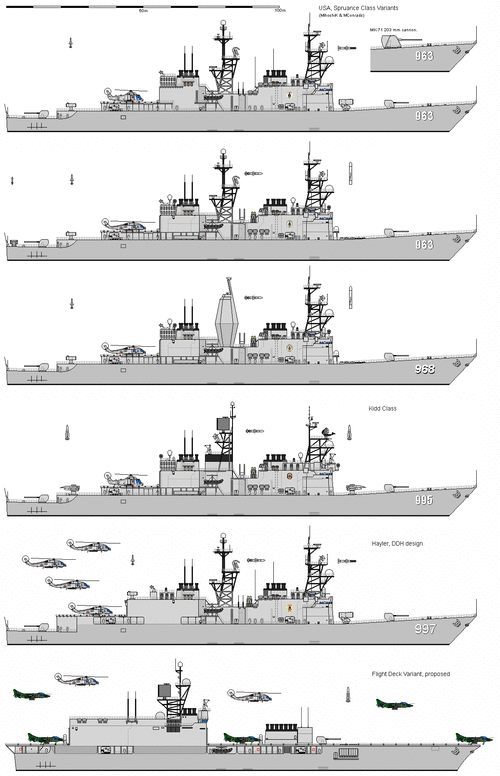
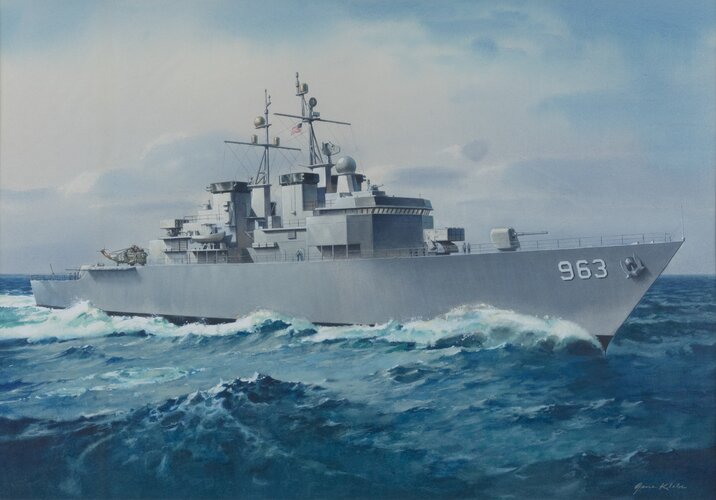
Regarding the 3 Spruance derivatives that were built: Spruance, Kidd and the Ticonderoga classes.
Which was the most capable?
Also didn't the Kidds were considered for VLS modernization?
In terms of AAW, the Ticonderogas were clearly the best. AEGIS was superior to the Tartar-D and even New Threat Upgrade on the Kids, and the Ticos had more missiles as well.
In terms of ASW, on paper all three had the same SQS-53 bow sonar and SQR-19 towed arrays. But I'd take a Spruance over a Tico for sub hunting because the crew will have taken more time to focus on the mission.
I'd also probably take the Spruance for ASuW, since I believe they were the only ships of the three with the Classic Outboard direction finding system for targeting
Likewise, the VLS modified Spruances were probably superior for strike warfare, since they would usually carry more Tomahawks.
And no, as far as I know the Kidd class was never seriously looked at for VLS retrofit by the USN. There was brief discussion of a VLS refit when they were offered to Australia, but it would have been expensive and would have included fewer missiles than the Ticos due to how the Kidds were built.
Regarding the 3 Spruance derivatives that were built: Spruance, Kidd and the Ticonderoga classes.
Which was the most capable?
Also didn't the Kidds were considered for VLS modernization?
I'd also probably take the Spruance for ASuW, since I believe they were the only ships of the three with the Classic Outboard direction finding system for targeting
The Spruance got their VLS strictly for strike warfare -- it increased their Tomahawk load out by at least a factor of 4 or so, probably more depending on how many VL ASROC were really available and needed.
A table on p23 of Electronic Greyhounds, covering Cold War Battle Force Ships and Escorts states that the designations DD-998-1003 were intended to be used by "Spruance class for convoy command".
Can anybody be tell me anymore about these ships, and whether those hull numbers were genuinely assigned, or internally used by Litton for a proposal?
Didn't the Spruance have SQS-53, NTDS, LAMPS etc which were not available on the previous generation? Or what are you refering to with the 1950's combat system?
Didn't the Spruance have SQS-53, NTDS, LAMPS etc which were not available on the previous generation? Or what are you refering to with the 1950's combat system?
NTDS was developed from the 50s onwards IIRC, but was first deployed in numbers on the Belknap class. The ASW version was tested on some destroyer escorts but the first production run of it was IIRC on the Spruances.
@A Tentative Fleet Plan, I don't believe those hull numbers were assigned, or if they were it was only DD-998 and DD-999. Else the Zumwalts would not have started with DD(G)-1000.
The "convoy command" variant sounds like it could have been built off the back of the DDH, but its possible it was just a Spruance with extra C&C spaces and equipment (maybe a taller superstructure block?). Sounds intriguing though.
A contract for the development and production of thirty ships was awarded on 23 June 1970 to a new established by Ingalls Shipbuilding Division of Litton Industries, Pascagoula, Mississippi. The entire class was contracted to a single shipyard to facilitate design and mass-production, but construction was delayed by labour and technical problems. These large destroyers were surely among the more controversial of recent US warships: they were usually described as too large and too poorly armed. In fact they were the direct consequence of an attempt to replace the mass of Second World War destroyers, which were nearing the end of their lives in the mid-1960s.
Initially, it was hoped that most of the ASW destroyers would be replaced by Knox class ocean escorts, and that the Navy would build a new class of missile destroyers to make up for the gap in such construction since the early 1960s, a gap caused largely by the failure of the Typhoon system planned for FY63 and later units. Analysis suggested, first, that it would be wise to seek maximum commonality between the ASW and missile units, and second, that although each carrier would require six escorts, only three would need anti-aircraft missile capability. In addition, Secretary McNamara strongly espoused a project system in which preliminary design would be done by a contractor.
One of the benefits of a common hull was that, if the air threat were to increase in the future, ASW ships could easily be refitted to meet it. Ultimately, relatively few ships could be ordered, none of them for air defence. However, the Spruance remained an anti-aircraft design with its missiles, radars and some of its computers never installed. To some extent, too, its large size was mandated by the requirement for 30kts in rough weather, a requirement of carrier operation.
Plans to install single lightweight 203mm/55 guns for amphibious fire support were cancelled in 1978, but the potential for major AA upgrade remains. Indeed, Iran ordered six (later reduced to four) anti-aircraft versions of the Spruance class in 1973-74. With the Iranian Revolution, they were offered for sale, and all four were purchased as the Kidd dass in July 1979, receiving DDG hull numbers in the Spruance series. As in the case of Virginia class cruisers, they have magazine stowage for 68 missiles, with two SPG-51D guidance radars plus an SPG-60. The greatly increased displacement of the Kidds is due in part to the addition of armour. A thirty-first Spruance, DD997, was authorised in FY78 with the proviso that it had increased helicopter facilities; however, she was identical to the 30 earlier ships already ordered, except for the provision of Kevlar armour and an SPS-49 air search radar. The Reagan Administration FY83-FY87 programme included three more ships of this type in FY86-FY87, out of a planned total of six. None was built.
From the navypedia site regarding the Kidd class http://navypedia.org/ships/usa/us_dd_kidd.htm...The greatly increased displacement of the Kidds is due in part to the addition of armour...
I know the Kidds have a more strongly built hull than the Spruances (by some sources a Kidd displaces more than a Tico) but this is the first time I've seen this
I know the Kidds have a more strongly built hull than the Spruances (by some sources a Kidd displaces more than a Tico) but this is the first time I've seen this
Agreed, this is the first I've heard of the Kidds having any level of armor.
Whatever refs Wiki is using, it gives the Kidds 1400 long tons greater full load displacement than the Sprucans. Which is about 200 long tons lighter than a Tico.
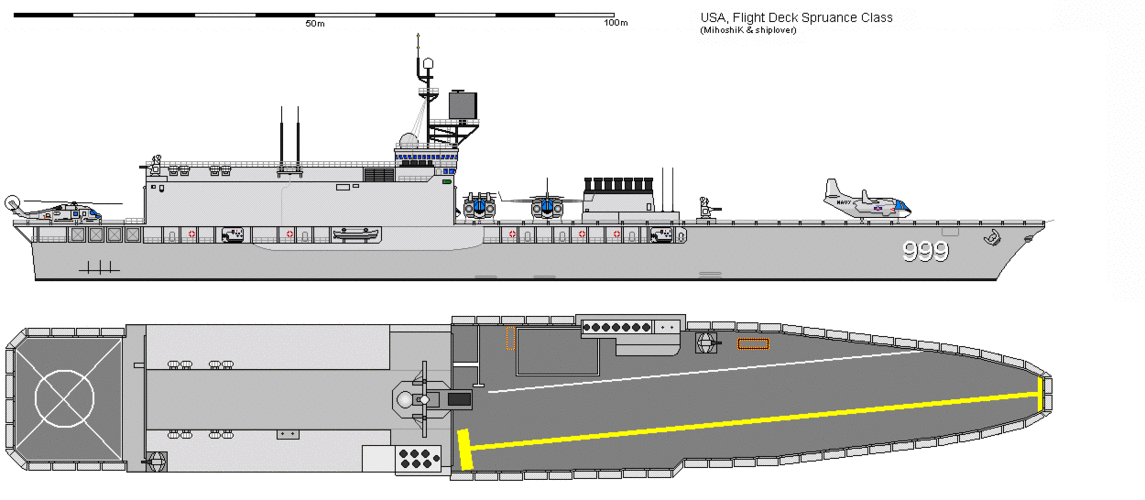
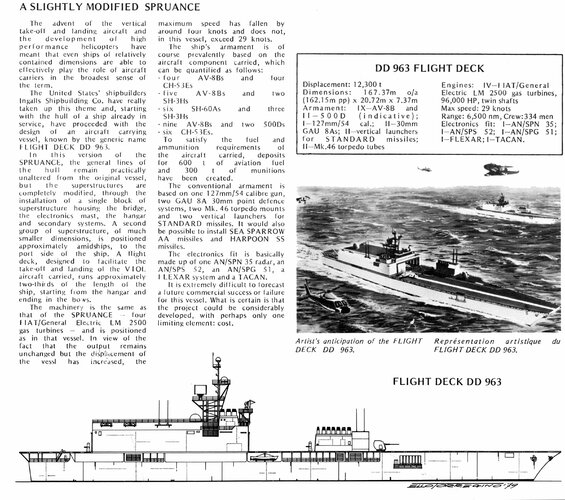
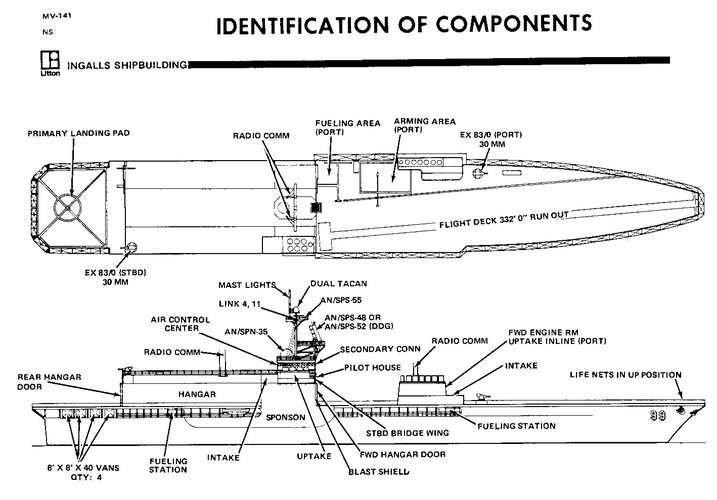
This design is 4 meters wider in beam than the standard Spruance/Kidd/Tico hull, at 20.72 meters rather than 16.8m. It did look to me as if a wider hull would be necessary for the extra weight and the flight deck.
I don't know how useful the Harriers would be, but the all ASW helicopter airgroup looks really useful. Although I'd probably go all of one type.
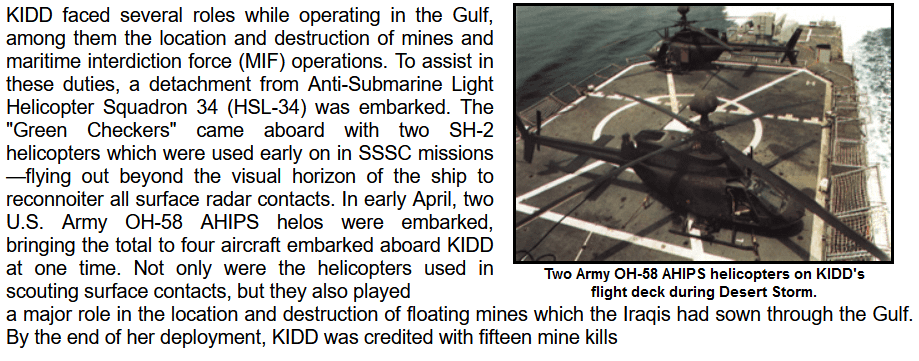
The Kidds had the same AAW fitment as the Virginias, so they were state of the art for the 70s, and they got the New Threat Upgrade. The end of the Cold War made them redundant, but NTU was pretty capable.
And no, as far as I know the Kidd class was never seriously looked at for VLS retrofit by the USN. There was brief discussion of a VLS refit when they were offered to Australia, but it would have been expensive and would have included fewer missiles than the Ticos due to how the Kidds were built.
They had a 24 missile and a 44 missile mark 26. Two 64s like the Ticos would be difficult, but I suspect you could replace them with 32 and 48 cell Mk41s more easily, and 80 vls would be more than anything that isn't a Tico or a Burke derivative. At least in the West. But I don't know what was considered for refit.
Agreed, this is the first I've heard of the Kidds having any level of armor.
Whatever refs Wiki is using, it gives the Kidds 1400 long tons greater full load displacement than the Sprucans. Which is about 200 long tons lighter than a Tico.
They had a 24 missile and a 44 missile mark 26. Two 64s like the Ticos would be difficult, but I suspect you could replace them with 32 and 48 cell Mk41s more easily, and 80 vls would be more than anything that isn't a Tico or a Burke derivative. At least in the West. But I don't know what was considered for refit.
Probably the best idea would be to give it a similar treatment as a VLS Spruance, with a forward VLS of ~48 or ~64 rounds and retain the rear Mk 26 for certain advantages it offers
Probably the best idea would be to give it a similar treatment as a VLS Spruance, with a forward VLS of ~48 or ~64 rounds and retain the rear Mk 26 for certain advantages it offers
The Spruances have the deck space for an aft vls module, but not the hull space under the deck because of what is under the gun deck aft of the helipad. There was space forward for a Mk71, so a module could be installed forward, presumably with some rearranging since the Mk71 would go where the 5" gun is.
The Kidds have different internal architecture, so putting a 64 cell module forward may not be possible. The reason I suggested 48 and 32 cell modules is because the Mk26 came in 24, 44, and 64 missile "modules", and the 64 missile module is the same size as a 64 cell Mk41 (see the modular Burke illustration in the Burke thread), so the 48 and 32 cell Mk41s should be close enough in size to the 44 and 24 missile Mk26 to fit. Step down to 32 and 16 and you I expect they would eaily fit the spaces, but you'd lose 20 missiles.
The Spruances have the deck space for an aft vls module, but not the hull space under the deck because of what is under the gun deck aft of the helipad. There was space forward for a Mk71, so a module could be installed forward, presumably with some rearranging since the Mk71 would go where the 5" gun is.
The Kidds have different internal architecture, so putting a 64 cell module forward may not be possible. The reason I suggested 48 and 32 cell modules is because the Mk26 came in 24, 44, and 64 missile "modules", and the 64 missile module is the same size as a 64 cell Mk41 (see the modular Burke illustration in the Burke thread), so the 48 and 32 cell Mk41s should be close enough in size to the 44 and 24 missile Mk26 to fit. Step down to 32 and 16 and you I expect they would eaily fit the spaces, but you'd lose 20 missiles.
The Mk 26 at the time was still the primary source of ASROC, and perhaps more importantly as the USN is deciding now, it can be reloaded at sea pretty reliably. It also has slightly greater range with SM-2 due to being able to point the missile optimally before launch, and probably has some anti-surface advantages for the same reason.
If you look at the forward Mk 26 launcher on DDG-993 and CG-47, you can see how the latter's rails are farther forward. As I understand it the greater magazine capacity in CG-47 was made at the cost of Mk 71 8" gun compatibility, expanding the forward launcher into structure that was reserved. At the time of the Spruance and Kidd that compatibility was retained but by the time of Ticonderoga it was already a lost cause. In any case I think Kidd could support the same forward 64 cell VLS that Spruance could, and if not, almost certainly the 48 cell version. Either way it would be a good leap in capability without sacrificing much.
Oh I nearly forgot. As far as a Spruance-derived helicopter destroyer goes, has this been posted yet?
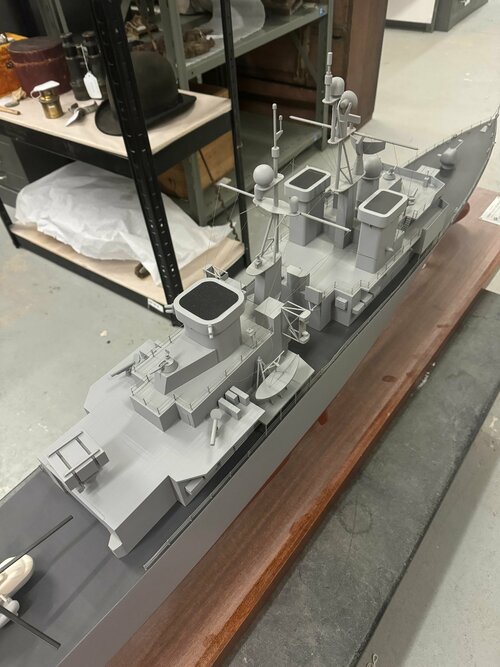
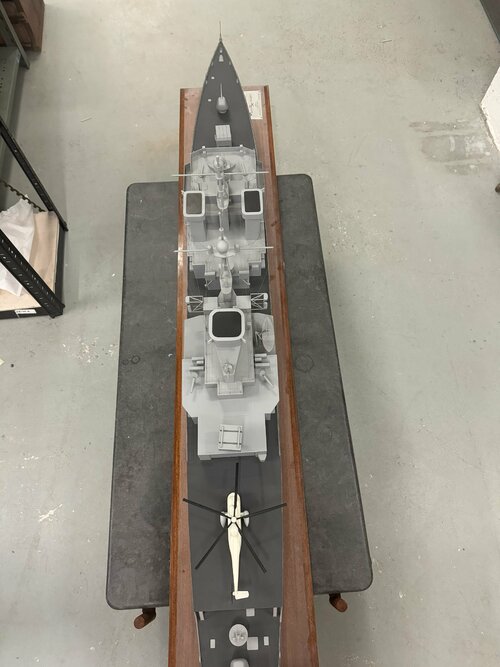
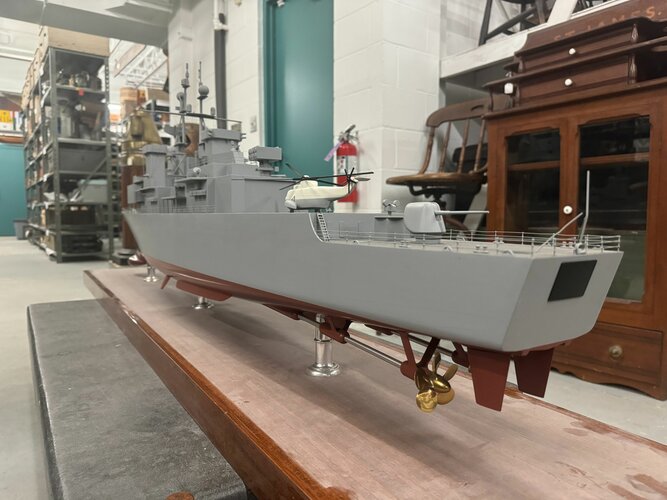
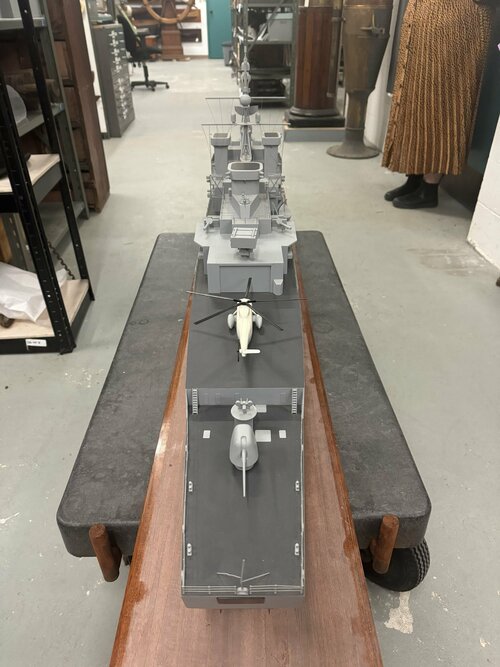
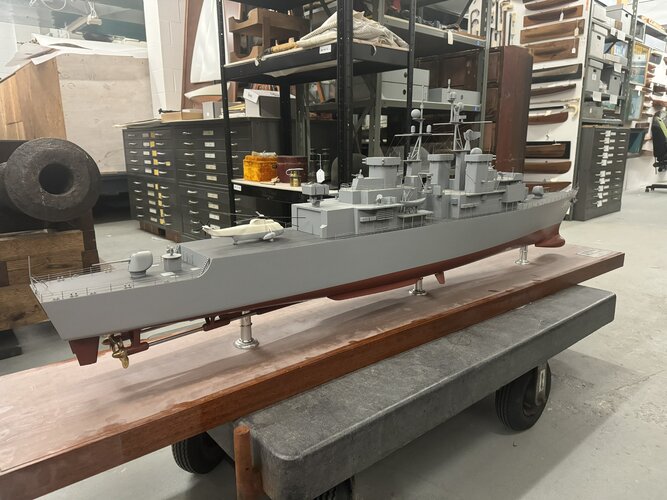
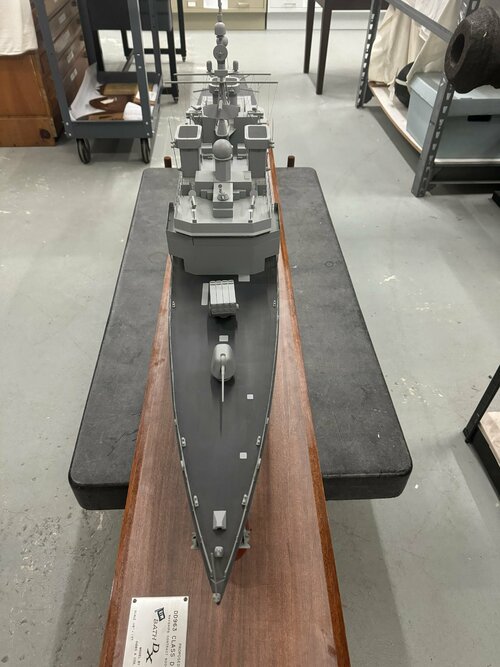
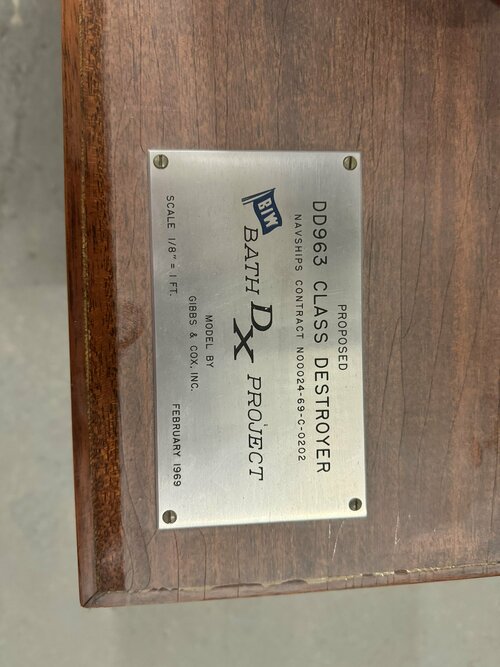
The Bath DX model ended up at the Maine Maritime Museum. I reached out to them, and they were nice enough to send photos back. Give them a visit https://www.mainemaritimemuseum.org/
Electronic Greyhounds has more info on the BIW DX submission, but I don't feel like digging it out. Ping me if you want it though.
The Bath DX model ended up at the Maine Maritime Museum. I reached out to them, and they were nice enough to send photos back. Give them a visit https://www.mainemaritimemuseum.org/
Electronic Greyhounds has more info on the BIW DX submission, but I don't feel like digging it out. Ping me if you want it though.
Just want to let you know that I saw this. I just haven't had the time to write anything, been swamped with schoolwork. Going to try and get something up later this week
Let’s first examine the origins of the Spruances, the DX program @acelanceloet , feel free to correct my inevitable mistakes. You’re the expert here.
As I understand it, the Spruances evolved out of the DX program, which was authorized sometime in the late 60s. The FY67 destroyer has fallen through because Vietnam ate all the money.
McNamara was the new SecDef, and he subscribed to the Total Package Procurement (TPP) system for defense acquisition. The DoD would identify what they needed, give requirements to the industry, and whoever won would get the whole contract. Losers get nothing.
DX was supposed to be the new ASW destroyer, but with the giant asterisk that it must be able to be converted to a AAW destroyer. This would be DXG. DXG would be a technically be a double-ended Mk26 ship, but the forward launcher would be devoted almost entirely to ASROCs.
The plan was first to procure DX hulls, then build DXGs. I want to say a roughly 30-18 mix, but don’t quote me on that. And it varied from year to year.
Three companies submitted proposals, Litton Ingalls, BIW (design by Gibbs & Cox), and General Dynamics. Litton Ingalls submitted the Spruance we all know and love, BIW submitted the above, and GD submitted a very compact design. Apparently 3 other companies submitted designs, but I can’t figure out who they were.
Litton ended up winning, because they offered a better contract, and had the industry and salesmanship to close the deal. Electronic Greyhounds describes it as Litton offering a "better vision for the future." I get the impression they were leading Navy on, as demonstrated by Spruance production.
Anothe reason I suspect BIW lost, the Litton design would make a superior DXG. When the DXG program was canceled, they had created provisions for the aft Mk26 launcher to come at the expense of either the aft gun or helipad. The Litton design could keep both systems, simply replacing the Mk29. Meanwhile, you clearly can't do that with the BIW design.
Also to clear up any potential confusion, Kidds are Spruance AAW conversions, not DXG.
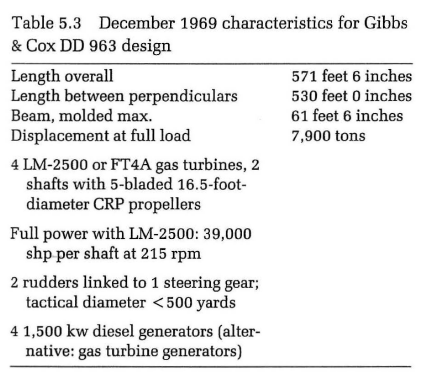
Electronic Greyhounds lists the following specifications for the BIW design:
The book also remarks that the BIW design would've been a better candidate for Aegis conversion, as it offered a wider beam.
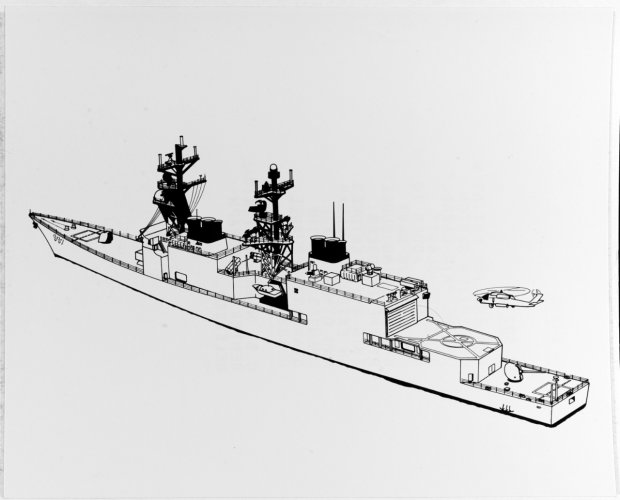
This is a reproduction (photo) of a pen and ink artist's conception of DDH-997 as an air capable destroyer that was donated to Naval History and Heritage Command by S.L. Morison in February 1978. Catalogue number is NH 86356. The Naval History and Heritage Command website has a larger TIFF version available for download on their website as well. https://www.history.navy.mil/our-co.../nhhc-series/nh-series/NH-86000/NH-86356.html
Presuming the artist's conception is relatively accurate the configuration makes me wonder if some of the aircraft were intended to be stowed nose to tail since the hangar does not appear to take up the full width of the superstructure (though the door does appear to be somewhat wider then on a standard Spruance class). That makes me wonder if the design would be able to rotate which airframes were in use very efficiently during operations.
This is a reproduction (photo) of a pen and ink artist's conception of DDH-997 as an air capable destroyer that was donated to Naval History and Heritage Command by S.L. Morison in February 1978. Catalogue number is NH 86356. The Naval History and Heritage Command website has a larger TIFF version available for download on their website as well. https://www.history.navy.mil/our-co.../nhhc-series/nh-series/NH-86000/NH-86356.html
Presuming the artist's conception is relatively accurate the configuration makes me wonder if some of the aircraft were intended to be stowed nose to tail since the hangar does not appear to take up the full width of the superstructure (though the door does appear to be somewhat wider then on a standard Spruance class). That makes me wonder if the design would be able to rotate which airframes were in use very efficiently during operations.
Yes, definitely. That space to the starboard side of the hangar deckhouse included the elevator for moving Sea Sparrow to the hangar roof for reloading the Mk 29, a generator uptake, and the flight control station.
With four LAMPs, the hangar would almost certainly have held them in a 2x2 configuration. Switching the door to a roll-up instead of slide open made the whole hangar width accessible so you could shuffle the helos by pushing one or even two out onto the flight deck, then moving the forward set to one side like a sliding tile puzzle. Probably at least one helo would be in deeper maintenance at any given time anyway. The most likely operating scheme would be to run one pair alternating until they broke, then swap one or both of the other pair that were being held in reserve.
The drawing omits RAST, which would make that shuffling harder; the final product would have needed it, but it may have interfered with the supply strikedown elevator that now opens onto the flight deck.
Electronic Greyhounds notes a subtle problem here. The preferred UNREP kingpost on the Spruance was aft of the flight deck, allowing simultaneous use of both. In the DDH version, it's ON the flight deck, which means no simultaneous UNREP and VERTREP or other helo ops.
Thanks for the info @TomS. Your post prompted me to look into Electronic Greyhounds and it turns out my library has a copy. Skipping ahead to the chapter on the Kidds does prompt me to nitpick one of your previous posts in this thread though (sorry!). You posted that the Spruances, Kidds, and Ticos all had the same SQS-53 bow sonar and SQR-19 towed array. However the book indicates that the heavy armament of the Kidds prevented installation of the long range surveillance equipment planned for the Spruances, "in particular towed array sonars and the Outboard communications intelligence system." Though interestingly the Ticos did manage to mount the SQR-19. The book also indicated the Kidds would not have their SQS-53 upgraded to C standard though I'm guessing that was more because of budget then technical feasability.
Getting back to the DDH variant that does make me wonder if it might also have been unable to mount the regular Spruance's surveillance equipment. Not being able to mount Outboard would probably not be such a big issue since not every Spruance had it but if it wasn't able to accomodate SQR-19 that would be a much more serious limitation since it could detect contacts for the helicopters to investigate.
Regarding the helicopters themselves, the two SH-3s option seems interesting since LAMPS didn't get dipping sonar until the MH-60R variant that entered service in 2006. I also wonder if it might have been possible to carry three or four Sea Kings if the rear gun was sacrificed though the stowage arrangement might be less the ideal.
The standard convention for propulsion plant numbering is even port, odd starboard. Thus #1 main engine would drive the starboard shaft and #2 the port. In a ship with 2 shafts and unit machinery spaces, thus it has been customary to have the starboard plant forward and port plant aft, so that you have #1A/1B boiler, #1 turbine, #1 MRG, etc. in #1 mainspace/#1 engine room/#1 fireroom, etc. Consequently, while I have not seen documentation, when originally designed Spruance very likely followed this convention, and if uptakes were offset this would put the fwd uptake to stbd and aft to port. However, as pointed out earlier, later in design it was realized that carriers generally operate with wind fine on the port bow to align with the deck, however this would be exactly the opposite of optimal on DD-963 with a port aft stack and helo pad aft of the uptakes. Flip flopping the plant arrangement improves this. However this results in one of the oddities of the 963/993/47 class ships - the propulsion plant numbering is all messed up. #1 main space contains #1 gas turbine generator, switchboard and various other items, but simultaneously #2 main engines, MRG, lube oil and fuel oil system, etc. This causes some degree of confusion.
Probably the best idea would be to give it a similar treatment as a VLS Spruance, with a forward VLS of ~48 or ~64 rounds and retain the rear Mk 26 for certain advantages it offers
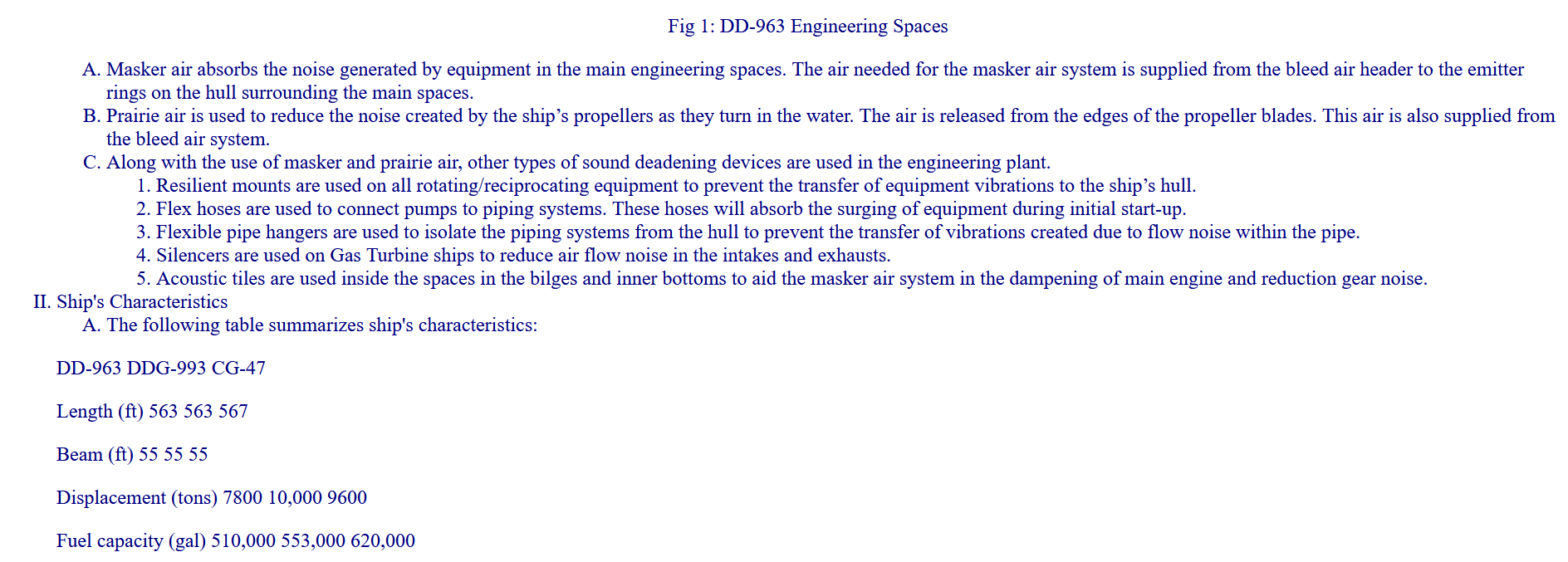
I would not put much faith in that as a reference. It looks like a informal study sheet rather than official data. 993/47 are certainly heavier ships than 963 owing to the much greater weapon outfit, but given that CG-47 is for all intents and purposes DDG-993 with more stuff stuck on, there's no logical reason they would be lighter. As an indicator, note that CG-47 has bow bulwarks whereas 993 doesn't.
NHHC has CG-47 at 9,600 tons, 993 at 9,300 and 963 at 7,800.
You posted that the Spruances, Kidds, and Ticos all had the same SQS-53 bow sonar and SQR-19 towed array. However the book indicates that the heavy armament of the Kidds prevented installation of the long range surveillance equipment planned for the Spruances, "in particular towed array sonars and the Outboard communications intelligence system." Though interestingly the Ticos did manage to mount the SQR-19.
Brain fart on that one. I'd forgotten that omission from the Kidds. I do know it was considered, and not totally convinced weight was the deciding factor. Another sneaky factor may have been manning, since Outboard needed about 18 people to operate and a secure space for them to work in, since its output was very sensitive.
The Ticos did get TACTASS but it took a fair bit of work. As Electronic Greyhounds discusses, the Ticos had to have a watertight opening at the transom for the sonar, where the original Spruance design did not. There are also a lot of little tweaks to the Spruance design that allow the Ticos to be substantially heavier without a notable change in dimensions.
Despite the reference to "heavy armament" I was definitely wondering if it might be more of a space issue then a weight issue. Though the book also mentions the Kidds being even heavier then the Ticos. I don't think there was any mention of center of gravity issues though which suggests they had less issues with weight up high.
Norman Polmar's Tails For Warships article does mention SQR-19 being considered for the Kidds. Not really sure whether the plan encountered space/weight difficulties as the phrasing in Electronic Greyhounds seems to suggest or whether it was more of a budget thing. Though as far as I know the rear Mk 26 magazines on the Kidds were the same size as the ones on the Ticos which did get SQR-19.
Obviously Sikorsky eventually won LAMPS III with the Seahawk, but as noted elsewhere on this forum they had considered a variant of Westland's Lynx for an earlier version of LAMPS. I find myself wondering whether the hangar of the DDH configuration proposed for Hayler would have had enough space to fit two Sea Kings and two Lynx since the folded length of a Sea King and a Lynx put together seems to be similar to that of two folded Seahawks placed nose to tail. I guess it would depend whether the hangar was wide enough for two Sea Kings side by side or whether it required them to be stored in a staggered manner.
Of course having two seperate types of helicopters on the same destroyer would complicate maintenance.
Obviously Sikorsky eventually won LAMPS III with the Seahawk, but as noted elsewhere on this forum they had considered a variant of Westland's Lynx for an earlier version of LAMPS. I find myself wondering whether the hangar of the DDH configuration proposed for Hayler would have had enough space to fit two Sea Kings and two Lynx since the folded length of a Sea King and a Lynx put together seems to be similar to that of two folded Seahawks placed nose to tail. I guess it would depend whether the hangar was wide enough for two Sea Kings side by side or whether it required them to be stored in a staggered manner.
Of course having two seperate types of helicopters on the same destroyer would complicate maintenance.
Given that the SH-60B didn't have dipping sonar I suspect the proposed LAMPS Sea Lynx would not have either though my understanding is that French Navy Lynx helicopters did carry both a search radar and dipping sonar. Given the usefulness of dipping sonar its interesting that it took til the MH-60R for LAMPS though of course LAMPS was supposed to be a multirole helicopter not strictly an ASW machine.
Anyway the Sea King Lynx combo is probably a questionable idea. Though imagining possible air group compositions has me really wishing I knew what the hangar dimensions of the DDH-997 proposal actually were. Electronic Greyhounds indicates 40 feet longer then a standard Spruance IIRC though I'm not sure what dimensions of a standard Spruance hangar were either.
Granted its not just about hangar volume either. I'm not sure the deck would be capable of handling something as heavy as a MH-53 even if the hangar had sufficient volume theoretically fit one.
Given that the SH-60B didn't have dipping sonar I suspect the proposed LAMPS Sea Lynx would not have either though my understanding is that French Navy Lynx helicopters did carry both a search radar and dipping sonar. Given the usefulness of dipping sonar its interesting that it took til the MH-60R for LAMPS though of course LAMPS was supposed to be a multirole helicopter not strictly an ASW machine.
Anyway the Sea King Lynx combo is probably a questionable idea. Though imagining possible air group compositions has me really wishing I knew what the hangar dimensions of the DDH-997 proposal actually were. Electronic Greyhounds indicates 40 feet longer then a standard Spruance IIRC though I'm not sure what dimensions of a standard Spruance hangar were either.
Granted its not just about hangar volume either. I'm not sure the deck would be capable of handling something as heavy as a MH-53 even if the hangar had sufficient volume theoretically fit one.
The trimaran LCS flight deck is tough enough to handle an H53 (someone was smart, "if the deck is physically large enough to hold an H-53, at some point someone is going to try to land an H-53 on it"), I'd assume that such a realization would happen for a Sprucan DDH.
The SH-60F was a Sea King replacement rather then part of LAMPS though? Although Sea Kings sometimes operated from Spruance class ships so SH-60Fs probably did as well. I'm not sure the SH-60F had Hawklink like the SH-60Bs though. They don't appear to have surface search radar either.
I guess with LAMPS and Sea King having differently capabilities (search radar vs dipping sonar) having both Sea Kings and a LAMPS Lynx aboard could make sense. I do wonder if moving/accessing the aircraft could be an issue with two of both types though one Sea King and two Lynx would probably be easier.
The trimaran LCS flight deck is tough enough to handle an H53 (someone was smart, "if the deck is physically large enough to hold an H-53, at some point someone is going to try to land an H-53 on it"), I'd assume that such a realization would happen for a Sprucan DDH.
With proper deck treatment it also might be possible to operate a Harrier for scouting sort of like how old cruisers would carry a float plane for that purpose. Though I suspect the wingspan would lead to either it blocking the helicopters or the helicopters blocking it. Older model Harriers had a shorter wingspan but even then I'm sceptical that the hangar would be wide enough to get the helicopters past it/it past the helicopters.
This site uses cookies to help personalise content, tailor your experience and to keep you logged in if you register.
By continuing to use this site, you are consenting to our use of cookies.