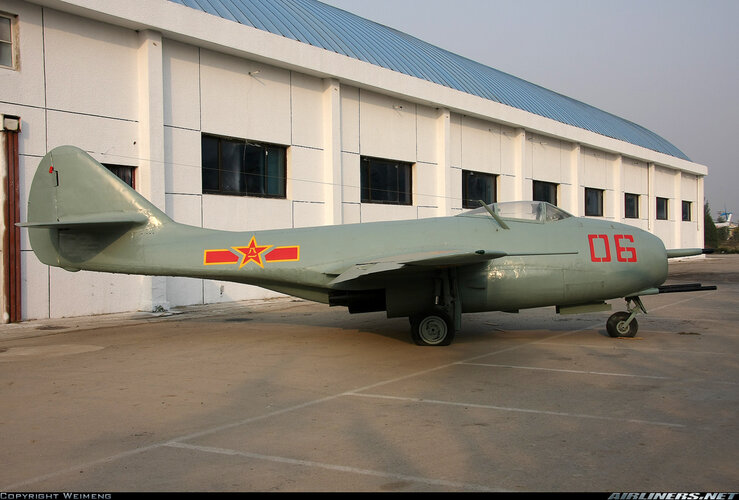
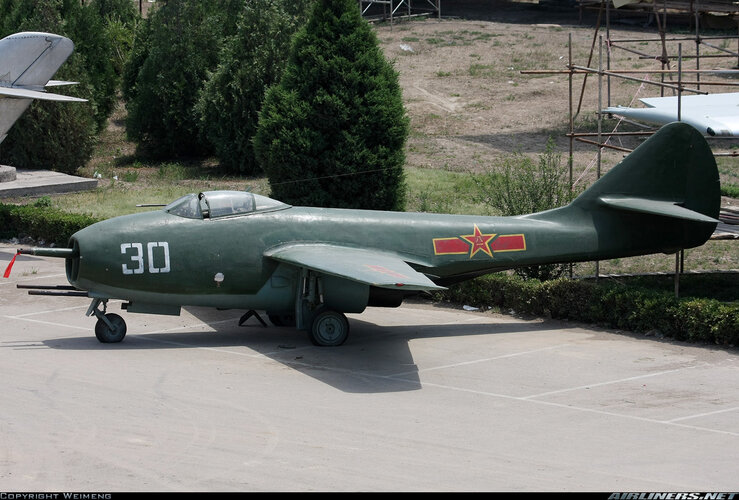
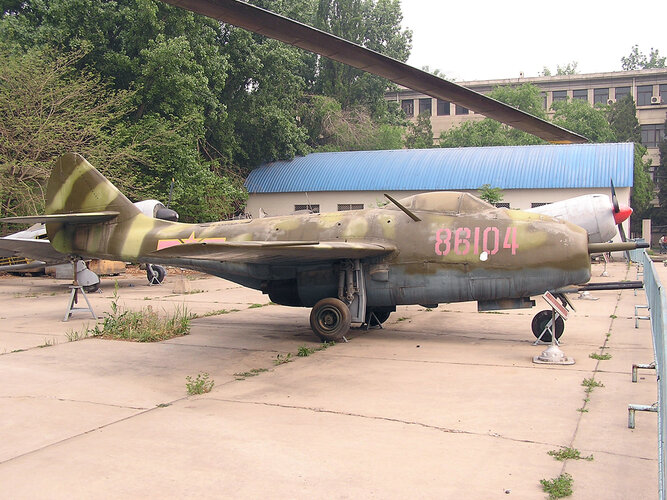
The early MiG's in China - MiG-9, MiG-15 and MiG-15UTI

Deino

Moderator
Staff member
Top Contributor
Senior Member
Joined
2 January 2006
Messages
4,251
Reaction score
8,373
Deino once again with a silly or maybe even stupid question … this time regarding on old type (in fact not my personal darling … I don’t like these old-barrel-type fighters!), the MiG-15 and MiG-15UTI in China.


Fact is that that in early 1950, with China entering the war in Koreas, MANY MiG-15 were delivered via the SU to the PLAAF.

Fact is also that in line with the build-up of a modern aircraft industry under the guidance of Soviet experts, the SU sent several (some say 847 !!) MiG-15 engineers and specialists to China to begin construction of the fighters by October of 1951. However no MiG-15 or MiG-15bis was ever manufactured in China since this agreement was changed to the MiG-17 (aka J-5).

- The still mysterious question therefore remains – in my opinion it is only some kind of Western invention or misinformation which over the years became FACT ... also take a look at several - esp. Russian - web-sites, Yefim Gordon's books on Chinese military aviation ... and not to mention wikipedia ! – why is the MiG-15/MiG-15bis called J-2 ??

- And then, since the Chinese aircraft industry / Shenyang built the MiG-15UTI trainer versions … is this really called JJ-2 ?? Again there are many contradicting reports on that !

- Besides that … are there any information available about the numbers of MiG-15 delivered and esp. the number of each version ??


My problem is, that no actual numbers are available and if/when the MiG-15UTI was really built in China, … then most likely a JJ-designation was plausible/possible.

As such a theory could be that following the canceled JJ-1 from Shenyang, most observers thought the "successor" (which the MiG-15UTI never was) would be most likely the JJ-2 ... and as such - esp. with nearly no knowing about anything in China at that time - the fighter itself should be the J-2.


Just an idea ...


Thanks in advance,
Deino
 
Re: The MiG-15 and MiG-15UTI in China

No-one ?? ???

At least via the Key-forum I received two answers via "Pinko":

There is one saying that Chinese start the designation of their 1st indigenously made plane in its class with “ 5” : to be H-5: 1st gen of bomber in PLAAF service or Q-5, 1st attacker , Z-5 the 1st helicopter or Y-5 and J-5 the 1st fighter. Because 5 pronounced in Chinese is close to the meaning of “None” in Chinese, which means everything starts from “none”. A belief 1st documented some near 3 thousand years ago by an ancient Chinese philosopher-Lao Tzu. Modern physician Niels Bohr certainly adopted this thought when he found his “model of atom” comes to the dead end, and he refered to the Lao tzu's thought as the last explanation .

To the other Q, Chinese just modified the existing Mig-15 to trainer themselves but not made them so it there no У ΜиГ-15 trainer made in China.

One saying is there are total up to 1460 Mig-15s imported from/given by USSR to China in 1950s. no one is made in China, because the starting licensed copy is Mig-17, which is designated J-5 and made in China.


... so at least one part of the puzzle ... ;D

Deino
 
Hey guys … with the help of some very nice guys from Germany I found out the following information:

• About 250 MiG-9 were delivered beginning from November 1950 on from ex-VVS-stocks
• First units were the 16. and 17. Fighter Regiments within the 6. Division at Anshan, Liaoning (Nov. 1950), the 19. and 21. Regiments within the 7. Division at Dongfeng Xian, Jilin (December 1950) and finally the 34. and 36. Regiments within the 12. Division (also December 1950)
• Quite interesting, they were operational only about 4 weeks later than the first MiG-15 unit (reportedly the 10. Regiment / 4. Division at Liaoyang, Liaoning)
• At least by 1956 all MiG-9 in fighter units were replaced by MiG-15

Maybe with some additional help we find out more ….

Deino ;D
 
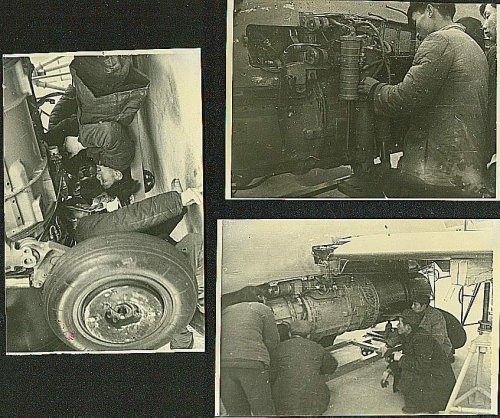
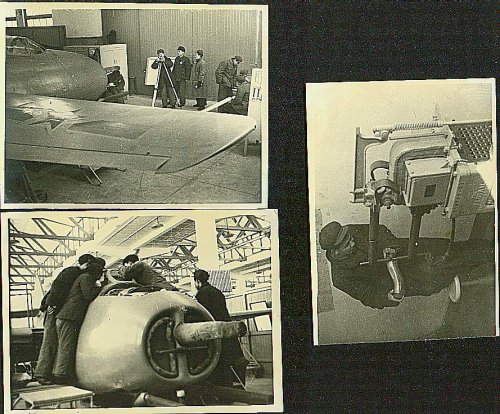
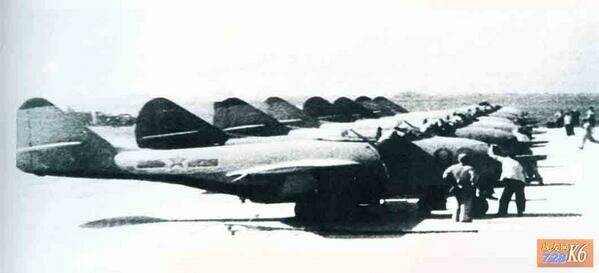
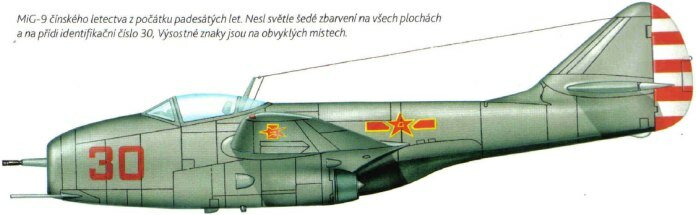
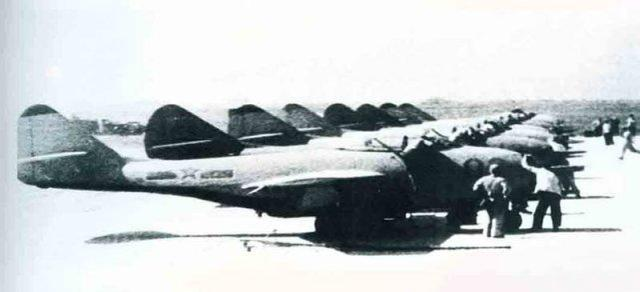
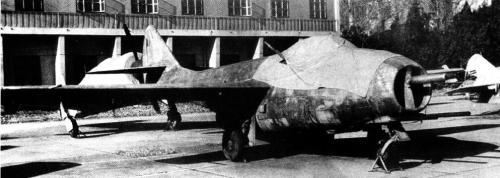
I just found these rare photos of Mig-9 in PLAAF colors. My sources state that the Mig9s were originally delivered to China in overall bare metal (as with Mig-15s) but were painted a whitish cream overall with light blue undersides. After one year the Mig9s were painted overall dull green with light blue undersides. Any information or photos welcome. These photos appear to be training photos and clearly show the Migs in a semi gloss overall gray. Thank you
 
I just found these rare photos of MiG-9 in PLAAF colors. My sources state that the MiG-9s were originally delivered to China in overall bare metal (as with MiG-15s) but were painted a whitish cream overall with light blue undersides. After one year the MiG-9s were painted overall dull green with light blue undersides. Any information or photos welcome. These photos appear to be training photos and clearly show the Migs in a semi gloss overall gray. Thank you
Which photos are you talking about ?
 
I mean, after a search on the web, I located this site and the above photos of PLAAF Mig-9s. I don't know where the poster found them in 2010 but they are extremely rare and a great help to aviation history.
 
These are some materials I found on Chinese websites.

Soviet Red Eagles Over Guangzhou: The MiG-9 Fighter Division of Colonel Pankratov

Author: Zhonghua Yingying (Eagle Striking Firmament)

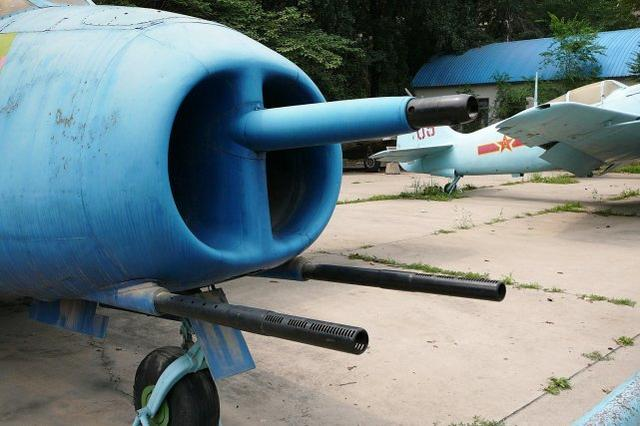
On January 1, 1951, Marshal Ye Jianying (叶剑英) presided over a grand review for cadets enlisting in the War of Resisting U.S. Aggression and Aiding Korea at Yuexiushan Stadium (越秀山体育场). As the ceremony unfolded, a formation of jet fighters with trident-shaped autocannon armament mounted on their noses roared across the sky. These MiG-9 fighters were flown by aircrews of the Soviet Air Force’s Pankratov Division.

After extensive research and verification by the author, the so-called Pankratov Division officially bore the designation of the 56th Air Defense Fighter Aviation Division of the Soviet Air Force. Its subordinate units were the 70th Fighter Aviation Regiment and the 172nd Fighter Aviation Regiment, commanded by Division Commander Pankratov .

Shortly before the Chinese People’s Volunteers crossed the Yalu River on October 19, 1950, the United States threatened aerial strikes against China’s major cities. In response, the Soviet government dispatched MiG-9-equipped fighter units exclusively for China’s urban air defense, while newer MiG-15 units were tasked with providing direct air cover for the Volunteers fighting in Korea.

Accordingly, the 56th Air Defense Fighter Aviation Division of the Soviet Air Force was formed in Azerbaijan between October and November 1950. It moved to Guangzhou in late November, initially tasked solely with local air defense patrols.

As both Chinese and Soviet observers realized the United States dared not bomb China’s key cities for fear of triggering World War III, the Soviet MiG-9 interceptor division gradually shifted its core mission to training Chinese pilots. After all, the skies of China ought to be guarded by the Chinese people themselves.

On May 5, 1951, the 18th Air Division of the Air Force under the Central South Military Area Command of the PLA was formally established at Guangzhou Baiyun Airport (广州白云机场).

Though the trident-style gun array on the MiG-9’s nose cut an imposing figure, this aircraft represented an early, immature generation of Soviet jet fighters. Its flight performance lagged behind contemporary U.S. jet fighters such as the F-80 Shooting Star. Worse, gunfire from its nose cannons would generate heavy smoke that could be ingested by the air intake, frequently triggering engine flameouts, rendering its actual combat reliability questionable.

The Soviet Union halted MiG-9 production after manufacturing only 598 airframes to shift mass production to the superior MiG-15. Nevertheless, when China placed its first large order for jet interceptors, the USSR pushed through a consignment of 372 MiG-9s, accounting for a staggering 62 percent of the total order volume.

Chinese Air Force personnel voiced widespread frustration over this deal, which many viewed as a misleading bargain imposed by Stalin. Dissatisfaction deepened sharply after the 4th Air Division gained frontline combat experience flying MiG-15s against U.S. F-84 Thunderjets in early 1951. Liu Yalou (刘亚楼), Commander of the PLA Air Force, frankly told Soviet military advisors that the MiG-9 could not hold its own even against the F-84.

In truth, MiG-15 pilots already faced stiff odds engaging bomb-laden F-84s, which shed significant weight and drag after releasing ordnance — the MiG-9 stood even less chance in such matchups.

Faced with China’s strong complaints, Stalin issued an official apology in late May 1951. He agreed to replace all 372 MiG-9s in the contract with an equal number of MiG-15s. The original contract payment remained unchanged, and additional shipping fees for the MiG-15s were levied separately. The MiG-9 interceptors already delivered to China were retained domestically for pilot conversion training.

For instructional purposes, the MiG-9 proved serviceable: pilots who mastered the MiG-9 transitioned far more smoothly to the MiG-15 platform.

On June 23, 1951, the 18th Air Division took delivery of 62 MiG-9 fighters handed over by the Pankratov Division. By early July, the unit received 51 MiG-15s. Soviet instructors from the Pankratov Division provided one-on-one technical coaching for Chinese air and ground crews.

Following four months of flight conversion training, the 18th Air Division’s MiG-15 detachments officially assumed full-time air defense duty over the Guangzhou region in late November 1951.

Meanwhile, the Soviet “Red Eagles” stationed over Guangzhou redeployed to Wangjiadun Airport (王家墩机场) in Hankou to train pilots of the 19th Air Division on MiG-9 operations. They only returned to the Soviet Union in late February 1952, once the 19th Air Division had fully qualified to take over Wuhan’s air defense missions.

A lesser-known source of local pride for Guangzhou residents is the story of Li Kang (李康), one of the pilots who flew over the city during the 1951 New Year parade. In July 1952, he returned to his hometown of Guangzhou when the 19th Air Division transferred to Baiyun Airport, serving as Acting Ordnance Chief of a flying regiment. During his tenure, he invented a rapid ammunition unloading procedure for the MiG-9, cutting the required time from 40 minutes down to just 10 minutes. This innovation drastically improved the aircraft’s turnaround rate for repeated sorties, winning great honor for the people of Guangzhou.

This article was originally published under the account “Eagle Striking Firmament” on December 5, 2018. 0eae0380e93384a8d081a422cb92d7ff.png bd60c91a0a15a0af3252b325c1f3aea7.png 9513111896c704e7608cc5b207555b18.png
 

Similar threads

Back
Top Bottom