

You are using an out of date browser. It may not display this or other websites correctly.
You should upgrade or use an alternative browser.
You should upgrade or use an alternative browser.
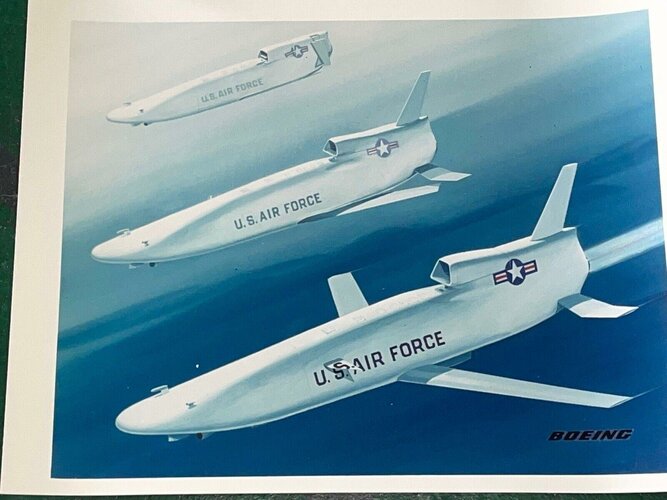
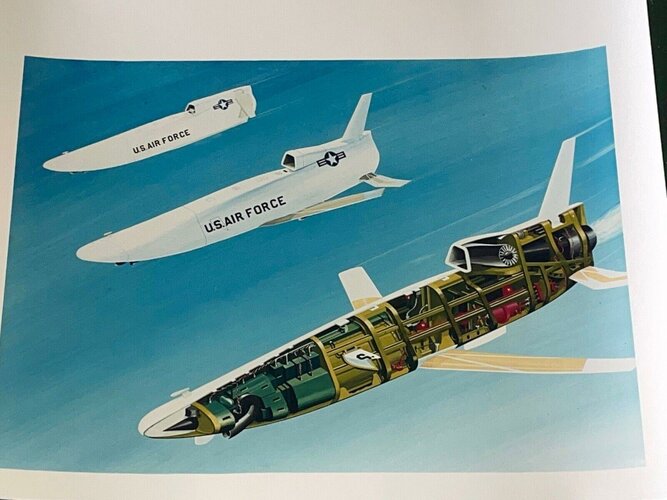
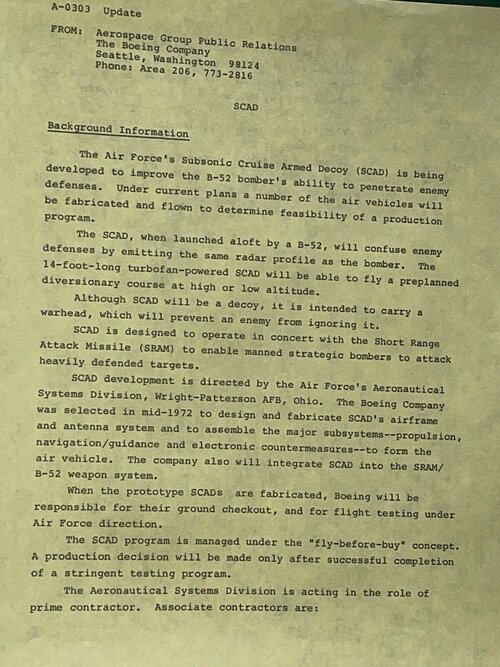
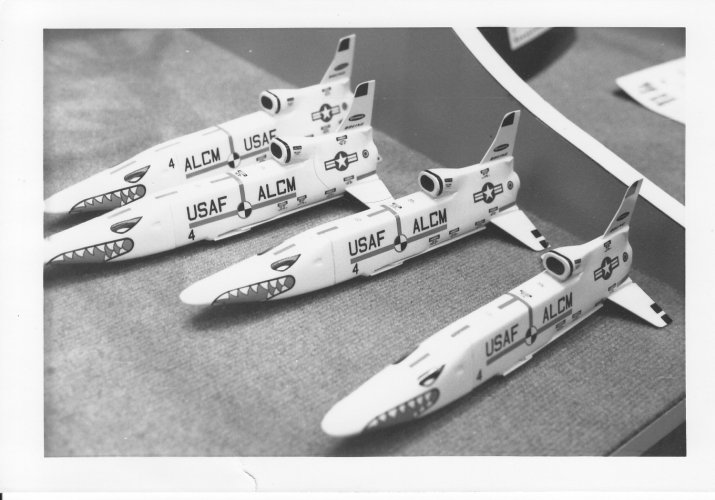
Early SCAD / ALCM studies to the ZAGM-86A
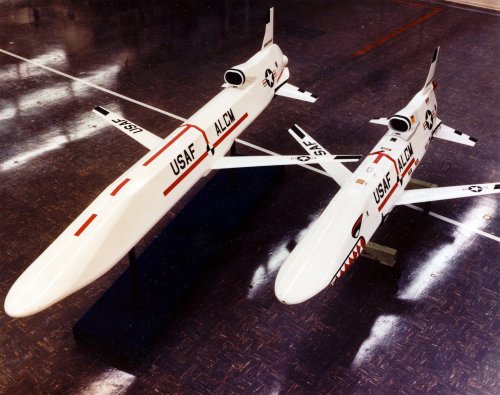
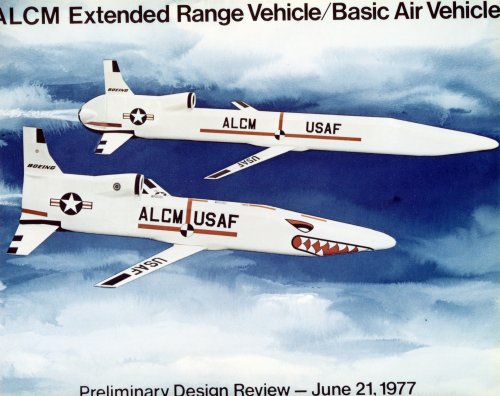
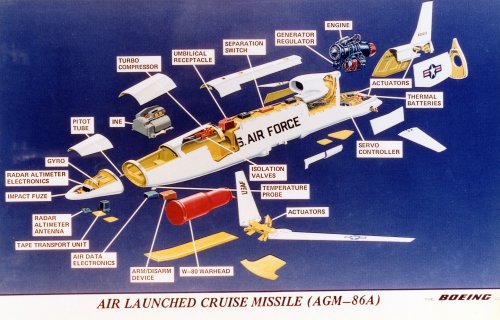
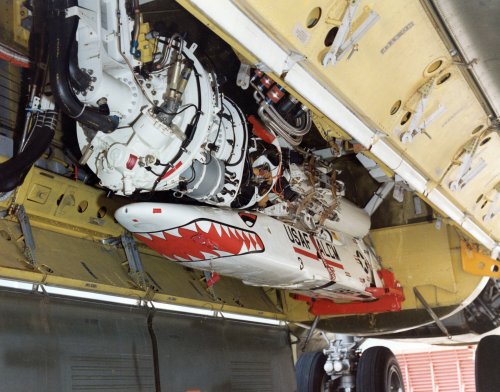
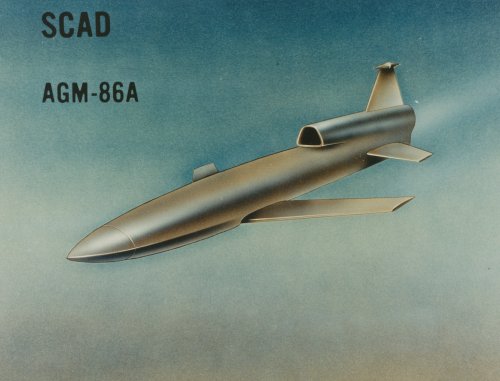
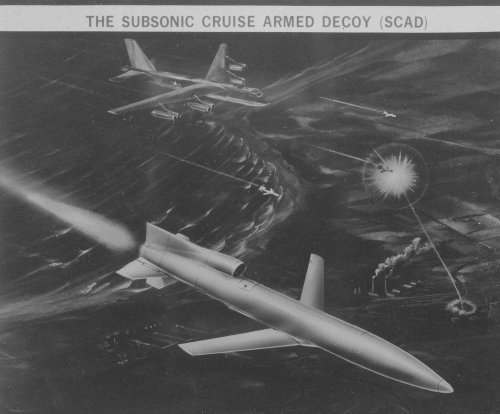
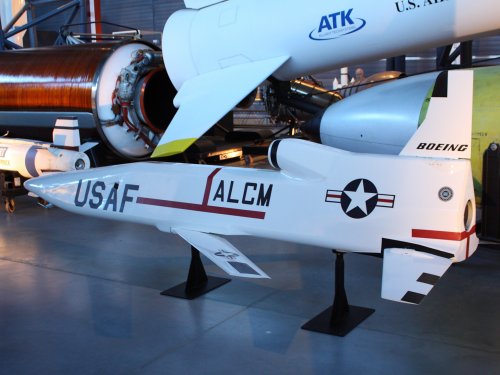

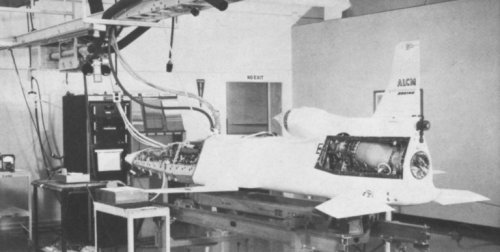
AGM-86A ALCM (Air Launched Cruise Missile) undergoing final pre-delivery tests at the Boeing plant.
Source:http://www.ausairpower.net/TE-Cruise-Missiles-1985.html
Source:http://www.ausairpower.net/TE-Cruise-Missiles-1985.html
Attachments

Grey Havoc
ACCESS: USAP
- Joined
- 9 October 2009
- Messages
- 24,500
- Reaction score
- 18,175
A 1974 AFIT thesis called "The In-House Management Approach: An Analysis of the Subsonic Cruise Armed Decoy Program". (DTIC link)
apparition13
I really should change my personal text
- Joined
- 27 January 2017
- Messages
- 760
- Reaction score
- 1,397
Just a quick note on the AGM-86A from Goetz's "A technical history of america's nuclear weapons: volume II - developments from 1960 through 2020 - second edition":
Length: 167.25 inches, (13'11.25", 4.24 meters)
Wingspan: 115 inches at 35 degrees,
Weight: 2082 pounds,
Speed: Mach 0.65-0.85,
Range: 650nm
They were about the same size as SRAM, so the B-1 could carry up to 24 of them internally.
I was looking for range, and couldn't find it online when I remembered I had the book. No index, which made it more difficult, but a useful book nonetheless.
That's a size and weight that would have made them tactical aircraft friendly. I'd say they would be better than a B-61 for attacking tactical targets, as would the SRAM 2, the intended replacement for the B-61. The warhead was around 300lbs, so substituting a conventional munition wouldn't yield much bang, but range could be sacrificed for payload.
Length: 167.25 inches, (13'11.25", 4.24 meters)
Wingspan: 115 inches at 35 degrees,
Weight: 2082 pounds,
Speed: Mach 0.65-0.85,
Range: 650nm
They were about the same size as SRAM, so the B-1 could carry up to 24 of them internally.
I was looking for range, and couldn't find it online when I remembered I had the book. No index, which made it more difficult, but a useful book nonetheless.
That's a size and weight that would have made them tactical aircraft friendly. I'd say they would be better than a B-61 for attacking tactical targets, as would the SRAM 2, the intended replacement for the B-61. The warhead was around 300lbs, so substituting a conventional munition wouldn't yield much bang, but range could be sacrificed for payload.
Last edited:
- Joined
- 5 May 2007
- Messages
- 2,018
- Reaction score
- 4,280
The original AGM-86A was a really interesting concept to be used by penetrating bombers, allowing them to attack multiple targets off their flight path and acting as an armed decoy. The later B version was really an alternative concept looking to avoid penetration entirely, less adaptable to alternative applications but a response to the political-military concerns of the time around penetrating bombers.That's a size and weight that would have made them tactical aircraft friendly. I'd say they would be better than a B-61 for attacking tactical targets, as would the SRAM 2, the intended replacement for the B-61. The warhead was around 300lbs, so substituting a conventional munition wouldn't yield much bang, but range could be sacrificed for payload.


- Joined
- 27 December 2005
- Messages
- 19,230
- Reaction score
- 35,692
In-house ASD (Wright Patterson) ALCM study.

Splendid Vision, Unswerving Purpose: Developing Air Power for the United States Air Force During the First Century of Powered Flight
2002
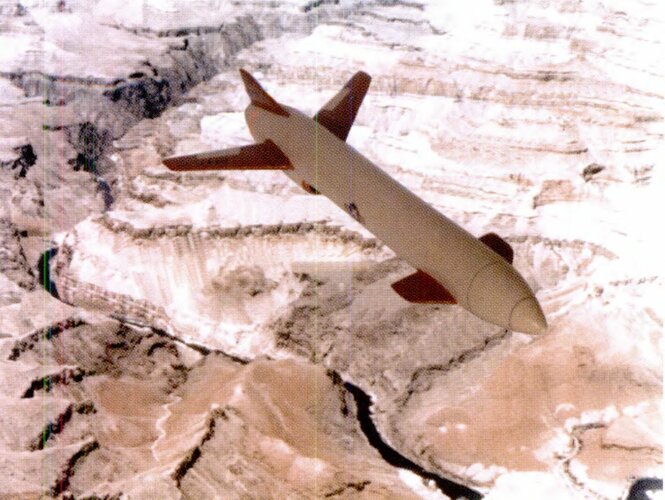
Early preliminary design studies of the ALCM included the Subsonic Cruise Attack Missile (SCAM), the Subsonic Cruise Armed Decoy (SCAD), and the Subsonic Cruise Unarmed Decoy (SCUD), the latter a replacement for the Quail decoy, all of which began as design studies by Wright Field's design engineers. ASD's Development Planning deputate worked with both the Air Force Avionics Laboratory and the Air Force Aero Propulsion Laboratory in developing the ALCM concept. Particularly vital was the projection of engine technologies for gas turbine power plants that were sufficiently small for use in a missile. After many years of further development studies in the Air Force and the Department of Defense, the AGM-86 ALCM achieved operational status in 1982.
Splendid Vision, Unswerving Purpose: Developing Air Power for the United States Air Force During the First Century of Powered Flight
2002
Last edited:
Grey Havoc
ACCESS: USAP
- Joined
- 9 October 2009
- Messages
- 24,500
- Reaction score
- 18,175

Tomahawk missile fan
ACCESS: Restricted
- Joined
- 19 September 2022
- Messages
- 44
- Reaction score
- 63
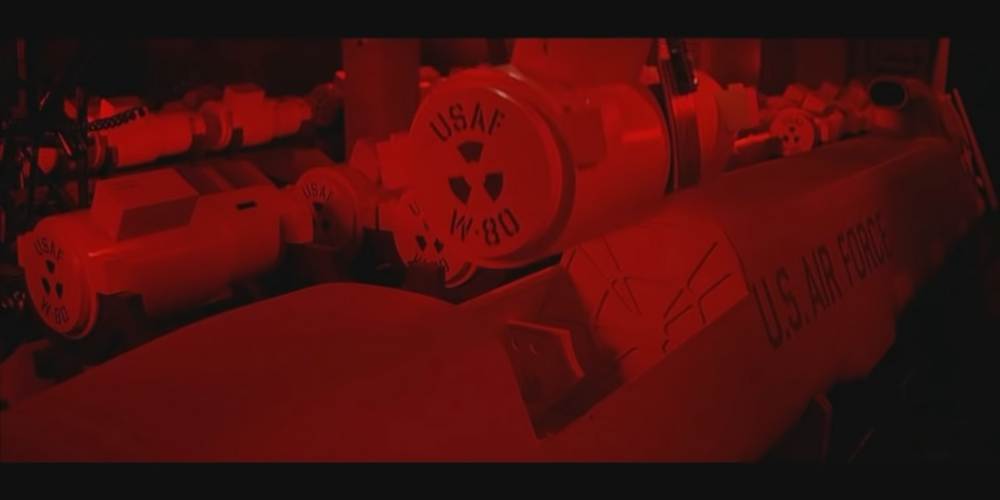
W80 nuclear warhead steal on AGM-86 ALCM.
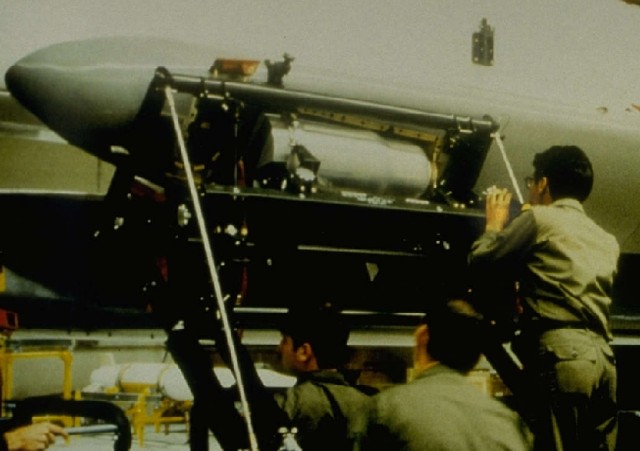
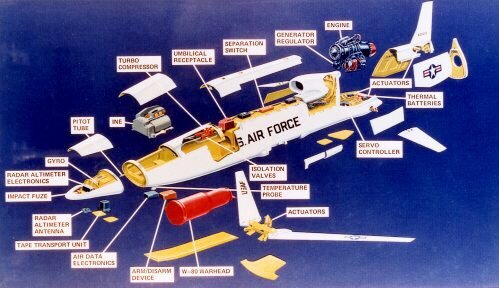
The film gives a fairly accurate representation of an AGM-86B however what they did get wrong is how the W80 is loaded into the missile.
Last edited:
The W80 warhead should be loaded from the bottom, not the top.
https://nuclearweaponarchive.org/Usa/Weapons/W80.html

https://nuclearweaponarchive.org/Usa/Weapons/W80.html
Attachments
Last edited by a moderator:

- Joined
- 14 June 2006
- Messages
- 2,300
- Reaction score
- 699
Now we are getting nearer the real ancestor of the ALCMs, and of all the modern (i.e. Seventies on) air breathing, air launched cruise missiles. The real ancestor was the CLAMP, Chemical Air Launched Missile Puny. After my very old post somewhere here, I am delighted to see CLAMP cited in the new Scott's work on US supersonic bomber projects talking about the GD Configuration 2120 AMPSS. CLAMP were intended as an alternative primary armament (four of them) housed in the rear bomb bay (one Mk-53 or four Mk-43 were the free-fall options). CLAMP were massive than the ALCM, remeber they were intended to be suersonic. The forward bay housed 9 SRAM-like missile. The available GA drawing of the GD aircraft shows a missile different from the real SRAM. I suggest, since the timeframe (June 1964) that this was a concept studied under the LASRM program.
This is the best I can conclude now. LASRM offspringed the concepts going to the ASALM.
This is the best I can conclude now. LASRM offspringed the concepts going to the ASALM.
Last edited:

Forest Green
ACCESS: USAP
- Joined
- 11 June 2019
- Messages
- 14,596
- Reaction score
- 31,708
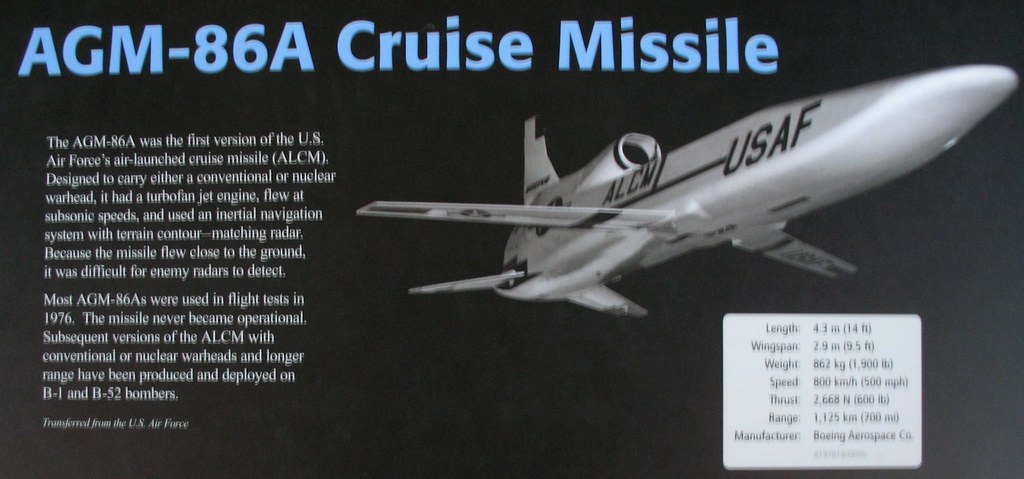
The little known ZAGM-86A. This is the missile that basically explains why a B-1B's bomb bays are too short for the AGM-86B/C/D. It was scrapped for having too short a range... then there was TASSM (also scrapped)... and then the JASSM was developed.
https://airandspace.si.edu/collection-objects/agm-86a-cruise-missile/nasm_A19781809000
https://airandspace.si.edu/collection-objects/agm-86a-cruise-missile/nasm_A19781809000

Last edited:
Forest Green
ACCESS: USAP
- Joined
- 11 June 2019
- Messages
- 14,596
- Reaction score
- 31,708
Yep, the A version had less range than they envisaged, so the longer -B was too short for the bays of the B-1B and B-52G.
Last edited:

- Joined
- 1 April 2006
- Messages
- 12,285
- Reaction score
- 15,111
Attachments
-
 1_822dd365da15cd84e5e43f5c2da092c8.jpg267.1 KB · Views: 100
 -
 1_822dd365da15cd84e5e43f5c2da092c8 (4).jpg205.4 KB · Views: 114
 -
 1_822dd365da15cd84e5e43f5c2da092c8 (2).jpg223.4 KB · Views: 118
 -
 1_822dd365da15cd84e5e43f5c2da092c8 (1).jpg259.8 KB · Views: 125
 -
 1_822dd365da15cd84e5e43f5c2da092c8 (3).jpg360.5 KB · Views: 129
Scott Kenny
ACCESS: USAP
- Joined
- 15 May 2023
- Messages
- 19,676
- Reaction score
- 28,160
For a stubby CALCM, I'd definitely want as close to a 1000lb warhead as I could get. I suspect that the range would end up down under 300nmi. In either case, you'd need a much more accurate guidance system to be useful, probably DSMAC early on and then some flavor of imaging via datalink as component sizes came down.Just a quick note on the AGM-86A from Goetz's "A technical history of america's nuclear weapons: volume II - developments from 1960 through 2020 - second edition":
Length: 167.25 inches, (13'11.25", 4.24 meters)
Wingspan: 115 inches at 35 degrees,
Weight: 2082 pounds,
Speed: Mach 0.65-0.85,
Range: 650nm
They were about the same size as SRAM, so the B-1 could carry up to 24 of them internally.
I was looking for range, and couldn't find it online when I remembered I had the book. No index, which made it more difficult, but a useful book nonetheless.
That's a size and weight that would have made them tactical aircraft friendly. I'd say they would be better than a B-61 for attacking tactical targets, as would the SRAM 2, the intended replacement for the B-61. The warhead was around 300lbs, so substituting a conventional munition wouldn't yield much bang, but range could be sacrificed for payload.
And I'm still amazed and confused at how the ALCM fuselage is mostly big die-cast chunks, not light weight stressed skin. Probably made the ALCM a lot cheaper to make than building it like a Cessna...
I just took a look at the Wiki pages for the SLAM and SLAM-ER, and I think a stubby CALCM would have been a significantly better choice than the Harpoon-based SLAM/ER. Yes, the SLAM/ER are lighter, but even a 300nmi stubby CALCM would have far better range than SLAM-ER. And you're not really losing any weapons capacity, any pylon carrying a SLAM is only carrying one missile. At worst you'd be short some fuel due to MTOW limits, which you fix by hitting a tanker before the strike departs.
- Joined
- 21 May 2006
- Messages
- 3,262
- Reaction score
- 2,885
Well, this is interesting - it's a full size mock up of the XAGM-86 SCAD, fitted with a detachable long-range fuel tank for extended range. The detachable fuel tank was dropped in favour of the longer AGM-86B, which produced the range required.
(Source: Project Terminated, Facebook.)
Regards
Pioneer
(Source: Project Terminated, Facebook.)
Regards
Pioneer
Attachments

Grey Havoc
ACCESS: USAP
- Joined
- 9 October 2009
- Messages
- 24,500
- Reaction score
- 18,175
Surface—launched interceptor missile (SLIM), a Rockwell International study using the Boeing CQM-10A missile with a hypersonic engine for Mach 4—6 speeds with an infrared/radar dual-mode guidance system. Garrett AiResearch has completed initial studies with a liquid oxygen-fueled hypersonic engine that could be adapted for SLIM.
https://www.secretprojects.co.uk/threads/1972-asd-projects.46820/post-806095SLIM also has a potential for airlaunch application, and Air Force interest in the missile has been renewed with the cancellation of the AGM-86 subsonic cruise armed decoy (SCAD) missile by the Pentagon.
- Joined
- 27 December 2005
- Messages
- 19,230
- Reaction score
- 35,692

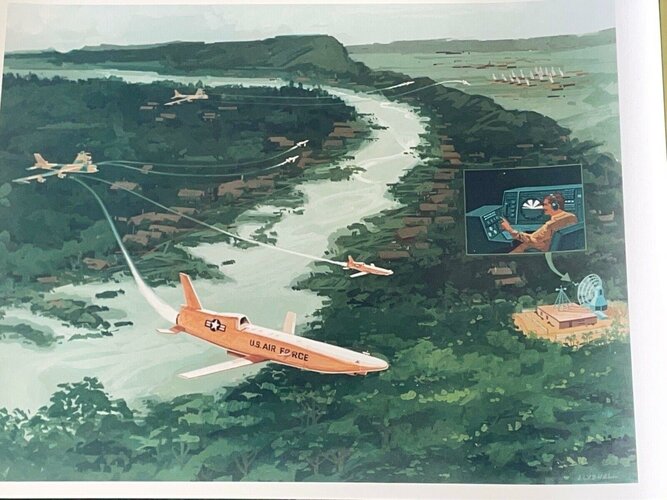
Drawing depicts Boeing 8-52 launching nine subsonic cruise armed decoy (SCAD) missiles to blank out radar in Soviet AWACS aircraft.
ASD to Keep Major SCAD Responsibility
Wright-Patterson AFB, Ohio—Air Force Aeronautical Systems Div. is taking a new approach for USAF in the development of the AGM-86 subsonic cruise armed decoy (SCAD), retaining in-house a major portion of the program management, including systems integration. There will be no prime contractor and no private systems integrator as such.
This has caused some apprehension in industry circles that ASD may be on the verge of adopting the old Army “arsenal concept,” where the service keeps system development firmly in hand, with a minimum of participation by outside companies. ASD has no such plans for the SCAD, which will be developed as a decoy for later models of the Boeing B-52 strategic bombers and possibly later for the North American Rockwell B-1. Its approach to
the management concept for the program was dictated by two major factors, according to division commander Lt. Gen. James T. Stewart:
The approach also reflects Gen. Stewart’s past experience in USAF space programs, where an associate, rather than a prime, contractor structure is the norm. Prior to his assignment as commander of ASD in June, 1970, Gen. Stewart had served successively as director of space systems at Air Force headquarters, as director of space in the USAF Air Staff and as vice director of the now-canceled Manned Orbiting Laboratory program.
- Need to strengthen ASD’s in-house avionics capability, which Gen. Stewart feels is not now as strong as it should be.
- Past experience with the development of the problem-ridden Mk. 2 avionics system for the General Dynamics F-111 variable-geometry fighter. Gen.Stewart says that the Mk. 2 experience confirmed that contracts for major avionic systems should not “be buried beneath [that of] a prime contract.”
The SCAD system program office (SPO), headed by Col. Jay R. Brill, will grow to become one of the largest in ASD as the program advances further into the development stage. The relatively-new SPO now has a total of 110 people, but Brill expects it to expand to about 250 in the near future. Of this total, approximately one-half will have engineering responsibilities. The SCAD SPO will retain control of systems integration, working with contracted assistance from Cornell Aeronautical Laboratory, Inc. There will be five subsystems and associate contractors for final development. But SCAD is being developed under the prototyping “fly-before-buy” concept. One contractor will be selected for each system, except the powerplant, of which two companies are building demonstrator models. Only one company will be contracted to build an airframe, since this will require relatively little effort so far as pushing the state of the art is concerned. The airframe contractor obviously will have to work closely with the SCAD SPO on the systems’ integration aspects of the program, however.
First SCAD contracts were let earlier this month when Williams Research Corp. and Teledyne CAE were selected to develop small, efficient turbofan engines to power the SCAD (AW&ST June 12, p. 22). Williams received a contract for $3 million, Teledyne for $4.38 million to conduct an eight-month demonstration phase for their respective engine designs. Subsequently, one will be selected to complete full—scale development of a prototype
powerplant.
Principal guidance subsystem competitors are Northrop, Singer Kearfott, Bendix, the Delco Div. of General Motors, Litton Industries and the Boeing Co. The 200-lb.-payload decoy system will include noise jamming transmitters, seton receivers and target repeaters. Competitors include Hallicrafters, Philco-Ford, RCA Corp. Sanders Associates and a team of GTE Sylvania and Raytheon.
The airframe competition is between Boeing and Lockheed Missiles & Space Co. A final production recommendation will be made to the Air Force by ASD only after prototypes of all systems have been successfully completed and test flown.
The basic question, says Brill, is “can we develop a credible decoy?” The prospects appear promising. Working under a joint ASD and USAF Avionics Laboratory project designated 691C, a multiband decoy prototype designed to reflect the image of a B-52 was installed in a McDonnell Douglas F-4 fighter and tested against simulated threat radars at Eglin AFB, Fla. With the system in operation, experienced operators could not distinguish the F-4 from an actual B-52, according to Brill.
The SCAD SPO is organized along the lines of a typical ASD system program office, but with three distinct characteristics
aside from its system integration responsibilities:
Need for the SCAD is evident, Brill says, in View of the latest Soviet buildup of its strategic defense network. The buildup includes the MiG-23 Foxbat high-altitude interceptor and reconnaissance aircraft with a look-down radar capability, improved anti-ballistic-missile missiles and the airborne warning and control system version of the Tupolev Tu-114 turboprop transport designated Moss by the North Atlantic Treaty Organization. Despite these improvements in Soviet capability, the SCAD hopefully will be capable of saturating that nation’s defensive system in the hopefully-remote event
- A systems analysis office will constantly monitor any evolving threat in the Soviet defensive network to determine if added capabilities are required for the SCAD to successfully complete its mission of confusing defensive radars attempting to track approaching B-1s and B-52s. The office will work closely with the Strategic Air Command and with ASD’s intelligence-gathering Foreign Technology Div.
- A projects division will serve as a management center for the five major SCAD programs, closely monitoring development schedules and cost.
- A procurement office will similarly monitor procurement schedules, cost and performance once a production decision has been reached.
of an all-out nuclear war.
As in other ASD programs, Brill plans to hold his contractors to a minimum of documentation, with his SPO officers making frequent trips into the field to
visit the companies involved. His office also will make maximum use of the various Air Force laboratories and already is working extensively with five on specific problems. There will be, Brill says, “total involvement with the contractors.” And, to insure that the system will meet the requirements of the user commands, representatives of the Strategic Air Command and the Air Force Training Commandhave been assigned to the SCAD SPO from the beginning of the program.
First priority will be the development of the decoy for the operational B-52, with work on the system for the still-under-development B-1 to follow downstream.
The electronic package for the B-1 SCAD will be substantially different than that for the B-52, although the propulsion systems will be similar. Brill’s office
already is working closely with the B-1 system program office to determine if the SCAD will be compatible with the avionics packages designed to go into the advanced bomber. He is working as closely with the program office for the Boeing short-range attack missile (SRAM), which also will be carried by both the B-52 and B-1. The SCAD will be designed to fit the SRAM internal rotary launcher.

Cornell Aeronautical Laboratory model shows general configuration proposed for SCAD. Wings and empennage will be foldable for internal storage in the B-52.
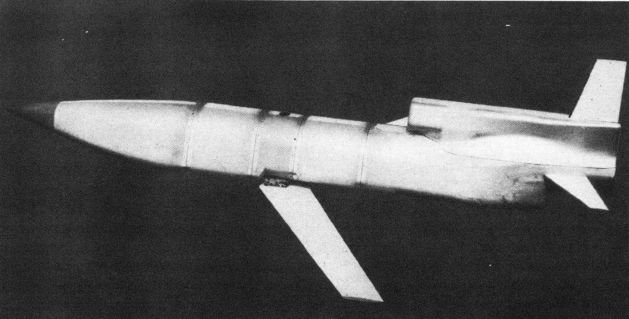
Aviation Week & Space Technology, 26 June 1972
Last edited:
Scott Kenny
ACCESS: USAP
- Joined
- 15 May 2023
- Messages
- 19,676
- Reaction score
- 28,160
It really is kinda too bad that no AGM-86s or Tomahawks were deployed with jammers and/or RCS increasers, chaff/flare dispensers, etc.
I mean, the nuclear payload is small enough that there should have been space for a fighter flare rack in at least one side of the airframe.
I mean, the nuclear payload is small enough that there should have been space for a fighter flare rack in at least one side of the airframe.
- Joined
- 27 December 2005
- Messages
- 19,230
- Reaction score
- 35,692

THE IN-HOUSE MANAGEMENT APPROACH : AN ANALYSIS OF THE SUBSONIC CRUISE ARMED DECOY PROGRAM
https://apps.dtic.mil/sti/citations/ADA067250
- Joined
- 27 December 2005
- Messages
- 19,230
- Reaction score
- 35,692
THE IN-HOUSE MANAGEMENT APPROACH : AN ANALYSIS OF THE SUBSONIC CRUISE ARMED DECOY PROGRAMHistory of the Subsonic Cruise Armed Decoy (SCAD) Program
Conceptual Phase
In the mid-1960’s Department of Defense and Air Force bomber penetration studies indicated a need for an improved decoy for the 1970’s and 1980’s as a replacement for the aging ADM-20C Quail. In July 1967, Headquarters Air Force Systems Command (AFSC) further directed a study toward the conceptual feasibility of a Subsonic Cruise Attack Missile (SCAM) to be utilized by the strategic bomber force . Aeronautical Systems Division (ASD) subsequently awarded conceptual study contracts to Beech Aircraft Corporation , Lockheed Missile and Space Company , and The Boeing Company.
In January 1968, the Strategic Air Command (SAC) issued a Required Operational Capability (ROC) for an improved decoy. SAC wanted a low cost, credible, reliable, unarmed B-52 decoy which would be compatible with the proposed B-1 , then known as the Advanced Manned Strategic Aircraft. SAC stated that they recognized that a warhead may ultimately become a necessity to preserve credibility of the Subsonic Cruise Aircraft Decoy, but that another ROC would be issued when that determination was made.
"On 12 January 1968, a Requirements Action Directive (RAD) was issued by Headquarters United States Air Force (USAF) to AFSC which officially identified SCAD as a Subsonic Cruise Armed Decoy . This document superseded a PAD that had been submitted just three weeks earlier initiating efforts on a pure bomber decoy . The new PAD called for preparation of a Concept Formulation Package/Technical Development Plan (CFP/TDP) for an air launched missile system which could operate as an attack missile and/or a bomber decoy . The deadline for submission of the CFP/TDP was 1 June 1968. Because of the short deadline , it was directed that ASD accomplish an in—house concept formulation study upon which to base the SCAD CFP/TDP . The in—house study was greatly reduced in scope compared to the contracted studies which would not be completed until July. Both the ASD and contracted studies indicated that the concepts were technically feasible and provided good flexibility for application as either a decoy , armed decoy , or attack missile. Neither study resulted in an approved program, however. According to the General Accounting Office :
“Disagreements within the Air Force over the SCAD concept developed in late 1968. SAC wanted an early Initial Operational Capability (IOC) unarmed decoy which would aid bomber penetration and was willing to accept a modified drone if it were a credible B-52 decoy. SAC did not want the development of a decoy delayed because of the complexity, higher costs, and additional risks associated with arming. The Air Staff and AFSC wanted a longer range armed decoy . It would be procured through a longer, more conservative, development strategy
and be compatible with the B-52 and B-1.”
On 7 October 1968, a SCAD Program Office cadre was established; this ZAGM—86A System Program Office was under the operational control of the Deputy for Development Planning and operational control of the Deputy for Systems Management . In January 1969, Lieutenant Colonel R. B. Shaw became SCAD ’s first Program Manager.
One of the major reasons for the differences in opinion on the SCAD concept was skepticism within DoD that a credible decoy could be developed. Those in favor of an armed system argued that if SCAD were armed it would allow for a more flexible system by providing a discriminant hedge. If warheads were carried on even a few of the decoys , all such vehicles would be credible targets and would necessitate attack by enemy defense systems even if the decoys could be discriminated from the launch aircraft.
Since neither of the previous studies had adequately addressed decoy electronics , two additional studies were initiated in June 1969. Both Raytheon and Philco—Ford concluded in these studies that they could build a decoy package to simulate the B-52 and still meet the size constraints.
In order to further narrow the spectrum of potential design concepts for the SCAD system, a second set of system design study contracts was awarded to Beech, Boeing and Lockheed in June 1969. The main study tasks were :
(1) to provide design and performance information on configurations that would be interchangeable with the Short Range Attack Missile (SRAM) for both internal and external B-52G/H carriage,
(2) to select optimum turbofan propulsion systems for each vehicle configuration, and
(3) to provide schedules and cost estimates for various development strategies.
These studies, completed in late 1969, confirmed the concept of the previous studies, and it was again concluded that SCAD was feasible in any of several configurations.
A second ROC was issued by SAC in September 1969 due to a lack of positive acquisition decisions on the previous ROC. This ROC re-emphasized
the need for a B-52 decoy by the early 1970’s, and requested a flight test of an electronic decoy package in order to demonstrate decoy credibility and provide a basis for tull scale development. As a joint SCAD Program Office/Avionics Laboratory project , a decoy flight test program was initiated in December 1969. It involved development and flight test of a decoy package covering major Soviet threat radar frequencies. Using off-the-shelf amplifiers, a decoy system was packaged and incorporated in a flight pod . The pod was mounted on an F-4C. The F-4 and a jamming B-52 were flown against simulated Soviet ground and airborne radar at Eglin Air Force Base. Throughout the flight evaluation program , conducted in 1970, experienced radar operators were unable to discriminate between the B—52 and decoy target.
Based on the results of the decoy flight test program , the Air Force gained sufficient confidence that a credible B-52 decoy could , in fact, be developed. The Chief of Staff of the Air Force on 12 December 1969, called for a two-phased approach to SCAD development. The first phase involved the procurement of an unarmed B—52 decoy , with an early operational deployment. The second phase called for an advanced armed decoy , compatible with the B—1. The SCAD Program Office consequently initiated studies to determine the feasibility of modifying existing missiles or drones to perform the first phase mission. Meanwhile, Colonel A. L. Wood succeeded Lieutenant Colonel Shaw as Program Manager in mid-1969.
Early in 1970, the Air Force prepared a draft Development Concept Paper (DCP ) is order to resolve issues and obtain a consistent Air Force/ Office of the Secretary of Defense (OSD) position on the program . Three options were included in the DCP which reflected the differences of opinion within DoD on the concept. Option 1 called for a B-52 decoy sized to be compatible with the SRAM rotary launcher. It would not be armed, but would be designed to allow for arming at a later date if required. Option 2 was a more sophisticated system which also allowed for greater flexibility . It would provide an armed decoy with an attack capability. Option 3 was for an attack missile which would give the bomber force a long range stand—off capability .
During coordination of the DCP all three options were supported. The Air Force backed Option 1, Defense Research and Engineering preferred Option 2, while Systems and Analysis liked Option 3. On 15 July 1970, the Deputy Secretary of Defense, David Packard , approved initiation of advanced development for SCAD along the lines of Option 1 - an unarmed decoy constrained in size for internal carriage with the alternative of arming at a future date. The Program was now ready to enter the Validation Phase.
- Joined
- 27 December 2005
- Messages
- 19,230
- Reaction score
- 35,692
THE IN-HOUSE MANAGEMENT APPROACH : AN ANALYSIS OF THE SUBSONIC CRUISE ARMED DECOY PROGRAMValidation Phase
Late in 1970 several TDP’s were developed but none were approved because of disagreements over the development strategy and proposed and schedules. Colonel Wood was reassigned in November and Mr. Julius Singer, former Assistant Program Manager, became SCAD’s third
director.
In an effort to get SCAD “off the ground”, an ASD study committee was established in November 1970. This committee , led by Mr. Singer and Mr. John E. Short, the ASD Commander’s Assistant f or Special Projects, developed a three phase development strategy for SCAD. The first phase, Scramble I, would be a six to nine month contracted electronic countermeasures payload development program followed by a flight test demonstration. Scramble II would employ ASD resources and facilities in preliminary design and development planning . The third phase was a development, acquisition , test and evaluation program. This strategy was temporarily halted when Congress failed to appropriate $10 million requested for SCAD in fiscal year 1971.
The AGM—86 Program Office was transferred from organizational control of the Deputy for Development Planning to the Deputy for Reconnaissance,
Strike and Electronic Warfare on 1 February 1971. In Feburary 1971, the Scramble plan was presented to AFSC and Air Force headquarters. The Scramble I portion was deleted since the Avionics Laboratory decoy credibility program would adequately demonstrate SCAD ’s credibility . The Air Staff accepted the remainder of the strategy which placed ASD in a prime contractor position with five subsystem contractors (airframe, engine, decoy electronics, navigation/guidance , and carrier aircraft equipment). This plan , which provided for a 42 month development program, was approved by the Secretary of the Air Force on 23 April 1971. In a message to the Commander of AFSC , General Ryan put his personal endorsement on the development approach by stating:
“The program proposed in the SCAD Technical Development Plan has been reviewed by SECAF/RD and OSD/ DDR&E Staffs and is approved in principle . I encourage sustaining the spirit and motivation of your command associated with the in—house approach proposed for SCAD.”
This TDP, entitled the “Accelerated Development Plan,” which featured an associate or subsystem contractor structure with the program office assuming the role of a prime contractor responsible for system integration , became the baseline plan against which future modifications
were measured.
In June 1971, Headquarters USAF issued System Management Directive SMD1—46l—689(l)—(AGM—86A) to AFSC to initiate the SCAB development
program in accordance with the approved development plan . The SMD included the following features :
(1) only an unarmed version of SCAD was to be developed , with physical provisions to allow arming later ,
(2) a study effort would be initiated to extend the range , and
(3) compatibility with B—1 was to be a secondary objective with B-52 decoy performance the primary objective.
Based on this direction , the program office worked on preparation of specifications , Statements of Work, and other Request for Proposal (RFP) materials under the direction of Colonel Jay R. Brill , who became Program Manager on 29 July 1971. On 12 August 1971, the Air Force completed negotiations with Cornell Aeronautical Laboratory , Inc., to provide engineering and technical assistance to the SCAB office in areas where ASD resources were limited . In September , ASD forwarded the Determination and Findings requesting authority to negotiate the AGM—86A subsystems and additional studies to Systems Command headquarters . On the same day, however, Headquarters USAF informed AFSC that Deputy Secretary of Defense Packard had issued a Program Decision Memorandum which contained a new funding arrangement for the SCAD program and would constrain the funding levels required for the approved development plan.
Headquarters AFSC then requested that ASD present alternative SCAD development plans. By 11 November , the AGM—86 office had submitted three
alternative plans. One was a redocumentation of the April 197Accelerated Development Plan which had previously been approved . The second plan was modified to show the full impact of the funding constraints. And the third was a partially constrained plan which maintained Secretary Packard’s funding for fiscal years 1972 and 1973, but was un-constrained in 1974 and out years. It allowed for more timely accomplishment of the program objectives than the fully constrained development plan.
Before approval could be granted on one of these plans, however, new direction from still another source changed the program. In July 1971, OSD issued DoD Directive 5000.1 which modified program management responsibilities , authorities and the sequencing of acquisition actions. New emphasis was placed on prototyping in lieu of paper studies of the McNamara era. Secretary Packard presented the idea of prototyping to Congress in September and the legislators reacted enthusiastically . The House of Representatives Committee on Appropriations directed that the development of SCAD be conducted under competitive prototype procedures.
As a result of this direction, the program office prepared several additional alternative plans in December 1971. In January 1972, the decision was made by the Air Staff to proceed with the April 1971 development plan , partially constrained by meeting the new funding levels in fiscal years 1972 and 1973. In addition , a competitive engine prototype program would be incorporated . Two engine contractors would be required to develop engines for a performance demonstration so that the competitive prototype program requirement could be met. A single contractor would be selected , based on the results of the performance demonstration, during the first year of full scale development.
By the end of January the program office incorporated these changes into a revised development plan and submitted it to Headquarters USAF . General Ryan approved the plan on 1 March and directed that the SCAD program should proceed without further delay . A Program Management Directive (PMD) which replaced the SMD , was received in the program office vithi~ a week. However , by this time the program had been revised and delayed such that when compared to the originally approved plan the General Accounting Office found : “. . . Indecision , disagreements, and other factors have caused slips in the milestones for the SCAD program . There has been a 10 to 12 month slip in the Con tract Award milestone , a 23 month slip in the First Flight milestone , and a 30 to 36 month slip in the Initial Operational Capability (b c) milestone .”
RFP ’s for all segment contracts were released to industry on 14 February . A competitive source selection process began and by July six contracts totaling over $150 million were awarded . The Boeing Company received two contracts; one for the development of the airframe and assembly of the air vehicle , and another for modification to the carrier aircraft equipment . Litton Systems , Inc. was awarded the navigation/guidance contract. Philco—Ford Corporation got the contract for development of the decoy electronics. Williams Research Corporation and Teledyne—CAE Division were selected to perform the prototype engine development and competitive demonstration .
Thus, after a lengthy validation which was characterized by continuous redirection , the program proceeded into full scale development.
Last edited:
- Joined
- 27 December 2005
- Messages
- 19,230
- Reaction score
- 35,692
Full Scale Development
Before entering into full scale development , a system should be well defined and free of most unresolved issues. The SCAD program, however , still had several issues which could be considered as unresolved. Primarily , the issue of arming was still around. Advocates of arming still argued that the decoy needed to be armed to provide a hedge against decoy discrimination. They found an ally in Senator Proxmire, who stated that the Air Force was “dragging its feet” in developing SCAD in order to keep the B-1 program, currently in engineering development, out of jeopardy. The Senator suggested that an attack version of SCAD could provide us with an alternative option to the B-1 for preserving our strategic bomber force. Another issue was the range of SCAD . If the SCAD were armed the warhead would displace fuel and result in a range less than adequate for a stand—off missile.
Still another unresolved issue was the B-1 compatibility issue. Slips in the development schedule of SCAD, due to all the replanning required , now made the SCAD deployment coincide with the B-1. There was also some question about the B-52 still being in the inventory by the time SCAD would be available.
In view of all these unresolved issues, the Defense Systems Acquisition Review Council (DSARC) which would normally precede full scale development was delayed until November 1972. In an effort to resolve the issues, the program office developed plans and authorized trade studies on all the issues.
The date of the DSARC meeting was changed several times , but in January 1973 it was indefinitely postponed . On 16 February 1973, the program manager briefed the Secretary of the Air Force , Robert C. Seamans , on alternative SCAD configurations. The presentation covered AGM-86 effectiveness analysis , performance , scheduling, and the cost of various designs. Dr. Seamans then authorized the SCAB office to brief the DSARC , presenting the contemporary AGM—86A configuration as the recommended Air Force program . By this time , a preliminary design of the unarmed B-52 decoy was well in hand and development was proceeding on schedule. Figures 3 through 6 show the contemporary design and configuration . Figure 3 illustrates how SCAD could be carried on either pylons or the SRAM rotary rack . Figure 4 shows the activation of SCAD ’s foldable surfaces immediately after launch. Figures 5 and 6 indicate the configuration and contractors responsible for each major subsystem.
On 15 March 1973 , the approved SCAD development program , along with alternate capability study results, were presented to the DSARC . The Air Force did not get a continuation decision, however, pending further illumination and resolution of requirements issues between OSD and the Air Staff. In addition , there was a request by the Office of the Secretary of Defense/Director of Defense Research and Engineering (OSD/DDR&E), John S. Foster , Jr., to develop another program option - the simultaneous development of both armed and unarmed SCAD vehicles . Dr. Foster requested a follow-up DSARC and it was scheduled for mid—April. On 13 April the DSARC presentation was made but again no firm program decision was reached. In May , the program office was directed to rebrief the DSARC in late June.
THE IN-HOUSE MANAGEMENT APPROACH : AN ANALYSIS OF THE SUBSONIC CRUISE ARMED DECOY PROGRAMTermination
Meanwhile, rumors of cancellation were descending on the program office. One of the earliest was an article in Aerospace Daily on 5 April , which was entitled “SCAD Seen in Danger of Cancellation.” The article reported that while some people in DoD Systems Analysis and some congressmen supported the program , there was considerable opposition to it within DoD and the Air Force , including Secretary Seamans. The final SCAD DSARC review was held on 28 June . After the presentation, Air Force members were excused while the DSARC went into executive session. On 9 July , the program office received the DSARC decision :
“...Following a meeting of the Defense Acquisition Review Council on 28 June 1973, the Deputy Secretary of Defense has decided to terminate the full engineering development of SCAD”
Thus, after some five years and approximately $65 million, the SCAD program died amidst indecision and disagreement.

- Joined
- 28 October 2019
- Messages
- 77
- Reaction score
- 328
Interesting reading. SCAD was a couple of years before my time at ASD, but I did know a few of the guys that worked on it---Al Goebel, Jerry Poncar, and others. Believe me, no one ever bragged about being involved in SCAD. I think they just wanted to forget it. Reading about this particular armed decoy did remind me that once upon a time, there was a requirement to include UGAD's (unguided armed decoys) in the ASPA/ATB program. It hung around briefly, but was dropped from the requirements before the FSD contract award.
Similar threads
-

-
 INVESTIGATION OF PERFORATED PLASTIC SPHERES CONCEPT FOR FUEL TANK FIRE SUPPRESSION
- Started by Grey Havoc
- Replies: 5
-
 1989 Navy/USAF Long Range Conventional Standoff Weapon (LRCSW)
- Started by flateric
- Replies: 21
-
 ASD Preliminary Designs in Splendid Vision, Unswerving Purpose
- Started by XP67_Moonbat
- Replies: 16
-
1980s US intercontinental cruise missile (& ATCM program)
- Started by GeorgeA
- Replies: 37