Alt Postwar Soviet Navy

uk 75

ACCESS: Above Top Secret
Senior Member
Joined
27 September 2006
Messages
6,622
Reaction score
7,444
I am delighted that others are already making good use of the Alt 60s US Navy thread. It probably needs a balancing thread to cover the Soviet Navy, which for both the USN and the RN was "the enemy fleet in being".
After the fifties scare surrounding the Swerdlow class cruisers, the nuclear submarine force came to represent the main threat from the Red Navy.
Some modest but dramatic looking classes of ship appeared in the 1960s.
The Kynda class missile cruisers with their huge surface to surface missile tubes.
The two Moskva class helicopter ships led to endless speculation about possible Soviet carriers. The first VSTOL fighter shown in 1967 encouraged such worries.
The Kresta class were seen at the time as additional surface warfare threats, though they were actually more ASW units.
The Krivak class with their large missile tubes and gun armament seemed much more modern and capable to journalists than the modestly armed Leanders and Knoxes.
We know from other threads that the Soviets had their own share of funsome unbuilt projects, so over to you...
 
We know from other threads that the Soviets had their own share of funsome unbuilt projects, so over to you...
Well, I have an idea of making the M-11 "Storm" SAM system into the universal, multi-purpose missile system. Lets look at some data:

* The V-611 surface-to-air missile of the "Storm " have length of 620 cm, diameter 60 cm, finspan 140 cm and weighted 1844 kg.

* The RPK-1 "Vihr" anti-submarine rocket have a length of 600 cm, diameter 54 cm, mass 1800 kg. The rocket is unguided, launched from its own dedicated rail launcher.

It looks like it is perfectly possible to fit RPK-1 rocket on the "Storm" magazine and rail launcher, with just a simpler adapters.

* 9M79 "Tochka" battlefield ballistic missile have a length of 640 cm, 65 cm diameter and 1544 cm wingspan. I.e. it could fit into slightly modernized "Storm" magazines.

In essense, my idea was to make M-11 "Storm" a universal missile launch system, capable of firing anti-air, anti-submarine, and land attack missiles. In 1960s, it would gave significant advantage in fhnctionality (and help to deviate from over-specialization in Soviet doctrines)
 
Wasn't there also a 203mm naval piece designed in conjunction/competition with the AK-130?
 
Shame the Forger was that bad. The Soviets had a spy at Avro Canada in the days of John Frost WS-606A, imagine if Yakovlev had made it work...
 
The Kresta class were seen at the time as additional surface warfare threats, though they were actually more ASW units.
The Kresta I was indeed a mini-me Kynda (half the missile complement), but the Kresta II was an ASW unit with Matel'.

I'm not sure what I would do too differently.
During the 1960s the Soviets developed a whole range of quite impressive designs from the Kashin to the Nanuchka and many of the older destroyers were heavily rebuilt during the 1970s. The seemed to grasp the ASW role fairly quickly in response to the NATO SSBN threat, hence the increasing shift to helicopter carriers and ASW cruisers, but still leaving ample room for surface strike capability.
Saying that, the Moskva's had big room for improvement. Their hullform was rather flawed and they were poor seaboats. Perhaps a slightly smaller ship or one with a more conventional hull and layout may have allowed another one or two ships to be built instead of the first Kievs. Even some Sverdlov helicopter cruiser conversions would have been useful assets.

I think my main focus would be to get more standardised ships for the 1970s underway, instead of the Sovremenny and Udaloy and the multiple small fast attack craft. And also to develop a more standardised family of SAMs and SSMs.
I do like Dilandu's M-11 system idea. During the Cold War, NATO intelligence believed the RPK-1 to be based on a FROG-series rocket. The RPK-1 always seemed to be rather wasteful in terms of having its own dedicated twin-arm launcher and magazine. Although intended for cruisers it took up a lot of space and weight and a dual-use M-11 magazine would have made more sense.
 
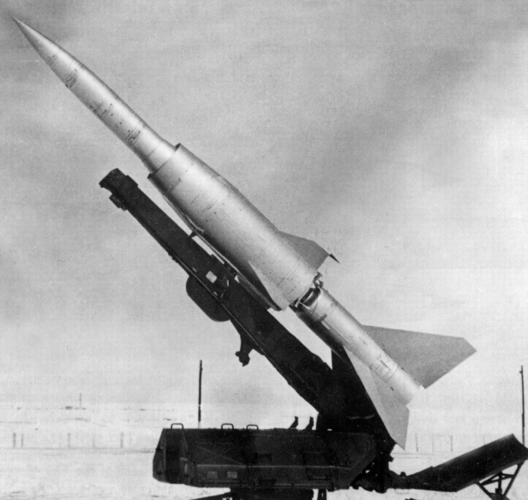
One other thing that I considered; missile rebuilds of "Sverdlov"-class cruisers. There was an attempt to modernize one cruiser ("Dzerjinsky") to carry medium-range S-75 SAM (as M-2 "Volkhov-M" navalized system), but the results were far from satisfactory. The V-753 missiles were developed for land-based system, used quite nasty oxidizer - red fuming nitric acid - and while was quite efficient, was not exactly suitable for naval deployment.

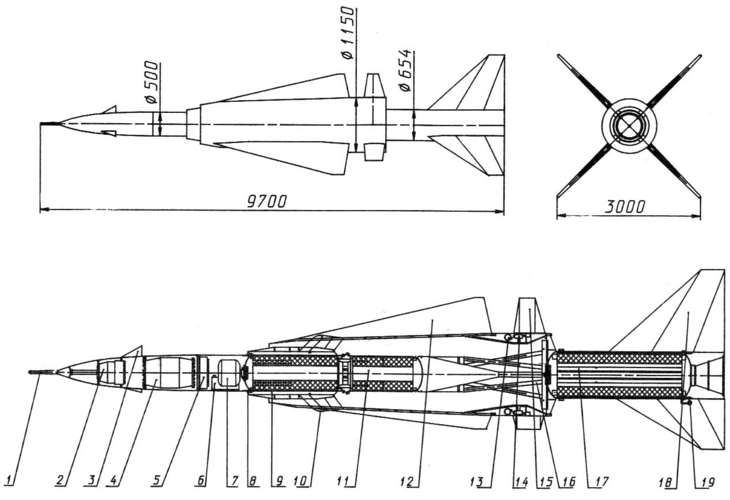
But there were some air-breathing missiles, developed for S-75 SAM in 1950-1960s. Ramjet-powered 17D was developed in late 1950s and tested in 1960-1962. While PVO strany did not consider it advantageous enough to continue development (it was supposed to have much longer range than standard rocket-powered missiles, but actually have only marginal advantage), it actually may be very advantageous for the Navy:

1625151499140.png 1625151520290.png

The kerosene-fueled, air-breathing ramjet missile would be much simpler to handle onboard the ships, than rocket-powered one with toxic oxidizer.

So my idea is to rebuild some of late-series "Sverdlov"'s as single-ended missile cruisers, with two M-2 "Volkhov-M" launchers and two control stations instead of rear turrets. They would be equipped with 17D ramjet-powered missiles, for area air defense functions.

And there are five incomplete "Sverdlov"'s hulls, works on which stopped in 1959, close to 70-80% completion. They could be used as basic for double-ended missile cruisers; with four M-2 "Volkhov-M" instead of forward and rear turrets, or maybe with a combination of M-2 and M-1 "Volna" short-range, low-altitude systems.
 
So my idea is to rebuild some of late-series "Sverdlov"'s as single-ended missile cruisers, with two M-2 "Volkhov-M" launchers and two control stations instead of rear turrets. They would be equipped with 17D ramjet-powered missiles, for area air defense functions.

And there are five incomplete "Sverdlov"'s hulls, works on which stopped in 1959, close to 70-80% completion. They could be used as basic for double-ended missile cruisers; with four M-2 "Volkhov-M" instead of forward and rear turrets, or maybe with a combination of M-2 and M-1 "Volna" short-range, low-altitude systems.
I can just imagine the horrified reactions of western naval staffs!

Saying that, the Moskva's had big room for improvement. Their hullform was rather flawed and they were poor seaboats. Perhaps a slightly smaller ship or one with a more conventional hull and layout may have allowed another one or two ships to be built instead of the first Kievs. Even some Sverdlov helicopter cruiser conversions would have been useful assets.
If I'm not mistaken, the original Moskva design would have been quite seaworthy. However the hull design of the first two in the class was greatly simplified in order that they could be built in a shorter timeframe. Further units from the planned third ship (assigned the name Kiev) onwards would have had the original hull design, but procurement of additional units was unexpectedly put on hold indefinitely. The official reason given was that the class would be less effective against SSBNs armed with the new Poseidon missile that was scheduled for introduction in the early 1970s than they were against Polaris armed boomers (which had to get a lot closer to Soviet territory in order to be able to service a lot of their targets). The real reason was that the aircraft carrier advocates within the Soviet government and defence establishment been able to successfully get the resources intended for further Moskvas reallocated to the Project 1143 'heavy aviation cruiser' program, which they saw as a important stepping stone on the path to a full nuclear powered CATOBAR carrier. In something of a dark irony, the name Kiev was shortly thereafter reassigned to the first of class of Project 1143.

Not building further Moskva-class helicopter cruisers had come to be seen as a mistake by the Soviet Navy brass by the late 1970s, but attempts to get follow on designs approved (including nuclear powered) effectively got bogged down in committee I believe.
 
Last edited:
I can just imagine the horrified reactions of western naval staffs!

Well, a double-ended cruiser, with four fire control channels, capable of tracking four targets simultaneously & guide two missiles per each... as USN learned in Vietnam, you should not underestimate "flying telegraph poles")
 
Thanks everyone. I had hoped that the Soviet Navy would generate some good stories and info.
The ships were impressive enough in real life but some of your suggestions cry out to be drawn by some of our friends here and on Shipbucket.
 
This old thread seems more relevant after the sinking of the Slava class Moskva and the reliance of the Russians on frigate sized ships.

I also think I should have widened the scope so am renaming this thread from alt 1960s to alt Post war.

This should allow discussion of subs vs surface ships and the battleship debate. As you know I love broad interpretations of my threads.
 
One other thing that I considered; missile rebuilds of "Sverdlov"-class cruisers. There was an attempt to modernize one cruiser ("Dzerjinsky") to carry medium-range S-75 SAM (as M-2 "Volkhov-M" navalized system), but the results were far from satisfactory. The V-753 missiles were developed for land-based system, used quite nasty oxidizer - red fuming nitric acid - and while was quite efficient, was not exactly suitable for naval deployment.

But there were some air-breathing missiles, developed for S-75 SAM in 1950-1960s. Ramjet-powered 17D was developed in late 1950s and tested in 1960-1962. While PVO strany did not consider it advantageous enough to continue development (it was supposed to have much longer range than standard rocket-powered missiles, but actually have only marginal advantage), it actually may be very advantageous for the Navy:

View attachment 659879View attachment 659880

The kerosene-fueled, air-breathing ramjet missile would be much simpler to handle onboard the ships, than rocket-powered one with toxic oxidizer.

So my idea is to rebuild some of late-series "Sverdlov"'s as single-ended missile cruisers, with two M-2 "Volkhov-M" launchers and two control stations instead of rear turrets. They would be equipped with 17D ramjet-powered missiles, for area air defense functions.

And there are five incomplete "Sverdlov"'s hulls, works on which stopped in 1959, close to 70-80% completion. They could be used as basic for double-ended missile cruisers; with four M-2 "Volkhov-M" instead of forward and rear turrets, or maybe with a combination of M-2 and M-1 "Volna" short-range, low-altitude systems.
Are you refering to the Project 64 cruisers? Yes definitely should have finished the hulls to that design, the 64 had the same weapons used later on the Project 58 (which ironically was built to use the leftover missiles from the aborted Project 64 conversion as i understand), except more of them and on a bigger, more seaworthy hull.

Agree about the existing Sverdlovs as well, either double ended of single ended SAM conversion with M-1 or M-2 missiles would have added a very significant SAM capability to the VMF. Even better with the ramjet 17D. I think there were plans for such conversions, Project 70 or Project 71 i think.
 
One other thing that I considered; missile rebuilds of "Sverdlov"-class cruisers. There was an attempt to modernize one cruiser ("Dzerjinsky") to carry medium-range S-75 SAM (as M-2 "Volkhov-M" navalized system), but the results were far from satisfactory. The V-753 missiles were developed for land-based system, used quite nasty oxidizer - red fuming nitric acid - and while was quite efficient, was not exactly suitable for naval deployment.
Yeah, IRFNA is absolutely not what you want onboard ship!


But there were some air-breathing missiles, developed for S-75 SAM in 1950-1960s. Ramjet-powered 17D was developed in late 1950s and tested in 1960-1962. While PVO strany did not consider it advantageous enough to continue development (it was supposed to have much longer range than standard rocket-powered missiles, but actually have only marginal advantage), it actually may be very advantageous for the Navy:

View attachment 659879View attachment 659880

The kerosene-fueled, air-breathing ramjet missile would be much simpler to handle onboard the ships, than rocket-powered one with toxic oxidizer.

So my idea is to rebuild some of late-series "Sverdlov"'s as single-ended missile cruisers, with two M-2 "Volkhov-M" launchers and two control stations instead of rear turrets. They would be equipped with 17D ramjet-powered missiles, for area air defense functions.

And there are five incomplete "Sverdlov"'s hulls, works on which stopped in 1959, close to 70-80% completion. They could be used as basic for double-ended missile cruisers; with four M-2 "Volkhov-M" instead of forward and rear turrets, or maybe with a combination of M-2 and M-1 "Volna" short-range, low-altitude systems.
Talos-ski!

That would be impressive for sure.
 
If you do not mind combining Soviet / Russian and Western military technology as Ukraine has done in the current Russo-Ukrainian War, how about replacing the Sovremenny and Udaloy II class destroyers' and Slava class cruisers' 130mm AK-130 twin-barrel gun turret with the British 4.5"/55 Mark 8 or American 5"/54 or 5"/62 Mark 45 single-barrel gun turret?
 
If you do not mind combining Soviet / Russian and Western military technology as Ukraine has done in the current Russo-Ukrainian War, how about replacing the Sovremenny and Udaloy II class destroyers' and Slava class cruisers' 130mm AK-130 twin-barrel gun turret with the British 4.5"/55 Mark 8 or American 5"/54 or 5"/62 Mark 45 single-barrel gun turret?
Technically possible, albeit costly. From practical point of view, frankly, my IMHO is that two 76-mm OTO Melara mounts would be better idea than one 4-5 inch mount.
 
I was reading somewhere that the Swerdlow cruisers were sufficiently capable for the RN to retain a battleship force to counter them.
We know from various threads here that the UK designed new ships, aircraft and weapons to counter the Swerdlow.
If the Soviet Union had built up this capability in the 1950s and 60s the RN too would have to have looked very different.
 
I was reading somewhere that the Swerdlow cruisers were sufficiently capable for the RN to retain a battleship force to counter them.
It's... actually complicated. The "Sverdlow's threat" was more a Royal Navy increasingly desperate attempt to hold its traditional niche in post-war situation. British admirals invented the idea that "Sverdlov"-class cruisers would be used for raiding British communication lines, despite likely knowing perfectly that USSR never was interested in surface raiders, and such use of cruiser forces were not even included in Soviet planning.
 
What kind of carrier could the Soviets have put up by 1965, assuming a naval buildup that continues despite the handover from Stalin to Khruschev, and assuming perhaps a secondhand carrier from the lend-lease days?

It is reasonable to get one or two Midway-equivalents by then or would it just be too technically demanding?
 
What kind of carrier could the Soviets have put up by 1965, assuming a naval buildup that continues despite the handover from Stalin to Khruschev, and assuming perhaps a secondhand carrier from the lend-lease days?
Well, I speculated a lot on this matter. Most likely USSR would follow the idea of smaller, specialzed warships, build around specific weapon systems - it was essentially a central doctrine of this time, supported not only by Khrushev, but many other naval ranks, Gorshkov including.

So the most likely Soviet carrier would be relatively small ship, about 25.000-30.000 tons, specifically dedicated to fleet air defense and airspace control. They would not have much of strike role - USSR have shipborne and airborne cruise missiles for that - they would be mainly a platforms for interceptors and air superiority fighters. The early 1960s PBIA project (rus. PlavBasa Istrebitelnoy Aviatsiy - Floating Fighter Base) was basically what was most likely.
 
In my personal AH, the Soviet Navy post-war alternative actually started pre-war, with a more balanced attitude toward shipbuilding. So:

* In late 1920s, a "Komsomolets" training ship was converted (as proposed) to small experimental carrier.

* In early 1930s, a hull of incomplere battlecruiser "Izmail" is completed as fast aircraft carrier "Osoaviakhim". At the same time, fire-damaged battleship "Frunze" (of "Gangut" type) is restored as fast battleship/battlecruiser.

* In 1939, both those ships are sent from Baltic to Far East to quickly reinforce the Pacific Fleet in case border clashes with Japan would escalate. So two most modern and capable units of Soviet Navy avoid being trapped in Baltic when WW2 starts.

* In 1942, both "Frunze" and "Osoaviakhim" are moved to Arkhangelsk, to reinforce Northern Fleet and protect Arctic convoys. This move allows USSR to gather experience in carrier operations in 1942-1945.

* After war, in early 1950s, USSR build first series of three light carriers, about 25.000 tons each - "Chkalov", "Krylia Proletariata" and (new) "Osoaviakhim", firstly with piston-driven and mixed-propulsion planes (like Mig-13 piston/motorjet fighter), then with turbojet and turboprop ones (Yak-40 fighter and Tu-91 attack plane)

* In late 1950s, a major program of carrier construction is finally adopted. Under Khrushev influence, carriers are supposed to be light, compact, and their role is strictly air defense/air superiority, i.e. their airwings are composed mostly of fighter planes and some AEW aircraft. Their function is to provide air cover for the Soviet fleets, disrupt NATO reconnaisance and anti-submarine efforts, and provide escort fighters for maritime strike bombers;

* During 1958-1962, a large series of PBIA-based carriers - about 20.000-25.000 tons, gas turbine powered, with fuel-explosive catapults and Yak-40 fighters wings (augmented with Tu-91M based AEW planes and some ASW planes). Also, a number of incomplete Sverdlov-class cruisers are finished as single-end and two-end missile cruisers, with M-2 Volkhov SAM's (equipped with ramjet-powered missiles - such missiles were actually tested for S-75 system)

* In late 1960s, a variable-sweep wing Mach 2 fighter is developed for Soviet carriers.
 
Last edited:
* In early 1930s, a hull of incomplere battlecruiser "Izmail" is completed as fast aircraft carrier "Osoaviakhim". At the same time, fire-damaged battleship "Frunze" (of "Gangut" type) is restored as fast battleship/battlecruiser.
I'd suggest swapping those two if the fire was really bad.

Complete the Izmail as a Battlecruiser, rebuild the Frunze as a carrier.

Because a bad fire is going to force the replacement of all the overheated armor anyways, so you're looking at a pretty massive rebuild there. You could be looking at having to replace the armor belt down to the waterline!
 
I'd suggest swapping those two if the fire was really bad.

Complete the Izmail as a Battlecruiser, rebuild the Frunze as a carrier.

Because a bad fire is going to force the replacement of all the overheated armor anyways, so you're looking at a pretty massive rebuild there. You could be looking at having to replace the armor belt down to the waterline!
The "Frunze" damage was mainly in terms of equipment loss. The fire gutted three boilers in forward boiler room, destroyed central gunnery room and forward dynamo room, caused significant damage to conning tower and bridge, destroying all gunnery equipment there. Also, almost all wiring in bow part of the ship was damaged either by fire, or by firefighting (the battleship was mothballed at the moment of fire, so there was no casualties - but also no one to put down the fire, till firefighters arrived from port).

Hull, guns and main machinery weren't affected, but the equipment damage was too severe to be repaired in Civil War-torn country. So the ship was decommissioned, and partially cannibalized to repair other three battleships. In late 1920s and 1930s there were several efforts to restore "Frunze" - including turning her into fast battlecruiser (her hull was of sufficient shape, so she needed only more power), but they all failed due to money being spent on other priorities.

Complete the Izmail as a Battlecruiser
Alas, not possible. Her hull was in high enough completion for barbettes being already installed - and there were neither turrets, nor enough 14-inch guns for her to be completed. Rebuilding "Izmail" to accomodate turrets from, say, "Frunze", would require major hull diassembly. Just not practical.
 
Izmail, of course, would make a much better carrier, because she was longer and faster.
Granted.


The "Frunze" damage was mainly in terms of equipment loss. The fire gutted three boilers in forward boiler room, destroyed central gunnery room and forward dynamo room, caused significant damage to conning tower and bridge, destroying all gunnery equipment there. Also, almost all wiring in bow part of the ship was damaged either by fire, or by firefighting (the battleship was mothballed at the moment of fire, so there was no casualties - but also no one to put down the fire, till firefighters arrived from port).

Hull, guns and main machinery weren't affected, but the equipment damage was too severe to be repaired in Civil War-torn country. So the ship was decommissioned, and partially cannibalized to repair other three battleships. In late 1920s and 1930s there were several efforts to restore "Frunze" - including turning her into fast battlecruiser (her hull was of sufficient shape, so she needed only more power), but they all failed due to money being spent on other priorities.
If the fire was that bad, it sounds like the hull and armor may have been compromised.

Which would mean a very expensive/extensive rebuild. So rebuilding as a battlecruiser may be better. Remove damaged armor, replace old enginerooms. Possibly use the newer main engines (high-speed turbines with major gear reduction?) so she could be a fast battleship and keep the armor thickness, if not remove some armor thickness.


Alas, not possible. Her hull was in high enough completion for barbettes being already installed - and there were neither turrets, nor enough 14-inch guns for her to be completed. Rebuilding "Izmail" to accomodate turrets from, say, "Frunze", would require major hull diassembly. Just not practical.
Ugh. Rats.

Okay, a carrier she becomes!
 
If the fire was that bad, it sounds like the hull and armor may have been compromised.
AFAIK her hull was in good condition even in 1930s, so apparently they weren't. The fire likely was localized by internal longitudal bulkheads.

Which would mean a very expensive/extensive rebuild. So rebuilding as a battlecruiser may be better. Remove damaged armor, replace old enginerooms. Possibly use the newer main engines (high-speed turbines with major gear reduction?) so she could be a fast battleship and keep the armor thickness, if not remove some armor thickness.
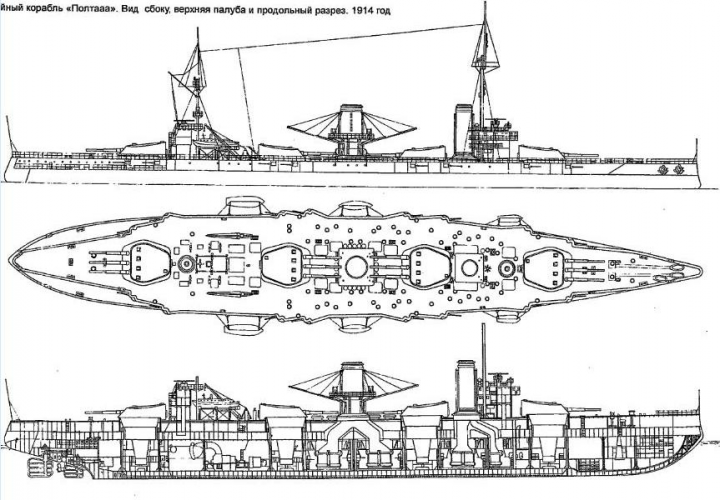
Well, yes, it was supposed to be extensive. Basically the ship was gonna be changed from this -

1780665470747.png

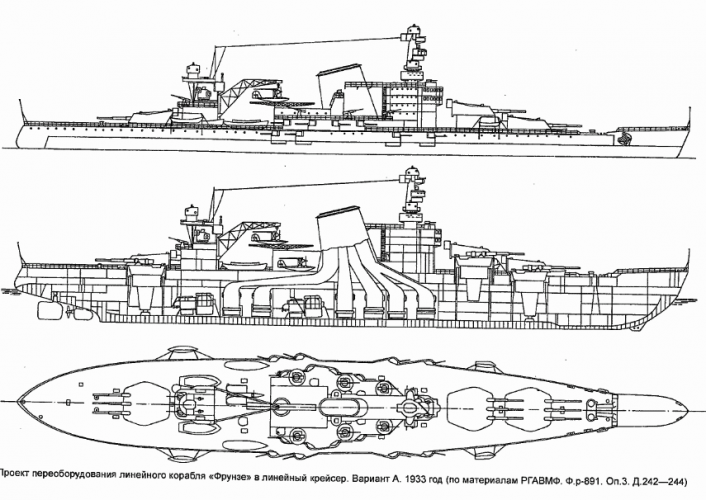
To this:

1780665482810.png

They project suggested to leave "A" and "X" turrets in their place, but move turret "P" on a new superfiring position (making it turret "B") and remove turret "Q" completely.

The space, freed by midship turrets removal, would be used to install a new boilers - from the stockpile, left from incomplete "Izmail"-class battlecruisers - and new set of cruising speed turbines. The goal was to achieve 30-knot speed (albeit 27 knots was also considered sufficient). To improve hydrodynamic, the bow was planned to be lenghtened, and internal bulkhead strenghtened to improve anti-torpedo protection.

(sorry for offtop, but this ship is important in my AH)
 
Whoa! That's on the order of "Kongo rebuild" extensive!
More than that - close to Italian battleship's rebuild. Alas, proponents of the plan never managed to persuade leadership enough, so despite several attempts, it was ultimately not fulfilled. I always considered this a major mistake - rebuilding "Frunze" would provide Soviet industry with valuable experience it lacked...

P.S. But let's not derail the thread, shall we?) After all, it's about post-war Soviet Navy, not pre-war)
 
I was thinking about scrapping the Kuznetsov and building an improved Kiev class to support the Yak-141, with funds devoted to the Mig-29K and Su-33.
 
As to the thread topic instead of that diversion, I was kinda thinking more Papa class subs instead of Oscars. Or maybe Papa IIs, since there were issues with the original Papa.
 
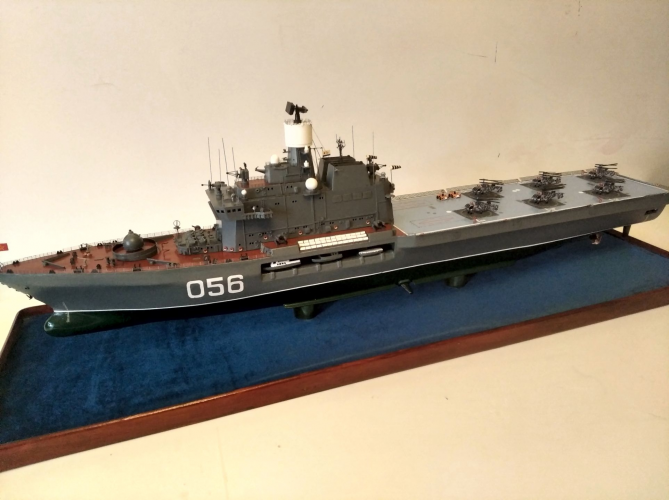
Pr.10200 Khalzan

The Pr.10200 was designed on the initiative of Admiral N.N. Amelko as a relatively cheap ASW helicopter carrier. The design was evaluated against the Pr.1143 Kiev class and an ASW version of Pr.10780, where it turned out to have considerably worse search capability. The design also became nearly as expensive and complex as Pr.1143.5, too noisy, and unable to meet military structural strength and damage control requirements. Regardless of this it was planned in March 1980 to build two ships of this class at the Chernomorsky shipyard before 1990. However, this decision was revoked, and Khalzan re-designed into the Pr.11780 landing ship.
The Pr.10200 was based on the hull of the Pr.1609 Kapitan Smirnov fast container ship, however eventually only the underwater part of the hull and the power plant remained the same. The design was to also have a well deck and capacity to carry a battalion of marine infantry and 50-60 tanks.

Displacement full load, tons: 31,000
Length, metres: 229.4/212.2
Beam, metres: 39.2/30.0
Draught, metres: 9.9
Speed, knots: 27
Propulsion: 2 GTU, 50,000 shp

Missiles:
12 SA-N-9 Gauntlet (RZ-130 Kinzhal) vertical launchers.
Guns:
8 AK-630M 30 mm.
Helicopters:
28 Ka-27 Helix-A.


Most of the information comes from postings on a Russian forum some years ago that has vanished since.

Now could someone please post pics of the Pr.11780 from the Russian forum linked above? :)
About project 1609 here are a lot of informationa and a lot of good images like this one:

https://karopka.ru/work/019d46e2-6fba-73a5-baa2-d58fcb2bd5a3
1786054246045.png
 
Back
Top Bottom