The vast majority of what.. post is other's work and that counts for many other CONTRIBUTORS. Copyright infringement mostly involves someone getting paid for some else's work so....
 
Last edited:
Reveals how the Abrams one shot 120mm was a inferior compromise compared to the RDF tank 90mm HV auto with its superior direct fire successful engagement capability and the MBT-70 152mm gun/launcher w/ its potential to have evolved to an indirect fire engagement capability. The two tanks that should have been.
It isn't. The gun-launcher was a PoS, it wasn't uncommon that you are either going to fire only ATGMs or only rounds due to how badly the system was designed (just firing one round of cannon ammunition is more than enough to damage the ATGM firing system to the point of combat ineffectiveness). The moment that the 105 got APFSDS ammunition that was actually practical, pretty much everyone in NATO abandoned the gun/launcher concept. Only the Russians and Israelis had any success with the concept.

Right now, we're at the end of cordite-based propellants (so to speak) and thus unable to get more oomph out of our guns. The Chinese had to increase the caliber and massively increase the case size just to get a conventional (i.e. something from the cordite 'tree') propellant to fling an APFSDS round at Mach 5. The only other way to increase the lethality of a gun is via upping the size and thus weight... which is considered the method of last resort for pretty much everyone.

Electrothermal Chemical guns are still decades away from implementation, so the only real way forward is upping the gun size...
152 mm gun/launcher proved a disaster on Sheridan light tank. Since cases were combustable, it was too easy for an ember to set the second round on fire before the breech locked closed.
As for increasing caliber ... that just leads to increasingly heavy tanks that are too heavy for bridges, much less air-dropping.
 
Reveals how the Abrams one shot 120mm was a inferior compromise compared to the RDF tank 90mm HV auto with its superior direct fire successful engagement capability and the MBT-70 152mm gun/launcher w/ its potential to have evolved to an indirect fire engagement capability. The two tanks that should have been.
It isn't. The gun-launcher was a PoS, it wasn't uncommon that you are either going to fire only ATGMs or only rounds due to how badly the system was designed (just firing one round of cannon ammunition is more than enough to damage the ATGM firing system to the point of combat ineffectiveness). The moment that the 105 got APFSDS ammunition that was actually practical, pretty much everyone in NATO abandoned the gun/launcher concept. Only the Russians and Israelis had any success with the concept.

Right now, we're at the end of cordite-based propellants (so to speak) and thus unable to get more oomph out of our guns. The Chinese had to increase the caliber and massively increase the case size just to get a conventional (i.e. something from the cordite 'tree') propellant to fling an APFSDS round at Mach 5. The only other way to increase the lethality of a gun is via upping the size and thus weight... which is considered the method of last resort for pretty much everyone.

Electrothermal Chemical guns are still decades away from implementation, so the only real way forward is upping the gun size...
152 mm gun/launcher proved a disaster on Sheridan light tank. Since cases were combustable, it was too easy for an ember to set the second round on fire before the breech locked closed.
As for increasing caliber ... that just leads to increasingly heavy tanks that are too heavy for bridges, much less air-dropping.
We were discussing the mbt_70, which was not too heavy for bridges but was never given a chance similar to the RDF tank. The Russians continue to perfect gun launched missiles. The return of ram jet round will see the West do the same.
Of course, that just means the US as continental Europe will already, likely be, enslaved by Asia.

..love the Brits but their defense industry is broken.
 
Last edited:
Reveals how the Abrams one shot 120mm was a inferior compromise compared to the RDF tank 90mm HV auto with its superior direct fire successful engagement capability and the MBT-70 152mm gun/launcher w/ its potential to have evolved to an indirect fire engagement capability. The two tanks that should have been.
It isn't. The gun-launcher was a PoS, it wasn't uncommon that you are either going to fire only ATGMs or only rounds due to how badly the system was designed (just firing one round of cannon ammunition is more than enough to damage the ATGM firing system to the point of combat ineffectiveness). The moment that the 105 got APFSDS ammunition that was actually practical, pretty much everyone in NATO abandoned the gun/launcher concept. Only the Russians and Israelis had any success with the concept.

Right now, we're at the end of cordite-based propellants (so to speak) and thus unable to get more oomph out of our guns. The Chinese had to increase the caliber and massively increase the case size just to get a conventional (i.e. something from the cordite 'tree') propellant to fling an APFSDS round at Mach 5. The only other way to increase the lethality of a gun is via upping the size and thus weight... which is considered the method of last resort for pretty much everyone.

Electrothermal Chemical guns are still decades away from implementation, so the only real way forward is upping the gun size...
152 mm gun/launcher proved a disaster on Sheridan light tank. Since cases were combustable, it was too easy for an ember to set the second round on fire before the breech locked closed.
As for increasing caliber ... that just leads to increasingly heavy tanks that are too heavy for bridges, much less air-dropping.
The 152mm Shillelagh was a problematic system, but that doesn't mean that gun-launchers, with more modern tech, aren't a viable concept. Even the French ACRA, from roughly the same time, seems to have had much more potential.

The Russian 2A70 100mm (as on the BMP-3/BMD-4) does pretty much exactly what the 152mm on the Sheridan was supposed to do without any of the issues the Sheridan had (including excessive recoil that pulled the first two roadwheels off the ground when firing). It's an interesting approach for infantry support:
  • In high intensity operation, it provides ATGM capability
  • In all operations, but particularly in COIN/GWOT operations, it provides HE support for the infantry that is credible vs. buildings and strongpoints that would resist 25-30mm fire. If the enemy doesn't have armor, then it's easy to see the possibility of carrying some thermobaric and/or cannister/flechette rounds in place of the normal ATGM load out
A "modern" version of a 152mm gun/launcher would be an interesting option for vehicles in the 25-30 ton range that were infantry support oriented.
 
Reveals how the Abrams one shot 120mm was a inferior compromise compared to the RDF tank 90mm HV auto with its superior direct fire successful engagement capability and the MBT-70 152mm gun/launcher w/ its potential to have evolved to an indirect fire engagement capability. The two tanks that should have been.
It isn't. The gun-launcher was a PoS, it wasn't uncommon that you are either going to fire only ATGMs or only rounds due to how badly the system was designed (just firing one round of cannon ammunition is more than enough to damage the ATGM firing system to the point of combat ineffectiveness). The moment that the 105 got APFSDS ammunition that was actually practical, pretty much everyone in NATO abandoned the gun/launcher concept. Only the Russians and Israelis had any success with the concept.

Right now, we're at the end of cordite-based propellants (so to speak) and thus unable to get more oomph out of our guns. The Chinese had to increase the caliber and massively increase the case size just to get a conventional (i.e. something from the cordite 'tree') propellant to fling an APFSDS round at Mach 5. The only other way to increase the lethality of a gun is via upping the size and thus weight... which is considered the method of last resort for pretty much everyone.

Electrothermal Chemical guns are still decades away from implementation, so the only real way forward is upping the gun size...
152 mm gun/launcher proved a disaster on Sheridan light tank. Since cases were combustable, it was too easy for an ember to set the second round on fire before the breech locked closed.
As for increasing caliber ... that just leads to increasingly heavy tanks that are too heavy for bridges, much less air-dropping.
The 152mm Shillelagh was a problematic system, but that doesn't mean that gun-launchers, with more modern tech, aren't a viable concept. Even the French ACRA, from roughly the same time, seems to have had much more potential.

The Russian 2A70 100mm (as on the BMP-3/BMD-4) does pretty much exactly what the 152mm on the Sheridan was supposed to do without any of the issues the Sheridan had (including excessive recoil that pulled the first two roadwheels off the ground when firing). It's an interesting approach for infantry support:
  • In high intensity operation, it provides ATGM capability
  • In all operations, but particularly in COIN/GWOT operations, it provides HE support for the infantry that is credible vs. buildings and strongpoints that would resist 25-30mm fire. If the enemy doesn't have armor, then it's easy to see the possibility of carrying some thermobaric and/or cannister/flechette rounds in place of the normal ATGM load out
A "modern" version of a 152mm gun/launcher would be an interesting option for vehicles in the 25-30 ton range that were infantry support oriented.
You dont even need to go 152mm these days to get good performance out of it.

The US Armys XM1111 Mid-Range Munition could be shot out of a 120mm. It even came in HEAT and Kinetic versions that was independent of the the firing velocity since it had its own engine. With the KE one expected to kill any future tank.

Was ment to allow tank beyond line of sight ability with it inbuilt seeker.

Shame it was part of the Future Combat System, and was canceled with it.

The KE version be real useful to fire out of a Low pressure gun to kill tanks while you use a slot HEat round for everything else.
 
Reveals how the Abrams one shot 120mm was a inferior compromise compared to the RDF tank 90mm HV auto with its superior direct fire successful engagement capability and the MBT-70 152mm gun/launcher w/ its potential to have evolved to an indirect fire engagement capability. The two tanks that should have been.
It isn't. The gun-launcher was a PoS, it wasn't uncommon that you are either going to fire only ATGMs or only rounds due to how badly the system was designed (just firing one round of cannon ammunition is more than enough to damage the ATGM firing system to the point of combat ineffectiveness). The moment that the 105 got APFSDS ammunition that was actually practical, pretty much everyone in NATO abandoned the gun/launcher concept. Only the Russians and Israelis had any success with the concept.

Right now, we're at the end of cordite-based propellants (so to speak) and thus unable to get more oomph out of our guns. The Chinese had to increase the caliber and massively increase the case size just to get a conventional (i.e. something from the cordite 'tree') propellant to fling an APFSDS round at Mach 5. The only other way to increase the lethality of a gun is via upping the size and thus weight... which is considered the method of last resort for pretty much everyone.

Electrothermal Chemical guns are still decades away from implementation, so the only real way forward is upping the gun size...
152 mm gun/launcher proved a disaster on Sheridan light tank. Since cases were combustable, it was too easy for an ember to set the second round on fire before the breech locked closed.
As for increasing caliber ... that just leads to increasingly heavy tanks that are too heavy for bridges, much less air-dropping.
There is literally no other option for tank guns, I'm afraid. Armor has finally caught up to guns right now, and the only way to penetrate the armor effectively is up-gunning. You would think that up-caliber-ing would be effective but, not really, especially with the US using DU rounds (which have to have a velocity of 1.55km/s to be actually effective, at least if you want to take advantage of its various properties).
Reveals how the Abrams one shot 120mm was a inferior compromise compared to the RDF tank 90mm HV auto with its superior direct fire successful engagement capability and the MBT-70 152mm gun/launcher w/ its potential to have evolved to an indirect fire engagement capability. The two tanks that should have been.
It isn't. The gun-launcher was a PoS, it wasn't uncommon that you are either going to fire only ATGMs or only rounds due to how badly the system was designed (just firing one round of cannon ammunition is more than enough to damage the ATGM firing system to the point of combat ineffectiveness). The moment that the 105 got APFSDS ammunition that was actually practical, pretty much everyone in NATO abandoned the gun/launcher concept. Only the Russians and Israelis had any success with the concept.

Right now, we're at the end of cordite-based propellants (so to speak) and thus unable to get more oomph out of our guns. The Chinese had to increase the caliber and massively increase the case size just to get a conventional (i.e. something from the cordite 'tree') propellant to fling an APFSDS round at Mach 5. The only other way to increase the lethality of a gun is via upping the size and thus weight... which is considered the method of last resort for pretty much everyone.

Electrothermal Chemical guns are still decades away from implementation, so the only real way forward is upping the gun size...
152 mm gun/launcher proved a disaster on Sheridan light tank. Since cases were combustable, it was too easy for an ember to set the second round on fire before the breech locked closed.
As for increasing caliber ... that just leads to increasingly heavy tanks that are too heavy for bridges, much less air-dropping.
The 152mm Shillelagh was a problematic system, but that doesn't mean that gun-launchers, with more modern tech, aren't a viable concept. Even the French ACRA, from roughly the same time, seems to have had much more potential.

The Russian 2A70 100mm (as on the BMP-3/BMD-4) does pretty much exactly what the 152mm on the Sheridan was supposed to do without any of the issues the Sheridan had (including excessive recoil that pulled the first two roadwheels off the ground when firing). It's an interesting approach for infantry support:
  • In high intensity operation, it provides ATGM capability
  • In all operations, but particularly in COIN/GWOT operations, it provides HE support for the infantry that is credible vs. buildings and strongpoints that would resist 25-30mm fire. If the enemy doesn't have armor, then it's easy to see the possibility of carrying some thermobaric and/or cannister/flechette rounds in place of the normal ATGM load out
A "modern" version of a 152mm gun/launcher would be an interesting option for vehicles in the 25-30 ton range that were infantry support oriented.
Thing is, for NATO, the experience was so bad that it turned everyone within NATO (especially the US) off of any such system. So you have to use a standard cannon. Out of the various 'western' nations, only Israel is using such technology.
Reveals how the Abrams one shot 120mm was a inferior compromise compared to the RDF tank 90mm HV auto with its superior direct fire successful engagement capability and the MBT-70 152mm gun/launcher w/ its potential to have evolved to an indirect fire engagement capability. The two tanks that should have been.
It isn't. The gun-launcher was a PoS, it wasn't uncommon that you are either going to fire only ATGMs or only rounds due to how badly the system was designed (just firing one round of cannon ammunition is more than enough to damage the ATGM firing system to the point of combat ineffectiveness). The moment that the 105 got APFSDS ammunition that was actually practical, pretty much everyone in NATO abandoned the gun/launcher concept. Only the Russians and Israelis had any success with the concept.

Right now, we're at the end of cordite-based propellants (so to speak) and thus unable to get more oomph out of our guns. The Chinese had to increase the caliber and massively increase the case size just to get a conventional (i.e. something from the cordite 'tree') propellant to fling an APFSDS round at Mach 5. The only other way to increase the lethality of a gun is via upping the size and thus weight... which is considered the method of last resort for pretty much everyone.

Electrothermal Chemical guns are still decades away from implementation, so the only real way forward is upping the gun size...
152 mm gun/launcher proved a disaster on Sheridan light tank. Since cases were combustable, it was too easy for an ember to set the second round on fire before the breech locked closed.
As for increasing caliber ... that just leads to increasingly heavy tanks that are too heavy for bridges, much less air-dropping.
The 152mm Shillelagh was a problematic system, but that doesn't mean that gun-launchers, with more modern tech, aren't a viable concept. Even the French ACRA, from roughly the same time, seems to have had much more potential.

The Russian 2A70 100mm (as on the BMP-3/BMD-4) does pretty much exactly what the 152mm on the Sheridan was supposed to do without any of the issues the Sheridan had (including excessive recoil that pulled the first two roadwheels off the ground when firing). It's an interesting approach for infantry support:
  • In high intensity operation, it provides ATGM capability
  • In all operations, but particularly in COIN/GWOT operations, it provides HE support for the infantry that is credible vs. buildings and strongpoints that would resist 25-30mm fire. If the enemy doesn't have armor, then it's easy to see the possibility of carrying some thermobaric and/or cannister/flechette rounds in place of the normal ATGM load out
A "modern" version of a 152mm gun/launcher would be an interesting option for vehicles in the 25-30 ton range that were infantry support oriented.
You dont even need to go 152mm these days to get good performance out of it.

The US Armys XM1111 Mid-Range Munition could be shot out of a 120mm. It even came in HEAT and Kinetic versions that was independent of the the firing velocity since it had its own engine. With the KE one expected to kill any future tank.

Was ment to allow tank beyond line of sight ability with it inbuilt seeker.

Shame it was part of the Future Combat System, and was canceled with it.

The KE version be real useful to fire out of a Low pressure gun to kill tanks while you use a slot HEat round for everything else.
HEAT is going the way of the dodo, from what I can understand. Largely because armor schemes and technology have been rendering it impudent. With EMRA (Electromagnetic Reactive Armor) slowly becoming a thing and composite/laminate armor schemes requiring stupidly large warheads to make viable while ADS is going to make top-attack munitions harder to utilize...

... then add to the fact that we'll be getting armored exoskeletons in the near future...
 
HEAT is going the way of the dodo, from what I can understand. Largely because armor schemes and technology have been rendering it impudent. With EMRA (Electromagnetic Reactive Armor) slowly becoming a thing and composite/laminate armor schemes requiring stupidly large warheads to make viable while ADS is going to make top-attack munitions harder to utilize...

... then add to the fact that we'll be getting armored exoskeletons in the near future...
Was leaning more on the the HE is of the High Explosive anti tank of the acroymon.

We always will need to be able to make a good size hole in something, and Frags will still mess people up so taht not going away for a LONG time.
 
HEAT is going the way of the dodo, from what I can understand. Largely because armor schemes and technology have been rendering it impudent. With EMRA (Electromagnetic Reactive Armor) slowly becoming a thing and composite/laminate armor schemes requiring stupidly large warheads to make viable while ADS is going to make top-attack munitions harder to utilize...

... then add to the fact that we'll be getting armored exoskeletons in the near future...
Was leaning more on the the HE is of the High Explosive anti tank of the acroymon.

We always will need to be able to make a good size hole in something, and Frags will still mess people up so taht not going away for a LONG time.
Not really. The thing about the exoskeleton research is that it's basically one hop and a skip away from being genuine power armor (the biggest stumbling block has always been powerplant, or more specifically the lack of capable powerplant). Add this with the fact that we're starting to implement Battletech metallurgy (mere decades ago anyone who knew about metallurgy would laugh at the idea that Battletech's EndoSteel would be an actual thing, back in 2016, people aren't laughing) in addition to that... the implications are rather disruptive to our understanding of combat.

Remember, HE and friends rely not on explosive power but shrapnel to do damage to infantry. What happens when the fragmentation isn't as potent?
 
There is literally no other option for tank guns, I'm afraid. Armor has finally caught up to guns right now, and the only way to penetrate the armor effectively is up-gunning. You would think that up-caliber-ing would be effective but, not really, especially with the US using DU rounds (which have to have a velocity of 1.55km/s to be actually effective, at least if you want to take advantage of its various properties).
IMHO guns look like they are still the best option for main battle tanks, but there are others. A medium caliber gun (50-76mm) and LOSAT/CKEM would be a kinetic energy approach, top attack is an option (with HEAT or SFF) esp from a 152mm Gun-Launcher, and a good sized thermobaric warhead might be more than enough for a firepower (and even mobility) kill, by disabling all the optics, the APS, and probably the secondary and quite possibly the main armament.

Also, as great a solution as a long 120mm gun, a 130mm, or a 140mm gun might be for anti-tank work, they are massive overkill for HE oriented work and, as barrels get longer, will be make tanks less maneuverable in dense or urban terrain. So horses for courses . . .

Thing is, for NATO, the experience was so bad that it turned everyone within NATO (especially the US) off of any such system. So you have to use a standard cannon. Out of the various 'western' nations, only Israelis using such technology.
Agree. Technically Cockerill has the Falarick, designed with a Ukrainian company, so there is a NATO country produced gun launched missile, but I don't know of any "western" country adopting it.

The US has a long and sad history of trying to do things 5-10 years to early and then dumping great concepts. NLOS and FOG-M come to mind . . .

HEAT is going the way of the dodo, from what I can understand. Largely because armor schemes and technology have been rendering it impudent. With EMRA (Electromagnetic Reactive Armor) slowly becoming a thing and composite/laminate armor schemes requiring stupidly large warheads to make viable while ADS is going to make top-attack munitions harder to utilize...


... then add to the fact that we'll be getting armored exoskeletons in the near future...

I agree that HEAT is having a much tougher time ever since improved armor types/arrays appeared, but it still seems reliable enough, especially in larger missiles (e.g., Hellfire). It's true that HEAT warheads are getting larger and more complex (e.g., precursor charges), requiring larger, more expensive missiles, but a 60-70 ton tank with a complex armor array, an RWS, and an APS is a very expensive target, so it's still worth building the bigger missiles . . . at least for now.

I think APS is probably a bigger threat to relatively low velocity, HEAT based antitank weapons than armor technology but we'll see.

 
There is literally no other option for tank guns, I'm afraid. Armor has finally caught up to guns right now, and the only way to penetrate the armor effectively is up-gunning. You would think that up-caliber-ing would be effective but, not really, especially with the US using DU rounds (which have to have a velocity of 1.55km/s to be actually effective, at least if you want to take advantage of its various properties).
IMHO guns look like they are still the best option for main battle tanks, but there are others. A medium caliber gun (50-76mm) and LOSAT/CKEM would be a kinetic energy approach, top attack is an option (with HEAT or SFF) esp from a 152mm Gun-Launcher, and a good sized thermobaric warhead might be more than enough for a firepower (and even mobility) kill, by disabling all the optics, the APS, and probably the secondary and quite possibly the main armament.

Also, as great a solution as a long 120mm gun, a 130mm, or a 140mm gun might be for anti-tank work, they are massive overkill for HE oriented work and, as barrels get longer, will be make tanks less maneuverable in dense or urban terrain. So horses for courses . . .

Thing is, for NATO, the experience was so bad that it turned everyone within NATO (especially the US) off of any such system. So you have to use a standard cannon. Out of the various 'western' nations, only Israelis using such technology.
Agree. Technically Cockerill has the Falarick, designed with a Ukrainian company, so there is a NATO country produced gun launched missile, but I don't know of any "western" country adopting it.

The US has a long and sad history of trying to do things 5-10 years to early and then dumping great concepts. NLOS and FOG-M come to mind . . .

HEAT is going the way of the dodo, from what I can understand. Largely because armor schemes and technology have been rendering it impudent. With EMRA (Electromagnetic Reactive Armor) slowly becoming a thing and composite/laminate armor schemes requiring stupidly large warheads to make viable while ADS is going to make top-attack munitions harder to utilize...


... then add to the fact that we'll be getting armored exoskeletons in the near future...

I agree that HEAT is having a much tougher time ever since improved armor types/arrays appeared, but it still seems reliable enough, especially in larger missiles (e.g., Hellfire). It's true that HEAT warheads are getting larger and more complex (e.g., precursor charges), requiring larger, more expensive missiles, but a 60-70 ton tank with a complex armor array, an RWS, and an APS is a very expensive target, so it's still worth building the bigger missiles . . . at least for now.

I think APS is probably a bigger threat to relatively low velocity, HEAT based antitank weapons than armor technology but we'll see.
The thing is, APS is capable of plucking APFSDS out of the air, which is disastrous for anything not hypersonic (where the plasma sheath protects the missile from pretty much anything that is not a UV laser ADS/PDL). So those Hellfires? They're not going to have a good time.
 
There's not a lot a T-72B3 can do to stop a Hellfire besides maybe ask a Pantsir to shoot at it, or shoot the gunship before it launches, really. Given how effective the latter has been in Syria this is a somewhat dubious proposition. There is no APS that can protect against APFSDS in service with the Russian Army. Or any army, for that matter. I'm not even sure there is one period, besides on the couple dozen T-14s that have been built, and those can only protect against top attack weapons, though that's just a smoke grenade.

The Russian Army has never really liked Arena since it makes the T-72 very tall, although Arena-M seems to have solved that partially, but I don't think it's actually in service in large quantities since it's still in testing IIRC.
 
" ... The Russian Army has never really liked Arena since it makes the T-72 very tall, although Arena-M seems to have solved that partially, but I don't think it's actually in service in large quantities since it's still in testing IIRC."
Quantity is the key variable. While Russia may have invented active armor, it is still expensive. We question how expensive it will be to up-armor all of Russia's fleet of tanks.
Third World countries will require decades to up-armor all their tanks. There is also the question about whether Third World armies can afford to maintain armor that sophisticated. One little "best before due date" in armor software can render it useless if they do not pay Russia for updates.
 
" ... The Russian Army has never really liked Arena since it makes the T-72 very tall, although Arena-M seems to have solved that partially, but I don't think it's actually in service in large quantities since it's still in testing IIRC."
Quantity is the key variable. While Russia may have invented active armor, it is still expensive. We question how expensive it will be to up-armor all of Russia's fleet of tanks.
Third World countries will require decades to up-armor all their tanks. There is also the question about whether Third World armies can afford to maintain armor that sophisticated. One little "best before due date" in armor software can render it useless if they do not pay Russia for updates.
That and Russia is currently the equivalent of Italy in terms of economy, but everyone and their brother is investing in ADS systems and quite a few of the more modern systems are anti-APFSDS capable and having spots on their tanks and vehicles to add them on.
 
The thing is, APS is capable of plucking APFSDS out of the air, which is disastrous for anything not hypersonic (where the plasma sheath protects the missile from pretty much anything that is not a UV laser ADS/PDL). So those Hellfires? They're not going to have a good time.

I wouldn't say this if you weren't uniquely quick on the "Haha" smiley trigger, but this is a remarkably ill-informed post.

Something shaped for hypersonic velocities at close to sea level (like an APFSDS penetrator, for example) is unlikely to be "protected" by a plasma sheath, especially on the frontal aspect.

APS systems do not "pluck" APFSDS out of the air. Systems effective against KE penetrators typically only deflect them using blast or impact, reducing penetration by some percentage depending on engagement range.

The most effective active defense against KE penetrators seems to be launching a plate of some kind towards them, reducing penetration by over 90 percent. It's hard to see how a plasma sheath would offer any protection against impacting a flying armor plate, or how a laser would be more effective.

Even APS systems designed for use against slower HEAT missiles tend to suffer from residual penetration that varies depending on warhead size and engagement range.

APS isn't magic.
 
Last edited:
There are some decent materials simulations being done by people on Youtube that show, more or less, what ERA and APS really do. They're pretty neat.

View: https://www.youtube.com/watch?v=YUlNU-uziF4

View: https://www.youtube.com/watch?v=nsJQe3i2dvE

Aside from Afghanit (maybe), I can't think of any APS that has even marginal capability against LRPs being used by any country in the world. They get shown around trade shows a lot but no one is running off to buy them and the companies and engineers that make those sorts of things are getting merged and moved around quite often.
 
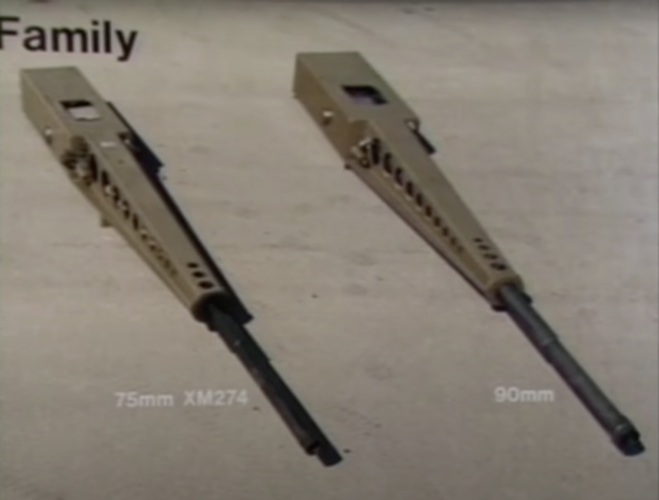
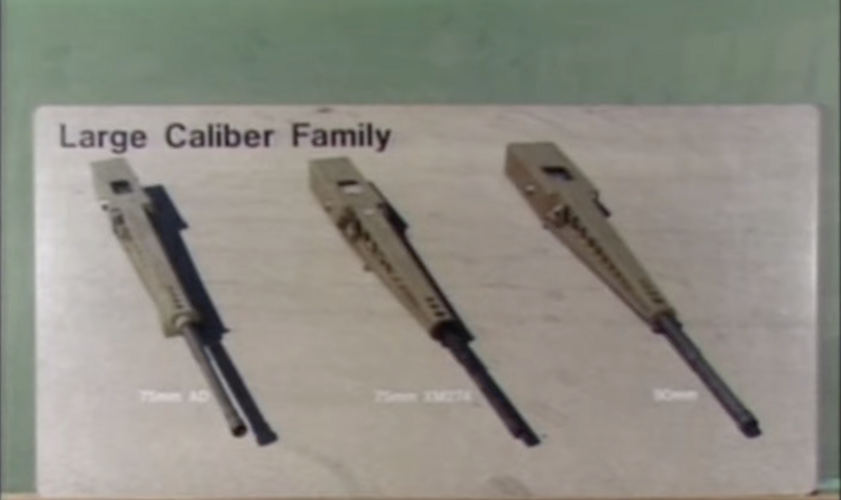
Photo of the 75mm and 90mm CTA automatic smoothbore cannons from the Smithsonian "Stoner Tapes" interview. The 90mm was an enlarged XM274; built when the Army demanded additional firepower to cope with future Soviet Armor. The heavier gun led to the Marines pulling out of the project to due weight concerns, leading to the program to collapse and reform into the Armored Gun System program (AGS).

90mm CTA.png


Attachments

  • ARES CTA.png
    ARES CTA.png
    2 MB · Views: 115
Photo of the 75mm and 90mm CTA automatic smoothbore cannons from the Smithsonian "Stoner Tapes" interview. The 90mm was an enlarged XM274; built when the Army demanded additional firepower to cope with future Soviet Armor. The heavier gun led to the Marines pulling out of the project to due weight concerns, leading to the program to collapse and reform into the Armored Gun System program (AGS).

View attachment 710316

as mentioned in the vid, a 105mm version was being tested. ..would have been a transformational capability.

PS: a priceless vid BTW Muchos Gracias Isayyo2 for postin.
 
Photo of the 75mm and 90mm CTA automatic smoothbore cannons from the Smithsonian "Stoner Tapes" interview. The 90mm was an enlarged XM274; built when the Army demanded additional firepower to cope with future Soviet Armor. The heavier gun led to the Marines pulling out of the project to due weight concerns, leading to the program to collapse and reform into the Armored Gun System program (AGS).

View attachment 710316

at the ~37:45 Mr. Stoner starts discussing sizes & rates like 2 rds a sec... say what!

starting @44:50 Mr Stoner wryly points out "you can draw your own conclusions."
 
Last edited:
at the ~37:45 Mr. Stoner starts discussing sizes & rates like 2 rds a sec... say what!

starting @44:50 Mr Stoner wryly points out "you can draw your own conclusions."
I mean, the XM274 was reliably doing 60rpm out of the 75mm... You can push things faster than that, but I'm pretty sure an MBT would not like catching 3 rounds in 3 seconds.
 
I would assume (we all know what that means) that it was similar to the TTS used on the M60A3, etc.

The RDF-LT was using a laser rangefinder, right?
Yeah, the fire control system of the HSTV-L (maybe RDF-LT) had auto-tracking and a laser rangefinder. I'm pretty sure the reticle was different from the M60A3 but yeah, might be impossible to find.

Edit: the TTS on the M60A3 was the Raytheon AN/VSG-2, so not similar to the HSTV-L.
 
Good day,
I was wondering if are there any available Videos of any of these vehicles?
Thanks in advance if yes
 
I mean, the XM274 was reliably doing 60rpm out of the 75mm... You can push things faster than that, but I'm pretty sure an MBT would not like catching 3 rounds in 3 seconds.
I suspect that even if it didn't out right lollipop the turret . It would certainly mission kill it rather effectively.
It probably wouldn't be much fun for the crew either. People tend to be soft and squishy and liable to spring inconvenient leaks when encountering high velocity fragments.
 
And your point is what again? The render is still a futuristic concept.
Hi jsport, I am the creator of this space engineers build and I would like to clear the air. The build was made several years ago when I was new to tank building in that game, and there was no intention by me to make a "future proposal" or conceptual HSTV-L. I was simply enamoured by the tank, and had very limited blocks available to me to build it correctly, additionally I was also very new to building this calibre of thing so the final product looks substantially different to the real thing.
I apologise for any confusion caused by my build, however I also find some great humour in that my ancient space engineers build has found its way onto a forum such as this one.
If you have any questions, please feel free to reply - Archie
 
The problem of rapid firing gun is dispersion. Say 60 or 120 rpm, 75mm high velocity on light vehicle. That will be recoiled as hell and i guess dispersion will be huge like 5m at 1000m. The first round may be accurate but the following round, there is no way you can control accuracy as the whole system is still in vibration.

So no matter rate of fire, maybe half or three quarter will be missed tank size target, which renders the whole point of rapid firing anti tank gun useless. If you single shot then you turn back to traditional system
 
Hi jsport, I am the creator of this space engineers build and I would like to clear the air. The build was made several years ago when I was new to tank building in that game, and there was no intention by me to make a "future proposal" or conceptual HSTV-L. I was simply enamoured by the tank, and had very limited blocks available to me to build it correctly, additionally I was also very new to building this calibre of thing so the final product looks substantially different to the real thing.
I apologise for any confusion caused by my build, however I also find some great humour in that my ancient space engineers build has found its way onto a forum such as this one.
If you have any questions, please feel free to reply - Archie
Thank you for the detailed response. You r an accomplished and creative artist.IMHO no one believes or belived his is new product proposal, but again great work.
 
The problem of rapid firing gun is dispersion. Say 60 or 120 rpm, 75mm high velocity on light vehicle. That will be recoiled as hell and i guess dispersion will be huge like 5m at 1000m. The first round may be accurate but the following round, there is no way you can control accuracy as the whole system is still in vibration.

So no matter rate of fire, maybe half or three quarter will be missed tank size target, which renders the whole point of rapid firing anti tank gun useless. If you single shot then you turn back to traditional system
The problem is there are various types of recoil mitigation technologies ie developed under MRAAS ie variable muzzle brake et al +rarefaction (RAVEN) which might reduce recoil over 80% and dispersion would be thus reduced.
 
The problem of rapid firing gun is dispersion. Say 60 or 120 rpm, 75mm high velocity on light vehicle. That will be recoiled as hell and i guess dispersion will be huge like 5m at 1000m. The first round may be accurate but the following round, there is no way you can control accuracy as the whole system is still in vibration.

So no matter rate of fire, maybe half or three quarter will be missed tank size target, which renders the whole point of rapid firing anti tank gun useless. If you single shot then you turn back to traditional system
That ARES 75mm had a dispersion of less than half a meter at 1km, in rapid-fire.
 
1 moa is about 1 inch for 100 yards or 3cm at 100m.

50cm at 1km is less than 2 moa. A 1 moa is a good sniper rifle, sub moa do exist but that is still good. And 1 moa group is single careful shot each time.

1 moa gun in rapid mode will be easily 5 moa in burst mode, e.g 1.5m at 1000m.

There are some guns specifically designed for accurate burst but, they are short burst like 2 or 3 rounds, and very mechanically complexed, i.e g11 and an94.

Also these guns are designed for accurate burst often has very high rate of fire to shot the second or third round before the gun even recoiled fully.

Now applied to this gun. There is no sign of specially designed for accurate burst. The rate is low, i.e 60 or 120 rpm which the gun will be fully recoiled. High velocity medium caliber, the recoil will be strong. So double it could achieve 0.5m rapid fire at 1km.

Design a small group at rapid fire is extremely hard. The barrel is reflexed and bend, the whole system move and vibration. So it seems your information is quite incorrect.
 
Design a small group at rapid fire is extremely hard. The barrel is reflexed and bend, the whole system move and vibration. So it seems your information is quite incorrect
No you bias is.

This is literally test data off the vehicles they design for.

They average a half a meter dispersion at 1km at full rate of fire.

Was the whole point of the design and they succeeded.

It's a hard fact with documentation.
 
Maybe, do you have the document?
 
Lol, i doubt any of you can provide document for dispersion smaller than 0.5m at 1km in rapid mode.

First of all, this is an old project before 1990s, so most likely docs are archived. Maybe some of the members here have high clearance but i doubt anyone pay that much attention to a small project. Even if it's not secret, digging those would take a lot of time.

Secondly, assume some ppl already did the job of finding dispersion data of rapid firing 75mm, if two random members on internet also have read it, it's very likely widely published. But quick google provides nothing. Which means both of you must have clearance and access to highly sensitive non public material, which is very unlikely.

You two may have access to non public matters, but it proved both of you must worked in the same field, or have the same special interest, e.g land vehicle, armored, anti tank, 80s era.. which very low possibility, likely zero chance happened.

Thirdly, wiki said, in 1979, it failed dispersion test, and after fixing that, it gets dispersion similar to mbt, imo which means 1 moa or 0.3 mil or 30cm at 1km. But this is for single shot only. There is no dispersion for burst mentioned.

There's no thing indicated burst shot has smaller than 50cm while single shot dispersion already is 30cm, which is very low. And i doubt anyone can cited a source as reasons mentioned above. Maybe you mistaken this and translated to rapid fire dispersion.

All special designed gun system like g11 or an94 have much higher dispersion. A large gun like 75mm is harder since making large heavy precision components are harder and more expensive.
 
Hi, little later (20 years) but what's the link/download to the PDF on the 76mm RDF/LT
 

Similar threads

Back
Top Bottom