Dornier / BGT Viper AAM

overscan (PaulMM)

Administrator
Staff member
Joined
27 December 2005
Messages
19,230
Reaction score
35,692
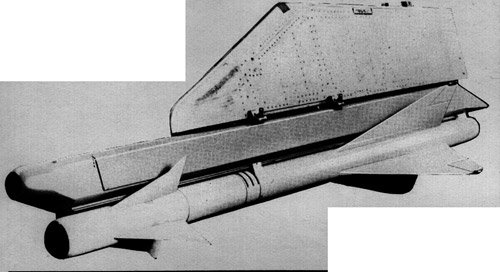
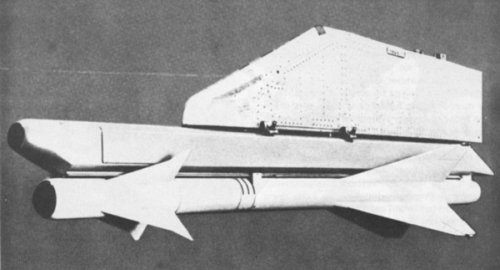
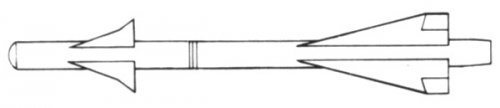
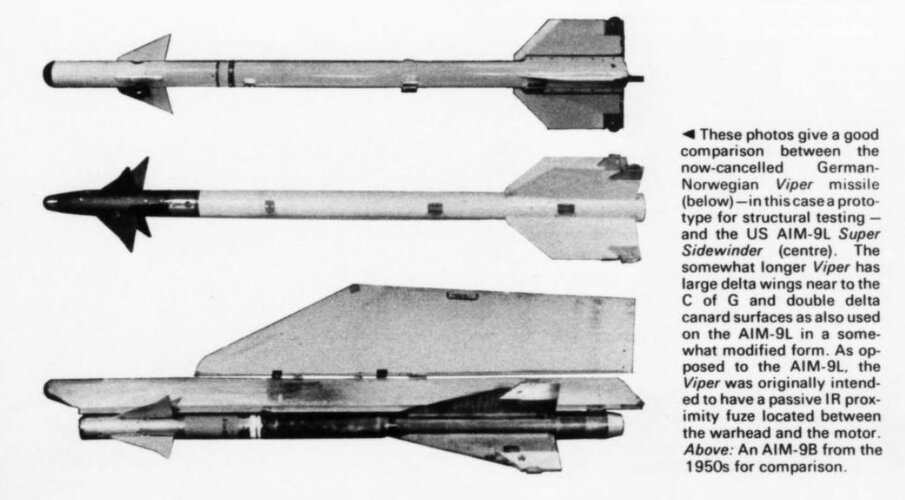
Development of Viper was initiated by Dornier and BGT in 1969 as a Sidewinder (AIM-9B) replacement. It used a improved seeker, featuring increased sensitivity, wider look angle, and increased tracking rate. Improvements to the rocket motor and aerodynamics increased the range. One very odd feature was the IR search and acquisition unit in the missile launcher, which allowed multitarget engagement by not having to rely on the host aircraft to locate a target.

Expected first flight was 1975, with service entry on the F-4F and MRCA in 1977.

The project was cancelled in 1974 because of the US AIM-9L program, though Viper was superior in a number of aspects.

Sources
Jane's Weapons Systems 1974-75 p143
Illustrated Encyclopaedia of the Worlds Rockets & Missiles Bill Gunston, 1979 p213
 

Attachments

  • Viper01.jpg
    Viper01.jpg
    34.4 KB · Views: 1,106
  • Viper02.jpg
    Viper02.jpg
    38.9 KB · Views: 1,007
  • Viper03.jpg
    Viper03.jpg
    8.6 KB · Views: 1,014
Ha i hoped the forum had something about this missile ;D

Does somebody know if the missile seeker had all aspect capabilities like the aim-9L ?

thx
 
Bodenseewerk/Dornier Viper


These two companies are working, under Bundeswehr contract, on a Sidewinder replacement based on Bodenseewerk's experience gained during Sidewinder licence production. The company advanced its own technology by developing the Sidewinder 1A improved guidance and control unit, designated FGW Mod 2, which is unaffected by sun-reflecting surfaces and has a much smaller dead zone when approaching the target into sun.

Viper is a medium-range/dogfight missile with a motor burn time about double that of Sidewinder and a minimum effective range of 200m-300m. The motor is a new unit being developed by Kongsberg Vapenfabrik. The missile's launcher is equipped with an infra-red search unit to acquire targets and then point the Viper IR head in the correct direction. The launcher also houses a cooling unit for the IR heads.

Viper is designed to lock on to targets within a squint angle of ±15° while on the launcher, compared with Sidewinders ±2°. The prototype missile should be ready by the end of the year and service entry is scheduled for 1975-1976. MRCA and Alpha-Jet will be amongst the types to carry the weapon.
 
Last edited:
The seeker capabilities aren't impressive; given it compares off boresight seeker capabilities with the AIM-9B ones, I assume it was still a tail chaser, to enter service just when the US was getting the AIM-9L ready.....

Even the original R550 Magic missile had a 40º off boresight angle, although it was still mostly a rear chaser, with better angles and thus a larger fire envelope.
 
At the same time that they discussed the Lance program, the ministers also disclosed that Germany and Norway have signed an agreement for collaboration on the development of the Viper air-to-air missile. Dornier System has been conducting studies of the weapon for the German air force.
AWST June 18, 1973
Aerodynamic testing of Dornier Viper air-to-air missile for the German air force is scheduled to begin in Germany by year end. The missile’s solid rocket motor is now in test. The missile head, including infrared seeker, is operating on a functional mockup. Norway is participating with Germany in developing the propulsion system for the air-to—air missile (AW&ST June 18, p. 22).
AWST July 9, 1973
Germany plans to halt development of the Dornier Viper air-to-air infrared guided missile. The Viper had been envisioned as a follow-on to earlier
model U.S. Sidewinders. The Germans are discussing with the US. their role in operating the AIM-9L missile, and also a partnership with the US. in developing the next generation of infrared guided missile.
AWST November 11, 1974
Germany has halted development of its Dornier Viper air-to-air infrared missile, earlier thought to be a follow-on to older model Sidewinder missiles (AW&ST
Nov. 11, p. 11) and will procure the AIM-9L advanced Sidewinder for its inventory.
AWST December 23, 1974
 
Last edited:
Viper
Sidewinder follow-on under development for the German forces by Dornier System, using a Norwegian motor and guidance from Bodenseewerk, which produced Sidewinder guidance heads under licence. Viper improves on Sidewinder in target acquisition, launch requirements, thrust endurance, manoeuvring capability and proximity fuzing. The system includes test equipment. The launch rail can include a target-seeker to assist missile lock-on.

Flight International 25 October 1973
 
An article on Dornier Aerodyne and Viper was in the French Aviation Magazine, Issue 612 15/06/1973 (I don't have it).
 
Looks like Air Power magazine's prediction about the Kukri. But that ended up being a R550/Magic copy.
 
I finally got my hand on 'BGT - Die Geschichte eines Hochtechnologie-Unternehmens' which is the official history of BGT up to the acquisition by Diehl.
The book has some nice pictures and some background on the Viper.
It claims that the missile was primarily a BGT product, but that Dornier got the lead role because one of their project-management-teams had just gotten freed up by the canceling of the Korps-Aufklärungsdrohne while BGT would have had to build such a team from the ground up.

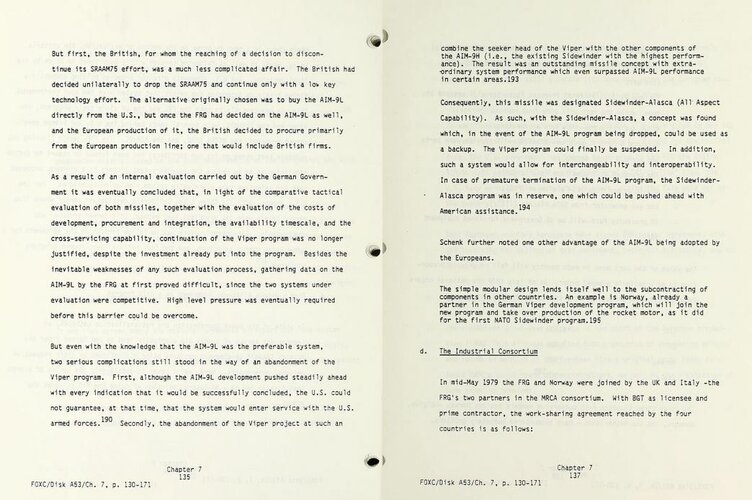
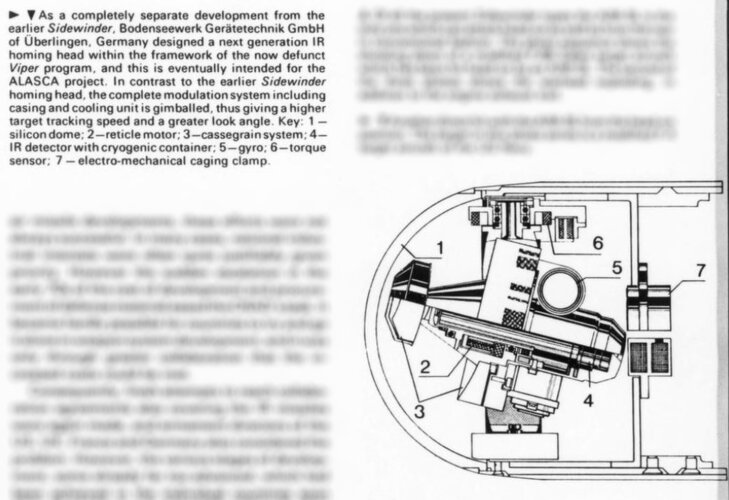
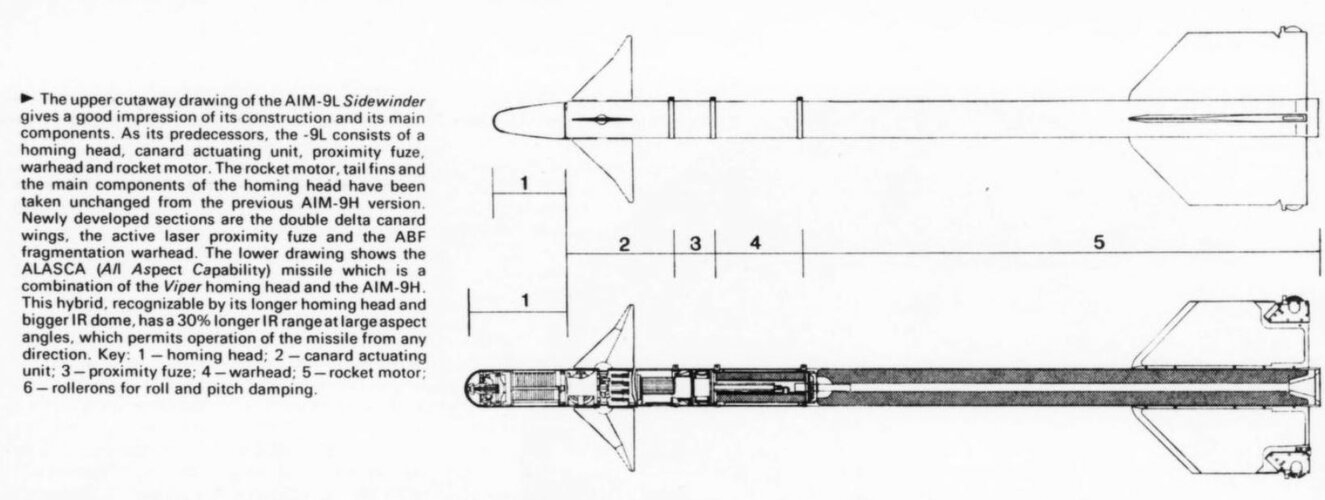
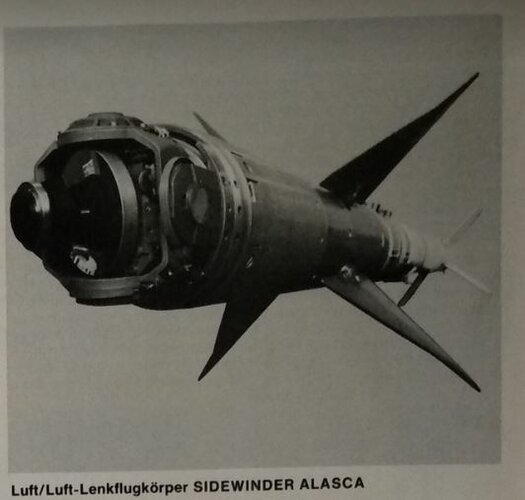
In 1974 apparently some issues with the AIM-9L seeker were discovered in testing that endangered the whole program, leading BGT to offer a hybrid of the AIM body with the Viper seeker-head. This combination was called ALASCA (All Aspect Capability). This solution was tested at China Lake until 1978, but returned to the background already in 1976, after the issues with the AIM-9L were resolved. The book claims that ALASCA had, compared to the AIM-9L, a 30% larger 'Seeker-detection-range' (Not sure if i translated that correctly, the original is "Suchkopf-Auffassreichweite").

Based on ALASCA BGT later also build the experimental SARS (Semi Active Radar Sidewinder) first in cooperation with GEC-Marconi and later with Motorola. But presumably this had very little left in common with the Viper.
 
In 1974 apparently some issues with the AIM-9L seeker were discovered in testing that endangered the whole program, leading BGT to offer a hybrid of the AIM body with the Viper seeker-head. This combination was called ALASCA (All Aspect Capability). This solution was tested at China Lake until 1978, but returned to the background already in 1976, after the issues with the AIM-9L were resolved. The book claims that ALASCA had, compared to the AIM-9L, a 30% larger 'Seeker-detection-range' (Not sure if i translated that correctly, the original is "Suchkopf-Auffassreichweite").
Unfortunately in the digitized version of 'NATO : a business history' the exact page talking about this is missing.
 

Attachments

  • viperpagemissing.JPG
    viperpagemissing.JPG
    142.6 KB · Views: 239
The seeker capabilities aren't impressive; given it compares off boresight seeker capabilities with the AIM-9B ones, I assume it was still a tail chaser, to enter service just when the US was getting the AIM-9L ready.....

Even the original R550 Magic missile had a 40º off boresight angle, although it was still mostly a rear chaser, with better angles and thus a larger fire envelope.

ALASCA stands foe "ALl ASpect CApability" so the BGT seeker was clearly pretty modern with cooling,
 
Last edited:
Looks like Air Power magazine's prediction about the Kukri. But that ended up being a R550/Magic copy.
Not really the case.
Kukri had features of both the AIM-9 and Magic, both of which were in the inventory at the time, so this was logical to look at both missiles when starting design.
The Magic and Kukri have a considerably different diameter, for example.
So not really a Magic "copy".
 
another picture of ALASCA
 

Attachments

  • ALASCAfoto.JPG
    ALASCAfoto.JPG
    31.8 KB · Views: 257
Development of Viper was initiated by Dornier and BGT in 1969 as a Sidewinder (AIM-9B) replacement. It used a improved seeker, featuring increased sensitivity, wider look angle, and increased tracking rate. Improvements to the rocket motor and aerodynamics increased the range. One very odd feature was the IR search and acquisition unit in the missile launcher, which allowed multitarget engagement by not having to rely on the host aircraft to locate a target.

Expected first flight was 1975, with service entry on the F-4F and MRCA in 1977.

The project was cancelled in 1974 because of the US AIM-9L program, though Viper was superior in a number of aspects.

Sources
Jane's Weapons Systems 1974-75 p143
Illustrated Encyclopaedia of the Worlds Rockets & Missiles Bill Gunston, 1979 p213
The images of the pylons... which aircraft do they belong to?
 
If the IRST in the pylon could send a signal to the radar display CRT in the cockpit, that would have been a pretty slick advance.
 
Last edited:
https://gallica.bnf.fr/ark:/12148/bd6t53332014/f3.item

maybe this is the one?

edit: yes this is the one
View attachment 749120View attachment 749119

i do request someone french to do the translations lol

i dont fully trust google translate
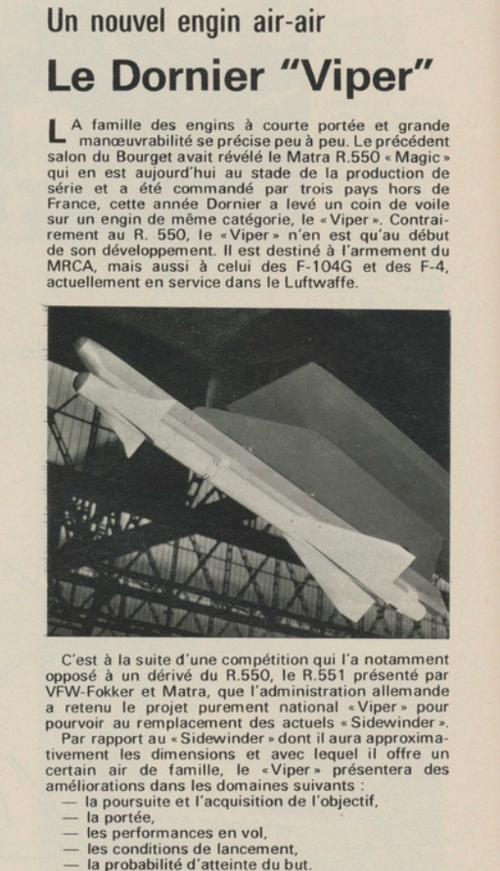
A New Air-to-Air Missile
The Dornier "Viper"

The family of short-range, high-maneuverability missiles is gradually taking shape. The previous Paris Air Show revealed the Matra R.550 "Magic," which is now in series production and has been ordered by three countries outside of France. This year, Dornier unveiled a new missile in the same category, the "Viper." Unlike the R.550, the "Viper" is only at the beginning of its development. It is intended to arm the MRCA, but also the F-104G and F-4, currently in service with the Luftwaffe.
It was following a competition that notably pitted it against a derivative of the R.550, the R.551 presented by VFW-Fokker and Matra, that the German administration selected the purely national "Viper" project to replace the current "Sidewinder" missiles.

Compared to the "Sidewinder," with which it will have approximately the same dimensions and with which it shares a certain family resemblance, the "Viper" will offer improvements in the following areas:

— target tracking and acquisition,
— range,
— flight performance,
— launch conditions,
— probability of hitting the target.

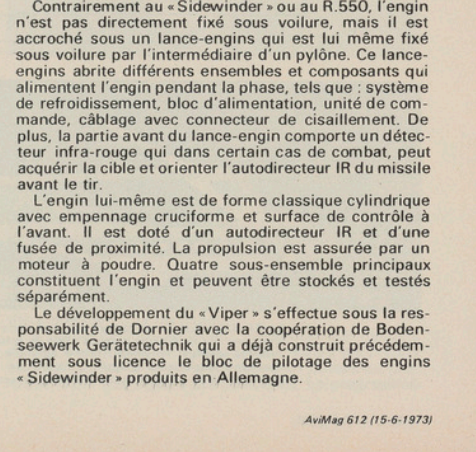
Unlike the "Sidewinder" or the R.550, the missile is not directly attached under the wing, but is suspended under a missile launcher which is itself attached under the wing by means of a pylon. This missile launcher houses various assemblies and components that power the missile during its operation, such as: a cooling system, a power supply, a control unit, and wiring with a shear connector. Furthermore, the front section of the missile launcher includes an infrared detector which, in certain combat scenarios, can acquire the target and orient the missile's IR seeker before firing.
The missile itself has a classic cylindrical shape with a cruciform tail and a control surface at the front. It is equipped with an IR seeker and a proximity fuse. Propulsion is provided by a solid-propellant motor. Four main sub-assemblies make up the missile and can be stored and tested separately. The development of the "Viper"is being carried out under the responsibility of Dornier with the cooperation of Bodenseewerk Gerâtetechnik, which had previously built under license the piloting unit of the "Sidewinder" vehicles produced in Germany.
 
I finally got my hand on 'BGT - Die Geschichte eines Hochtechnologie-Unternehmens' which is the official history of BGT up to the acquisition by Diehl.
The book has some nice pictures and some background on the Viper.
The Fleet Air Arm purchased 500 AIM-9B Sidewinders to arm their Scimitar aircraft. After the Scimitar went out of service, what remained of these missiles were transferred to the Buccaneer force and I believe that at some point they were upgraded to the FGW Mod 2 standard. In his post on this thread on 25 July 2013, "overscan (Paul MM)" gives the following brief details of the modification:
These two companies are working, under Bundeswehr contract, on a Sidewinder replacement based on Bodenseewerk's experience gained during Sidewinder licence production. The company advanced its own technology by developing the Sidewinder 1A improved guidance and control unit, designated FGW Mod 2, which is unaffected by sun-reflecting surfaces and has a much smaller dead zone when approaching the target into sun.
Does the BGT book give programme and technical details of the FGW Mod 2 upgrade to the AIM-9B Sidewinder by FGW/BGT, and of the UKs purchase of the FGW Mod 2 upgrade? Any advice on sources of this information would be appreciated.
 
Does the BGT book give programme and technical details of the FGW Mod 2 upgrade to the AIM-9B Sidewinder by FGW/BGT, and of the UKs purchase of the FGW Mod 2 upgrade? Any advice on sources of this information would be appreciated.
I dont have my copy at hand atm. I will try to get back to you in the first week of August.
 
Does the BGT book give programme and technical details of the FGW Mod 2 upgrade to the AIM-9B Sidewinder by FGW/BGT, and of the UKs purchase of the FGW Mod 2 upgrade? Any advice on sources of this information would be appreciated.
From 'BGT - Die Geschichte eines Hochtechnologie-Unternehmens' translated with DeepL:
However, the AIM-9B Sidewinder, equipped with an infrared seeker and originally developed to intercept bombers at high altitudes, quickly reached its inherent physical limits when deployed in Europe under European weather conditions and at low altitudes, and when facing small, manoeuvrable aircraft. A rapid solution had to be found so that the F-104G Starfighter interceptors, which were also built under licence in Europe, could carry out their tasks effectively.

First steps of our own
For BGT, as the main contractor, this meant taking a serious look at the missile’s design and performance, understanding the weaknesses that had emerged during deployment, and rectifying them as cost-effectively as possible. The outcome of these considerations led to modifications to the seeker and warhead. To reduce troublesome interference from the sun and sunlit cloud edges, the sensitivity of the lead sulphide detector was shifted from the near to the mid-infrared range using a Joule-Thomson cooler. The cooling gas supply required for this, in the form of a small cylinder, was housed in a separate compartment in the rear section of the seeker head. At the same time, the glass dome of the IR seeker head was replaced with a silicon dome more resistant to rain-erosion, the outdated tube-based electronics were converted to semiconductor technology, and the energy saved was used to introduce a permanent drive for the seeker head’s attitude gyroscope. The warhead was also given better insulation against the aerokinetic heating of the outer skin and the explosive charge beneath it, which occurs at high Mach numbers. A titanium casing, which provides better insulation, was used in place of the previous aluminium outer skin.
These modifications, developed primarily by BGT, led in 1969 to a second European Sidewinder production and modification programme under the designation AIM-9B/FGW Mod. 2. Germany once again took on the role of lead nation and BGT was once more appointed prime contractor. The customer nations included Germany, Denmark, the Netherlands and Norway. As in the first Sidewinder programme, the passive infrared proximity fuse was sourced from the USA. The entire development, testing and set-up of the production line were carried out in just four years, between 1965 and 1969, with a budget of 1.7 million DM – a modest sum by today’s standards. This also included the first attempts at missile system simulation at BGT, which were developed in collaboration with the German Aerospace Research and Test Institute (DFVLR) using analogue computers. By 1973, in addition to the production of 2,800 complete missiles for the German Air Force, a total of 3,779 retrofits of guidance and control components had been carried out for Germany, Denmark, the Netherlands and Norway. The AIM-9B/FGW Mod.2 Sidewinder programme laid the foundations for the development of the company’s own, albeit modest, development and systems capabilities in the field of guided missiles.

As part of the Sidewinder combat effectiveness enhancement programme AIM-9B/FGW Mod.2, which was carried out between 1965 and 1973, the seeker and its signal-processing electronics were primarily adapted to meet the increased requirements. The most significant change was the switch from vacuum tubes to semiconductor technology. The lower power consumption of the semiconductor components also made it possible to power the seeker’s attitude gyro throughout the entire free-flight phase. This resulted in improved tracking performance of the seeker. Just under 7,000 units of the AIM-9B/FGW Mod.2 Sidewinder, featuring the new, enhanced semiconductor electronics, were manufactured. The knowledge of semiconductor technology gained in this way also benefited other programmes, such as the development and manufacture of the Viper/ ALASCA seeker, the Kormoran on-board computer for the German Navy’s F-104G Starfighter fighter aircraft, and the production of the inertial platform for the Kormoran 1 anti-ship missile between 1972 and 1982.
 
Last edited:
Hi Voltzz, Many thanks for the info on AIM-9B/FGW Mod.2. The information in the BGT book is very helpful and is likely to be authoritative, but it raises the following couple of questions (your extracts in italics):
1. "To reduce troublesome interference from the sun and sunlit cloud edges, the sensitivity of the lead sulphide detector was shifted from the near to the mid-infrared range using a Joule-Thomson cooler. The cooling gas supply required for this, in the form of a small cylinder, was housed in a separate compartment in the rear section of the seeker head."
Cooling the PbS IR detector to the Nitrogen boiling point of 77K, as in the AIM-9D, would extend the useful wavelength range from 3.0 to 3.8µ, but cooling it to the sublimation temperature of CO₂ (195K) would only extend the useful wavelength range to around 3.3µ. Some secondary sources (e.g. https://www.ausairpower.net/TE-Sidewinder-94.html ) suggest the FGW Mod.2 used CO₂, but it seems more likely that they would have used Nitrogen. The extract you have given from the BGT book is not explicit on the cooling gas. Has anyone seen a primary source that is explicit on this?
2. "As in the first Sidewinder programme, the passive infrared seeker was sourced from the USA."
I thought that BGT/FGW produced the modified seeker. Does this quote imply that BGT obtained baseline AIM-9B seekers from the USA and then modified them to the FGW Mod.2 standard?
 
2. "As in the first Sidewinder programme, the passive infrared seeker was sourced from the USA."
I thought that BGT/FGW produced the modified seeker. Does this quote imply that BGT obtained baseline AIM-9B seekers from the USA and then modified them to the FGW Mod.2 standard?
Sorry, this is a mistranslation i did not catch. In the original it is: "Aus den USA wurde [...] der passive Infrarot-Annäherungssensor bezogen." This most likely refers to the IR proximity fuse.
I will correct the mistake in the original comment.
 
1. "To reduce troublesome interference from the sun and sunlit cloud edges, the sensitivity of the lead sulphide detector was shifted from the near to the mid-infrared range using a Joule-Thomson cooler. The cooling gas supply required for this, in the form of a small cylinder, was housed in a separate compartment in the rear section of the seeker head."
Cooling the PbS IR detector to the Nitrogen boiling point of 77K, as in the AIM-9D, would extend the useful wavelength range from 3.0 to 3.8µ, but cooling it to the sublimation temperature of CO₂ (195K) would only extend the useful wavelength range to around 3.3µ. Some secondary sources (e.g. https://www.ausairpower.net/TE-Sidewinder-94.html ) suggest the FGW Mod.2 used CO₂, but it seems more likely that they would have used Nitrogen. The extract you have given from the BGT book is not explicit on the cooling gas. Has anyone seen a primary source that is explicit on this?
I found one more passage in the book mentioning the Mod. 2 that also answers your question about the cooling gas:
Conventional infrared seeker heads

As mentioned elsewhere, BGT began producing the infrared seeker head for the AIM-9B Sidewinder under licence in 1960, with around 10,000 units manufactured by 1969. From the mid-1960s onwards, BGT, independently of the licence holder, the US Navy, made significant modifications to the attitude gyro seeker of this missile, which was later designated the AIM-9B/FGW Mod. 2 Sidewinder. These modifications included the retrofitting of a cooled lead sulphide IR detector and a cooling unit using highly compressed carbon dioxide as the coolant, the conversion of the guidance electronics from vacuum tubes to semiconductor technology, the installation of a permanent drive for the seeker’s attitude gyroscope, and the replacement of the glass dome with a silicon dome that was more resistant to erosion. The developments carried out by BGT from the second half of the 1980s and into the early 1990s on the Sidewinder variants AIM-9L/I and AIM-9L/I-1, independently of the US Navy as the licence holder, were essentially limited to protection against countermeasures and are described in the previous chapter.
 
Wasn't the US DoD tri-services designation for the FGW.2 the AIM-9F?
 
Wasn't the US DoD tri-services designation for the FGW.2 the AIM-9F?
Yes. The US DoD allocated the designation AIM-9F to the AIM-9B/FGW Mod.2. However, some US publications on the Sidewinder family skip over the AIM-9F version, and simply leave a gap in their descriptions of the sequence between AIM-9E and 9G.

The extracts from the BGT book posted by Voltzz in this thread describe the original European license manufacture of the AIM-9B, in production by BGT from 1960 to 69, plus the development from 1965 to 69 of the FGW Mod.2 upgrade, with the resulting second European Sidewinder production programme starting in 1969. As well as production of new missiles, this second European programme carried out a large number of retrofit modifications to the original AIM-9B missiles.

The UK procured 500 AIM-9B missiles directly from the US in 1958, to arm the Fleet Air Arm's Scimitar fighters. When the Scimitar was withdrawn from Service its missiles were passed on to the FAA Buccaneers, which then found their way into the RAF Buccaneer fleet when the aircraft carrier HMS Ark Royal was de-commissioned in 1978. At some point along the way, these AIM-9B's were upgraded to the FGW Mod.2 standard. Although several subsequent standards of Sidewinder were purchased by the UK (AIM-9D, G and L) the "9B Mod.2" missiles were not "retired" until 1992, shortly before the Buccaneer was withdrawn from Service as a result of the "Peace Dividend" force reductions after the end of the Cold War.

Note that some secondary sources fail to distinguish between the two distinct European Sidewinder production programmes.
 
I suppose that the FGW.1 would be the licensed produced AIM-9B before the deign upgrade?
 

Similar threads

Back
Top Bottom