Bailey
ACCESS: Secret
- Joined
- 24 July 2009
- Messages
- 308
- Reaction score
- 55
Stargazer2006 said:I wouldn't mind finding a photograph of this rare aircraft, either!
Possibly here...............http://img688.imageshack.us/i/usn36722.jpg/
Regards Bailey.

Stargazer2006 said:I wouldn't mind finding a photograph of this rare aircraft, either!

F-14D said:Looks like this is being punted, anyway:
http://defensetech.org/2010/02/02/coin-attack-plane-not-til-next-year/


Colonial-Marine said:You know, personally I like the idea of some sort of light COIN aircraft, but the lack of any serious armor on the proposals worries me. Perhaps I am being a bit foolish in imagining something like a modern A-1 Skyraider, but I can't imagine a T-6 would hold up to well to HMG fire.

yasotay said:Plus does anyone in the west still make radial engines?

AeroFranz said:The turboprop engine, with its higher power to weight ratio, buys you more ordnance for a given gross weight. They are however thirstier...
anyway, Ed Heinemann did design a successor to the A-1 (A2D), as we know, and it was turboprop-powered (nevermind that the powerplant itself caused its undoing!).

Stargazer2006 said:yasotay said:Plus does anyone in the west still make radial engines?
Why go for radial? I guess a Skyraider-like aircraft with turbine engine would be a fine design.
Stargazer2006 said:Thanks, Abraham, for stating the case of the radial engine so clearly and concisely. Makes a lot of sense...

Abraham Gubler said:Stargazer2006 said:Thanks, Abraham, for stating the case of the radial engine so clearly and concisely. Makes a lot of sense...
I’m not quite stating the case for a radial engine, rather the advantages of a reciprocating engine – which can be inline, V, inverted V, radial, rotary and others – compared to a turbine. Of course the turbine has the advantage of considerably better power to weight ratios and uses safer heavy fuels.
The whole argument for a reciprocating engine is in hot and dirty air that can be found at low altitudes. I don’t see the need for a low altitude close air support aircraft with the kind of target acquisition and self protection suites available to contemporary aircraft. Networked with low altitude ISR platforms a high flying CAS aircraft can have the advantages of being low combined with the safety and efficiency of staying high.
frank said:All the ag-pilots I've known who've gone from a radial to a turbine, won't go back. There is just too much benefit to a turbine.
AeroFranz said:I might add: who will maintain a radial engine? AFAIK there are no radials in AF use, only gas turbines. So you would have to train all the maintenance people on a totally different type of engine.
Worse yet, radials, to the best of my knowledge would have a hard time running on Jet-A. Now you need a separate fuel supply chain.

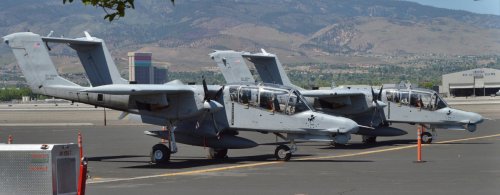
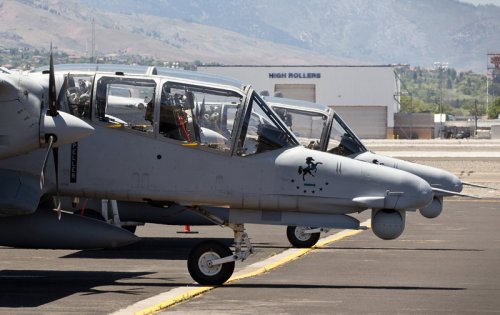
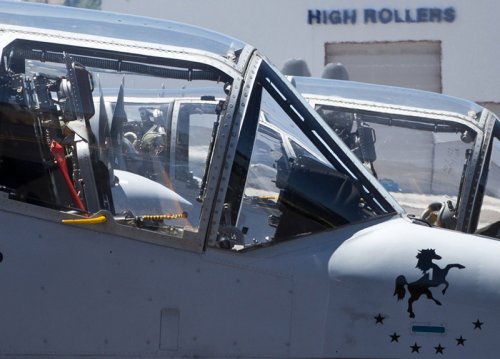
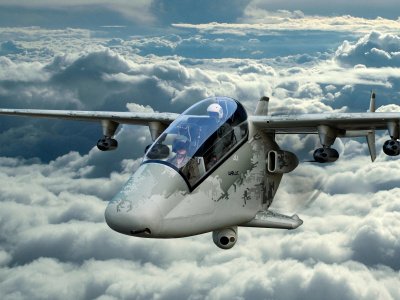
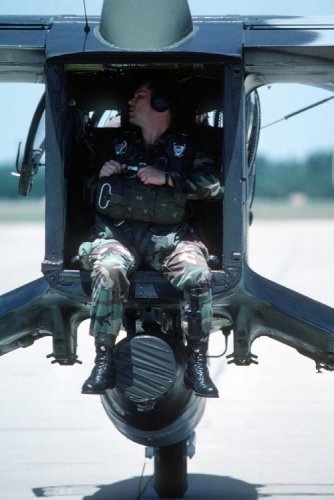
In recent months, the U.S. special operations community has been quietly evaluating two North American OV-10G+ Bronco light combat aircraft at Naval Air Station Fallon, Nev., and at Nellis Air Force Base, Nev.
The Combat Dragon II program is aimed at demonstrating that a small, turboprop-powered warplane can be effective in “high end/special aviation” missions of the kind encountered in Afghanistan. The program is a follow-on to an earlier demonstration program called Imminent Fury, which used a leased A-29B Super Tucano. The current effort is also called Phase Two of Imminent Fury
Congress tried to kill Combat Dragon II 18 months ago. The Navy’s special operations community – specifically, its Irregular Warfare Office headquartered in the Pentagon – was able to resurrect the effort with help from Air Force Special Operations Command (AFSOC).


Guided .50cal is on the way. The 30mm on the AH-64E is impressively accurate these days.SpudmanWP said:I wonder if they are looking at alternative PGMs like APKWS, LOGIR, LZUNI, etc?
On the gun side, how about swapping the "spray & pray" 20mm? It would allow for more ammo, a lighter gun, less recoil, and (IMHO) a better overall CAS solution.