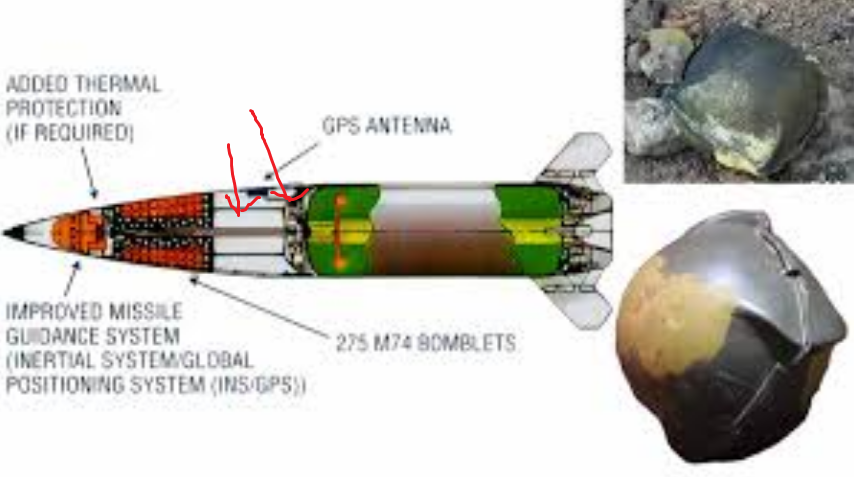
Thank you. And what about a part from the first photo that a guy looks at? Is that the engine part or something else?
In the top photo? That appears to be the remains of the warhead section (bit behind munitions), probably from an ATACMS M39A1 Block IA smaller cluster warhead based on length and the fact it was a cluster warhead in the video.


1732649555643.png
1732648302617.png
 
Last edited:
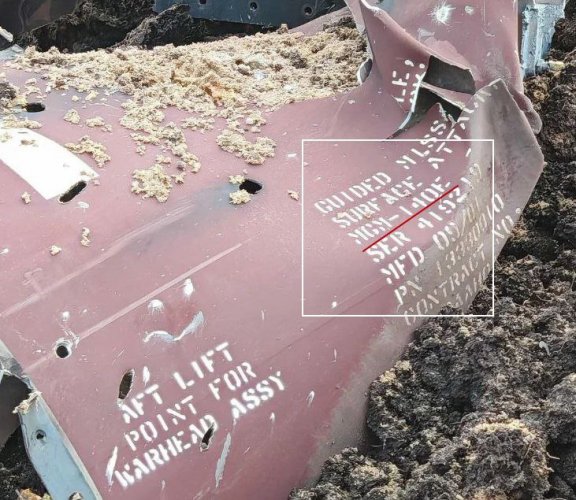
Russian MoD published photos of the remains of the ATACMS missiles that attacked the Kursk-Vostochny airfield (Khalino) on the 25th instant, and an S-400 site at Lotarevka in the Kursk region on the 23th instant. Considering the lack of the remains of the warhead and the payload visible on the photos, can our experts assess if the ATACMS missile's engine could have received a hit to the side while descending but after releasing the warhead? Or could the puncture to the engine stage emerge only after hitting the ground?
The lack of a warhead in the same location makes me think that the remains here had already dumped their submunitions before any possible interception.


What is the wingspan of the ATACMS when its' tail-fins are folded?
On the order of 26"/66cm, they had needed a modified fin fold to fit inside the 688 VLS tubes which are 25" in diameter.
 
On the order of 26"/66cm, they had needed a modified fin fold to fit inside the 688 VLS tubes which are 25" in diameter.

The reason I was asking is that one way and ATACMS could be air launched would be to carry it inside an airworthy launch-tube and fired out of that tube (The tube no doubt being jettisoned afterwards).

No, not physically practical. Let's start with the fact that ATACMS as built has no lugs for aircraft carriage and no reinforcement that would allow you to add them. It's designed to sit inside a tube, and that tube is welded into a steel lattice frame. Not suitable for air launch.

I thought about it and IMO there are several ways an MGM-140 could be air launched without modifying the missile itself. One example I've mentioned in reply to Scott Kenny.
 
The reason I was asking is that one way and ATACMS could be air launched would be to carry it inside an airworthy launch-tube and fired out of that tube (The tube no doubt being jettisoned afterwards).


I thought about it and IMO there are several ways an MGM-140 could be air launched without modifying the missile itself. One example I've mentioned in reply to Scott Kenny.

It's a very complicated, draggy, and heavy approach. Notice how many tube-launched missiles are in service from fixed-wing aircraft. (Rough count is zero.)
 
It's a very complicated, draggy, and heavy approach.

Draggy and heavy, yes, but I wouldn't call it complicated (The MGM-140 is launched from a tube), but then this is one of several ways I've thought of that an ATACMS could be air-launched without modifying the missile.
 
Draggy and heavy, yes, but I wouldn't call it complicated (The MGM-140 is launched from a tube), but then this is one of several ways I've thought of that an ATACMS could be air-launched without modifying the missile.

It is probably more complicated than it looks. The ground canisters are designed with the expectation that they will be housed inside a pod with a structural lattice frame around them, not hanging off a pylon. And so forth.

The question becomes, does the US actually need an ATACMS launched from an aircraft? Does it fill a pressing operational need? I don't see one.
 
The question becomes, does the US actually need an ATACMS launched from an aircraft? Does it fill a pressing operational need? I don't see one.

I wasn't thinking of the US but of Ukraine.
 
Not sure either of those system work against BMs, only S-300/S-400/S-500s really (and S-350 now). Using 'work' in the loosest possible terms.

Buk-M3 still uses SARH, never heard of BM interception using SARH, not without a nuclear warhead anyway. Tor-M2 uses RFCLOS, which isn't really great for anything.

I hate to rain on your parade, but every piece of information in this post is wrong. First, Russia's Buk-M3 uses ARH, while the upgraded older models use SARH, & The Buk has proven to be their best system for dealing with ATACMS for the same reason that The S-300 & S-400 have struggled in that the missiles on The Buk shoot on the way up & the initial elevation angle is adjustable thanks to the launcher, whereas The S-300 & S-400 have arguably the worst possible interceptors for this task. Remember, those larger platforms are designed to take on aircraft by way of larger missiles that are lofted above, before ultimately falling on, their targets, so regardless of their initial speed, they simply lose too much energy to be able to bend/curve downwards in time against ATACMS that are coming straight down at a considerably velocity.

Ironically enough, upgraded Soviet S-75 & S-125 systems/missiles are actually ideal for this "mission" for, well, exactly the same reason as The Buk as, again, both older "antiques" shoot on the way up with the initial elevation angle also being adjustable, & before you laugh, the modern variants of, say, The S-125 from Russia, like The Pantsir, are much more accurate, now, & can intercept targets with a top speed of 1000 m/s, or just under the maximum speed of ATACMS. I could very well be wrong, of course, but for Russia, the challenge of taking down ballistic missiles doesn't stem from the radars or even a lack of "hit-to-kill" technology - you simply need missiles with speed, range, maneuverability, &, crucially, sufficient motor burn times in order to be able to intercept the incoming missile while yours is still under power (I can't do anything about the personnel, LOL). The Buk burns for 15 seconds, there is a version of The S-75 that has an insane kinematic range of 60 kilometers meaning that the booster & motor burn for a combined 50 seconds, which is just nuts, lol, & The S-125 uses a 4 second booster & a 22 second sustainer at 780 m/s. From there, calculating the point of interception, or thereabouts, is just basic math.

Regarding The Tor, RFCLOS is simply command guidance, meaning that, just like The Pantsir (as well as The S-75, S-125, & Osa), the missiles don't have their own seeker heads, but the idea that RFCLOS "isn't really great for anything" is absolute nonsense.

Overall, Russia would do well to implement a kind of Irbis-E upgrade combined with the rotating ability of The S-350 for their S-300 & S-400 systems by adding a second twt, thereby doubling the power & amount of target channels for said platforms while also greatly enhancing sensitivity, & the same should be done with The Pantsir & Tor, except that those engagement radars won't rotate (duh). Even for shortrange systems, only being able to handle three & four simultaneous targets, respectively, isn't even close to being good enough, imo, but get them to 6 & 8 & you're cooking with gas.

Similarly, the current specs of The S-300 & S-400 are pretty good, but they could be so much better. Being able to prosecute 6 concurrent targets with 12 missiles (The S-300) within some field of view that I cannot currently remember was great in The 80s, but now? No, & especially not with TOT strikes that exploit the "blind spots" of such systems which can be at least somewhat addressed by having the engagement radars rotate at 40 rpm as is the case with The S-350. At that point, you would just have to equip those larger platforms with Pantsir & S-125 missiles, among others, for example, to be able to fend off saturation attacks without having to use "the good stuff", if that makes any sense, & the same goes for their shortrange systems, as instead of trying to stop ATACMS solely with the more expensive S-300 & S-400, simply outfit The Pantsir & Tor with their own launchers for S-125 missiles, & the result is that you have just dramatically increased your defensive capability against ATACMS, etc., across the board for practically nothing, as those upgraded S-125 missiles are ridiculously cheap. The setup time isn't great, of course, but this is a much more realistic "solution", which reminds me - The Buk family should at least have an additional launcher.

Okay, that should be everything. Sorry, lol, smh.

 
你的作品做得很好.我想看到你画的这个 MGM140 ATACMS 的更多设计.你能发出去吗?
Please remember that the forum language is English. You can machine translate your text as I did for you.

请记住论坛的语言是英语。你可以像我为你做的那样,使用机器翻译你的文字。

谢谢!
 
Please remember that the forum language is English. You can machine translate your text as I did for you.

请记住论坛的语言是英语。你可以像我为你做的那样,使用机器翻译你的文字。

谢谢!
ok
 
MGM-140E allegedly intercepted yesterday over Voronezh.

mgm-140e.jpg

Sources:


And the alleged interception:

 
Last edited:
Thank you Forest G. as speculation that this was Ukr ballistic has been put to rest.
 
More imagery of the downed MGM-140E in Voronezh.


Was ATACMS one of the submunition carrying variants or the one with the 500lb unitary warhead?
 
Defense Updates has put out a video about how the US army sunk an Iranian submarine using an MGM-140 (Not its' usual target):


The Bandar Abbas Naval Base, located along Iran’s southern coastline, constitutes one of the most strategically significant military installations in the Middle East. Its importance derives primarily from its proximity to the Strait of Hormuz—a narrow maritime chokepoint through which a substantial share of global oil shipments transits. The ability to monitor, influence, or disrupt traffic through this corridor carries far-reaching economic consequences, positioning Bandar Abbas as a central pillar of Iran’s maritime strategy.​
Against this backdrop, it is unsurprising that the United States military would target the base, focusing on high-value assets stationed there. More noteworthy, however, is the reported employment of long-range artillery in an attempt to neutralize a submarine—an unconventional approach given the inherent challenges associated with engaging submerged or mobile underwater platforms.​
In this video, Defense Updates analyzes how Iran's most potent submarine has been sunk using ATACMS?
Chapters:
0:00 TITLE
00:11 INTRODUCTION
01:16 SPONSORSHIP - NordVPN
01:50 INSIGHTS
02:52 IRINS TAREGH
04:20 ATACMS STRIKE
06:00 ANALYSIS
 
If it's not moving, it's no different than hitting a building, honestly. And M57 ATACMS Unitary uses a Harpoon warhead, which was originally designed with submarine targets in mind (Harpoon originally being intended to target surfaced subs)
 
Last edited:
Wes O'Donnell has uploaded a video concerning Ukraine's picky use of donated MGM-140s:


Ukraine just used ATACMS in a rare appearance on the Ukraine battlefield. But Ukraine’s ATACMS missiles are not used very often, and there’s a very specific reason why. In this video, I break down limited supply, the Trump effect, political restrictions, and why Ukraine treats ATACMS like a strategic “last resort” while relying on drones and domestic missiles for daily strikes. The takeaway is simple: ATACMS wins moments. Drones and local production win wars.​
Tldr: This video discusses the surprisingly "rare" use of Ukraine's ATACMS, a powerful long-range missile system. We examine why this critical asset, designed for "deep strike" capabilities, isn't deployed more often. Additionally, we discuss the innovative FP-5 "Flamingo" "cruise missile" and its potential to reshape "military technology" in the ongoing "Ukraine war."​
 
Wes O'Donnell has uploaded a video concerning Ukraine's picky use of donated MGM-140s:

There is also another quite significant reason. jamming. LOTS and LOTS of jamming. as well as relatively decent AD operations
 
There is also another quite significant reason. jamming. LOTS and LOTS of jamming. as well as relatively decent AD operations

Jamming doesn't seem to have effected the ATACMS much and just as a reminder the MGM-140 uses an inertial navigation system with GPS assistance meaning it can fly pure inertial (If less accurate) trajectories.
 
Jamming doesn't seem to have effected the ATACMS much and just as a reminder the MGM-140 uses an inertial navigation system with GPS assistance meaning it can fly pure inertial (If less accurate) trajectories.
I mean yes it can use INS but the point of jamming is to make somethin less accurate. The MGM is also relatively expensive and is simply not worth using on smaller targets since jamming does cause it to Drift(INS inaccuracy) so only targets like airfield or refineries or any other big targets are reliably hit and these are a lot harder to disable unless under constant strike like what's happening in Iran
 
Ukraine has only been using the MGM-140 sparingly due to a) a limited number in their inventory and b) until recently US vetos over what targets to strike if they're in Russia but that appears to have changed recently.
 
I think the biggest limitation is numbers, though the need to have US approval probably also make it less responsive. Even if the U.S. is allowing some strikes against Russia, the process of asking at all slows down the firing cycle.
 
The numbers of MGM-140s that Ukraine gets in the near future are likely to increase as more PrSMs enter the US stockpile.
 
I mean yes it can use INS but the point of jamming is to make somethin less accurate. The MGM is also relatively expensive and is simply not worth using on smaller targets since jamming does cause it to Drift(INS inaccuracy) so only targets like airfield or refineries or any other big targets are reliably hit and these are a lot harder to disable unless under constant strike like what's happening in Iran
INS is not dependent on GPS, it uses gyro technology. Laser gyros are able to be accurate over thousands of miles. GPS augmented guidance can be jammed but spoofing minor errors is a much greater problem. If a GPS seeker sees a large error in GPS information it may filter out the information. But minor innacuracies may not be rejected and garbage information compounds. G-I-G-O.
 
The jamming is more likely to increase uncertainty over potential targets location, in making radar based locating and radio communications for drones more difficult if at times impossible.
 

Similar threads

Back
Top Bottom