English translation of the Serb or Czech text about the P-418 in post #9:
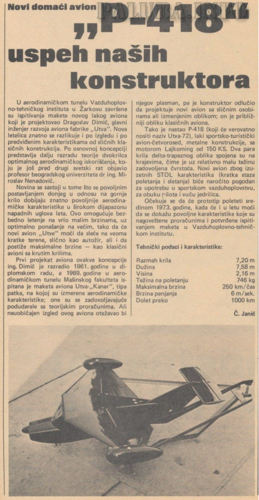
New Domestic Plane P-418
The Success of Our Constructors
In the aerodynamic tunnel of the Vazduhoplov Technical Institute in Žarkov, tests
of the model of the new light aircraft designed by Dragoslav Dimić, chief engineer
of aircraft development of the "Utva" factory, were completed. The new aircraft is
significantly different in terms of appearance and expected characteristics from
similar classic constructions. According to its basic concept, it is a further
elaboration of the biplane theory of optimal aerodynamic utilization, which was
published by Belgrade University professor Dr. Eng. Miroslav Nenadović.
The novelty consists in being favorable by placing the lower wing in relation to
the upper wing, they get significantly more favorable aerodynamic characteristics
in a wide range of attack angles of flight. This allows for smooth flying at very
low speeds, with optimal behavior at higher speeds, so that the new "UTVA" plane
will be able to land on very short terrains, similar to an autogyro, but also
reach maximum speeds - like classic fixed-wing airplanes.
In the first project of an airplane of this concept, Eng. Dimić began his diploma
work in 1961 and by 1969, in the aerodynamic tunnel of the Faculty of
Mechanical Engineering built a mock-up of the UTVA Kanar canard-type aircraft,
on which the aerodynamic characteristics were measured. They satisfactorily
matched the theoretical calculations. But the unusual appearance of this
aircraft was perceived as too unconventional, so the constructor decided to
design a new less unorthodox plane, but with a changed shape closer
to the shape of classic planes.
This is how the P-418 (which will probably bear the name Utva-72) was born,
a light sport-tourist aircraft-four-seater, metal construction, with a 150 HP
Lycoming engine. Two pairs of delta-trapezoidal wings are joined at the ends,
which provides strength with a relatively low weight. Due to its exceptional
STOL (short take-off and landing) characteristics, the new aircraft will be
particularly suitable for use in sports aviation, for pilot training and towing
gliders.
It is expected that the prototype will fly in the middle of 1973, when it will
be possible to prove in flight the favorable characteristics that were hinted at
by the calculations and confirmed by testing the model at the Aviation Technical
Institute.
Technical data and features:
Wingspan 7.20m
Length 7.58m
Height 2.16m
Take-off weight 746kg
Maximum speed 250km/h
Range 1000km
by C. Janic