US Navy in World War II - Was there sufficient production capacity to complete more heavy combatants (Battleships, Carriers etc.)?

The same reason 20mm Oerlikons were retained against Kamikazes - the perception of at least being able to give it a shot, even if success is unlikely. And maybe, just maybe, you get presented with an undemanding target that your missiles can actually hit - e.g. a MiG-17 coming in at subsonic speed with bombs or rocket packs in the case of the Bostons, or an Iranian F-5 in the case of the Perrys. You miss 100% of the shots you don't take.
Even then, those aircraft would be coming in at wavetop levels. And the missile systems under discussion here were totally unable to target, let alone hit, a sea skimmer. Regardless of whether that was a missile or a manned aircraft
 
I happen to be re-reading Friedman's Naval AA Guns and Gunnery at the moment and just read the relevant section. The vulnerable area of a single-engined kamikaze was about 7 times* greater for a 40mm Bofors hit than an Oerlikon, but a twin Oerlikon fired at 8 times the rate of a single Bofors, so that balanced out. The problem was the Oerlikon would kill the kamikaze close enough that the ship might still be hit. Against a twin-engined aircraft, the potential of a fatal 20mm hit significantly increased (no engine protecting the pilot).

* Assuming a 20mm hit could break the wing spar; if not then the vulnerable area was 30 times larger for the Bofors.
The other reason for the USN retaining the 20mm was that it was un-powered and free swinging using manpower alone. So if a ship was hit and lost power to all those lovely 5"/quad & twin 40mm mounts, it still had some means of defending itself.
 
Beyond a certain point in time, those missiles were so far beyond obsolete and incapable of dealing with modern threats, that retaining them became more trouble than they were worth. It's the same reason that the USN removed the SM-1s from the Perry class frigates long before the ships themselves left service. The missile was no longer able to deal with then current threats
The same reason 20mm Oerlikons were retained against Kamikazes - the perception of at least being able to give it a shot, even if success is unlikely. And maybe, just maybe, you get presented with an undemanding target that your missiles can actually hit - e.g. a MiG-17 coming in at subsonic speed with bombs or rocket packs in the case of the Bostons, or an Iranian F-5 in the case of the Perrys. You miss 100% of the shots you don't take.
Even then, those aircraft would be coming in at wavetop levels. And the missile systems under discussion here were totally unable to target, let alone hit, a sea skimmer. Regardless of whether that was a missile or a manned aircraft

I'm with Pathology Doc on this one, Sergeant. Unless your warship's weapons and fire control are utterly nonoperational, something is better than nothing. To defend herself during the Falklands War, HMS Antrim fired one of her ancient Seaslug SAMs (that missile's sole combat use). It didn't come close to hitting the striking A-4s, which hugged the waves, but perhaps the enormous flame and exhaust of the 2-ton missile's launch threw off an Argentine pilot's concentration for a moment.
 
A couple questions arise. What is the manpower situation? Do you have trained skilled people to build these ships? Trained skilled people to crew these ships? What/s the supply chain situation all the way back to the mines in Mesabi? The European was was figured to be over by mid=1945. You will need ground troops for occjupation forces, but the Battle of the Atlantic is over and those ships can be moved to the Pacific.
This is not my specialty, but I have a general opinion.
The industrial capacity of the USA at that time did not seem to be a limiting factor to expand production, in my opinion the limiting factor would be the ability to train crews for so many new ships.
It is not enough to quickly produce many ships, it would also be necessary to install hundreds of thousands of new equipment, increasingly advanced, test them and train the crew.
And what about combat experience? That is not improvised. Think of the mistakes made on Guadalcanal by American cruisers equipped with new radar equipment that commanders failed to use and lost to Japanese cat-eyed lookouts and long-range torpedoes.

As it turned out, American men were not the limiting factor. The US Navy in 1939, just before the Second World War started, had about 125,000 officers and men. Five years later, there were over three million USN personnel, fighting all over the world. Obviously the great majority were amateurs (landsmen), and many mistakes from inexperience were made—but overall they did very well against the hardened Axis navies, and won out in the end.

The same with the USA's Depression-era shipyard workforce: while necessarily padded out with unskilled women as many men went into the military, by all accounts everyone learned quickly and the shipbuilding effort was a lauded success.
 
Poor material state means that much of the equipment and fittings on the ship are not in a fit condition for operational use. This could include electric motors, pumps, wiring, hatches, or even small things like bulkhead fittings, paint and decking, and the like. It might mean the ship has experienced a higher-than-expected level of corrosion in the hull and superstructure.
Neglected maintenance, missing equipment, or any of hundreds of other issues contribute to a "poor material state." Having a crew and command that neglect maintenance or simply can't do it because of a lack of parts, materials, or even in the worst case, concern for doing it, all contribute too.

Agreed, although you don't also mention the enemy's part in those poor material states. As an example, after veteran battleship HMS Warspite was gutted by two German Fritz X guided bombs in the Mediterranean in 1943, she was "repaired" in Scotland by permanently closing off X turret and the damaged boiler room, and filling in the big hole in her bottom with concrete. In that state Warspite was sent back into the fight, bombarding German positions on Sword Beach during D-Day with her three remaining turrets. Evidently "a fit condition for operational use" has a different meaning in the peacetime navy vis-a-vis in the midst of an all-out war.
 
Evidently "a fit condition for operational use" has a different meaning in the peacetime navy vis-a-vis in the midst of an all-out war.
Also consider Yorktown's miracle three-day repair which, if it didn't make her brand-spanking-new, at least gave the Americans a flight deck they wouldn't otherwise have had (and which they were desperate for).

That being said, I submit that you should look at Warspite as she sits on the morning of 3 September 1945 and ask yourself:

"In an imaginary universe where the battleship still rules the waves and where Britain is swimming in money, is this the ship I want to take in for a complete overhaul to her fire control systems, secondary and light AA armament and repair of her wartime battle damage to make her as good as she can be until guided missiles are ready in ten years? Or do I settle for more permanently sealing up her hull so I can put her out to pasture in Portsmouth as a war museum and refit something newer and faster that hasn't been beat to within an inch of its life on various occasions over the last thirty years?"
 
...Next, the number of large naval guns was also limited by production capacity that was all on the East coast as well. Since you needed X number of guns for Y number of ships in whatever size, that too predicted what production capacity would be...
...BTW-16" guns were made in Louisville, KY, East of the Mississippi , but definitely not East Coast.

I hadn't heard this, Artie Bob: please name that Louisville facility at your convenience, so that I can read up about it. As far as I knew, for as long as the US had battleships, battleship guns were manufactured at the Naval Gun Factory in Washington DC, and at the arsenal at Watervliet, NY up the Hudson River from me (mostly army artillery there, including M1919 16-inch guns, but with some naval work too). While the steel came from refineries around the nation, I didn't know of a third location for finished battleship guns, even during the giant WW2 buildup.
 
Also consider Yorktown's miracle three-day repair which, if it didn't make her brand-spanking-new, at least gave the Americans a flight deck they wouldn't otherwise have had (and which they were desperate for). That being said, I submit that you should look at Warspite as she sits on the morning of 3 September 1945 and ask yourself: "In an imaginary universe where the battleship still rules the waves and where Britain is swimming in money, is this the ship I want to take in for a complete overhaul to her fire control systems, secondary and light AA armament and repair of her wartime battle damage to make her as good as she can be until guided missiles are ready in ten years? Or do I settle for more permanently sealing up her hull so I can put her out to pasture in Portsmouth as a war museum and refit something newer and faster that hasn't been beat to within an inch of its life on various occasions over the last thirty years?"

No argument from me, Doc: the wartime Royal Navy (and those gathered Pearl Harbor construction workers) did what they had to do to win. And a good thing too.

In the actual non-swimming-in-money postwar UK, neither of those choices was taken; see for example posts #3 and 17 in the thread "which long-gone 20th-century ship would you like as a museum today?"
 
In the actual non-swimming-in-money postwar UK, neither of those choices was taken
Well, indirectly they did take one, deciding that Vanguard was too far advanced to cancel and giving her the best of everything they had (including the best bow for the best seakeeping in shit weather that ever went onto a BB). But just about everything else except the newest of the KGVs was begging for a peaceful end (except for Warspite, which raged against the dying of the light on her way to the breakers).

I think the answer to the thread in general is that the Americans probably could have built a lot more but recognized soon enough that they didn't need to, while the British needed to build a lot more but found out on reflection that they couldn't (and made some very poor decisions with the money they spent).
 
Agreed, although you don't also mention the enemy's part in those poor material states. As an example, after veteran battleship HMS Warspite was gutted by two German Fritz X guided bombs in the Mediterranean in 1943, she was "repaired" in Scotland by permanently closing off X turret and the damaged boiler room, and filling in the big hole in her bottom with concrete. In that state Warspite was sent back into the fight, bombarding German positions on Sword Beach during D-Day with her three remaining turrets. Evidently "a fit condition for operational use" has a different meaning in the peacetime navy vis-a-vis in the midst of an all-out war.
I hadn't heard this, Artie Bob: please name that Louisville facility at your convenience, so that I can read up about it. As far as I knew, for as long as the US had battleships, battleship guns were manufactured at the Naval Gun Factory in Washington DC, and at the arsenal at Watervliet, NY up the Hudson River from me (mostly army artillery there, including M1919 16-inch guns, but with some naval work too). While the steel came from refineries around the nation, I didn't know of a third location for finished battleship guns, even during the giant WW2 buildup.
.
1. The USN/USMC have several categories of capability for aircraft - non-flight-capable, flight-capable only, partial mission capable (PMC), and full mission capable (FMC).

PMC means that the aircraft can carry out some operational missions but not others - these are assigned to missions that match the capability they do have - an A-6 with its radar and bombing computers inop would be assigned as an in-flight refueler, etc.

For warships you can see the parallels.


2. And Bethlehem Steel, Pennsylvania.
 
I hadn't heard this, Artie Bob: please name that Louisville facility at your convenience, so that I can read up about it. As far as I knew, for as long as the US had battleships, battleship guns were manufactured at the Naval Gun Factory in Washington DC, and at the arsenal at Watervliet, NY up the Hudson River from me (mostly army artillery there, including M1919 16-inch guns, but with some naval work too). While the steel came from refineries around the nation, I didn't know of a third location for finished battleship guns, even during the giant WW2 buildup.
The name of the facility was Naval Ordnance Station Louisville, it was active beginning in WW II and continuing through the 1990s. I visited the facility in the 1950s and knew people that worked there. I believe there is a Wikipedia article on the internet. BTW, on my freshman midshipman cruise in 1955, was a powder room handler for #2 turret on BB-64.
ArtieBob
 
I happen to be re-reading Friedman's Naval AA Guns and Gunnery at the moment and just read the relevant section. The vulnerable area of a single-engined kamikaze was about 7 times* greater for a 40mm Bofors hit than an Oerlikon, but a twin Oerlikon fired at 8 times the rate of a single Bofors, so that balanced out. The problem was the Oerlikon would kill the kamikaze close enough that the ship might still be hit. Against a twin-engined aircraft, the potential of a fatal 20mm hit significantly increased (no engine protecting the pilot).

* Assuming a 20mm hit could break the wing spar; if not then the vulnerable area was 30 times larger for the Bofors.
Once the kamikaze threat began, US ship captains wanted their 20mm replaced with more 40mm mounts wherever possible. There were several problems with the 20mm against kamikaze:

1. The guns had no value in distracting or driving off the attacker unlike was previously possible. You had to physically destroy the plane.
2. The 20mm didn't have the stopping power and range to do that. Even if it hit the plane multiple times it was likely to still strike the ship simply because it was close enough to follow a ballistic path into it.
3. The 40mm could use a proximity fuze while the 20mm couldn't.

In the US fleet, word got around that if you heard the 20mm's open up it was time to brace for impact while the engine room crew knew that they needed to shut down the blowers and ventilation to prevent the blast and fire from being sucked in.

The twin Oerlikon was simply an attempt to beef up 20mm firepower where more 40mm's couldn't be fitted. The older 1500 tonner destroyers (Benson / Livermore class and earlier) often didn't have the reserve weight for more 40's and were stuck with 20mm's. The worst of the bunch were probably the Gridley class. This class got no 40mm due to weight and stability issues and by the beginning of 1945 had half their torpedo tubes removed to help with those issues. Even then, they got just 6 x 20mm singles and their 4 x 5"/38's.

The USN also commissioned operations research studies on AA effectiveness and recommended that destroyers and smaller ships maintain a steady course at speed rather than maneuver wildly as the later made effective AA fire more difficult while cruisers and larger ships that were more stable firing platforms should attempt to maneuver to avoid being hit as this had little or no effect on AA fire effectiveness.
 
3. The 40mm could use a proximity fuze while the 20mm couldn't.
The initial proximity fuse was for the 5" (Jan '43), with the 3" appearing later (1945?), there was no proximity fuse for the 40mm until possibly as late as the 1980s (Bofors PFHE). The inavailability of a 40mm proximity fuse is why there was a mass replacement of the Bofors with the 3" RF twin post-war.
 
My guess is that by this time the Navy preferred to develop new Terrier-armed DLGs from the keel up, rather than gut out and refurbish any further existing hulls?

Different ships for different purposes. The cruiser conversions and Long Beach were cruisers with command and fighter direction facilities, whilst the DLGs were screening ships. I imagine they Terrier cruiser conversions were dropped once Talos became viable. Cleveland class also required more work to modernise, having limited internal volume and requiring the CIC to be moved below the protective deck.

Of the Baltimores, only Boston and Canberra got Terrier, and that as a unique, single-ended, vertical loading system with two launchers and 144 missiles. Wikipedia repeatedly refers to the "obsolescence" of this missile armament, which seems strange since Terrier itself successfully evolved into Standard, but the evolution was quite marked in terms of physical form and perhaps the launchers and magazines in these ships couldn't handle the newer versions?

My understanding is that Boston and Canberrra's magazines were not compatible with later variants of Terrier or Standard ER with the strakes replacing the forward moving fins. I don't think they ever received NTDS either.
 
I'm with Pathology Doc on this one, Sergeant. Unless your warship's weapons and fire control are utterly nonoperational, something is better than nothing. To defend herself during the Falklands War, HMS Antrim fired one of her ancient Seaslug SAMs (that missile's sole combat use). It didn't come close to hitting the striking A-4s, which hugged the waves, but perhaps the enormous flame and exhaust of the 2-ton missile's launch threw off an Argentine pilot's concentration for a moment.

However, complex electronic systems fairly quickly become utterly nonoperational without maintenance, trained technicians, spare parts, etc. Likewise, missiles have a finite life span. So yes, an obsolete missile system may not be useless, but it also at some point becomes incredibly painful and costly to keep even marginally functional. The real world is a resource constrained environment; spending inordinate amounts of effort on a system who's primary benefit is making Sailor feel slightly better (and oh by the way, most are smart enough to understand if a system is so obsolete to be effectively useless, and may very well have more of a negative moral impact from having to maintain a useless system than the positive of pretending to be able to defend themselves) is going to have impacts elsewhere.
 
The initial proximity fuse was for the 5" (Jan '43), with the 3" appearing later (1945?), there was no proximity fuse for the 40mm until possibly as late as the 1980s (Bofors PFHE). The inavailability of a 40mm proximity fuse is why there was a mass replacement of the Bofors with the 3" RF twin post-war.
I could be wrong, but as a first loader on a quad 40 mount, my memory is we had vt fuzes in 1955. During that midshipman cruise, I also handled the 16" powder bags and 5" shells (GQ, Air Defense and Gun Firing stations). On my senior cruise, was a first loader on a 3"/50 mount. Loading the 40 mm was a lot of fun, not so with the 3", bumping butts with the other center loader, plus the 3" round seemed much heavier than the 40mm clip and it was really hard to get straight into the rotary feeder. After commissioning was CIC and Air Defense Officer on an LSD.
 
2. And Bethlehem Steel, Pennsylvania.
The name of the facility was Naval Ordnance Station Louisville, it was active beginning in WW II and continuing through the 1990s. I visited the facility in the 1950s and knew people that worked there. I believe there is a Wikipedia article on the internet. BTW, on my freshman midshipman cruise in 1955, was a powder room handler for #2 turret on BB-64.
ArtieBob

Thanks, ArtieBob. The Wikipedia article on Naval Ordnance Station Louisville (active from 1941) doesn't specifically state that battleship-sized gun barrels were manufactured there, but I'll take your word for it as a knowledgeable vet. And TA Gardner and BlackBat pointed out the Bethlehem Steel factory in Pennsylvania, including with demonstrative photos. So (with the Naval Gun Factory in Washington DC, and Watervliet Arsenal in NY) that's four American facilities making battleship guns during World War 2. Even more of an all-out effort than I had known: interesting!
 
The initial proximity fuse was for the 5" (Jan '43), with the 3" appearing later (1945?), there was no proximity fuse for the 40mm until possibly as late as the 1980s (Bofors PFHE). The inavailability of a 40mm proximity fuse is why there was a mass replacement of the Bofors with the 3" RF twin post-war.
I could be wrong, but as a first loader on a quad 40 mount, my memory is we had vt fuzes in 1955. During that midshipman cruise, I also handled the 16" powder bags and 5" shells (GQ, Air Defense and Gun Firing stations). On my senior cruise, was a first loader on a 3"/50 mount. Loading the 40 mm was a lot of fun, not so with the 3", bumping butts with the other center loader, plus the 3" round seemed much heavier than the 40mm clip and it was really hard to get straight into the rotary feeder. After commissioning was CIC and Air Defense Officer on an LSD.

Yes, I too spotted TA Gardner's error, DWG. He must have been thinking of modern weapons. ('Fuse' is correct for the time, but I'll use current spelling 'fuze' for clarity.) The late-war VT fuze for USN 5-inch guns, and US Army 155mm guns, was considered a miracle of miniaturization, with a rudimentary radar that used the shell body as its receiver. Squeezing that fuze down into a 3-inch (76.2mm) AA shell didn't succeed until WW2 was over, and there was no way that 1940's vacuum-tube tech could stuff such a fuze into a 40mm shell.

But TA Gardner's point stands, that captains on the spot wanted beefier 40mm cannon instead of 20mm to deal with the kamikaze threat.
 
Well, on the process of manufacturing battleship guns, this book is hard to beat.


It's available on Amazon for about $30 US.

Chapter VI goes into detail on it including photos and drawings. Much of the work is done vertically in a special casting pit. This has the advantage of both taking up less room in the factory footprint and overcoming issues with gravity and droop that would otherwise occur. It also makes it clear by the processes involved that making them is not something you can do on an assembly line. It's a work by craftsmen and takes considerable effort and time.
 
Much of the work is done vertically in a special casting pit. This has the advantage of both taking up less room in the factory footprint
OTOH gun pits are a major infrastructure item and the UK found itself short of them during the re-armament phase in the mid-late 30s due to closures during the recession (Coventry Ordnance Works most notably).
 
OTOH gun pits are a major infrastructure item and the UK found itself short of them during the re-armament phase in the mid-late 30s due to closures during the recession (Coventry Ordnance Works most notably).
Well, that goes without saying. You can only cast so many gun barrels and each one takes considerable time and effort to finish entirely.
 
...It also makes it clear by the processes involved that making them is not something you can do on an assembly line. It's a work by craftsmen and takes considerable effort and time.
OTOH gun pits are a major infrastructure item and the UK found itself short of them during the re-armament phase in the mid-late 30s due to closures during the recession (Coventry Ordnance Works most notably).

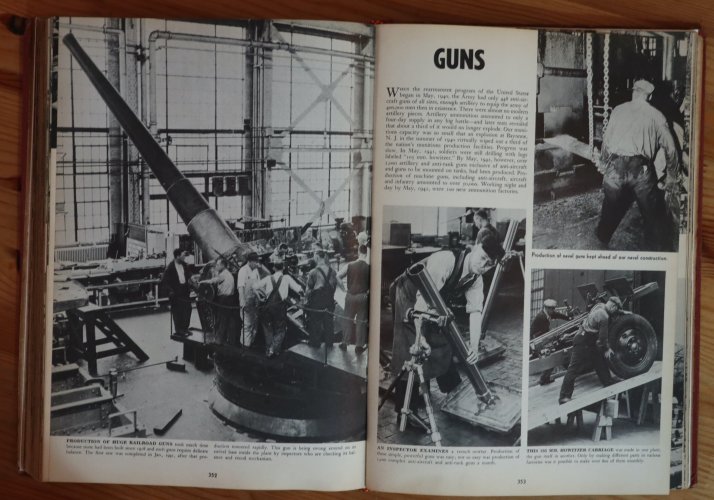
In the illustrated 1942 book War In Our Time that I inherited from my grandparents, page 352 (see attached) agrees with you on the difficulty of restarting production of the biggest guns many years after the last skilled workman had been laid off. Difficult, but not impossible.

Despite the caption 'railroad gun' here, taking a guess I suppose this photo shows one of the US Navy's 16-inch Mark 2 guns transferred to the Army in 1940 (after it was discovered this mark wouldn't fit in Iowa-class battleships) being fitted into a mount designed for the Army's M1919 16-inch gun. Batteries of such guns were hurriedly emplaced around the approaches to New York, among other locations along the American seaboard, and manned by the Coast Artillery Corps. (As it turned out, none fired in anger.) But I invite checks of my guess.
 

Attachments

  • page.jpg
    page.jpg
    4.1 MB · Views: 10
However, complex electronic systems fairly quickly become utterly nonoperational without maintenance, trained technicians, spare parts, etc. Likewise, missiles have a finite life span. So yes, an obsolete missile system may not be useless, but it also at some point becomes incredibly painful and costly to keep even marginally functional. The real world is a resource constrained environment; spending inordinate amounts of effort on a system who's primary benefit is making Sailor feel slightly better (and oh by the way, most are smart enough to understand if a system is so obsolete to be effectively useless, and may very well have more of a negative moral impact from having to maintain a useless system than the positive of pretending to be able to defend themselves) is going to have impacts elsewhere.

I agree with your general stance, sdmuleman. And of course I agree with SSgtC when he urged that our fighting men be given the most effective weapons possible, for their success with fewest casualties. I simply point out the truism that one goes to war with what one has, and the truism that something is better than nothing.

But for your implied view that retaining an obsolescent missile aboard is more costly in money than replacing it with an all-new missile: nonsense. It was precisely as an economy measure in the 'resource-constrained environment' that, for example, HMS Antrim had to sail for the 1982 Falklands War with elderly Seaslugs rather than more capable Sea Darts. Seen in hindsight, and when cost is broadened from money to lives, a skimping that proved to be penny wise and pound foolish. And so on for countless other examples in naval and military history. Yet as you yourself state, defense budgets will never be infinite, even during an all-out world war. Many (most?) times a job has had to be done with suboptimal tools, and the men got on with it, regardless of feelings. I applaud them.
 
The USN/USMC have several categories of capability for aircraft - non-flight-capable, flight-capable only, partial mission capable (PMC), and full mission capable (FMC). PMC means that the aircraft can carry out some operational missions but not others - these are assigned to missions that match the capability they do have - an A-6 with its radar and bombing computers inop would be assigned as an in-flight refueler, etc.

For warships you can see the parallels.

I do see the parallels; thank you for this info. Of course, there must be orders-of-magnitude difference in serviceability potential between a necessarily lightweight (hence flimsy) warplane and a battleship, whose main armament and innards were equivalent to the heavy machine tools in German factories that (the US Strategic Bombing Survey found) were so difficult to permanently put out of service even with repeated direct hits.
 
In the illustrated 1942 book War In Our Time that I inherited from my grandparents, page 352 (see attached) agrees with you on the difficulty of restarting production of the biggest guns many years after the last skilled workman had been laid off. Difficult, but not impossible.

Despite the caption 'railroad gun' here, taking a guess I suppose this photo shows one of the US Navy's 16-inch Mark 2 guns transferred to the Army in 1940 (after it was discovered this mark wouldn't fit in Iowa-class battleships) being fitted into a mount designed for the Army's M1919 16-inch gun. Batteries of such guns were hurriedly emplaced around the approaches to New York, among other locations along the American seaboard, and manned by the Coast Artillery Corps. (As it turned out, none fired in anger.) But I invite checks of my guess.
None were. But you should note that that 16" gun was more powerful and longer ranged than the 16"/50 guns fitted to the S. Dakota's and Iowa's were.
 
There seems to be a bit of confusion creeping in here about which guns were fitted to what ships and coast defences.

The naval 16"/50 Mark 2/3 was designed for the Lexington class battlecruisers and South Dakota class battleships, which were cancelled under the Washington Naval Treaty in 1922. These weapons became Army coast defence guns. From Navweaps:-

"As a result of these ship cancellations and redesigns, most of these Mark 2 and Mark 3 guns wound up being used by the US Army as Coast Defense Artillery. Twenty guns were transferred to the Army between 1922 and 1924 and all but three of the remaining guns were transferred in January 1941 following the Iowa fiasco. The Army considered these guns to be excellent weapons in that role and used them along with their own 16"/50 (40.6 cm) M1919. By August 1945 there were forty of these ex-naval guns in active coast defense batteries. "

Just to confuse things further the Army had its own 16"/50 M1919 gun design for coast defence. Again from Navweaps:-

"The US Army's 16"/50 (40.6 cm) M1919 coastal defense gun was an almost completely different design and was one of the few wire wound guns ever built in the USA. It weighed nearly 24 tons (25 mt) more than the Mark 2 and was about 0.5 calibers longer. A total of eight of these guns were built with six being used in three two-gun coastal defense batteries, the first of which was installed during 1923-1924 at Battery Williston, on the west side of the entrance to Pearl Harbor, "where they had a field of fire that completely encircled the island of Oahu [Hawaii] and reached beyond its shores at every point" - from "Seacoast Fortifications of the United States." The other two batteries were installed at Long Island, New York and at Boston, Massachusetts. All other 16" (40.6 cm) coastal batteries used the former naval guns."


The 16"/45 Mk 1 was designed for the Colorado class. These were reconstructed in the 1930s as the 16"/45 Mk 5 & 8.


The North Carolina & South Dakota classes of the 1930s were fitted with the 16"/45 Mark 6 gun.

When the Iowas were designed there was a cock up between departments within the USN. The turret designed for them was found to be incapable of taking the 16"/50 Mark 2 from the 1920s as originally envisaged. As it was too late to redesign the ship to take a larger turret, BuOrd developed a new lightweight 16"/50 gun. This was the 16"/50 Mark 7 which was installed in the Iowas and was intended for the Montanas.
 
Back
Top Bottom