Seems Canada wants to move past just being an Observer. This little snippet isn't really news anywhere, just a line mixed in other stories.
Perhaps for subsequent blocks/mods where they could take part but unlikely for initial production lots.

This is politics, but I'm only observing context rather than advocating a position or saying any political development is good or bad, so I hope that's allowable in this thread.

Japan has been mentioned too.
Historically, other than WWII had never had interest or participated in the pacific or conflict like Vietnam. Since the Korean War immediately followed WWII and was under a UN mandate I consider this case convenient happenstance.
Up until recently Canada basically only traded with the US and or NA. Again as good as zero interest beyond other than NATO commitment.
https://blog.tradewheel.com/canadas-major-imports-and-exports-by-country
Right now trade with asia/pacific is 113-120B; 130.8B with the EU, and 390B with US or ~1:~1:~3 or ~40% non-US
The pacific makes out 20% with Japan 20% of that or ~4% total. Japan like South Korea or Taiwain is more risk than anywhere near worth it. I don't see any construct they would join other than intelligence sharing.
 
6 is a fairly safe bet, possibly 8 to 10 if the Twin Missile Carriers for SRAAMs can take APKWS pods. And that configuration could still take three tanks and four Meteors.
The missile rails can only carry rail launched AAMs.
The outermost stations are SRAM only.
This leaves potentially 6 stations for rocket pods, 4 if carrying 2 tanks.
The centre station is needed for the targeting pod.
If the twin bomb racks were a thing, EF could carry 8 or 12 (without tanks) rocket pods.
 
The missile rails can only carry rail launched AAMs.
The outermost stations are SRAM only.
This leaves potentially 6 stations for rocket pods, 4 if carrying 2 tanks.
The centre station is needed for the targeting pod.
If the twin bomb racks were a thing, EF could carry 8 or 12 (without tanks) rocket pods.
IIRC the most recent F-15 photos have shown Hydra/APKWS pods on the standard triple ejector racks. So if a Typhoon can carry ~3500lbs on a pylon it could carry 2x3 APKWS pods.

That said, we're in the GCAP thread. And APKWS on GCAP would require something like launch tubes in the bay doors, or using trapeze rails to get a pod/pods clear of the bay.
 
The missile rails can only carry rail launched AAMs.
That's a fair point, though it's more they can only carry weapons designed to fit the launch rail. Perhaps what we really need is a LAU-131 switched to rail attachment points, rather than 14" lugs. My other concern there would be whether they fit in the mass limits of the hardpoint - it might be necessary to fly the pod with a tube or two empty.

There's only the outboard SRAAM hardpoints that are restricted that way, the inner and outerwing hardpoints are designed to take ordnance-specific pylons at need. It should be a reasonably simple switch to carry 2 LAU-131s on derivatives of either the Twin Missile Carrier or the Brimstone pylon fitted with the appropriate attachments. They'd need clearing, of course, but that's standard for any new weapon.

If you want a counter-drone beast mode in a Typhoon, I think the potential's there to be developed and I don't see any major show-stoppers.

WRT the IRST/designator pod on the centre fuselage hardpoint, the Eurofighter, outside of the Luftwaffe, already has PIRATE as an IRST, giving you the option to use PIRATE plus a laser designator on one of the forward Meteor stations, freeing the central fuselage hardpoint for a tank. It might require a software tweak, but probably not a major one.
 
I don't see any construct [Japan] would join other than intelligence sharing.

Tides are changing under the new, more hawkish PM and her defence minister.

https://www.twz.com/sea/japan-opens-the-door-to-acquiring-nuclear-powered-submarines

China’s rapidly expanding naval force, including its growing submarine fleet and increasingly distant maritime operations, is forcing Tokyo to consider how it would monitor and potentially counter Chinese forces farther from the Japanese archipelago.

Not a policy or a plan yet, but a definite tilt.

The development could also create new opportunities for Japan to work more closely with Australia and the other AUKUS partners. Australia is in the process of acquiring its own conventionally armed, nuclear-powered submarine capability under AUKUS Pillar I, with U.S. and U.K. nuclear-powered submarines also scheduled to operate from Australia. Japan has separately been identified as a potential partner for AUKUS Pillar II, which covers advanced capabilities and technology cooperation.
A Japanese decision to pursue SSNs could eventually create a much deeper basis for cooperation with Australia, including submarine interoperability, undersea warfare, workforce and technical expertise, infrastructure, sustainment, and potentially aspects of the industrial base. Analysts have already examined how Japan could fit into the wider AUKUS submarine ecosystem as Australia’s nuclear-submarine program develops.
 
Tides are changing under the new, more hawkish PM and her defence minister.

https://www.twz.com/sea/japan-opens-the-door-to-acquiring-nuclear-powered-submarines

China’s rapidly expanding naval force, including its growing submarine fleet and increasingly distant maritime operations, is forcing Tokyo to consider how it would monitor and potentially counter Chinese forces farther from the Japanese archipelago.

Not a policy or a plan yet, but a definite tilt.

The development could also create new opportunities for Japan to work more closely with Australia and the other AUKUS partners. Australia is in the process of acquiring its own conventionally armed, nuclear-powered submarine capability under AUKUS Pillar I, with U.S. and U.K. nuclear-powered submarines also scheduled to operate from Australia. Japan has separately been identified as a potential partner for AUKUS Pillar II, which covers advanced capabilities and technology cooperation.
A Japanese decision to pursue SSNs could eventually create a much deeper basis for cooperation with Australia, including submarine interoperability, undersea warfare, workforce and technical expertise, infrastructure, sustainment, and potentially aspects of the industrial base. Analysts have already examined how Japan could fit into the wider AUKUS submarine ecosystem as Australia’s nuclear-submarine program develops.
I was refering to Canada ofc as that was the talking point.
As for Japan, South Korea, Germany etc. I've been saying two years ago the moment the WH/Ukraine disaster happened there is inevitably a shift toward nuclear profiliation. This was a no brainer to begin with. Japan openly making it known now is because a certain someone tweeted days ago only nukes gives him pause.
 
IIRC the most recent F-15 photos have shown Hydra/APKWS pods on the standard triple ejector racks. So if a Typhoon can carry ~3500lbs on a pylon it could carry 2x3 APKWS pods.

The EF is not an F-15 though. Meaning there are no TER options at this point.
Could one be developed? Sure.
EF's wing pylons in question are not rated for 3500 lbs, most likely good enough for 3 full pods though.

That said, we're in the GCAP thread. And APKWS on GCAP would require something like launch tubes in the bay doors, or using trapeze rails to get a pod/pods clear of the bay.

Or simply use external pylons.

That's a fair point, though it's more they can only carry weapons designed to fit the launch rail. Perhaps what we really need is a LAU-131 switched to rail attachment points, rather than 14" lugs. My other concern there would be whether they fit in the mass limits of the hardpoint - it might be necessary to fly the pod with a tube or two empty.

Probably easier to develop a twin or triple rack.
Weight could be an issue when carrying 3 pods on the outer stations, don't know the weight limits.

There's only the outboard SRAAM hardpoints that are restricted that way, the inner and outerwing hardpoints are designed to take ordnance-specific pylons at need. It should be a reasonably simple switch to carry 2 LAU-131s on derivatives of either the Twin Missile Carrier or the Brimstone pylon fitted with the appropriate attachments. They'd need clearing, of course, but that's standard for any new weapon.

Yes they need clearing. But they are not cleared atm. I was referring to actually possible configurations at this moment in time.

If you want a counter-drone beast mode in a Typhoon, I think the potential's there to be developed and I don't see any major show-stoppers.

WRT the IRST/designator pod on the centre fuselage hardpoint, the Eurofighter, outside of the Luftwaffe, already has PIRATE as an IRST, giving you the option to use PIRATE plus a laser designator on one of the forward Meteor stations, freeing the central fuselage hardpoint for a tank. It might require a software tweak, but probably not a major one.

Same issue. The targeting pod mounted on a missile station only exists in theory. It has been addressed by @Scorpion82 a few times.
 
The EF is not an F-15 though. Meaning there are no TER options at this point.
Could one be developed? Sure.
EF's wing pylons in question are not rated for 3500 lbs, most likely good enough for 3 full pods though.
To be fair, absolutely nothing prevents use of LAU-61; USMC hornets in gulf already did.
The French also immediately began from bigger launcher, despite the obviously broken aesthetic.
1000030713.jpg
It's more of a matter of realistic number of intercept passes per sortie. Drone path planners are rarely kind enough to give you a scroller game session.

Plus it's a F-15 problem, as rocket rated pylon just happens to discsrd away drop tanks anyway. So TER here is not that much of an advantage.
 
Are you sure they did?
On the EF, the fact that it's not integrated prevents it's use.
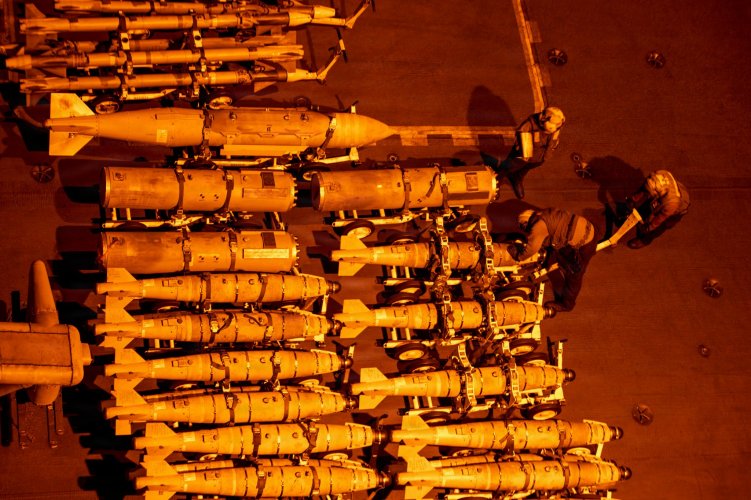
Not 100% sure, but are there many other candidates on a carrier deck in what appears to be a plane weapon rack? There's no other candidate since Harrier retirement.
I am personally somewhat surprised it was necessary, but apparently this is the way SoH convoys work.
Even now, with 14+6 (+gun) weapons, Typhoon is only behind Americans and soon Rafale in this metric.

I really doubt rocket trials and fcs modes were original plan/desired/optimal use case for GCAP.
DEW turret like on J-36? maybe.
 
Last edited:
The EF is not an F-15 though. Meaning there are no TER options at this point.
Could one be developed? Sure.
EF's wing pylons in question are not rated for 3500 lbs, most likely good enough for 3 full pods though.
I think the problem is the painful drag of 19-shot packs versus 7-shots.

If I was going to custom design some rocket packs for the problem, I'd make the pods look more like Mk80 series, with frangible nose covers (and rocket-exhaust-tolerant tail covers). Not a simple cylinder, but one with a curved outer layer and hanging lugs extending through the cover.


Or simply use external pylons.
And give up your stealth?

How about "no."
 
And give up your stealth?

How about "no."
Do you care at that point though? APKWS on GCAP doesn't present as a deep inside adversary territory capability, were it to happen would likely be for point defence of a location whether fixed or mobile in a rear area.
 
Do you care at that point though? APKWS on GCAP doesn't present as a deep inside adversary territory capability, were it to happen would likely be for point defence of a location whether fixed or mobile in a rear area.
Where do you intend to be intercepting the targets?

For example, Poland (or GCAPs operating over Poland) would need to intercept those drones more or less on the border, which means within range of the Russian IADS. Depending on where exactly Japan operates their GCAPs, they may also be operating within a Russian, Chinese, or North Korean A2AD bubble.

And those cases mean you need lots of ordnance while retaining stealth.
 
For example, Poland (or GCAPs operating over Poland) would need to intercept those drones more or less on the border, which means within range of the Russian IADS. Depending on where exactly Japan operates their GCAPs, they may also be operating within a Russian, Chinese, or North Korean A2AD bubble.
You're asking the impossible.
And if you remove the impossible part, Eurofighter/F-16 does everything you need.
 
Where do you intend to be intercepting the targets?

For example, Poland (or GCAPs operating over Poland) would need to intercept those drones more or less on the border, which means within range of the Russian IADS. Depending on where exactly Japan operates their GCAPs, they may also be operating within a Russian, Chinese, or North Korean A2AD bubble.

And those cases mean you need lots of ordnance while retaining stealth.
Could safely argue by the time GCAP comes along there will be CCA/drones that can take that mission and GCAP doesn't need APKWS integration.
 
Could safely argue by the time GCAP comes along there will be CCA/drones that can take that mission and GCAP doesn't need APKWS integration.
IMHO automating APKWS mission will be one of the most difficult missions to outsource.

Too much low altitude congested/adverse weather.
 
IMHO automating APKWS mission will be one of the most difficult missions to outsource.

Too much low altitude congested/adverse weather.
If it is a stand-alone system sure but the scenario postulated isn't a stand-alone system, it would be integrated into an IADS at which point there are already land based systems that can accomplish this mission. Adding an air based autonomous component would then not be difficult.
 
Not 100% sure, but are there many other candidates on a carrier deck in what appears to be a plane weapon rack? There's no other candidate since Harrier retirement.
I am personally somewhat surprised it was necessary, but apparently this is the way SoH convoys work.
Even now, with 14+6 (+gun) weapons, Typhoon is only behind Americans and soon Rafale in this metric.

MH-60 Sea Hawk.
The 19 shot launchers are not listed in the flight manual. Which could be outdated of course, but I also haven't seen any SH pics carrying them.
 
MH-60 Sea Hawk.
The 19 shot launchers are not listed in the flight manual. Which could be outdated of course, but I also haven't seen any SH pics carrying them.
SH can't be, but USMC hornets are the most obvious candidate.
Which is weird to me (hornets operate with at least 14/28 rockets, and they're amongst best jets for the job); Seahawks are indeed possible.

Whatever the case, the main point was that larger launchers are available, and all 1980-1990s jets still can use it by default.
GCAP can be taught to do it (and probably should), but I very much doubt it was in original plan, and IMHO small air is such a big threat, that it by itself justifies retention of current fighter stocks.
They are already here, they're already better at it than oversized "stealthy cruisers" likely can be, and improving legacy fighters in this direction is more value added, sooner.

For any CUDAs, future small effectors, etc - Eurofighter is already in fleet, small&nimble, has all the enabling sensors, and easily carries 20 missiles (and gun).
 
Last edited:

Similar threads

Back
Top Bottom