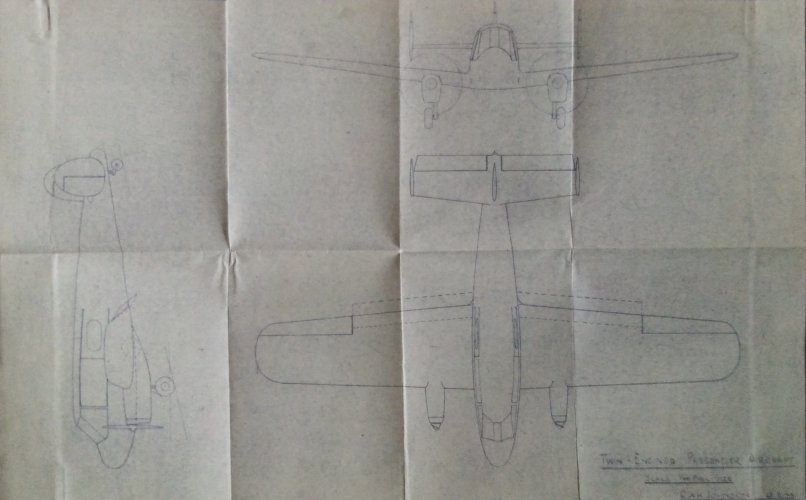
Some of those dates align then - being a student in 1939 and graduating in 1940.
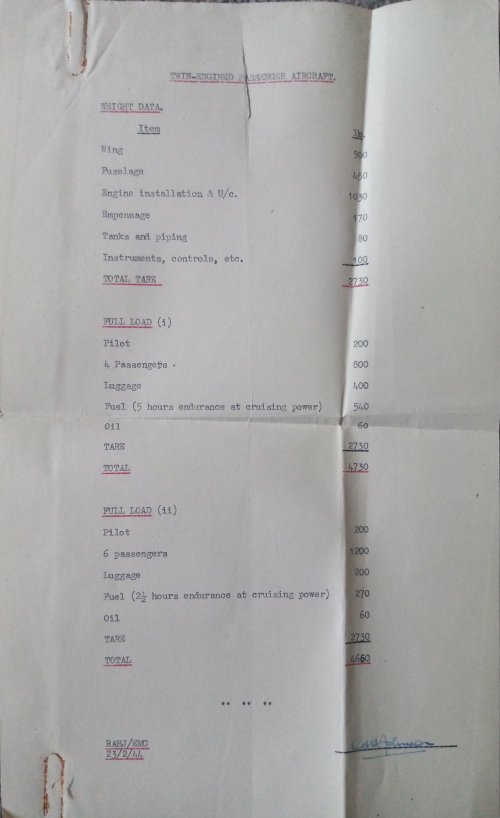
I wouldn't dismiss the potential for this to be a preliminary design to what turned out as the smaller M.75 Gemini in 1945, I noticed the bottom of the weights breakdown is filed "RAHJ/EMC" which looks like an official company signature block rather than something he has been doodling in his spare time.
Looking over the weight breakdown it seems a little pessimistic compared to usual Miles weight estimates. For example the pilot's weight here is 200lb but most Miles figures from this period use a figure of 160lb. The other figures seem a tad high too, especially if it is using a Messenger wing and empennage.
The design seems to be a halfway-house between the M.75 Gemini and the M.57 Aerovan.
The tare weight of 2,730lb - just over twice that of the Messenger (1,360lb), 800lb more than the Gemini (1,930lb) but less than the Aerovan (3,070lb).
540lb of fuel in the 4-pax case is higher than the 495lb (65gal) of the Gemini and the 365lb (50gal) of the Aerovan (this would give the Johnson design a fuel load of around 72-73gal but only 270lb/~35gal in the 6-pax case); oil too is higher 60lb versus 36lb for the Gemini and 45lb (5gal) for the Aerovan (oil capacity around 6.6gal for this design?).
The Gemini only had a payload of 369lb but this design seems capable of 1,200lb, while the Aerovan was designed for much larger loads of 1,760-2,160lb. AUW at 4,730lb is 1,430lb more than the Gemini but less than the Aerovan (5,400lb with 10-pax or 5,800lb with freight).
So a much-longer ranged Gemini or a short-range 7-seater. Feels less economic that either of the built designs to operate.