You are using an out of date browser. It may not display this or other websites correctly.
You should upgrade or use an alternative browser.
You should upgrade or use an alternative browser.
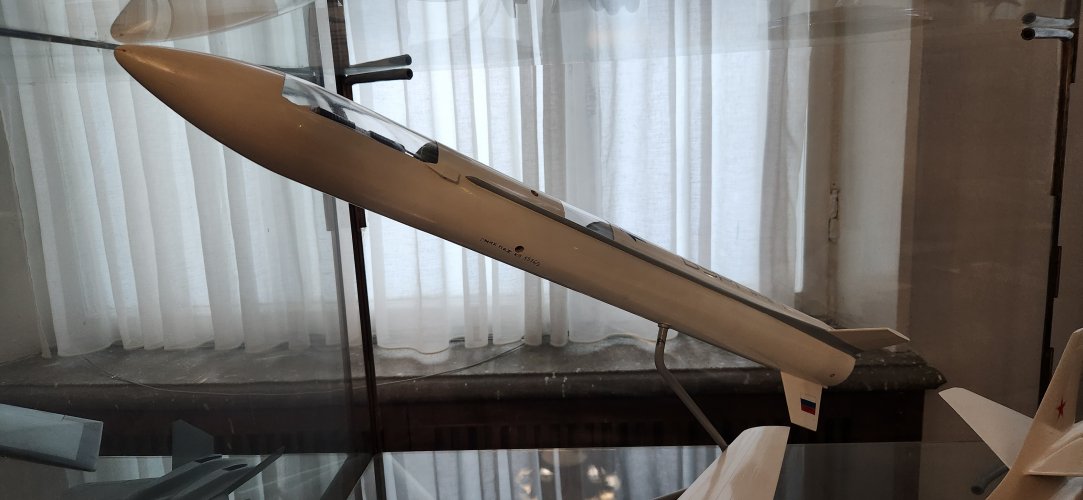
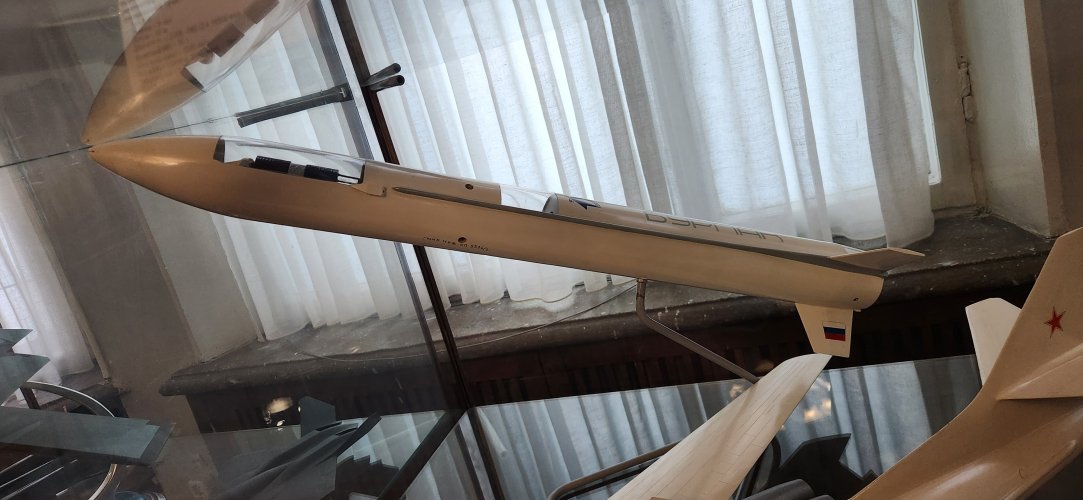
Tupolev Tu-160SK / Burlak-Diana space launcher
- Thread starter TsrJoe
- Start date
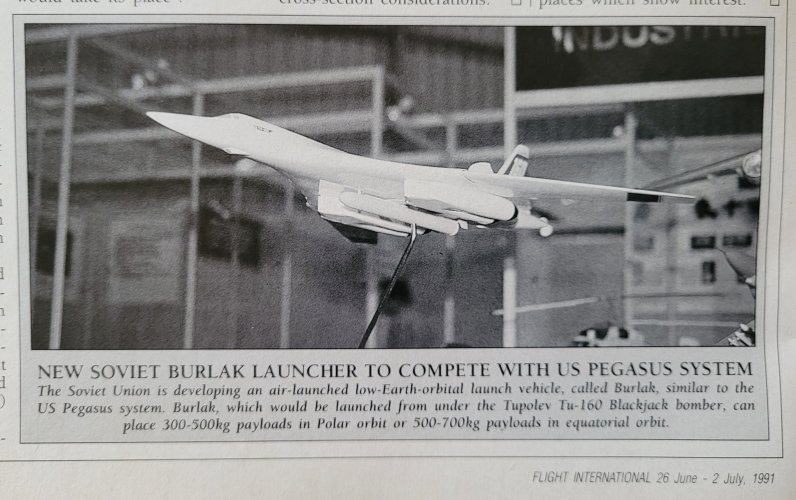
Flight International, 26 June 1991
That vaguely rings a bell for me although I would've thought the Soviets would've tried using a modified Tu-95 Bear as a launch-aircraft instead of a modified Tu-160.
Scott Kenny
ACCESS: USAP
- Joined
- 15 May 2023
- Messages
- 19,678
- Reaction score
- 28,163
I wonder if they were wanting Mach 2 launch speeds?That vaguely rings a bell for me although I would've thought the Soviets would've tried using a modified Tu-95 Bear as a launch-aircraft instead of a modified Tu-160.
I wonder if they were wanting Mach 2 launch speeds?
That would certainly enable a higher launch payload especially if it was released in a zoom-climb.

FighterJock
ACCESS: Above Top Secret
- Joined
- 29 October 2007
- Messages
- 7,260
- Reaction score
- 8,575
So what sort of paylodes would they be wanting to launch at Mach 2 from the modified Tu-160?
The first mega-constellation craze, in the 1990's. Such as Motorola Iridium. https://www.iridiummuseum.com/timeline/
https://www.globalsecurity.org/space/world/russia/burlak.htm
https://testpilot-ru.translate.goog...urlak.htm?_x_tr_sl=ru&_x_tr_tl=en&_x_tr_hl=fr
9.81*325*ln((20+10+0.7)/(2+10+0.7))+9.81*325*ln((10+0.7)/(1+0.7))+600 = 9279 m/s
https://www.globalsecurity.org/space/world/russia/burlak.htm
https://testpilot-ru.translate.goog...urlak.htm?_x_tr_sl=ru&_x_tr_tl=en&_x_tr_hl=fr
The Burlak two-stage launch vehicle project was proposed by the Raduga Design Bureau in 1991 to restore the orbital constellation of reconnaissance and early warning satellites during military operations. Launched from a Tu-160SK aircraft, the rocket was intended to deliver lightweight satellites to any desired orbit, both for the creation of multi-satellite systems and for their maintenance, with the replacement of satellites that had reached the end of their service life or had failed. The initial design envisioned the ability to launch a 700 kg commercial payload into equatorial orbit. In addition to the Tupolev ASTC and the Raduga Design Bureau, the MEI Design Bureau, the TsAGI, the Flight Research Institute, the NIIAS, and several other industrial organizations participated
in the development of the aerospace complex . The environmentally friendly, cost-effective, mobile, and operational Burlak complex, being developed under the conversion program, is designed to launch small satellites into orbit for the creation of a communications system, satellite navigation, control, mineral exploration, etc. Technically, the use of the Tu-160 carrier aircraft as the first stage for launching the Burlak space rocket boosters makes it possible to:
Payload launched by the Burlak launch vehicle
reduce the initial mass of the space booster;
eliminate the vertical section of the trajectory while ensuring the initial rocket velocity of 220-500 m/s (M= 0.8-1.7) at altitudes of 9-13 km;
eliminate the need for the maintenance and servicing of expensive launch complexes.
The two-stage Burlak launch vehicle will weigh 32 tons, be 22 meters long, and have a diameter of 1.6 meters. Unlike the Pegasus, it has no wings, and the tail unit is folded when suspended beneath the aircraft.
The first stage of the launch vehicle is equipped with an R0.201 (RD-0244) liquid-propellant rocket engine, which is also used for the first stage of the R-29RM SLBM. The second stage propulsion system (R0.202 (RD-0242)) will operate in two firings. Hydrazine and nitrogen tetroxide are used as fuel.
A new launch vehicle, the Burlak-M, was planned to be developed based on the Burlak rocket. The first stage of the Burlak-M will use a hypersonic air-breathing engine.
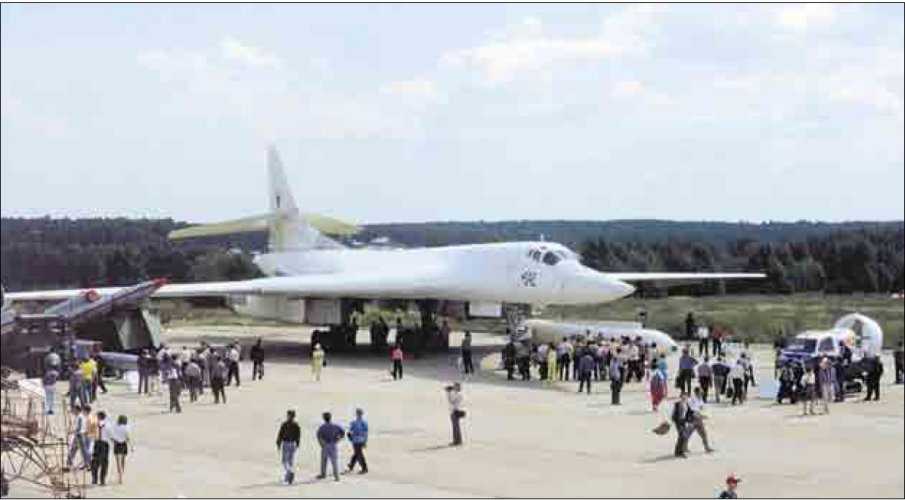
According to calculations, the payload mass of this variant should increase by 1.5 times compared to the Burlak system. The Burlak launches beyond the densest layers of the atmosphere—from an altitude of 9-11 km or 12-13 km with a relatively high initial velocity of Mach 0.8 or Mach 1.7 (depending on the launch altitude). These conditions ensure the launch of payloads weighing 600-800 kg (polar orbits) or 840-1100 kg (equatorial orbits) into orbits at altitudes of 200-1000 km. The cost of one commercial launch is estimated at $2.5 million. The cost of launching 1 kg of payload into orbit is in the range of $6,000-8,000. In 1995, the Raduga Design Bureau completed the preliminary design of the booster rocket. In 1996, it was planned to submit the design to the State Defense Industry Committee and build an electrified full-scale metal mockup. The plan was to place orders at the DMZ for the first prototypes, with the goal of completing their construction within three years and conducting the Burlak's maiden launch in 1998. In 1995, a Tu-160 aircraft carrying a wooden mockup of the Burlak booster was unveiled at the Paris Air Show and generated considerable interest among specialists and the public. Initially, the program was purely Russian, but it soon became known to the German firm OHB-System of Berlin. Together with the Russian Burlak Association, the firm carried out two phases of in-depth studies commissioned by the German space agency DARA. These studies demonstrated not only the technical feasibility of the project but also confirmed its promising economic and commercial prospects. To further advance the project's practical implementation, the Russian and German companies agreed to establish a joint venture to manage the program, dubbed "Burlak-Diana." In 1997, the Tu-160 with a model of the Burlak was shown at MAKS.
9.81*325*ln((20+10+0.7)/(2+10+0.7))+9.81*325*ln((10+0.7)/(1+0.7))+600 = 9279 m/s
Last edited:
JetPropulsion
ACCESS: Restricted
- Joined
- 19 July 2024
- Messages
- 49
- Reaction score
- 126
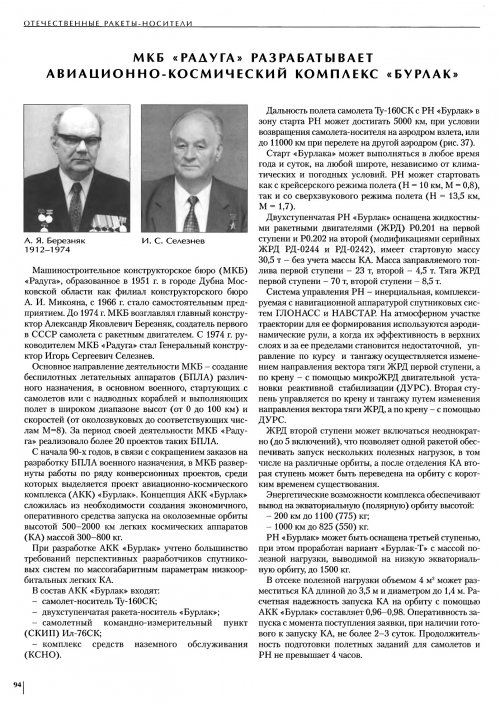
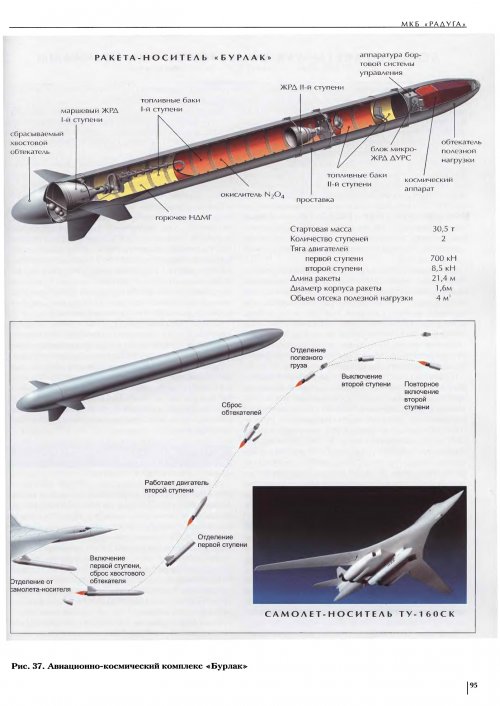
From book "Launch vehicles. Spaceports" Umanskii.
First stage engine - P0.201 rocket engine, based on main block of 3D37 (from 3M37 missile), second stage engine P0.202, based on RD-0242 (from 3M25 missile).
Payload (equatorial / polar orbit):
- 200 km: 1100 / 775 kg;
- 1000 km: 825 / 550 kg.
Mass at start: 30,5 tonn
Number of stages: 2
Thrust of engines
- first stage 700 kN;
- second stage 8,5 kN.
Lenght of rocket 21,4 m
Diameter of body 1,6 m
Payload volume 4 m. cube
First stage engine - P0.201 rocket engine, based on main block of 3D37 (from 3M37 missile), second stage engine P0.202, based on RD-0242 (from 3M25 missile).
Payload (equatorial / polar orbit):
- 200 km: 1100 / 775 kg;
- 1000 km: 825 / 550 kg.
Mass at start: 30,5 tonn
Number of stages: 2
Thrust of engines
- first stage 700 kN;
- second stage 8,5 kN.
Lenght of rocket 21,4 m
Diameter of body 1,6 m
Payload volume 4 m. cube
Attachments
JetPropulsion
ACCESS: Restricted
- Joined
- 19 July 2024
- Messages
- 49
- Reaction score
- 126
From "Novosti kosmonavtiki" №7, 1997 (translation with site deepl.com)
1. The Ministry of Economy of Russia and the Ministry of Foreign Economic Relations and Trade of the Russian Federation, together with the Ministry of Defense of Russia, the Ministry of Foreign Affairs of Russia, the Raduga Machine-Building Design Bureau, the A. N. Tupolev Aviation Scientific and Technical Complex Joint Stock Company, the State Company Rosoboronexport, and other interested federal executive authorities and organizations shall conduct negotiations with the German Space Agency and ONV-SUTEM GmbH (Bremen, Germany) on scientific and technical cooperation in the creation of the Burlak-Diana aerospace complex.
To host delegations from the Federal Republic of Germany in the Russian Federation for the purpose of conducting negotiations and, at the request of the German side, to send Russian delegations to the Federal Republic of Germany.
Expenses related to hosting and sending delegations shall be borne by the interested Russian organizations.
2. Authorize the Ministry of Economy of Russia and the Ministry of Foreign Economic Relations and Trade of the Russian Federation to disclose the technical characteristics of the Tu-160SK carrier aircraft, the Burlak space launcher, and the Il-76SK aircraft command and control center, as approved by the Russian Ministry of Defense, the Russian Ministry of Defense, the Russian Ministry of Foreign Economic Relations and Trade, and the Russian Ministry of Foreign Affairs on the procedure for international cooperation in the creation of the Burlak-Diana aerospace complex dated February 12, 1997.
3. The Ministry of Economy of Russia and the Ministry of Foreign Economic Relations and Trade of the Russian Federation, together with the Ministry of Defense of Russia, the Ministry of Foreign Affairs of Russia, the State Technical Commission of Russia, the Federal Security Service of Russia, and the state-owned company Rosoboronexport, shall, based on the results of negotiations with the German side, submit relevant proposals to the Government of the Russian Federation in accordance with the established procedure.
Moscow
April 2, 1997
№ 428-p
Chairman of the Government
of the Russian Federation
V. Chernomyrdin
Attachments
JetPropulsion
ACCESS: Restricted
- Joined
- 19 July 2024
- Messages
- 49
- Reaction score
- 126
From "Novosti kosmonavtiki" №3, 1991 (translation with site deepl.com)
USSR. The "Burlak" Project.
On Friday, September 6, a meeting was held at the Scientific and Industrial Union of the USSR between its president, A. I. Volsky, and the French Minister of Economy, Finance, and Budget, Pierre Berregov. The meeting was attended by directors and chief designers of defense industry enterprises. The French were invited to familiarize themselves with a system being developed by the design bureau headed by A. A. Tupolev, the State Research Institute of Aviation Systems headed by E. A. Fedosov, and the "Raduga" Design Bureau headed by I. S. Seleznev, called "Burlak". According to the project, a small rocket is planned to be installed on the TU-160 strategic bomber, which will be able to launch a 900-kilogram communications satellite into a polar orbit.
According to A. A. Tupolev, this project is much cheaper than its american analogue, "Pegasus".
Attachments
JetPropulsion
ACCESS: Restricted
- Joined
- 19 July 2024
- Messages
- 49
- Reaction score
- 126
https://rulaws.ru/president/Raspory...03.01.1996-N-2-rp/?ysclid=mfvdhtvfuc688667673PRESIDENT OF THE RUSSIAN FEDERATION
DECREE
№ 2-rp of January 3, 1996
1. In connection with the work being carried out in the Russian Federation to create the Burlak-Diana aerospace complex, consisting of a TU-160 aircraft, the two-stage Burlak space launcher, and the Il-76SK aircraft command and measurement station, designed to launch small and medium-sized artificial Earth satellites into low orbits, it is hereby authorized to:
the demonstration at international air shows and exhibitions of an analogue of the Burlak-Diana aerospace complex in a configuration and with technical characteristics agreed upon with the Russian Ministry of Defence, the Russian State Corporation for Space Activities, and the Russian State Technical Commission;
conducting negotiations with foreign organizations on scientific and technical cooperation in the creation of the Burlak-Diana aerospace complex, in agreement with the FSB of Russia and the SVR of Russia, on the basis that such cooperation should not involve the transfer of equipment and technologies related to missiles and weapons to other states.
2. The Government of the Russian Federation shall determine the procedure for the participation of Russian organizations in the implementation of this order and shall make decisions based on the results of their negotiations with foreign organizations, as well as on the temporary export of an analogue of the Burlak-Diana aerospace complex in accordance with the legislation of the Russian Federation in the field of export control and taking into account the provisions of the Treaty between the Union of Soviet Socialist Republics and the United States of America on the Reduction and Limitation of Strategic Offensive Arms
3. This order shall enter into force on the day of its signing.
President
of the Russian Federation
B. YELTSIN
JetPropulsion
ACCESS: Restricted
- Joined
- 19 July 2024
- Messages
- 49
- Reaction score
- 126
So, let’s go on going on.
From book "Strategic missile carrier-bomber Tu-160" A. M. Zatuchnyi, V. G. Rigmant, P. M. Sineokii. M.: 2016.
From book "Strategic missile carrier-bomber Tu-160" A. M. Zatuchnyi, V. G. Rigmant, P. M. Sineokii. M.: 2016.
The topic "Zoologist" (A. V. Bliznyuk) explored the possibility of creating an aviation rocket and space system based on the Tu-160. By that time, the "Burlak-Diana" system had been developed with a 25-tonne solid-fuel rocket, a model of which, suspended under a Tu-160 aircraft, was demonstrated at the Le Bourget Air Show in 1995 year.
...
Topic "Zoologist" was continued in a variant of the Tu-160 equipped with an RSM-54 (SS-23) liquid-fuel rocket. In 2003 year, the preliminary design project was successfully defended. After that, the topic was transferred to the OKR, but was not supported by the military due to the high environmental risk of the project. The project was in demand for some time by Rostelecom, but was also discontinued for the same reasons. Funding for the development of environmental safety measures for solid-fuel missiles, which was included in the "Gor-Chernomyrdin" program, was suspended due to political factors.
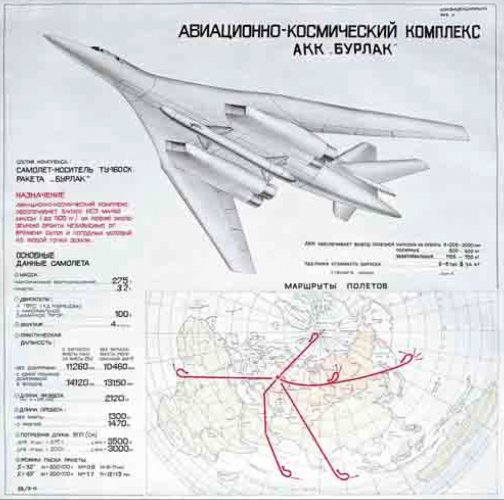
Tu-160SK. A separate topic in the work of the OKB was the design of an aviation-space complex, in which the first stage was to be the Tu-160 — the aircraft- carrier of aviation complex "Burlak" Tu-160SK.
The reduction in the volume of military equipment production in Russia forced the developers of the Tu-160 aircraft to look for new civilian applications for it. In the beginning 1990s years, the OKB, together with the "Raduga" machine-building design bureau and the Moscow power institute of aviation systems, developed the "Burlak" aviation complex project, which was intended to launch commercial artificial satellites into near-Earth orbits. According to the prepared project, the "Burlak" complex included:
- the Tu-160SK carrier aircraft (a modified serial Tu-160);
- the "Burlak" rocket- carrier;
- ground support, training, and information processing facilities.
The three-stage, liquid-propelled "Burlak" rocket-carrier, weighing 20 tonnes, was planned to be suspended under the fuselage of the aircraft.
The maximum payload weight that could be launched into orbit was 800–850 kg, and the delivery cost was $6,000–8,000 per kg of payload. The Tu-160SK, equipped with an in-flight refueling system, could launch a rocket with a satellite from virtually any location on the planet. The flight range with a carrier rocket located not on an external suspension under the fuselage, but inside the cargo compartment, was calculated to be 1,000 km without refueling the carrier in the air. The rocket was to be launched at altitudes of 9,000 m to 14,000 m at carrier speeds of 850–1,600 km/h. The Tu-160SK, together with the rocket for loading a foreign satellite, could make an intermediate landing at any country's airbase, while guaranteeing the safety of the customer country's technology. Only the structural elements of the satellite had to be agreed in advance: power supply, dimensions, weight, operating temperature range, etc.
With the help of the "Burlak system", it was possible to launch several satellites into orbit at the same time. According to preliminary calculations, the air launch of the carrier rocket at high altitudes and speeds made it possible to reduce the energy costs of launching equivalent loads by 2-3 times compared to a ground launch. The cost of a launch using the "Burlak" complex was estimated to be 2–2.5 times lower than that of rockets with similar payload capacity launched vertically from the ground.
The ability to choose the rocket launch point over the ocean ensured delivery to any orbit and eliminated the problem of leasing land for possible rocket stage fall zones. In terms of its tactical and technical characteristics, the "Burlak" complex significantly surpassed the American subsonic launch complex, which was based on the Boeing B-52 carrier aircraft and the "Pegasus" rocket- carrier. Thus, the Tu-160 heavy strike aircraft could also be used for peaceful purposes. Attempts were made to involve interested foreign partners in the work on the creation of the Burlak-Diana aerospace complex. Thus, Russian Federation Government Decree No. 428-r of 2 April, 1997, instructed the Russian Ministry of Economy, the Ministry of Foreign Economic Relations and Trade, together with the Ministries of Defense and Foreign Affairs, the Design Bureau "Raduga", the ANTK named A. N. Tupolev, and the State Corporation "Rosoboronovozhenie" to hold negotiations with the German Space Agency and ONV-SYSTEM GmbH on scientific and technical cooperation in the creation of the "Burlak-Diana" complex. However, no practical results were achieved.
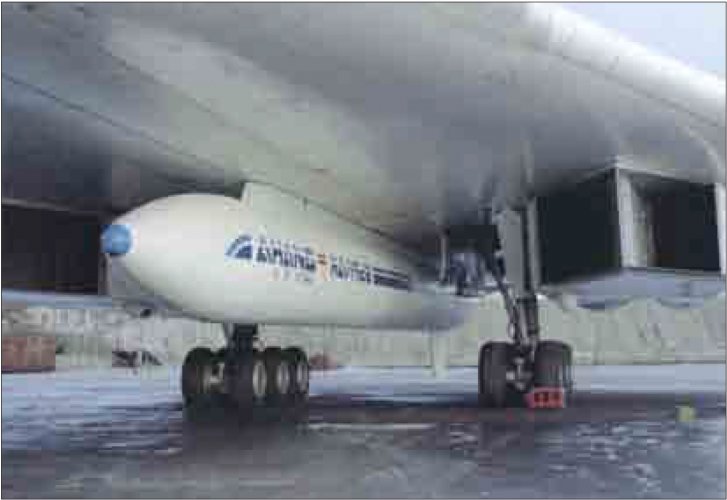
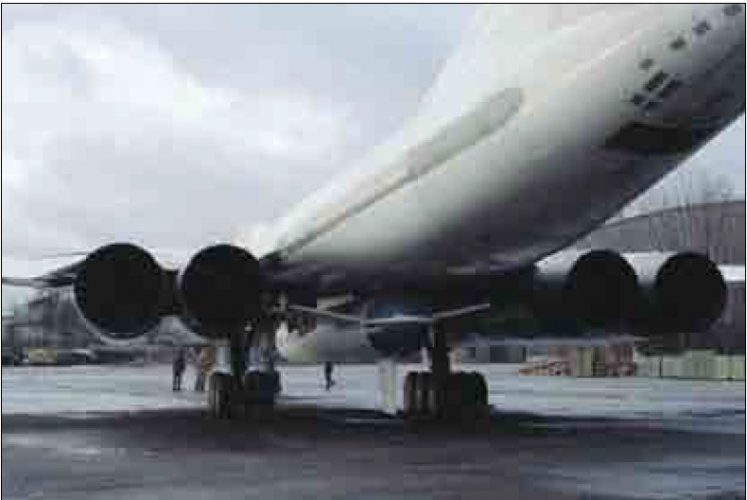
For the first time, MKB "Raduga", OKB MEI, tupolevs OKB, and OHB-SYSTEM GmbH presented a model of the Tu-160SK carrier aircraft with a two-stage "Burlak-Diana" rocket on an under-fuselage pylon at the Singapore Airshow in 1994. The following year, a mock-up of the Tu-160SK complex with a model of the "Burlak" carrier rocket was presented to the public and specialists at the international aerospace shows in Le Bourget and MAKS-95 in June and August, respectively. Two years later, the same aircraft without a tail number was displayed at the MAKS-97 air show.
Work on the "Burlak-Tu-160" project at the OKB was further developed in the "Tu-160-Shtil" system.
Attachments

JetPropulsion
ACCESS: Restricted
- Joined
- 19 July 2024
- Messages
- 49
- Reaction score
- 126
Let’s go on going on.
(Translation use www.deepl.com)
* "Shtil" - civil modification from 3M37 missile to rocket-carrier.
(Translation use www.deepl.com)
https://testpilot.ru/russia/other/haal/Note:HAAL-2000 aerospace complex
In 1995-99 year, design bureaus and enterprises in Russia and Ukraine developed a joint program called High Altitude Air Launch (HAAL), which envisaged the creation of a number of aerospace complexes. One of them, the "2001", envisaged the Tu-160 aircraft as the carrier and one of the existing rockets weighing between 20 and 50 tonnes with a payload capacity of 400 to 1.500 kg as the launch vehicle.
This project can be seen as a continuation of the "Burlak-Diana" project.
However, the use of the "Shtil"* rocket as a booster raises questions. Mounting this rocket, weighing between 45 and 47 tonnes, under the Tu-160 is problematic due to its large size.
One of the main participants in the RCATC (Russian Commonwealth Aerospace Technology Consortium) consortium is the commercial concern Yakovlev Aircraft. Its chief designer is S. A. Yakovlev, son of the famous aircraft designer A. S. Yakovlev, and its director is James T. Hollister.
The two-stage booster, weighing 32 tonnes, launches from the Tu-160 at an altitude of 13 km and is designed to deliver up to 1.135 kg into low Earth orbit (LEO). The launch cost is approximately $5 million.
The advantages of the project include:
- the use of ready-made technical solutions, which reduces modernization costs and technical risk;
- basing the Tu-160 in Pryluky (Ukraine), where there are already ready-made crews and maintenance personnel;
- suspending the payload and launching it into orbit in the customer's country removes restrictions on the export of technology.
On 3 March, 1999, the Ukrainian government authorized RCATC to sell three Tu-160s belonging to the Ukrainian Air Force and spare parts for them to the American company Platforms International Corporation (PIC) for $20 million to convert the aircraft into missile carriers for launching satellites. On 5 March, PIC signed a strategic partnership agreement with RCATC. Another American company, Orbital Network Services Corporation (OrbNet), was responsible for organizing launches using Pegasus launch vehicles. Ukraine was to receive 20% of the profits from the operation of the converted Tu-160s.
Ukraine's attempt to sell strategic bombers to a private company (even an American one) was a clear violation of the START II treaty, according to which all Ukrainian Tu-160s were to be destroyed by the end of 2001, with the exception of those that would remain as museum exhibits. Russia's principled position found support in Washington, which also spoke out against any violation by Ukraine of the fundamental provisions of the treaty.
However, in May 1999, the US State Department and the Ukrainian government reached an agreement that the commercial use of three Tu-160s would not violate the START treaty, provided that they were modernized to prevent their use in combat.
According to J. Hollister, Yakovlev Aircraft has reserved up to 400 first-stage liquid-propellant rocket engines and several dozen liquid-propellant rocket engines for the second stage of the accelerator. The cost of the program is estimated at $100 million, including the purchase of three Tu-160s. The first launch is planned three years after the start of funding.
At the same time, uncertainty surrounding the "Iridium" satellite communications project, as well as Ukraine's transfer of the remaining airworthy Tu-160s to Russia, cast doubt on the future of the program.
Description
Design Yakovlev Aircraft
Designation Program “2001”
Type Aviation and space complex
Project 1995-1999
Flight data
Launch speed, km/h (M=) 1700 (1.7)
Launch altitude, km 13
Orbital altitude of launch vehicle, km 200-1000
Maximum payload weight, kg 1135
Sources of information:
Air launch in the launch services market and in the conversion of heavy aircraft / Alexander Zhilin Center /
Ukrainian BlackJack will not go to America / Avia.Ru /
Ukraine sells three Tu-160 strategic bombers / Air International, 04/99 /
Tu-160 Launch Program Revamped To Cut Costs / AW&ST, 12 June, 2000 /
* "Shtil" - civil modification from 3M37 missile to rocket-carrier.