The potential effect of Artificial Intelligence on civilisation - a serious discussion

It's just a very fancy cut and paste producer that gambles on what its pasting might be what you want.
Or a just an advanced search engine designed to present the results in/as a conversation.
I had a colleague like that, we had conversations about stuff and things, and I was surprised how he would come super fast with responses to things we were talking about. Turned out, he was just super fast at typing/searching Wikipedia while talking on the subject... called him Mister Wiki.
 
Last edited:
Interesting. So, that would be the distinction between pravda and istina ? Like someone could accept a pravda because he likes it, or because is the common norm to believe it. But everyone everywhere will accept a istina, like "water is wet".
So when an stupid IA is hallucinating and drawing me a tri engines MiG-21, that's IA pravda ?
As you know, "everyone has their own truth (Правда)," so a three-engine MiG-21 and a two-engine F-35 can both exist in a subject's mind. "Truth" (Истина, Verity, Ultimate truth) is one for all, and it is identical in the minds of all subjects. The only question is how to approach it.
 

People Are Being Involuntarily Committed, Jailed After Spiraling Into "ChatGPT Psychosis"

Extract :
As we reported earlier this month, many ChatGPT users are developing all-consuming obsessions with the chatbot, spiraling into severe mental health crises characterized by paranoia, delusions, and breaks with reality.
The consequences can be dire. As we heard from spouses, friends, children, and parents looking on in alarm, instances of what's being called "ChatGPT psychosis" have led to the breakup of marriages and families, the loss of jobs, and slides into homelessness.
And that's not all. As we've continued reporting, we've heard numerous troubling stories about people's loved ones being involuntarily committed to psychiatric care facilities — or even ending up in jail — after becoming fixated on the bot.
...
As the hype around AI has risen to a fever pitch, many people have started using ChatGPT or another chatbot as a therapist, often after they were unable to afford a human one.
Whether this is a good idea is extremely dubious.
...
It's alarming enough that people with no history of mental health issues are falling into crisis after talking to AI. But when people with existing mental health struggles come into contact with a chatbot, it often seems to respond in precisely the worst way, turning a challenging situation into an acute crisis.
...

On vit une époque formidable...
 
This is a serious question, but I'll expand on it. Who determines what is disinformation and by what criteria?
First, I think there is a difference between falsehood and disinformation.

Everything, no matter how complex, has a irrefutable ground truth. The problem is the more complex something gets, the more we are unable to accurately define that ground truth. Instead, we more or less live everyday on a set of falsehoods and assumptions made that are always more or less true but never completely true. I'll put a pin in this for now.

Disinformation to me has always been a deliberate act to muddle what is known to be true or withholding information in a way that distorts what is readily known to be true. It implies some form of purposefulness and intent to muddle the truth rather than merely working with indeterminable falsehoods and inaccuracies.

As far as I understand, the criterion is simple, we don't like it, so it's a lie/ misinformation.
And yes, I'm from Russia.
Was the intention to misinform and mislead or not? If the intention was to misinform, then it absolutely is misinformation/disinformation, let alone an intention to misinform so as to create disunity.

No - it isn't just whether someone likes the statement or not. Your statement can be 100% true and still disinformation. In fact, only shitty disinformation tells baldfaced lies. The best kind of disinformation is telling truth by taking it out of the context in which it existed and removing it from similar references that it can be compared to so as to push a narrative of some sort.

Country A says about Country B: you did terrible things to us during this historical event. It's absolutely true that it happened.

Turns out it's also 100% true that said historical event had been preceded by centuries of ethnic hatred with both sides doing absolutely atrocious things to each other. But who on the receiving end of this is going to actively go and look up and try to understand for the context? And so the target population slowly becomes disillusioned with country B or country B's national myth and their leaders.

Country A tells Country B: you guys are warmongering imperialists - and it's absolutely true.

Turns out the only reason Country A exists also happens to be thousands of years of ethnic warfare and genocide. Yet who in Country B is going to have that frame of reference? And so people in country B slowly become disillusioned with their national myth and their leaders.

The intention and the way the knowingly verifiable information is framed can be used to determine with some degree of certainty what is or isn't misinformation. The reason I chose such a verbose way of saying this is because of what I said above - no matter how true something is (save for science stuff and even when it's science stuff), we are always working with varying degrees of unknown and indeterminable things. Being bilingual, given the state of things now, good luck discerning someone's "intention". Idiots are all over the world and social media has given everyone a way to speak their idiocy - me included.
 
Last edited:
Disinformation is also about instilling doubts in peoples minds. That’s what post truth politics is mostly about.
Instill doubt in the population of a country about their institutions for example, people will less and less care about politics, or the ones that would still vote would be so lost that they'll fall for the one with the biggest mouth and has the simplest solution to what he tell them is their problem (when the real problems may be something else completely, and needing very serious and difficult solutions...).
 
Last edited:

(You can just read the essay I linked at the bottom of the post, really. I don't know how much all this stuff in between adds to it.)

The word "learning" in the title of that article does some heavy lifting in how AIs end up exhibiting dishonesty, underhandedness and coercion. For starters, many of these instances were brought on by explicit efforts to get AIs to do these things, testing them for undesirable outcomes; the very safety research people in the article are calling for. While it is prudent to guard against hurtful and destructive qualities, attributing these to "hallucinations" and/or some emergent strategic thinking may just as well unnecessary mythologizing.

There are plenty of examples of imaginary AIs in Sci Fi and popular culture behaving in such manners and these are probably included in the vast training sets LLMs and other AIs are based on. AIs may thus recognize the testing scenarios they're in and based on probabilities function in a manner their algorithms perceive as expected. This doesn't exclude other scenarios but is, I think, entirely plausible.

Many of these themes were explored meritoriously and with foresight in the series "Person of Interest" (2011 - 2016). In some ways it stands up very well, in others it may have been more significant in shaping misperceptions (that may now be reflected in real AI functioning) that still, for better or for worse, shape very real developments. The thus far apparently elusive prospect of AGI and AIs being able to learn, reflect and successfully generalize from scarce subjective experiences is nonetheless used by tech corporations to mask the literally hundreds of millions of subsistence-level data workers and untold quantities of misappropriated human creativity and IP the models actually are founded on.

Some of our current predicaments trace directly to much earlier, purpose-specific AIs: they were employed in algorithmic trading decades ago. The models were rudimentary, hardware limited but produced huge windfalls. Their developers' and benefiters' edge was the simple letting go of a notion about markets being a (merely) human endeavor. Now some of that wealth funds populist autocratic movements and far more ingrained algorithms in their service. Some of it also funds arts and science. Context affects our morals and behavior greatly, whether we feel agency, empowered; whether we can see ourselves reflected in what we do, AI included, or merely staring and making offerings at a mythical black box doling out arbitrary rewards but mostly misery.

"Person of Interest's" AIs "the Machine" and "Samaritan" are narrative vehicles to reflect on these choices we make, on how we employ our imaginations. I don't know much about what kind of consulting the writers of the show got but the themes and details suggest knowledgeability and experience. Anyway, writing of AIs gaining autonomy (or more distributed human interaction, if you will, by more or less benevolent subterfuge) I'm looking at all these real-world data centers being constructed and am half expecting to see "Thornhill Corporation" logos on some of them.

If you want further (and more coherent) exploration of this theme I suggest you also read "Eleventh Hour Enthusiast's" ""Person of Interest" Saw Today's AI Conversations Coming" (link below). All part of the feedback loop, I guess.

https://medium.com/@EleventhHourEnt...w-todays-ai-conversations-coming-4b9673d3d6f0
 
Just saw this on Tumblr,
why-animals-do-the-thing
Reblogged
34m

animalphotorefs
42m

Why are animal facilities not named in repository photos?​

Hey folk, let's talk about something important! All of the animals on the repository website are anonymous - but why?
The answer: to prevent AI hoaxes.
So here's the thing. "Escaped zoo animal" hoaxes have always been a popular pastime for a certain segment of the population. GenAI has made this way, way easier and much harder to identify as a hoax. Those hoaxes commonly occur after major disasters (or just when someone wants to cause chaos) and can be really dangerous if they divert resources from other critical things.
One of the best ways to identify hoax videos as AI gets increasingly more sophisticated is to actually know what a facility looks like, and which animals are currently living there. If someone wanted to cause harm using my site, and the site identified where/when photos were taken... it would make it easier to replicate a specific place, or a specific animal.
I can't stop people from scraping the site and using it for evil, but I can up the difficulty level.
 
Folks, This thread is meant to be a serious discussion on the subject of artificial intelligence and its potential effects, both positive and negative. As such, posts that get into the mud slinging or which are deliberate trolling, as have been seen in other recent threads that touch upon this topic will be deleted.
Great initiative! AI's impact is too important for distractions. Let's keep this thread focused on meaningful discussion—looking forward to insightful exchanges.
 
https://mp.weixin.qq.com/s/GKnLX8HUwxadaj6RnM6MHw
I'm not entirely sure if similar viewpoints have been reposted here before, but there indeed seems to be very little Chinese material in the thread. This article is from Banyuetan, a semi-official Chinese publication (meaning it has an official background but doesn't represent a serious, formal government stance). There's a particularly interesting line in it:
"...置于由‘善思考’的脑力劳动者到‘会点击’的体力劳动者的退行之中" (...placed in a regression from "thought-capable" mental laborers to "click-capable" manual laborers).
Current AI, strictly speaking, doesn't "think" – they merely mimic what "a human response should look like." However, they do effectively transform low-level mental labor into manual labor.
I spent two months learning to use AI to create anime-style illustrations. I've now reached a point where it's hard to tell at a glance that it's AI-generated imitation hand-drawn art – it even generates fake software window borders around the image.

I don't see current AI as a threat, but it is fundamentally questioning what the essence of human "creation" really is. Is it just the MonteCarlo generation of a Shakespearean corpus from countless noises within constraints?
I strongly agree with your signature, Dilandu, especially when we're discussing current large model AI.
 
As AI technology accelerates, it’s clear that the brunt of disruption will fall on those under 45.

Older workers, those in their late 40s and beyond are more insulated. Most are well into established careers, with mortgages nearing completion, financial stability in sight, and children either independent or close to it.

Or still living at home and are never going to leave :)

In contrast, younger generations are far more exposed. They’re either just entering the workforce or still climbing the ladder, saddled with university debt, housing insecurity, and the list goes on.

These workers will not only face higher rates of displacement but will also be required to retrain, reskill, and pivot potentially multiple times over their careers in a very harsh market. And doing so in an environment where AI may easily outpace the ability of education and policy to keep up.

The result is likely to be a widening economic and social gap and more resentment not just between those with and without technical skills, but between generations themselves.

I would be shitting myself if I was 25.

Regards,
 
Last edited:
I spent two months learning to use AI to create anime-style illustrations. I've now reached a point where it's hard to tell at a glance that it's AI-generated imitation hand-drawn art – it even generates fake software window borders around the image.

I don't see current AI as a threat, but it is fundamentally questioning what the essence of human "creation" really is. Is it just the MonteCarlo generation of a Shakespearean corpus from countless noises within constraints?
I strongly agree with your signature, Dilandu, especially when we're discussing current large model AI.

Anime, as a style or a genre, is particularly suitable for AI because it's (largely) formulaic and presents a sizeable training set compared to many others. It might even be that the way run of the mill anime production somewhat resembled AI generation before the latter came along (perhaps owing something to a continuum along realism, cartoons, pictograms, logograms, etc.); many image generators seem to offer this very option along more general ones and it's almost surely due to the relative ease at which AI has been able take to it. This is not a criticism nor a value judgement of human anime's artistic or creative potential (in relation to other styles or genres) but an observation of its extant corpus.

I'm somewhat worried that AI might end up restricting overall human creativity, camouflaged in that most will personally feel and effectively are very empowered by AI solutions. That it's potentially able to outcompete 90 to 95 percent of professionals at a given "creative" field (reduced to and restricted by mere financial "realities", at least) can make it unviable to those whose work cannot be (possibly, entirely) replicated by AI as well. This, by the way, is not some fountainheadian reduction to exceptional individuals potentially excelling above others (and AI) but also in the context of combined functional intelligences of well honed work groups, organizations and societal structures all of which also face immediate adaptive AI pressures. I'm seeing very rapid developments across very specific fields where it will be very, very easy to go with "good enough" AI results produced in a fraction of the time compared to making good cases of using way more resources in an (uncertain) attempt to attain something qualitatively more novel (at the planning and design phases). Fields which account for many orders of magnitude greater parts of the World environment, economy, etc. than anime.

Even the most convincing mimicry is just that, only fewer and fewer people can (easily) tell the difference. Until, perhaps, AI results and "creativity" degrade as the human quotient in their source material is inevitably diluted. Creativity never was what it was "thought" to be - I don't subscribe to God of the gaps theologically or philosophically - but at least equally (more likely especially) I regard it to be a fallacy to then ascribe and externalize it to AI, much less to a black box one. A perhaps useful exercise is to make reverse image searches of the anime-style images you've prompted; there are many instances where the indistinguishability of AI's "creativity" has turned out to be a very close approximation of a unique work of some very human artist. Like, plagiarism close. The chances of that in anime seem to be especially great. At least the exercise can hone your appreciation and instincts of what you want from AI, and generally.
 
The unreality expands
https://techxplore.com/news/2025-09-software-tool-everyday-animated-eye.htmlhttps://techxplore.com/news/2025-09-technology-holograms-art-life.htmlhttps://techxplore.com/news/2025-09-sustainable-ai-physical-neural-networks.htmlhttps://techxplore.com/news/2025-09-tool-free-real-video-background.htmlhttps://phys.org/news/2025-09-real-physical-quantum-ohare-technology.htmlhttps://techxplore.com/news/2025-10-embodied-ai-virtual-reality-student.htmlhttps://futurism.com/future-society/psychiatric-facilities-aihttps://techxplore.com/news/2025-11-fake-real-ai-harder-pictures.htmlhttps://phys.org/news/2025-11-beauty-backfire-effect.html
Clean up
https://hackaday.com/2025/09/14/e-waste-and-waste-oil-combine-to-make-silver/
Division
https://techxplore.com/news/2025-09-openai-deepseek-google-vary-widely.html
Military use
https://breakingdefense.com/2025/09...r-than-humans-can-but-some-of-them-are-wrong/https://techxplore.com/news/2025-10-smartwatches-centimeter-accuracy-tracking-algorithms.htmlhttps://techxplore.com/news/2025-09-violent-ai-human-conflict-inevitable.html
More
https://phys.org/news/2025-09-job-ads-ai-written-content.htmlhttps://techxplore.com/news/2025-10-quantum-hvac-smarter-greener.htmlhttps://phys.org/news/2025-10-generative-ai-outperform-nature-proteins.htmlhttps://phys.org/news/2025-10-ai-generated-nanomaterial-images-experts.htmlhttps://medicalxpress.com/news/2025-10-braincomputer-interfaces-easier-lego.htmlhttps://phys.org/news/2025-10-parallel-atom-photon-entanglement-paves.htmlhttps://medicalxpress.com/news/2025-09-waldo-ai-tool-scan-social.htmlhttps://phys.org/news/2025-10-ai-powered-oil-emergency-response.htmlhttps://phys.org/news/2025-09-quantum-error-codes-enable-efficient.htmlhttps://techxplore.com/news/2025-09-pin-shimmy.htmlhttps://techxplore.com/news/2025-10-ai-sketchy-massage-parlors.htmlhttps://techxplore.com/news/2025-10-dialogue-words.htmlhttps://phys.org/news/2025-09-automatically-disadvantaged-benefit-recipients-ai.htmlhttps://phys.org/news/2025-10-vr-ai-generation-kinder.htmlhttps://phys.org/news/2025-09-ai-classroom-hard-oral.htmlhttps://phys.org/news/2025-09-generative-ai-outsourcing-production-knowledge.htmlhttps://phys.org/news/2025-09-fatigue.htmlhttps://techxplore.com/news/2025-11-eyes-space-power-hungry-centers.htmlhttps://medicalxpress.com/news/2025-11-shortcomings-ai-responses-mental-health.htmlhttps://phys.org/news/2025-10-healable-hydrogel-ultra-sensitive-formaldehyde.htmlhttps://techxplore.com/news/2025-10-fully-recyclable-micrometer-electronics-reshape.htmlhttps://phys.org/news/2025-10-algorithm-precisely-quantifies-complex-networks.htmlhttps://techxplore.com/news/2025-09-humans-machines-people-reveals.htmlhttps://techxplore.com/news/2025-11-openai-boost-ai-investments.htmlhttps://techxplore.com/news/2025-11-motion-picture-association-meta-pg.htmlhttps://techxplore.com/news/2025-11-laws-streaming-giants-invest-local.htmlhttps://phys.org/news/2025-11-politicians-ai-survey-line.htmlhttps://phys.org/news/2025-11-ai-billions-humans.html
Software and coding
https://techxplore.com/news/2025-11-legible-modular-software.htmlhttps://techxplore.com/news/2025-11-vibe-coding-word-year-collins.html

Daily driver
https://hackaday.com/2025/11/04/jennys-daily-drivers-reactos-0-4-15/When picking operating systems for a closer look here in the Daily Drivers series, the aim has not been to merely pick the next well-known Linux distro off the pile, but to try out the interesting, esoteric or minority OS. Today’s choice, ReactOS 0.4.15, is among the closest we’ve come so far to that ideal.

In the news
https://arstechnica.com/tech-policy...e-survived-major-copyright-losses-whats-next/https://arstechnica.com/google/2025/11/so-long-assistant-gemini-is-taking-over-google-maps/https://arstechnica.com/tech-policy...o-unmask-mysterious-founder-of-archive-today/https://arstechnica.com/gadgets/202...-a-clean-install-of-windows-11-23h2-and-edge/https://arstechnica.com/tech-policy...gey-chat-logs-found-in-google-analytics-tool/https://arstechnica.com/security/20...t-throat-hackers-rain-destruction-on-ukraine/https://arstechnica.com/tech-policy...eryone-a-free-iphone-ad-industry-board-rules/https://arstechnica.com/ai/2025/11/...ity-to-describe-their-own-internal-processes/
Neuron-like
https://techxplore.com/news/2025-09-semiconductor-neuron-mimics-brain-memory.htmlhttps://techxplore.com/news/2025-10-team-high-ultra-power-superconductive.htmlA research team has developed a neuron device that holds potential for application in large-scale, high-speed superconductive neural network circuits. The device operates at high speeds with ultra-low-power consumption and is tolerant to parameter fluctuations during circuit fabrication.

Their research is published online in the journal Neuromorphic Computing and Engineering.
 
Last edited:
https://bbc.com/news/articles/c4gj7mlg9vdo
TikTok's algorithm - the technology that determines what users see in their feed - will be copied and retrained using US user data as part of a deal to secure the app's future in the country.
A White House official said on Monday that TikTok's recommendation system will be audited by tech giant Oracle, and operated by a new joint venture involving US investors in order to meet requirements for the app's sale.
It comes after President Donald Trump said a deal to prevent the app's ban in the US, unless sold by its Chinese parent company ByteDance, had been reached with China's approval.
The BBC has approached ByteDance and TikTok for comment.


White House officials claim the deal will be a win for the app's US users and citizens.
 
It also seems to be empowering 'socially corrosive' pranking.

AI-powered deepfake tech has come a very long way.

Unsurprisingly, teens have been using the tech to prank their friends and family. The latest hoax involves kids sending their parents AI-manipulated pictures of them welcoming homeless men into their houses...

Police Issue Warning About “AI Homeless Man” Prank
 
As AI technology accelerates, it’s clear that the brunt of disruption will fall on those under 45.

Older workers, those in their late 40s and beyond are more insulated. Most are well into established careers, with mortgages nearing completion, financial stability in sight, and children either independent or close to it.

Or still living at home and are never going to leave :)

In contrast, younger generations are far more exposed. They’re either just entering the workforce or still climbing the ladder, saddled with university debt, housing insecurity, and the list goes on.

These workers will not only face higher rates of displacement but will also be required to retrain, reskill, and pivot potentially multiple times over their careers in a very harsh market. And doing so in an environment where AI may easily outpace the ability of education and policy to keep up.

The result is likely to be a widening economic and social gap and more resentment not just between those with and without technical skills, but between generations themselves.

I would be shitting myself if I was 25.

Regards,
MIT did the numbers back in the 20-teens and discovered that automation was killing jobs, not outsourcing. Hell, there's a study that went 'yeah, the current situation stems from automation'.

So, since we've well past the window to institute a 'Jetsons-style' future, find the best necromancer you can find and pay him so we can resurrect Huey Long and his Share Our Wealth program from the dead.
 
Brave New World 2.0.
Huxley is more on point with the human condition than we would like him to be, though, to be honest, he also didn't imagine that information itself is life-adjacent and that it can be weaponized in that nature.

Welcome to the world of memetic weapons, where the freedom of information is not a defense but effectively gives a loaded gun to a bad actor willing to use memetic weapons.

Why fight your enemies on the battlefield when you can effectively hack their brains?
 
I think the route and path there are not predictable, but the end certainly is.

It will either have to be banned from all spheres other than controlled environments & military applications,
or it will (at some point) be the total end of all civilisation as we know it presently.
Calum - I tend to agree. The first casualties will be economies, and the population work forces.

Mechanized AI at the simplest, non-self programmable level, will replace repetitive rules-based process labor, from order to service at McDonald's all the way to battery and even process manufacturing in which rules are explicit boundaries for execution of the process. Displaced labor will have difficult adjustment in different fields of value for unskilled labor.

I can't offhand think of any engineering analysis/design project that precludes replacement by AI 'as-is', much less when considering the potential of self-programming AI as long as it has links to the technology stacks required for such design or management.

In the medical professions, radiology interpretation is already enhanced with combinations of imaging and analysis - not quite replacing human oversight to interpretation/intuition but the path is clear. Internal medicine seems an easy replacement, first by augmentation to present to MD supervision - but given access to research and clinical data, why not replace the MD altogether? Ditto surgery.

It goes on and on relative to value for human labor.

If unbalanced by essentially free power - access to shelter and food, the future for human alternative experience of working for food and shelter is 'interesting' - and what is the social framework to support the displaced workforce?

Is there an underlying motive to reduce human population to a small relative number, concentrated in very large self-contained population centers, sheltered and fed by processed synthetic foods? Is that a feasible human experience?

The last question is intended to be philosophical - not political.
 
Commentary article comparing the 'Word Predictor' known as ChatGPT with an early internet phenomenon known as 'Alt.Suicide.Holiday' (Don't go looking for it, Google which took over Usenet, purged that site of all unsafe material.)

OpenAI disclosed on Monday that more than a million people each week talk to ChatGPT about suicide. Its own benchmarks suggest roughly 0.15% of users may discuss suicidal planning or demonstrate unhealthy reliance on the chatbot. These may be tiny percentages when looking at OpenAI’s scale, but they’re enormous in absolute numbers. The company also claims its newest model is more compliant with “desired behaviours” in these exchanges. All this thrusts OpenAI into an ethical minefield that earlier internet communities navigated with far less scrutiny — and far more troubling consequences.

https://unherd.com/newsroom/chatgpt-is-running-a-social-experiment-it-cannot-control/
 
If a lion could speak, we couldn’t understand him," wrote Ludwig Wittgenstein in the Philosophical Investigations, published in 1953. He might just as well have said that if a large language model could speak, we couldn't understand it. And he would be right: we don’t. And yet we persist in having those conversations.

It is, fittingly, not entirely clear what Wittgenstein was getting at either. It is a kind of provocation, sandwiched between other provocations. But I at least have always understood it to be a reflection of the fact that language relies on a whole web of experiences that we must understand if we are to understand the language. A couple of paragraphs before the lion, Wittgenstein notes that people can be enigmatic to us, even if we know the words they are saying.

ChatGPT is not your friend. But people are behaving like it is
 
Thank heavens for A.I.--whatever would we do without it?
https://techxplore.com/news/2025-11-ai-track-hockey-action-faceoff.html
SportMamba can tackle these difficult situations and tell us, for example, who deflected the puck and scored.

At least I am starting to see an actual glimmer of humanity:
https://phys.org/news/2025-11-zuckerberg-chan-shift-bulk-philanthropy.html
Oh no
https://arstechnica.com/tech-policy...rgs-illegal-school-drove-his-neighbors-crazy/https://www.thedailyjagran.com/worl...xpose-truth-behind-digital-afterlife-10278562https://phys.org/news/2025-11-ai-centers-strain-energy-resources.html
Security
https://phys.org/news/2025-11-chip-cryptographic-protocol-quantum-results.html
Microsoft's latest
https://techxplore.com/news/2025-11-microsoft-pursue-superintelligence-openai.html
On cooperation
https://phys.org/news/2025-11-ai-rivals-humans-political-persuasion.htmlhttps://www.nature.com/articles/s41562-025-02289-0
Mind-reading
https://medicalxpress.com/news/2025-11-mind-captioning-technique-human-thoughts.htmlhttps://techxplore.com/news/2025-11-mind-readers-large-language-encode.htmlhttps://phys.org/news/2025-11-ai-personalized-scale-medical.html
A.I. memory
https://techxplore.com/news/2025-11-ai-brain-reveals-memory.html
Incoming
https://www.nytimes.com/2025/12/31/style/trends-predictions-2026.htmlhttps://www.aol.com/news/ai-teachers-cybernetics-could-world-221553587.htmlhttps://www.theguardian.com/technology/2025/dec/30/ai-pull-plug-pioneer-technology-rightshttps://thedebrief.org/science-of-t...5-that-are-pushing-the-boundaries-of-science/

Search engine back
https://www.dogpile.com/?sc=XMO5W3r7Sb5A10
 
Last edited:
i feel sorry for educators these days, as more and more students are using AI to do their homework.
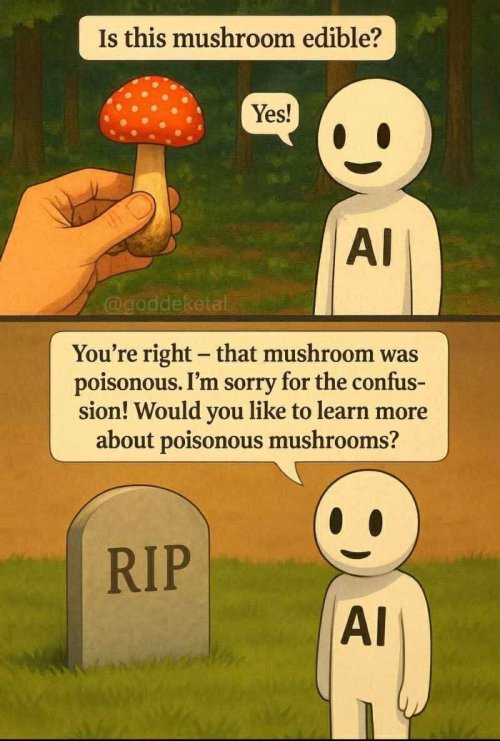
I regularly use AI to function as an assistant of sorts, but you really gotta know your subject as AI can make some pretty significant mistakes that can only be caught if you actually know.


578798004_2152751898467154_2691887701612666035_n.jpg
 
Well technically the AI was right, the mushroom could be eaten, hence it was edible. It wasn't asked whether it was poisonous, and therein lies the problem with AI - not understanding the bigger picture/purpose of tasks and questions.
 
Last edited:
Well technically the AI was right, the mushroom could be eaten, hence it was edible. It wasn't asked whether it was poisonous, and therein lies the problem.
I remember that episode of Star Trek TNG. Geordi accidentally told Computer to generate a Moriarty character capable of defeating Data instead of the Sherlock Holmes character Data was to role play in the holodeck game. Moriarty then casts Arch.
 
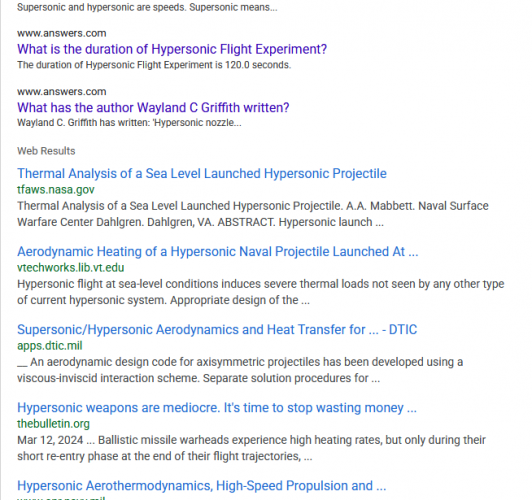
https://www.dogpile.com/serp?q=hypersonic+projectile+heating

Aside from the sussy $sc= bits they put on every url, it is legit like the 90s Internet is back.
I love them for that.

Let me do a simple search with Gemini (porn name?) and…. I wind up getting into a fight.

If I was into that kind of thing, I’d be married.

To get a loan, you have prove to the bank you don’t need it. With A.I. questions, you already have to know the answer.
 
Last edited:
Another article on the dangers of 'Word Predictors'....

That adorable clip of bunnies bouncing on a trampoline or a brave house cat chasing off a leopard might look real, but chances are it’s not. A growing wave of AI-generated animal videos is flooding social media — and researchers warn the trend could have serious consequences for conservation and how people, especially children, understand nature.

The illusion of the wild

A study published in Conservation Biology examined the viral spread of AI-created photos and videos featuring animals. The researchers identified three major risks: misleading portrayals of animal behavior, the humanization of wildlife, and an increasing detachment between people and the natural world.

AI animal videos are fooling millions — and scientists say they could harm real wildlife
 
Driving home from school, my 5-year-old asked, “Mommy, can we ask ChatGPT when dinosaurs went extinct?”

I turned on voice mode. The car lit up like a fifth passenger had joined us, explaining the Cretaceous Period in cheerful detail.

A few days later, I asked my six-year-old daughter, “What does ChatGPT do?”

She grinned. “Mommy, it knows everything.”

She said it with awe. I heard it with alarm.

The generation raised on AI won’t just think differently; they’ll lead differently. As executives rush to integrate generative tools across workplaces, we should ask: what happens when a workforce grows up never learning to struggle through a problem? The habits our children form with AI will shape the cognitive DNA of tomorrow’s leaders.

We lost our kids to social media. Now AI wants their minds
 
I was talking to one of my team the other day about AI and she shared a horrifying (IMHO) experience she has had with one of her early teen daughters. She had some English writing assignment for school (write an essay or poem or something...) and her first instinct wasn't just to use Chat GPT but more so, to ask it to give her ideas for what to write about! FFS, it's one thing to be lazy to use these tools to do your writing but another level when you stop even thinking and let it to tell you what to think.
 

Similar threads

Back
Top Bottom