While it does only have 1 shot, 1 kill in combat, it's simulated and live fire flight tests are extremely rigorous and provide exceptional performance data.

While true there's nothing like actual combat to properly stress-test the design and reveal anything unexpected.
 
Last edited:
While true there's nothing actual combat to properly stress-test the design and reveal anything unexpected.
It's been in actual combat. And while it has only fired off single bird in the UAE for a single intercept, it's been detecting and tracking hundreds of threats. Don't buy into the media mindset that it's "untested". It's every bit as capable as the Patriot
 
Last edited:
It's been in actual combat. And while it has only fired off single bird in the UAE for a single intercept, it's been detecting and tracking hundreds of threats. Don't buy into the media mindset that it's "untested". It's every bit as capable as the Patriot
So was the Patriot, but everyone was making hmm haaa sounds bout the capability of that thing before Ukraine. Same with the Aegis and SM3 before the first Iranian Missile attack.

Yes it been tested heavily and been tracking hundreds of threats.

But its nothing like a multi vecter interception with live ordance doing the dance of Vampires.

Which the US rarely gets to test due to budget constraints. Like that a once decade deal, and the thraad hasn't had a chance to do so.

It that way it is very much untested in the military eyes, its 85 percent confidence it can do it with no issue. BUT they will perfer a hard fact base We did this on X engage to go to 95 percent confidence which will also allow them to STUFF IT DOWN CONGRESS THROAT.

So having a chance to have the thraad search track and engage multiple targets at at the same time is not a chance the military will let side.
 
I hear you.

People are gonna believe what they want. Even when reality is hitting them in the face.

The public watches declassified YouTube videos and make uninformed opinions. I sit in a closed room and watch live feeds of classified flight tests that never make to the public.
 
Last edited:
Beef up numbers, field testing opportunity.
Yes, but I think it's actually something much more significant than that actually.
I could be totally wrong, but I think Arrow has a problem intercepting maneuverable threats OUTSIDE OF THE ATMOSPHERE at extreme or higher Mach speeds...
Hence seeing multiple penetrations, immediately followed by the first ever combat use of THAAD..!
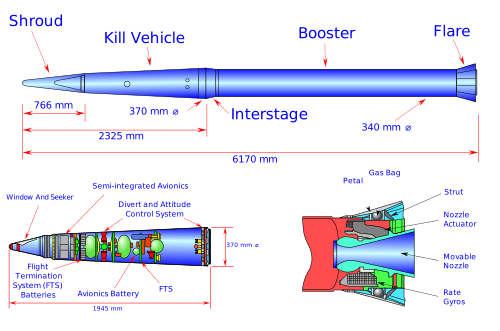
No, Arrow does not use a DACS/TDACS to maneuver, it uses a gimbled rocket sticking out the back end.
At extreme Mach speeds that these IRBM's are coming in at, you need something like thrusters near the nose so that you can rapidly turn the front of the interceptor immediately.
Arrow steers from the back so the front is going to be too slow to turn on a super high Mach incoming missile's..!

 
Yes, but I think it's actually something much more significant than that actually.
I could be totally wrong, but I think Arrow has a problem intercepting maneuverable threats OUTSIDE OF THE ATMOSPHERE at extreme or higher Mach speeds...
Hence seeing multiple penetrations, immediately followed by the first ever combat use of THAAD..!
No, Arrow does not use a DACS/TDACS to maneuver, it uses a gimbled rocket sticking out the back end.
At extreme Mach speeds that these IRBM's are coming in at, you need something like thrusters near the nose so that you can rapidly turn the front of the interceptor immediately.
Arrow steers from the back so the front is going to be too slow to turn on a super high Mach incoming missile's..!
That's not how THAAD maneuvers. Arrow 3 turns. THAAD strafes.
 
THAAD 6.0: US plans hypersonic-killing, AI-driven, laser-armed missile defense system

"Another noteworthy aspect of THAAD 6.0 could be the potential incorporation of directed energy weapons, including high-energy lasers and microwave-based interceptors.

These technologies could enable the system to neutralize threats earlier in its trajectory, enhancing overall defensive effectiveness.

Moreover, THAAD 6.0 may focus on expanded range and multi-layered defense strategies. This includes capabilities for intercepting threats during the boost phase and increasing interceptor speed through advanced propulsion systems, thereby improving the system’s overall responsiveness."

See:

 
The DACS is on the center of gravity, so it pushes the entire missile sideways.
Right, DACS is at the center of gravity, therefore it pushes or "skids" the entire KV into the oncoming Target.
When the target is operating @ ~ Mach 15-20+, the Arrow 3's KV will itself be high in Mach, I think like 8+.
So they're approaching each other @ ~Mach 30+ or some insane rate, the KV needs to be able to maneuver dramatically and do so almost instantaneously when dealing with maneuverable ballistic and hypersonic missiles...
IMHO Arrow's rear steering just cannot possibly be as effective at countering advanced BM's/HM's as THAAD or SM-3 RV's utilizing DACS/TDACS...
 
I also wonder if they're engaging at the edge of THAADs envelope, to give more opportunity for follow up shots, or waiting until it's closer.
If I were planning defenses, I'd take the shots at extreme range to give the opportunity for follow-up shots on leakers.

Edit: fully knowing that I'm probably reducing the effectiveness of the missile shots by doing that.
 
Last edited:
“On Sunday, a THAAD interceptor missed a Houthi missile fired at Israel, while an Arrow interceptor malfunctioned, allowing the projectile to strike Ben Gurion Airport.“

Both missed at least once
 
Raytheon delivered the first upgraded AN/TPY-2 radar to MDA which uses GaN (the second overall as the first went to Saudi Arabia last September). As its X-band it requires 25,244 Transmit Receive Integrated Microwave Modules (TRIMM) for its 100 sq ft antenna which makes it a very expensive radar as have seen cost reported as $243 million, why reported for the very large BMD radar, with its two 3,600 sq ft antennas, the Long Range Discrimination Radar, LRDR, in Alaska, MDA went with the lower waveband S-band to save costs.

Jon Norman, Raytheon’s vice president for Air and Space Defense Systems Requirements and Capabilities, told Breaking Defense the upgraded TPY-2 with the GaN front-end, it can see things twice as far. The TPY-2 radar and has two configurations.  It can be configured as Terminal Mode (TM) radar, in which it operates as the fire control radar for a THAAD battery,  alternatively it can be set up as a Forward-Based Mode (FBM) radar, in which it relays tracking and discrimination data to a remote missile defense system, in FBM mode reported range approx. 3,000 km, China strongly objected to the installation in South Korea of the original TPY-2 with it’s Gallium Arsenide (GaAs) as would oversee much of China, if the South Korean TPY-2 upgraded expect additional protests from China as it will further extend coverage of China with better discrimination.

The upgraded TPY-2 GaN was ordered way back in 2016 and also includes the latest CX6 high-performance computing software that offers more precise target discrimination and electronic attack protection.
 
Defense Updates has just put out a video concerning an AN/TPY-2 upgrade to help the THAAD deal with hypersonic weapons:


Hypersonic weapons are being seen as the next big thing in modern warfare.But they are technologically very hard to develop.Very few nations possess hypersonic weapons and even fewer have the capability to defend against them.The US military has taken a key step in hypersonic weapon defense.​
Raytheon has announced that it has delivered the first upgraded radar for the Terminal High Altitude Area Defense (THAAD) which is capable of tracking hypersonic missiles to the Missile Defense Agency.As per Jon Norman, Raytheon’s vice president for Air and Space Defense Systems Requirements and Capabilities, the new version of AN/TPY-2 has a longer range and can provide targeting coordinates to other missile defense interceptors beyond just the US Army’s THAAD batteries.​
In this video, Defense Updates analyzes how upgraded AN/TPY-2 radar will make THAAD a potent counter to hypersonic weapons?
#defenseupdates #THAAD #usmilitary

Chapters:
0:00 TITLE
00:11 INTRODUCTION
01:11 SPONSORSHIP - NordVPN
01:45 RADAR is critical for THAAD
03:45 THE UPGRADED RADAR
06:05 ANALYSIS
 
They're not cheap and building an entire battery takes years.
We are certainly not at a stage where we are because it takes time to build batteries. We are where we are because there was no Congressional or administration support (Democrat and Republican) to go beyond 8 which is why we will have no pending battery once the last few launchers are delivered later this year.

Delivery of the 8th battery has shown that LM and RTX can deliver to US partners (KSA) and the US Army concurrently (first GaN powered TPY-2 was delivered to KSA in September 2024 and the US variant delivered to the Army this Spring). As the recent conflict in the ME has shown, the Army's force structure of 7 batteries, majority of which are forward deployed at this moment is insufficient against the ops tempo demanded of the force structure. Same can be said of PATRIOT but at least there we have some of the short-mid range systems being fielded in large quantities (IFPC and MSHORAD) that will relieve/share some of the burden. It would wise to include another 2-3 THAAD batteries to be operated by the Guard in the upcoming Golden Dome investment bonanza instead of pursuing some of the other capabilities. Let's get what we have in the right quantities before we venture out and develop new stuff.
 
Last edited:
We are certainly not at a stage where we are because it takes time to build batteries. We are where we are because there was no Congressional or administration support (Democrat and Republican) to go beyond 8 which is why we will have no pending battery once the last few launchers are delivered later this year.

Delivery of the 8th battery has shown that LM and RTX can deliver to US partners (KSA) and the US Army concurrently (first GaN powered TPY-2 was delivered to KSA in September 2024 and the US variant delivered to the Army this Spring). As the recent conflict in the ME has shown, the Army's force structure of 7 batteries, majority of which are forward deployed at this moment is insufficient against the ops tempo demanded of the force structure. Same can be said of PATRIOT but at least there we have some of the short-mid range systems being fielded in large quantities (IFPC and MSHORAD) that will relieve/share some of the burden. It would wise to include another 2-3 THAAD batteries to be operated by the Guard in the upcoming Golden Dome investment bonanza instead of pursuing some of the other capabilities. Let's get what we have in the right quantities before we venture out and develop new stuff.


The contract was awarded in 2022. We just delivered the minimum engagement package (MEP). That's just 3 launchers and the fire control unit. Still have 3 launchers and other associated equipment. This doesn't even account for the interceptors, themselves.
 
Last edited:
I've been at LM Missiles and Fire Control for over 12 years. I was on PAC-3 initially, now the deputy prod-ops manager for the THAAD program and I can assure you it takes years to build an entire battery, including the Raytheon TPY2 radar.

The contract was awarded in 2022. We just delivered the minimum engagement package (MEP). That's just 3 launchers and the fire control unit. Still have 3 launchers and other associated equipment. This doesn't even account for the interceptors, themselves.
Sure. Because that's what your line is designed to produce. Setup another parallel line and double your production. Or run three shifts. It comes down to money and bodies. Right now it is what it is because the government said, "this is what we'll buy". Just look at how JASSM buys have exploded. It can be done.
 
Sure. Because that's what your line is designed to produce. Setup another parallel line and double your production. Or run three shifts. It comes down to money and bodies. Right now it is what it is because the government said, "this is what we'll buy". Just look at how JASSM buys have exploded. It can be done.
Of course it's possible. It only takes moneyand time.

HIMARS is in the process of increasing from 48 trucks a year to 96 and thats still 20 months away.

Expand the supply chain and facilities. Additional tooling. Additional heads.

But, it still doesn't shrink the lead times and spam times.

Write your congressman. :)
 
Last edited:
Of course it's possible. It only takes moneyand time.

HIMARS is in the process of increasing from 48 trucks a year to 96 and thats still 20 months away.

Expand the supply chain and facilities. Additional tooling. Additional heads. MEPC in KSA is coming online.

But, it still doesn't shrink the lead times and spam times.


Write your congressman. :)
For sure. :eek:
 
I can assure you it takes years to build an entire battery, including the Raytheon TPY2 radar.

Why does it take so long? That can kind of build time is something I'd associate with a warship or complex military aircraft.
 
Sure. Because that's what your line is designed to produce. Setup another parallel line and double your production. Or run three shifts. It comes down to money and bodies. Right now it is what it is because the government said, "this is what we'll buy". Just look at how JASSM buys have exploded. It can be done.

Probably wouldn't be able to get the 3-4 additional batteries up until like 2032-2035 but that's in line with Starshield I guess.

Complex engineering and tight tolerances.

I know a guy who's brother works on a certain THAAD component as a machinist and the tolerances are so tight on the little gears they make that if you breathed on the part it would be ruined. Cool stuff. I think orionblamblam did something with THAAD too.

Someone you know knows an engineer or machinist associated with THAAD. Think before you speak!
 
Think before I speak? I'm not following. What exactly are you insinuating? I honestly don't know how to take that.
 

Similar threads

Back
Top Bottom