:rolleyes:

What's your estimate then?


In fact I don't have any ... as long as we haven't seen P1 and can identify how much it differs to P0, as long as the new indigenous engines is not ready and at best some fancy PowerPoint-sheets, anything - even from TAI - is useless!

It is as useless like similar fancy illustrations and projections from Indians and HAL, the Tejas Mk.2 will finally be "whatever" and "when there's finally a new indigenous engine also for the AMCA, THEN ..." ...

Let's wait until then.
 
There's a significant change in height between the P0 and P1, perhaps the reduction means the vertical slabs have shifted to the tail section

I know placement of twin tails can potentially have large drag implication, also could interfere with vortex flow off the forebody. Anyone can theorize what possibly be reason why the tails move from positions that enclose the engines from the side to on top of the engine?

The vertical stabs are still on top for P1

1740423329390.png
 
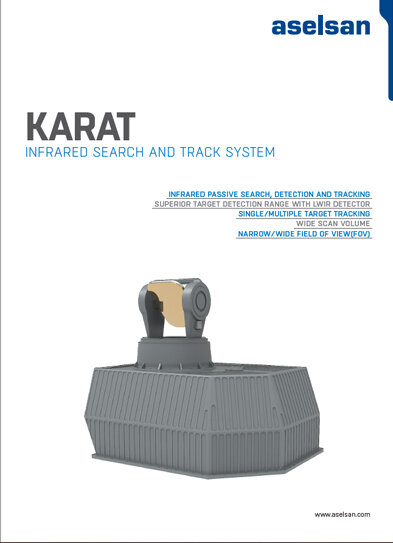
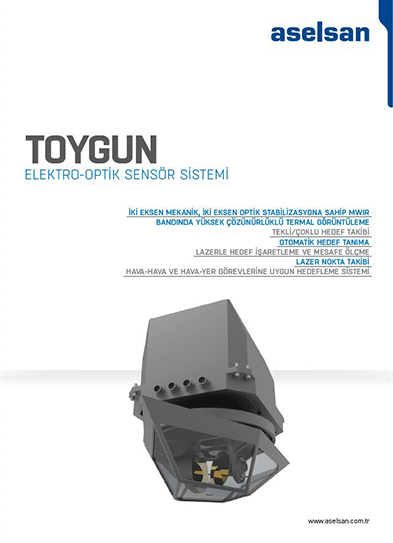
Kaan's IRST and EOSS, or at least downgraded versions of them (as far as we can guess), are set to start airborne tests on UAVs.
Aselsan CEO Ahmet Akyol confirmed that the tests for its TOYGUN and KARAT products would take place on a UAV platform as efforts continue to progress its “challenging” technology roadmap into 2025 and 2026.

View: https://x.com/ShephardNews/status/1894115189668098218?t=E_LteDFh3eL2NbVTxJg35g&s=19
 

Attachments

  • 1000022561.jpg
    1000022561.jpg
    64.6 KB · Views: 75
  • 1000022563.png
    1000022563.png
    33.1 KB · Views: 64
Last edited:

The chin mounted sensor is shown in the artwork? Looks like it has all around coverage. I wonder if it could be used simultaneously with the nose mounted sensor to provide all around battlefield awareness. With AI decision making software integrated it could provide pilot feedback on whether to engage aerial or ground based targets first.
 
I found the proposed Leonardo-radar contribution to Akinci quite underwhelming and hope that won’t be the case for other cooperations.

Your KAAN suggestion sounds good at first, till you think about the US-engine problem. That is something I have missed in all the alternative European-fighter discussions here, like Gripen or KF-21.
In my opinion, Gen. 4+ fighters (with or without US-engines) can be a good stopgap F-35 alternative till GCAP is operational - FCAS too, if you believe in it. Mainly because I think, that the Russians have enough on their plate for the next 10 years to start something against NATO.

KAAN with a British/Turkish engine would be a great base for a cooperation though, especially if they can get rid of this Turkish regime.

Edit - I don’t want to spam too much in this new thread, therefore this addition:
In this case, politics are important for this topic. Europe wants to get more independent because of US-policy shifts. I see therefore the current Turkish regime as an obstacle for deeper cooperations – that is my opinion.
p.s. I didn’t mention an interference from outside
 
Last edited:
KAAN with a British/Turkish engine would be a great base for a cooperation though, especially if they can get rid of this Turkish regime.
Whether you like Erdogan or not, regime change is rarely a good foundation for cooperation, especially if the country you're actively interfering in the politics of is a critical 'ally.'

In this case, Erdogan has nothing to do with our topic, as we're talking about a long-term cooperation between countries, not regimes.

We've seen enough of these regime changes by the West, fueled by hubris, over the past 35 years, and I think it's fair to say that the results have been simply horrendous...
 
I found the proposed Leonardo-radar contribution to Akinci quite underwhelming and hope that won’t be the case for other cooperations.

Your KAAN suggestion sounds good at first, till you think about the US-engine problem. That is something I have missed in all the alternative European-fighter discussions here, like Gripen or KF-21.
In my opinion, Gen. 4+ fighters (with or without US-engines) can be a good stopgap F-35 alternative till GCAP is operational - FCAS too, if you believe in it. Mainly because I think, that the Russians have enough on their plate for the next 10 years to start something against NATO.

KAAN with a British/Turkish engine would be a great base for a cooperation though, especially if they can get rid of this Turkish regime.
Problem is that there is no european engine alternative and turkey is developing there own engine. Ignoring the second part we still have to find a engine end M-88 barley makes wet as mutch thrust as the General Electric F110-GE-129 dry. Ej-200 is still a bit aboth that but the proposed stage II/ EJ-230 capabilitys you ain't getting enough out of it. We also have the other problem of having to redesign the whole thing just to fit them.
 
Problem is that there is no european engine alternative and turkey is developing there own engine. Ignoring the second part we still have to find a engine end M-88 barley makes wet as mutch thrust as the General Electric F110-GE-129 dry. Ej-200 is still a bit aboth that but the proposed stage II/ EJ-230 capabilitys you ain't getting enough out of it. We also have the other problem of having to redesign the whole thing just to fit them.
Just had a look and we're losing close to 3.780 Ibs or 1578,5 kg of weight, having a maximum diameter difference of 17,5 Inch or 44,45 cm and are 24,9 Inch or 63.246 shorter. Ignoring other stuff thats already lot to work with.
 
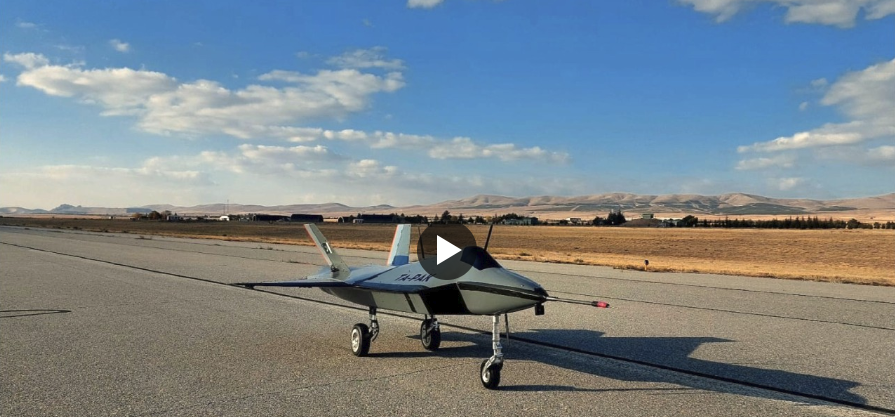
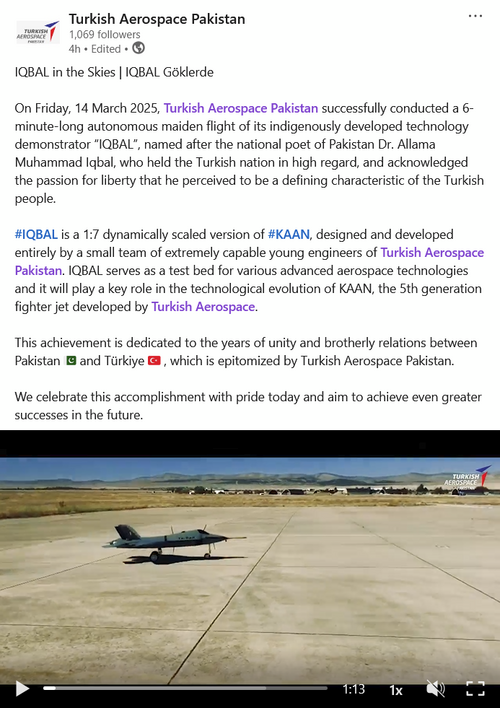
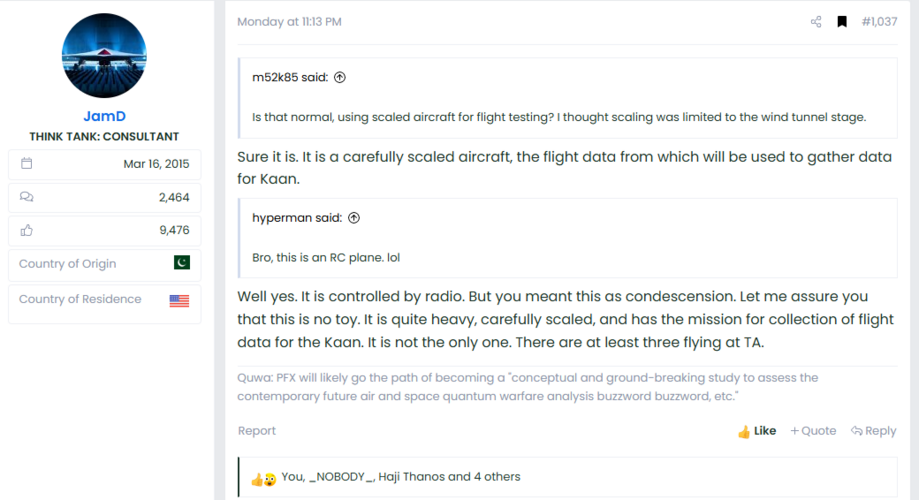
Hmm? Allegedly a scaled-technology demonstrator for Ka'an was tested.

View attachment 763510
View attachment 763511
Just something to keep the Pakistan office busy and to have something to show to local officials.

TAI headquarters in Ankara probably flew a couple of these even before the GTU-0 was assembled.

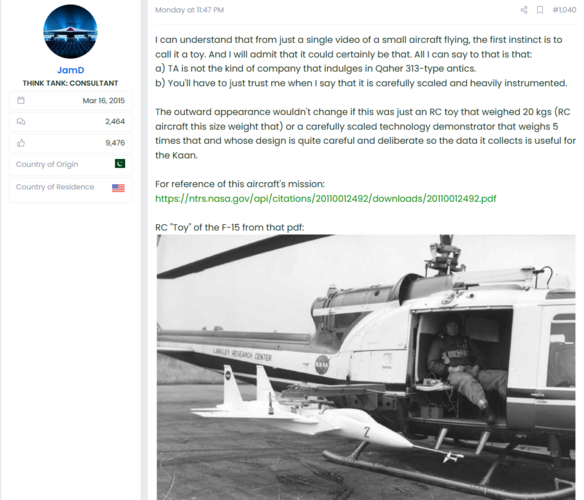
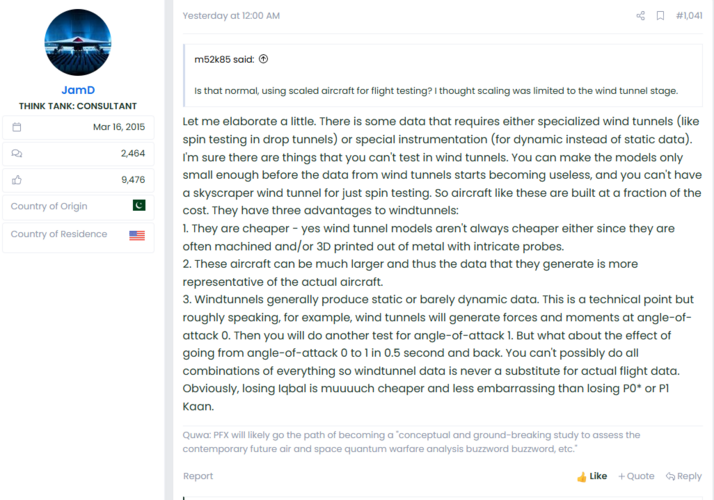
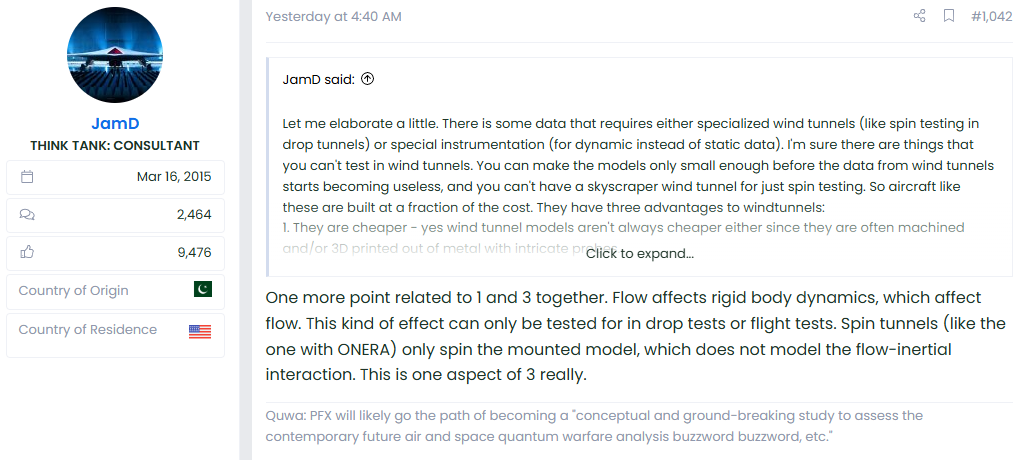
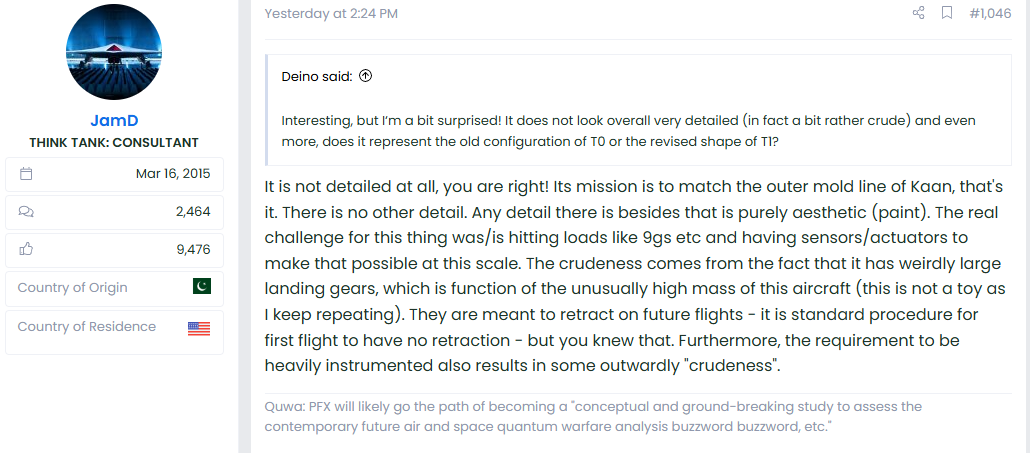
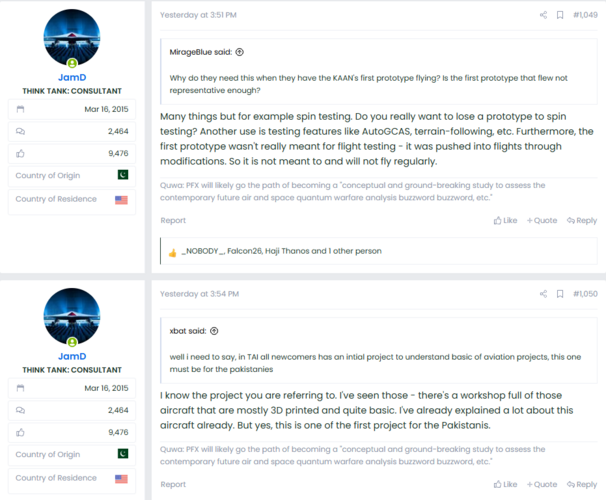
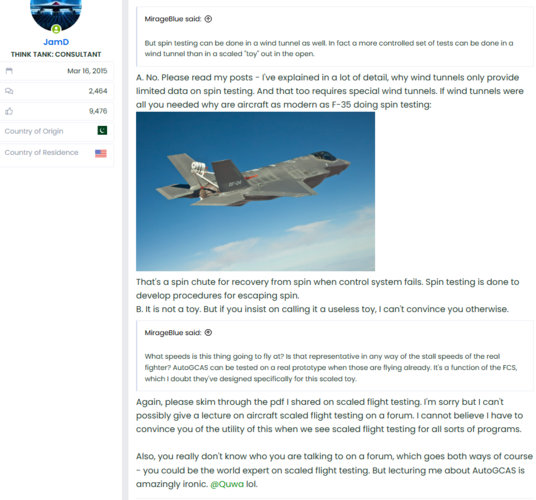
I also believe it is necessary to share @JamD's remarks, as he is an engineer in the industry. (I also suspect that he works at TA Pakistan or at least has colleagues working there.)

Screenshot 2025-03-19 094908.png
Screenshot 2025-03-19 095017.png Screenshot 2025-03-19 095100.png Screenshot 2025-03-19 095109.png
Screenshot 2025-03-19 095313.png Screenshot 2025-03-19 095954.png Screenshot 2025-03-19 095710.png
 
Just something to keep the Pakistan office busy and to have something to show to local officials.

TAI headquarters in Ankara probably flew a couple of these even before the GTU-0 was assembled.

I also believe it is necessary to share @JamD's remarks, as he is an engineer in the industry. (I also suspect that he works at TA Pakistan or at least has colleagues working there.)

View attachment 763518
View attachment 763519View attachment 763520View attachment 763521
View attachment 763526View attachment 763529View attachment 763528

Yeah. My opinion as well. Prototype of Kaan is much further along when you look at amount of details like sawtooth in weaponsbay/panels. They won’t risk flying a prototype unless they’ve had verification of the basic aerodynamics earlier.
 
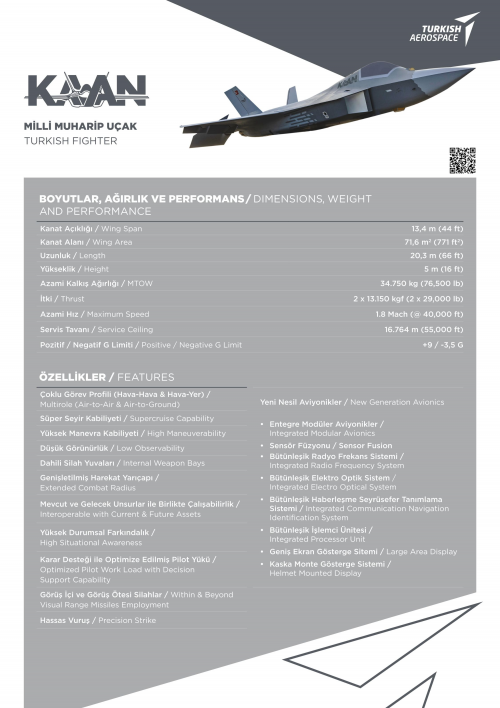
TAI updated the specs again :)
--
  • Dimensions, Weight and Performance

    • Wing Span : 13.4 m (44 ft)
    • Wing Area : 71.6 m² (771 ft²)
    • Length : 20.3 m (66 ft)
    • Height : 5 m (16 ft)
    • MTOW : 34,750 kg (76,500 lb)
    • Thrust : 2 x 13,150 kgf (2 x 29,000 lb)
    • Maximum Speed : 1.8 Mach (@ 40,000 ft)
    • Service Ceiling : 16,764 m (55,000 ft)
    • Positive / Negative G Limit: +9 / -3.5 G
--

1743243302276.png
 
TAI updated the specs again :)
--
  • Dimensions, Weight and Performance

    • Wing Span : 13.4 m (44 ft)
    • Wing Area : 71.6 m² (771 ft²)
    • Length : 20.3 m (66 ft)
    • Height : 5 m (16 ft)
    • MTOW : 34,750 kg (76,500 lb)
    • Thrust : 2 x 13,150 kgf (2 x 29,000 lb)
    • Maximum Speed : 1.8 Mach (@ 40,000 ft)
    • Service Ceiling : 16,764 m (55,000 ft)
    • Positive / Negative G Limit: +9 / -3.5 G
--

View attachment 764950
the only difference i noticed is the MTOW went from 60k lb to 76.500lb, which is a huge difference.
 
And the MTOW of 60.000lbs for Kaan is still BS for now and should be discarded. MTOW should be 75.000lbs with the indigenous engines.

... and still you think 75.000lbs with the indigenous engines (= 34,0t) are more reasonable or even realistic?

A MTOW of 70-80k lbs is most likely, so I took the figure in between, 75.000 lbs

I got very close. Nice to be vindicated again. Caveat, with indigenous engines it could bump the MTOW closer to 80.000lbs or even beyond that.

The length between the nozzles and radar array is now 16 meters with a theoretical empty weight of 16,8-17 tons which results in a thrust-to-weight ratio of 1,55 and a wing loading of 242 kg per square meters.

For modern fighter aircraft, empty weight is typically half the MTOW. 17375 kg empty weight for Kaan at minimum.
 
Last edited:
I got very close. Nice to be vindicated again. Caveat, with indigenous engines it could bump the MTOW closer to 80.000lbs or even beyond that.


For modern fighter aircraft, empty weight is typically half the MTOW. 17375 kg empty weight for Kaan, +/- 750kg.
Wikipedia is not a reliable source at all, no discussions of MTOW
https://en.wikipedia.org/wiki/Talk:TAI_TF_Kaan
 
I got very close. Nice to be vindicated again. Caveat, with indigenous engines it could bump the MTOW closer to 80.000lbs or even beyond that.


For modern fighter aircraft, empty weight is typically half the MTOW. 17375 kg empty weight for Kaan, +/- 750kg.
The given specs of the GTU-0/P0 suggest that it is capable of limited supercruise at M1.2-1.4 with 0.76-1.06 TWR.

If I remember correctly, the goal is for the production aircraft to achieve M1.5 supercruise.
 
Last edited:
Photo hasn't been shared before and remains significant. Timeliness isn't the only measure of relevance—important images can surface anytime, especially if they offer new context or insight.
Also image is from last year, outdated KAAN models are still used for displays, or as gifts by officials.

Thanks for your input though, thought you'd actually had updated the thread with something significant, instead your usual trying to take ownership what's posted in these threads. lmao..
 
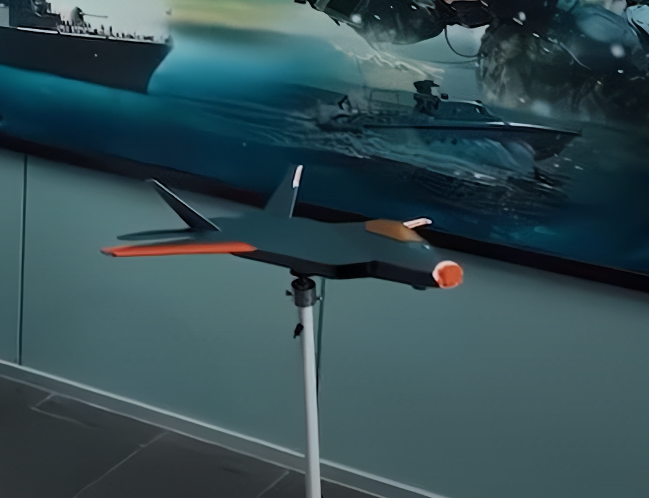
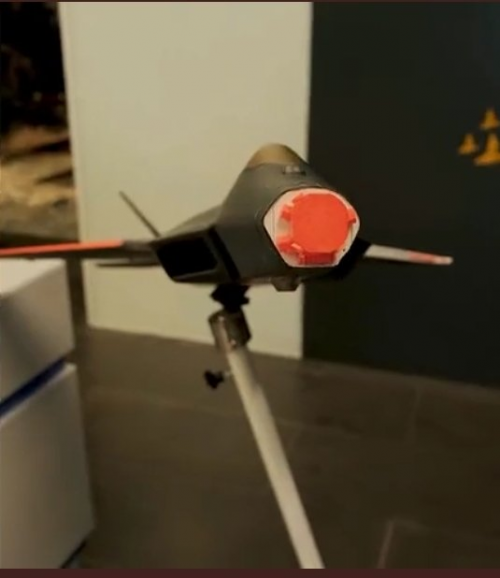
Should be Aselsan BURFIS FCR.
View attachment 765653

Not sure what's going on with the leading edges of the model which are also painted orange.
I believe this radar is more of a technology demonstrator than a prototype for a production model radar. Same was done for the F-16 radar which they displayed a demonstrator using brick modules some years ago which is different from the tile arrangement on the Murad 100 series.

Those LE could be EW or an Su-57 style L-band radar.
 
Last edited:
I believe this radar is more of a technology demonstrator than a prototype for a production model radar. Same was done for the F-16 radar which they displayed a demonstrator using brick modules some years ago which is different from the tile arrangement on the Murad 100 series.

Those LE could be EW or an Su-57 style L-band radar.

Closer image but LQ
1743849331965.png
 
Indonesian President Prabowo Subianto (currently on a state visit to Turkey) :

"Indonesia wants to take part in the 5th generation KAAN national combat aircraft project and also in the submarine project. We want to take part together with the Turkish defense industry and we want to benefit from this."

View: https://x.com/Faruksarioglu34/status/1910361531151265894
First pay your damn contribution to the Boramae Program...
 
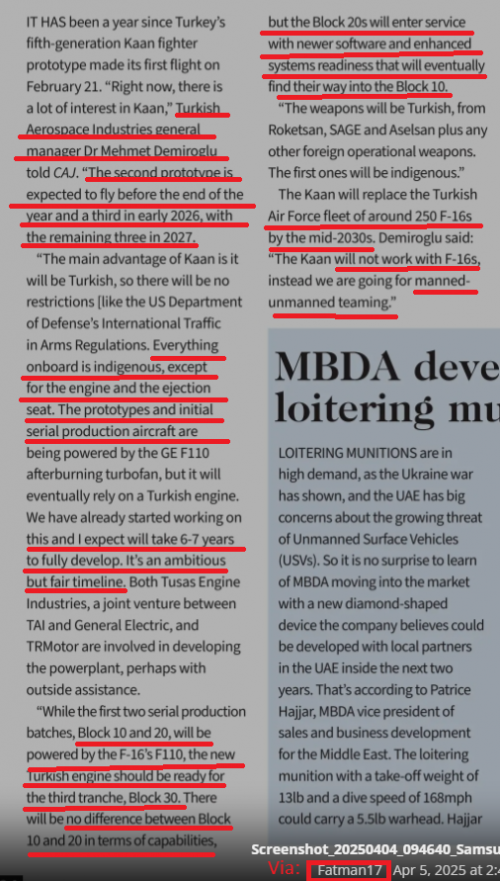
Here’s a good summary of what’s to come in the Kaan program by GM Mehmet Demiroglu, including future developments and milestones.
So the old definition of block 10 has been split into two blocks of block 10 and 20 now? and 6 prototypes in total. Quite some notable changes to the plan if we consider what we were told some years ago. I feel they are really quick in reflecting what they've learnt in terms of programme management and development processes, good for them.
 
Here’s a good summary of what’s to come in the Kaan program by GM Mehmet Demiroglu, including future developments and milestones.

View attachment 765788
6-7 years seems rather ambitious for a domestic engine fit for a large stealth fighter. For comparison, we just have to look at how long the development of the WS-15 and AL-51 took. Both developed by infinitely more capable nations with regards to their prowess and experience in the military aviation sector. Neither engine in frontline service to our knowledge in April 2025.

So how is 6-7 years an "ambitious but fair" timeline? Domestic development and production of military spec engines is arguably one of the most difficult and costly things to master.
 
6-7 years seems rather ambitious for a domestic engine fit for a large stealth fighter. For comparison, we just have to look at how long the development of the WS-15 and AL-51 took. Both developed by infinitely more capable nations with regards to their prowess and experience in the military aviation sector. Neither engine in frontline service to our knowledge in April 2025.
I think 2018 was the test flight date for the AL-51 and supposedly it will be on the Su-57's that will be produced this year which in total is a time span of 7 years, in other words 6-7 years seems feasible for the KAAN
 
I think 2018 was the test flight date for the AL-51 and supposedly it will be on the Su-57's that will be produced this year which in total is a time span of 7 years, in other words 6-7 years seems feasible for the KAAN


Let's wait and see ... they have to prove their IMO overambitious claims, not we have to explain them again why it is unlikely.

And even more flight test is only the last part of the development, so since the Turkish side so far has nothing built and even bench tested yet that is at least close to something that can be tested in flight, it is IMO totally unrealistic. But let's wait.
 
So how is 6-7 years an "ambitious but fair" timeline? Domestic development and production of military spec engines is arguably one of the most difficult and costly things to master.

The TF35000 program to develop a domestic engine for KAAN started in 2017, it's been 8 years, it'll be another 6-7 years until the engine is fully developed. Overall the engine development programme is 15 years - if what the GM is saying comes to fruition.

The context and knowing the history of the project is important.
 
TRmotor got established in 2017 but the actual detailed work on the engine started in 2023 after various (conceptual) designs from both domestic and foreign companies competed against each other. TEI and TRMotor design won against a foreign company likely to be Ivchenko Progress.

2025+6/7 years equals 2031-2032. In that case the engine development will take just 8-9 years to be "fully developed" starting from 2023.
But what does the CEO define under "fully develop"? I hope it means ready for serial production and not just ready to be flight tested or God forbid, ready to be fired up.

The problem for the Turks is not so much design as it is materials as stated by Demir. Indigenization of the entire chain of various alloys is being worked on from mining, to processing to casting and forging.

Design is easy these days when one has a solid grasp of the fundamentals of what one is designing. Simulation software and supercomputers can churn out lots of data in a short time.

And do not forget the Turkish turbomachinery sector is tied to the Western one and lots of shoulders have been rubbed in the last 3-4 decades.
 
Last edited:

Similar threads

Back
Top Bottom