Yes, Russia as an alternate source seems obvious, but if the stumbling block is tech transfer, I doubt they will offer what Turkey is looking for either. Case in point, there are contentious issues regarding the degree of tech transfer and/or licensed production under the S-400 deal too, AFAIK.

What I meant is that the engine and tech transfer doesn't have to be either/or deal. They get whatever engine (without tech) they can right now, one that can reasonably be replaced with an engine of similar weight/size/class in the next 10 to 15 years. And use that engine, right now, to help the v1.0 variant of their fighter get off the ground as soon as possible. (which may still be 10 years)

During all those years, they try to get various tech transfer deals from whoever they can, so they can one day (in 10 to 15 years?) start making such an engine on their own. Sure, it will probably be a 1990s/2000s tech engine being made in 2030s, but it's better than nothing. It would still power their plane alright and overall the capability leap over their F16s should still be satisfactory, WHILE achieving their goal of self sufficiency in steps.
 
While trying to understand how constituents of TFX will come to be, it'll be shortsighted not to put into context the amount of technical expertise and funding Turkey can bring to bear.

If the current level of technical capabilities can be empirically ascertained, then just following the successive investments over the years into R&D and production infrastructure will provide a good enough bearing on where this program is headed.

Relying solely on miraculous (due to ever changing geopolitics) externalities like another country (UK, Russia) providing core technologies and assessment into the program is a fig leaf. They can, at best, do 'technical studies' due to diplomatic efforts that provide some sense of direction of what needs to be done, but don't expect a handholding assistance, and as such, Turkey will need to do most of what is required on its own.
 
Last edited:
I also don't see how the US will rationally justify banning them from using an F110 in their demonstrators given they are part of NATO and that defense resilience is central to NATO interest.
Then any discussions for licence production is another matter that only would have to be debated in no less than a decade...
 
what are the options right now?

M88 - Probably unlikely. France and Turkey are on opposing sides in regards to the Med dispute and France is very pro Greece
F414/404 - Unsure. I thought it was the leading candidate but there's been a rift in regards to the S-400 system. not sure if its enough to stop the export of jet engines
EJ200 - assuming its the UK, Italy and Germany that can control its export. UK seems still friendly to Turkey. Italy is on the same side with Turkey on the Med disputes. Germany may oppose
RD-93 - I think the Russians are willing to export, but do the Turks want this engine?
WS-11 and WS-13 - would this be the first time Turkey imports anything from the PRC?

Turkey want a F110 sized engine and a plane that is bigger than F-15 so it would at least need WS-10 or AL-31, which the UK cannot offer as of now.
 
I also don't see how the US will rationally justify banning them from using an F110 in their demonstrators given they are part of NATO and that defense resilience is central to NATO interest.
Then any discussions for licence production is another matter that only would have to be debated in no less than a decade...
The point of contention is if Turkey could use the F110s they produce under license, for something that it wasn't originally meant to be used for. The US was very unhappy a few times when their defense products exported to another country were used or handled in a way they were not meant to be used for. I think this is a problem beyond NATO and considering Turkey is under sanctions regardless of being a NATO member for its purchase of S-400s, this could even give a leeway for the US to block Turkey from purchasing parts for their F-16s as a whole.

Apart from all these, they need a suitable FADEC for TF-X if they want to use F110s for it, which currently doesn't seem to be the case.
 
@Maro.Kyo : I understand. My point was that a demonstrator is not meant to be exported. Generally speaking, It's not even a prototype.
And then the time TFX is production ready, the political situation would certainly have evolved.
 
Yes, Russia as an alternate source seems obvious, but if the stumbling block is tech transfer, I doubt they will offer what Turkey is looking for either. Case in point, there are contentious issues regarding the degree of tech transfer and/or licensed production under the S-400 deal too, AFAIK.

What I meant is that the engine and tech transfer doesn't have to be either/or deal. They get whatever engine (without tech) they can right now, one that can reasonably be replaced with an engine of similar weight/size/class in the next 10 to 15 years. And use that engine, right now, to help the v1.0 variant of their fighter get off the ground as soon as possible. (which may still be 10 years)

During all those years, they try to get various tech transfer deals from whoever they can, so they can one day (in 10 to 15 years?) start making such an engine on their own. Sure, it will probably be a 1990s/2000s tech engine being made in 2030s, but it's better than nothing. It would still power their plane alright and overall the capability leap over their F16s should still be satisfactory, WHILE achieving their goal of self sufficiency in steps.
To be honest, the only case of transfer of technology concerning gas turbine core which I could think of that happened during the last 4 decades is when the US transferred F110 technology to Japan during FSX, soon F-2.

https://www.latimes.com/archives/la-xpm-1989-09-14-mn-267-story.html
And this was for the joint development + transfer of Japanese technology including composite structure and airborne AESA technology to the US. So it was more of a bilateral exchange. Even then it was met with a strong opposition just like how its described in the article.

So unless Turkey's got a technology they could offer to these countries, which isn't the case, I don't see any possibility in which any country would be interested in sellin gas turbine core tech.
 
While trying to understand how constituents of TFX will come to be, it'll be shortsighted not to put into context the amount of technical expertise and funding Turkey can bring to bear.

If the current level of technical capabilities can be empirically ascertained, then just following the successive investments over the years into R&D and production infrastructure will provide a good enough bearing on where this program is headed.

Relying solely on miraculous (due to ever changing geopolitics) externalities like another country (UK, Russia) providing core technologies and assessment into the program is a fig leaf. They can, at best, do 'technical studies' due to diplomatic efforts that provide some sense of direction of what needs to be done, but don't expect a handholding assistance, and as such, Turkey will need to do most of what is required on its own.
They are not completely blank concerning avionics tech, just like how they plan to replace MC, radar and few other components of their F-16 block 30 with their own AESA and MC in özgür program.

Problem is, there's nothing known anything beyond that, especially considering they are claiming that their jet will be "5th gen". Passive conformal sensors, data fusion engine, sophisticated data link, frequency selective or absorbing materials and structures are to name a few necessary technology that comes into my mind, all of which Turkey hasn't showcased of. So I would still doubt this plane, even when it flies with their own engine and radar, to be 5th gen, let alone 4.5th gen.
 
What I meant is that the engine and tech transfer doesn't have to be either/or deal. They get whatever engine (without tech) they can right now, one that can reasonably be replaced with an engine of similar weight/size/class in the next 10 to 15 years. And use that engine, right now, to help the v1.0 variant of their fighter get off the ground as soon as possible. (which may still be 10 years)

Well, if you drop the requirement for tech transfer there is no more reason to look anywhere other than the UK offer. EJ200 has a development road map out to 120kN (formerly known as EJ230) which is probably exactly what RR offered, albeit without the degree of localization desired by Turkey. So if tech transfer was a sticking point serious enough to end the UK partnership, turning to Russia is not going to solve this problem.

In other words, the model you propose could work just fine with a RR-supplied thrust-augmented EJ200, though it might be a bit more expensive than buying Izd.117S off the shelf. The political cost on the other hand...
 
Last edited:
This is exactly the core of the problem: why would they poor gasoline on the fire when the needs are yet null.

Rafale demonstrator did fly with F404 for example.
 
What I meant is that the engine and tech transfer doesn't have to be either/or deal. They get whatever engine (without tech) they can right now, one that can reasonably be replaced with an engine of similar weight/size/class in the next 10 to 15 years. And use that engine, right now, to help the v1.0 variant of their fighter get off the ground as soon as possible. (which may still be 10 years)

Well, if you drop the requirement for tech transfer there is no more reason to look anywhere other than the UK offer. EJ200 has a development road map out to 120kN (formerly known as EJ230) which is probably exactly what RR offered, albeit without the degree of localization desired by Turkey. So if tech transfer was a sticking point serious enough to end the UK partnership, turning to Russia is not going to solve this problem.

In other words, the model you propose could work just fine with a RR-supplied thrust-augmented EJ200, though it might be a bit more expensive than buying Izd.117S off the shelf. The political cost on the other hand...
The requirement for tech transfer would still NEED to be there, only not right away, not necessarily tied with the engine purchase. Thing is - it should be easier for Turkey to get tech transfer if:
A) the engine tech is not very advanced
B) the engine tech does not come from US/UK

Also, long term compatibility would need to be taken into account. If Turkey does get to buy off the shelf EJ200 - and then gets tech transfer from Russia or China - it might be quite hard to re-design the whole plane to accept different engines.

On the other hand, The Chinese WS13 is allegedly modeled to be interchangeable with Russian RD93. So any of those two engines might work. If Turkey can get off the shelf engines of either of those two makes now and then tech transfer in 10 years time, the overall conversion process would be much more seamless.

Downside is, of course, that those engines are not advanced, but if the other options like EJ200 are politically unavailable (as tech transfers) then there's there's just one course of action anyway. And technological independence is likely much more important for Turkey than having a generation newer engine in their TFX fighter.
 
I must admit, after reading the last posts I'm again even more concerned since a lot of speculations were mentioned - ranging from a Russian engine, a Eurojet EJ230 or similar ... - but from all I know, TAI is still claiming to roll out a prototype in March 2023. As such isn't it most urgent to have a final decision, to finalise the design and start preparing construction?

If the decision is still not being made on a F110 - which I took for granted - any change again to another European design or a Russian one would require a much wider redesign and as such even further delay the project.

But again, no answer from our Turkish friends ...
 
The requirement for tech transfer would still NEED to be there, only not right away, not necessarily tied with the engine purchase. Thing is - it should be easier for Turkey to get tech transfer if:
A) the engine tech is not very advanced
B) the engine tech does not come from US/UK

Concur with A), but I don't think B) applies (which was my point). If Turkey insists on transfer of advanced engine tech, B) won't help because non-Western players will guard their IP just as jealously. If it is prepared to accept A) however, why not reverse-engineer the F110, for which substantial know how is available locally?

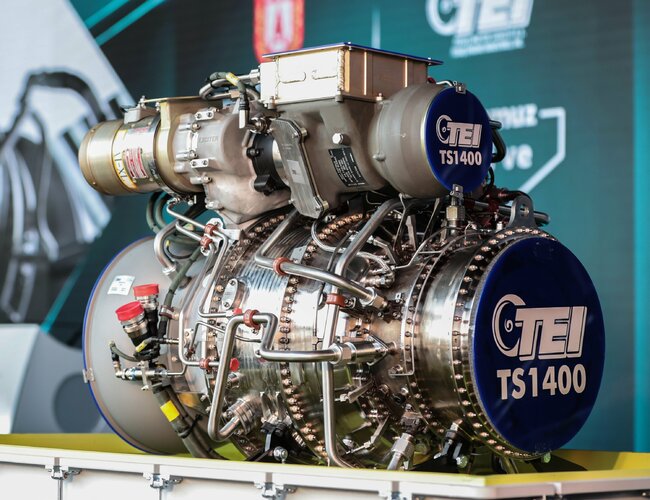
Turning to a different engine in the same class (WS-10, Saturn or Salyut AL-31F derivative) involves basically starting from scratch, albeit with the benefit of OEM consent. Based on precedent I'm not so sure the latter is an absolute prerequisite though, I could see the US tolerating an unofficial copy of an outdated engine. Certainly, it's not at all clear that the political fallout if any would be worse than the consequences of once more buying Russian or Chinese. Consider that quite a number of Turkey's advanced munitions projects (their SDB knock-off, the GÖKTUG AAMs) are thinly-veiled clones of their US counterparts, with nary a complaint. Or, for that matter (and perhaps even more poignantly), the TS1400 turboshaft and its resemblance to the LHTEC T800...

They may not endorse it, but apparently they can live with such an arrangement if it serves to keep Turkey from gravitating further toward Russia and China.
 
Last edited:
What I meant is that the engine and tech transfer doesn't have to be either/or deal. They get whatever engine (without tech) they can right now, one that can reasonably be replaced with an engine of similar weight/size/class in the next 10 to 15 years. And use that engine, right now, to help the v1.0 variant of their fighter get off the ground as soon as possible. (which may still be 10 years)

Well, if you drop the requirement for tech transfer there is no more reason to look anywhere other than the UK offer. EJ200 has a development road map out to 120kN (formerly known as EJ230) which is probably exactly what RR offered, albeit without the degree of localization desired by Turkey. So if tech transfer was a sticking point serious enough to end the UK partnership, turning to Russia is not going to solve this problem.

In other words, the model you propose could work just fine with a RR-supplied thrust-augmented EJ200, though it might be a bit more expensive than buying Izd.117S off the shelf. The political cost on the other hand...
The requirement for tech transfer would still NEED to be there, only not right away, not necessarily tied with the engine purchase. Thing is - it should be easier for Turkey to get tech transfer if:
A) the engine tech is not very advanced
B) the engine tech does not come from US/UK

Also, long term compatibility would need to be taken into account. If Turkey does get to buy off the shelf EJ200 - and then gets tech transfer from Russia or China - it might be quite hard to re-design the whole plane to accept different engines.

On the other hand, The Chinese WS13 is allegedly modeled to be interchangeable with Russian RD93. So any of those two engines might work. If Turkey can get off the shelf engines of either of those two makes now and then tech transfer in 10 years time, the overall conversion process would be much more seamless.

Downside is, of course, that those engines are not advanced, but if the other options like EJ200 are politically unavailable (as tech transfers) then there's there's just one course of action anyway. And technological independence is likely much more important for Turkey than having a generation newer engine in their TFX fighter.


But please correct me if I'm wrong: By all I know about the TFX, it is aimed to be a fighter larger/heavier than a F-15 or broadly comparable to a Raptor. As such any engine below a F110 - and IMO even this is not powerful enough - like a EJ200, an F414, M88, RD-93 or WS-13 is anyway irrelevant. Or are you discussing an engine for the Hürjet?
 
If Turkey insists on transfer of advanced engine tech, B) won't help because non-Western players will guard their IP just as jealously. If it is prepared to accept A) however, why not reverse-engineer the F110, for which substantial know how is available locally?

Well, we disagree there. While all countries usually guard their secrets, I do think there ARE differences. The older the engine tech is - the greater chances there are that a high-enough sum of money will indeed buy tech transfer. For example, if there wasn't the issue of politics, RR might gladly sell RB199 tech to Turkey. (providing such engine class even works for Turkey). But since there ARE political frictions abound when it comes to military cooperation of other NATO countries and Turkey - such deals may still fall through.

On the other hand, as you yourself said, China and Russia do have a vested interest in pulling Turkey closer to them. So in light of that, a decision could be made to sacrifice a bit of technological edge by selling previous generation engine tech. If that'll help seal the deal.

Turkey seems to be gravitating towards F110 simply because it's the only thing they have access to right now. But they have to size up the design of the plane so it suits the engines. And if F110 turns out to be an illegal solution, sure it could power up some prototypes - but then what? Turkey needs hundreds of engines produced.

While F110 is claimed to be made in Turkey - how do we know just how much of it is actually made by Turkey? Is it final assembly? Or production of all parts? There could very well be subsystems that Turkey would be lacking. https://asmedigitalcollection.asme....V002T02A020/2397636/v002t02a020-88-gt-305.pdf
Here it says, for example, that Volvo produced 35% of parts for RM12, while General Electric produced 65%. Even though it's usually claimed Volvo got the license for RM12, it apparently is far from a 100% license and full tech transfer. So I will allow myself to be sceptical of actual license that Turkey has to produce f110 completely on their own. In my opinion, there's a high chance they want to use ready made F110 just to power the prototypes. Despite what the US might say to that. But they may not have the means to produce further F110 in large numbers to power a whole future fleet of TFX fighters.

And if they tried completely reverse engineering F110 from scratch - well that's quite problematic. China tried it, and it took them basically 30 years to pull it off, with WS10 being the final result, mating all sort of technology in one final design. How long it might take Turkey is anyone's guess, depending on just how much they already know about F110, but it's still plausible we're talking a decade or two.

Of course, if the West does want to entice Turkey to keep away from Russia/China by dangling engine tech in front of it -that could work. But if that was SO important to the West, then none of the F-35 fiasco would have happened.


But please correct me if I'm wrong: By all I know about the TFX, it is aimed to be a fighter larger/heavier than a F-15 or broadly comparable to a Raptor. As such any engine below a F110 - and IMO even this is not powerful enough - like a EJ200, an F414, M88, RD-93 or WS-13 is anyway irrelevant. Or are you discussing an engine for the Hürjet?
TFX is, as far as I can tell, a very undefined project still. It started off as a medium class fighter. The fact they sought 90 kn thrust EJ200 shows as much. But since the F110 is the best thing Turkey can hope for at this moment, that may have pushed them to revise the design. Some sources still mention the 27 ton MTOW specification. If that IS true, then it's still a medium class plane somewhat. Of course, that may be just an old figure, back when EJ200 was in play. Interestingly, Avic's FC-31 MTOW figure was 28 tons. For a plane with two 90-100 kn engines.

I do believe TFX data will be changing in the future, as new developments on the engine front happen. Or, indeed, if they try to make it work with F110, then the plane will indeed be in the F-15 class.
But I wouldn't hold my breath waiting for it to really fly, let alone enter service. Way too much uncertainty right now.

 
On the other hand, as you yourself said, China and Russia do have a vested interest in pulling Turkey closer to them. So in light of that, a decision could be made to sacrifice a bit of technological edge by selling previous generation engine tech. If that'll help seal the deal.

Possible, but that didn't compel Russia to grant Turkey the kind of access to S-400 technology that it sought. Despite, as with jet engines, the next generation lurking in the wings, in the shape of the S-500.

And if they tried completely reverse engineering F110 from scratch - well that's quite problematic. China tried it, and it took them basically 30 years to pull it off, with WS10 being the final result, mating all sort of technology in one final design.

China was completely on its own though. I'm thinking tacit tolerance by the US of a Turkish 120kN engine project called TF120 or somesuch, with no acknowledged relation (by either side) but suspiciously similar architecture to the F110 :)

How long it might take Turkey is anyone's guess, depending on just how much they already know about F110, but it's still plausible we're talking a decade or two.

Absolutely! Exactly the same as all the alternatives :) That the official schedule is optimistic to the point of ridiculousness isn't up for debate.
 
But please correct me if I'm wrong: By all I know about the TFX, it is aimed to be a fighter larger/heavier than a F-15 or broadly comparable to a Raptor. As such any engine below a F110 - and IMO even this is not powerful enough - like a EJ200, an F414, M88, RD-93 or WS-13 is anyway irrelevant.
If more thrust is needed then just use three engines ;)

Its as realistic as some of the other options
 
But please correct me if I'm wrong: By all I know about the TFX, it is aimed to be a fighter larger/heavier than a F-15 or broadly comparable to a Raptor. As such any engine below a F110 - and IMO even this is not powerful enough - like a EJ200, an F414, M88, RD-93 or WS-13 is anyway irrelevant.
If more thrust is needed then just use three engines ;)

Its as realistic as some of the other options

Great idea, so they can hype another first.
 
But please correct me if I'm wrong: By all I know about the TFX, it is aimed to be a fighter larger/heavier than a F-15 or broadly comparable to a Raptor. As such any engine below a F110 - and IMO even this is not powerful enough - like a EJ200, an F414, M88, RD-93 or WS-13 is anyway irrelevant.
If more thrust is needed then just use three engines ;)

Its as realistic as some of the other options
Expect an IP infringement strike by Turbokat. :D
images (55).jpeg
 
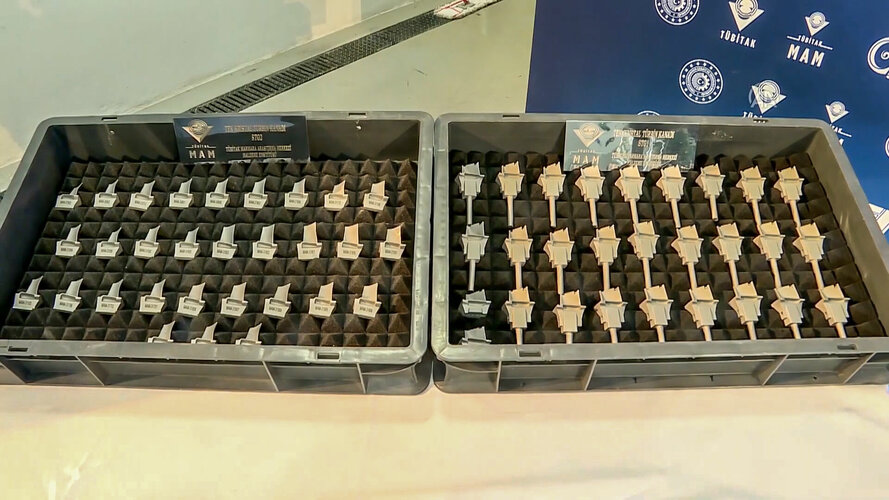
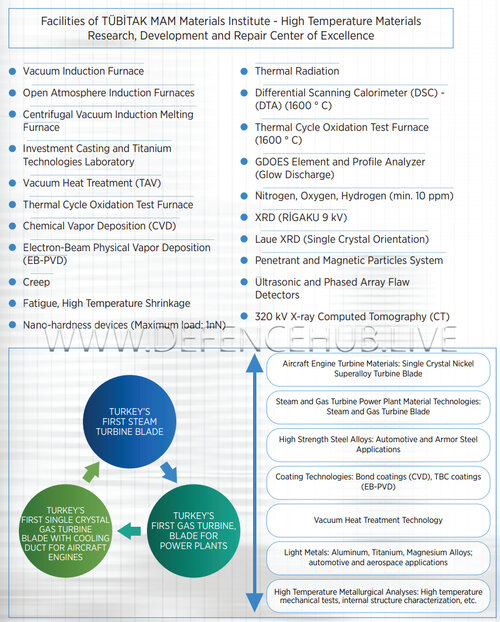
In the meantime, Tubitak MAM of Turkey delivered first set of single crystal turbine blades to TEI who will further machine the blades into end products for the Turkish 1400shp gas turbine engine. Engine manufacturer TEI claims that the technology and know-how accumulated during the development of gas turbine would be transferred into the development of Turkish F110 type engine..
These blades are for engine number 5 of TS1400.
Untitled-4.jpg 77263.jpg
 
Last edited:
If Turkey insists on transfer of advanced engine tech, B) won't help because non-Western players will guard their IP just as jealously. If it is prepared to accept A) however, why not reverse-engineer the F110, for which substantial know how is available locally?

While F110 is claimed to be made in Turkey - how do we know just how much of it is actually made by Turkey? Is it final assembly? Or production of all parts? There could very well be subsystems that Turkey would be lacking. https://asmedigitalcollection.asme....V002T02A020/2397636/v002t02a020-88-gt-305.pdf

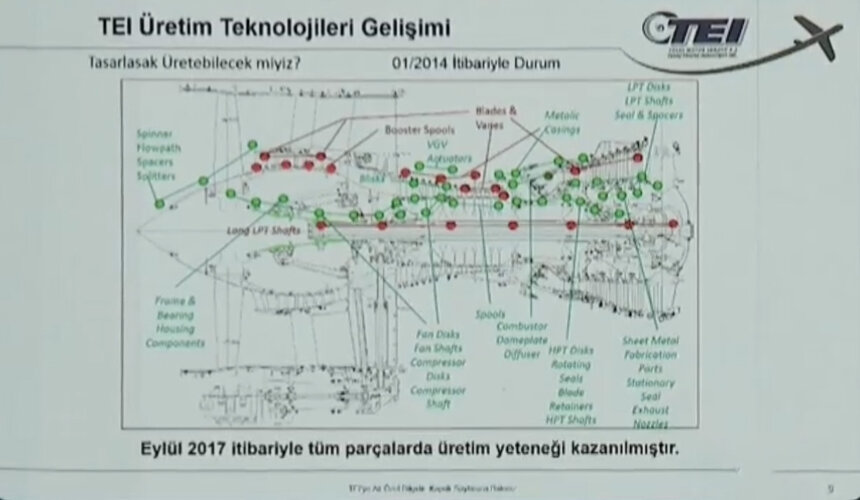
This issue was brought up in a recent interview with TEI General Manager, he pulled up a chart which showed areas in which Turkey had to work on to gain technological knowhow on - the studies and initiatives to gain the technology started in 2014 and completed with the red dots shown in the illustration of a Turbofan jet engine. Illustration claims all knowhow on critical parts of a turbofan engine were accumulated by september of 2017

Untitled-2.jpg


I'd also like to add that Turkey and Ukraine are working closely together to develop new generation of Gas Turbine engines for ship propulsion - we may see this expand to aerospace.
https://www.dailysabah.com/business/defense/turkish-ukrainian-firms-ink-defense-dealhttps://www.dailysabah.com/business...r-turkeys-next-gen-cruise-missile-local-media
 
Last edited:
Thanks for that chart. So, taking that at face value, by 2017 TEI was missing technology on:
Fan blades
High pressure compressor blades
Low pressure compressor blades
Vanes (also throughout the engine?)
Booster spools
Turbine blades

There's also the red dots throughout the central line of the engine. Not sure what those refer to. There is a line mentioning long low pressure turbine shafts, but it's unclear if the red dots are referring to that shaft.
 
Thanks for that chart. So, taking that at face value, by 2017 TEI was missing technology on:
Fan blades
High pressure compressor blades
Low pressure compressor blades
Vanes (also throughout the engine?)
Booster spools
Turbine blades

There's also the red dots throughout the central line of the engine. Not sure what those refer to. There is a line mentioning long low pressure turbine shafts, but it's unclear if the red dots are referring to that shaft.

No the feasibility studies started in 2014 those were the missing production technologies and know-how. By 2017 production capabilities / knowhow was gained, according to the presentation slide. The slide isn't clear enough to make out some of the missing production technologies, but I believe those you have written down were some of the areas where Turkey did not have capabilities in.
 
If Turkey insists on transfer of advanced engine tech, B) won't help because non-Western players will guard their IP just as jealously. If it is prepared to accept A) however, why not reverse-engineer the F110, for which substantial know how is available locally?

While F110 is claimed to be made in Turkey - how do we know just how much of it is actually made by Turkey? Is it final assembly? Or production of all parts? There could very well be subsystems that Turkey would be lacking. https://asmedigitalcollection.asme....V002T02A020/2397636/v002t02a020-88-gt-305.pdf

This issue was brought up in a recent interview with TEI General Manager, he pulled up a chart which showed areas in which Turkey had to work on to gain technological knowhow on - the studies and initiatives to gain the technology started in 2014 and completed with the red dots shown in the illustration of a Turbofan jet engine. Illustration claims all knowhow on critical parts of a turbofan engine were accumulated by september of 2017

View attachment 651131


I'd also like to add that Turkey and Ukraine are working closely together to develop new generation of Gas Turbine engines for ship propulsion - we may see this expand to aerospace.
https://www.dailysabah.com/business/defense/turkish-ukrainian-firms-ink-defense-dealhttps://www.dailysabah.com/business...r-turkeys-next-gen-cruise-missile-local-media

There have been a few cases where a turboshaft engine's core has been developed into a turbofan derivative. In all of those cases the original turbofan engine had a way higher power output compared to that of TEI TS-1400.

The older T55 variants for example had an output between 2,200~3,700 hp, from which the ALF502 was developed that has a 6,700 ~ 7,500 Ibf thrust.
T406 for the Osprey has an output of around 6,000 hp and the AE 3007 which uses the derivative core has a thrust between 7,000 Ibf to 9,500 Ibf.
T407 also had around 6,000 hp output and has been developed into CFE738 turbofan which has 5,900 Ibf thrust.

All of these turbofan engines have a bypass ratio between 5 ~ 6 to 1, so that should be taken into consideration when talking about the equivalent technology Turkey possesses for developing a turbofan engine because what they want is an engine with even lower bypass ratio than that.

What's really important isn't if they do have the technology, which is quantitative but rather if that technology is on a high enough level to be used to develop a turbofan engine they demand (F110 class) which is qualitative. From this perspective, when talking about gas turbine technology, one of the most representative figure is the turbine inlet temperature and as long as I know the Turks haven't specified for which temperature those technologies are suitable for.

Taking another example, which is Japan's gas turbine engine development history, the first aviation jet engine Japan has developed post-war was the J3 which had been developed since 1955. Then they continued to F3 and FJR710 of the 1970s and subsequently the XF5 and F7 of the 90s and XF9 of 2010s. Overall it took Japan around 20 years since the completion of F3, which had 2,650 Ibf (mil) of thrust and 940 ºc turbine inlet temperature till the completion of F3-400, which had 4,360 Ibf (mil) of thrust and 1,400ºc turbine inlet temperature.

To make it easier to comprehend, earlier GE F110 variants for Tomcat and Falcon had around 1,400ºc to 1,500ºc TIT.

I would not be so confident to believe if anyone claims that Turkey has an engine with TIT of over 1,400 ºc and that figure already is very generous.
 
Last edited:
Don't forget that CAE is among us (CAD/CFD). There is also undoubtedly some untold or secretive cooperation here and there.
So it won't take them 40 years. A decade is a reasonable time-line.
Remember that they are not targeting 21st century turbine Inn ovation but late 20ths.
 
Don't forget that CAE is among us (CAD/CFD). There is also undoubtedly some untold or secretive cooperation here and there.
So it won't take them 40 years. A decade is a reasonable time-line.
Remember that they are not targeting 21st century turbine Inn ovation but late 20ths.
Woopsie, that's a typo. I meant 20 years. 20 years because it was still an iteration of the F3. It took them 24 years after that to go from 1,400ºc to 1,600ºc of XF5.

Well, CAE surely does help but designing an engine with higher TIT is more than just the structure of the the turbine itself, as you would know. Developing a material durable enough at those temperatures and methods to mass-produce isn't where someone could use CAE for much help. I do suspect that Turkey would be getting or will be able to get some help from Ukraine but they could only help just so much. Also we've got to remember that TAI, SSB, TEI and other Turkish officials have repeatedly and openly claimed that they are going to make TF-X fly on supercruise.

Tbh it's all meaningless unless they make public of the TIT of their TS-1400 engine. Even achieving that late 20th century tech, 1,500ºc TIT, ain't going to be that easy unless they already have the technology to develop something with TIT higher than 1,400ºc in hand.

All in all we are talking about afterburning turbofan not turboshaft which is another kind of challenge they are facing. I've only used TIT because its one of the most representative quality to judge about one's gas turbine technology but there are important technologies apart from just turbine section related ones you need in order to develop an engine in the class of F110.
 
Last edited:
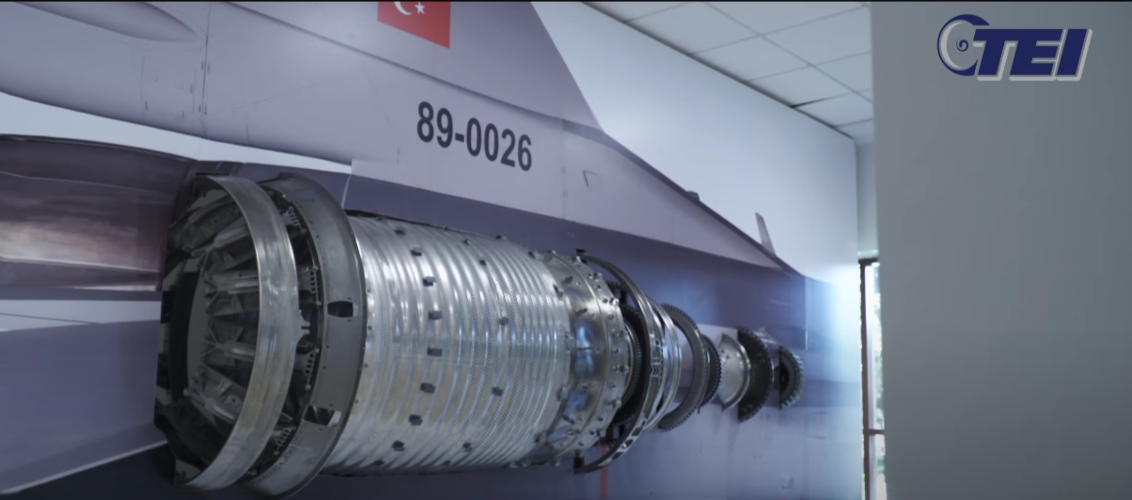
This is what TEI produces of the GE F110 engine, full engine assembly does take place at TEI of F110.
1613853912677.png
HPTR (High Pressure Turbine Rotor)
LPT Rotor
LPT Stage 1 Nozzle
LPT Stage 2 Nozzle
Turbine Frame
Bell Crank
Accessory Gearbox
Outer Duct
Exhaust Nozzle
Augmentor


TJ300- Turbojet engine 24cm diameter, weighs 30kg with a 1300n of Thrust (Anti-Ship missile engine)
View: https://www.youtube.com/watch?v=gVH-qQvr03E
 
Last edited:
I would not be so confident to believe if anyone claims that Turkey has an engine with TIT of over 1,400 ºc and that figure already is very generous.
And then there's F135 burning the first turbine blade at 2000°C.
 
https://www.savunmasanayist.com/tei-ts1400-kritik-parca-teslimi/
I did find out an article which mentions the turbine temperature. I would still refrain from completely believing it because its not an official document from TEI or Turkish army but granted this article is indeed true, it says that the turbine blades could operate at a temperature up to 1,400 ºc which would mean that the TIT of TS1400 would be somewhere in the region of 1,300 ºc ~ 1,400 ºc. Not far off from what I mentioned as a maximum figure I'm expecting.

That's still a long way to go for the aim of F110-GE-129 equivalent. We should remember that the 1,400 ºc ~ 1,500 ºc figure is that of the earlier variants of F110 like GE-400 or GE-100. I suspect that GE-129 would have an even higher TIT of over 1,500 ºc for better performance.

(edit) Just found out that the TIT of GE-129 ain't that different to that of GE-100 or GE-400. On the flipside that shows that there are other important factors than just the raw TIT figures that determines turbofan performance, just like what I've said above. Things like OPR for example.

Last but not least, once again its not the question of if Turkey could do it. Surely they could given enough time, but it would be extremely hard - to put it softly - to achieve that in the projected timeline.
 
Last edited:
I would not be so confident to believe if anyone claims that Turkey has an engine with TIT of over 1,400 ºc and that figure already is very generous.
And then there's F135 burning the first turbine blade at 2000°C.
Yes that surely is something, although there are some opinions that say it should actually be 3,200°F not 3,600°F, doubting the figures from Langston's article. Very interesting subject to discuss about but its unfortunately OT.
 
Okay, so bottom line conclusion is that Turkey has had more tech transfer on engines than Sweden?

So it'd take them less to develop a home grown iteration of F110 than it did the Chinese for F101/CFM56?

They'd still likely want a smaller, less powerful but more modern tech to power their jet though. Sizing up the TFX to a F15 weight class design is likely not what they ideally had in mind.
 
Okay, so bottom line conclusion is that Turkey has had more tech transfer on engines than Sweden?

So it'd take them less to develop a home grown iteration of F110 than it did the Chinese for F101/CFM56?

They'd still likely want a smaller, less powerful but more modern tech to power their jet though. Sizing up the TFX to a F15 weight class design is likely not what they ideally had in mind.
I don't think that it was necessarily only the transfer of technologies that brought Turkey to this point. Surely, cooperation with GE would've helped a lot but they did indeed invest into it.

Even so, like I've said they still do lack experience developing a turbofan engine which has some critical differences to the turboshaft they are most experienced in. On the other hand the Chinese were developing turbojet and turbofan engines since a very long time, although hindered by incidents like Cultural Revolution and Tiananmen Square Massacre in between. With all that experience, they still were faced with some major problems developing WS-10 from the knowledge they've gained via reverse engineering the CFM56 and AL-31.

All in all, I don't think it's going to be any easier for the Turks compare to what the Chinese have gone through, unless they, for example, reverse engineer the F110 and make a copy of it.
 
All in all, I don't think it's going to be any easier for the Turks compare to what the Chinese have gone through, unless they, for example, reverse engineer the F110 and make a copy of it.

But isn't that the very first, to be expected step for Turkey to take? Reverse engineering an engine would be the most efficient thing to do. That way they'd get a "domestic" engine as soon as possible. And as they're doing that, they have a parallel program to introduce various improvements and changes, for some future variants of the engine. If they DON'T reverse engineer it but strive for something better, they risk of getting stuck in development hell for possibly well over a decade, which by all accounts is NOT what TFX program is willing to wait for.
 
All in all, I don't think it's going to be any easier for the Turks compare to what the Chinese have gone through, unless they, for example, reverse engineer the F110 and make a copy of it.

But isn't that the very first, to be expected step for Turkey to take? Reverse engineering an engine would be the most efficient thing to do. That way they'd get a "domestic" engine as soon as possible. And as they're doing that, they have a parallel program to introduce various improvements and changes, for some future variants of the engine. If they DON'T reverse engineer it but strive for something better, they risk of getting stuck in development hell for possibly well over a decade, which by all accounts is NOT what TFX program is willing to wait for.
The question is if the US would allow such complete copy of their design to be produced without their authorization. Only a handful of critical components are manufactured directly at TEI which should mean that the rest of the engine are what they would not have been granted the transfer of design. More than 40% of the the TEI is owned by GE so I would suggest that the control over the American designs are still there. The US probably would have access to the logs on which engine went where. I'm not really convinced if under such environment Turkey could somehow send one of their F110 to TR Motor so that it could be disassembled. Especially under current situations.

Also, even though reverse engineering could provide some fast-track methods in engineering a product, it is also the case that one would always find a design or a component which they could not determine the function or meaning thereof, because reverse engineering is still essentially a guess work. What I meant with my comparison with the Chinese was that, the Turks at least were granted the license and design of the components of the engine and have manufactured and assembled the F110 for quite a long time. That would make the whole process of reverse engineering a lot easier compared to the case of China.
 
Last edited:

Similar threads

Back
Top Bottom