- Joined
- 1 April 2006
- Messages
- 12,285
- Reaction score
- 15,111


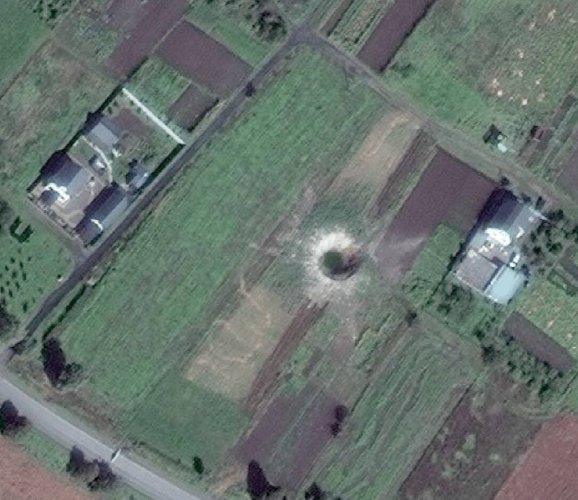
I don't think it necessarily implies that they were? I sure as hell wouldn't want to hang on to it.What on Earth were the owners of that house doing holding an unexploded AS-24 warhead?


Change "siezed" to "taken" and you probably get a more accurate translation of what went on.What on Earth were the owners of that house doing holding an unexploded AS-24 warhead?
Doesn't seem to have landed in the correct place either though.> It is presumed that EW caused the hypersonic missile to fall without detonation.
How is electronic warfare supposed to interfere with the internal arming and detonation mechanism? Does Ukraine suddenly field high powered microwave weapons gifted to them from the Adeptus Mechanicus?
The reasonable explanation is simply technical failure of the warhead, if that's an actual Kinzhal warhead to begin with.
View: https://x.com/TheDeadDistrict/status/1997553544623493179?s=20Doesn't seem to have landed in the correct place either though.
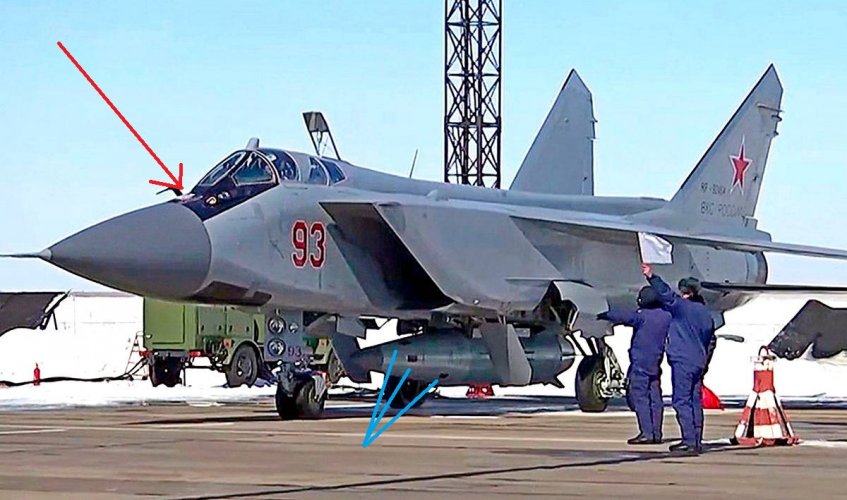
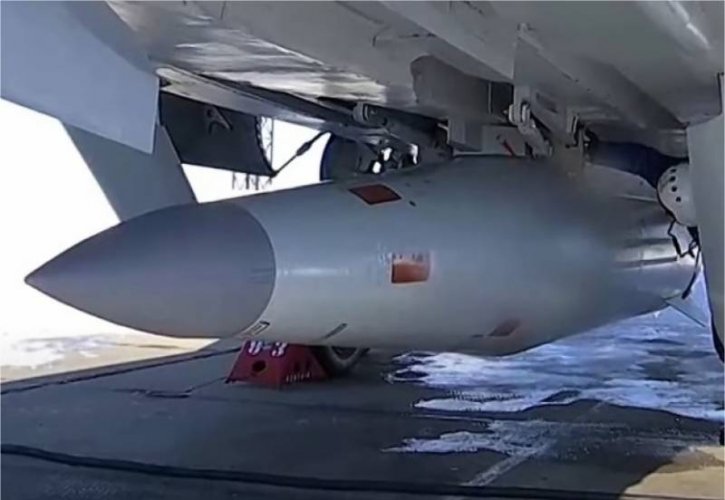
That's FAB, not Kinzhal (UMPK equipped bombs have shown to be susceptible to jamming, naturally).
Unless cluster munitions are used, but these leave completely different patterns as well.The aftermath of a kinzhal strike is far bigger then whatever images you are using.
View attachment 794403

https://www.trenchart.us/p/desperate-to-defeat-russian-missiles> It is presumed that EW caused the hypersonic missile to fall without detonation.
How is electronic warfare supposed to interfere with the internal arming and detonation mechanism? Does Ukraine suddenly field high powered microwave weapons gifted to them from the Adeptus Mechanicus?
The reasonable explanation is simply technical failure of the warhead, if that's an actual Kinzhal warhead to begin with.
Issue with that story is that the missiles, just like it's TEL based cousin, has multiple modes of guidance to provide redundancy, including INS which you cannot reasonably jam. Which means that the missiles, as soon as other modes of guidance become unviable, defaults back to the other guidance systems. We're talking about a weapon which can also hold a tactical nuclear warhead after all.https://www.trenchart.us/p/desperate-to-defeat-russian-missiles
The Ukrainians found out the Kinzhal uses a Soviet-era datalink to receive satellite guidance in the terminal phase, so they developed a system called 'Lima' to spoof it. One of the methods (and the namesake of the system) is making the missile think it's actually in Lima, Peru, making the missile try to rapidly turn around, which is not a good idea if you are flying at Mach 6. The missile falls apart from the violent manuevers and crashes.
I don't want to make grand accusations, but yes the source is non-credible.What I am trying to personally figure out is if a user is
A) Is he just rage-baiting other users (worked on me twice) to farm some kind of engagement?
B) is incredibly gullible to whatever any other random user says on the internet, like the twitter user he is referencing was using the term, "putler" in his tweet which questions if the person he is using as his source is of age to be allowed to even use the internet. If he does come to this thread, then I suggest he starts quoting Kyiv independent articles or well-known pro-Ukraine YouTube users making their coverages instead of random users which could be just kids using twitter.
while I'm not entire sure whether the image he show is from Kinzhal or not, the crater doesn't look small at all, arguably as big as the whole houseThe aftermath of a kinzhal strike is far bigger then whatever images you are using.
View attachment 794403
I don't think there's a single set of receivers/datalinks for any one of these systems - if you read some articles on the blog (and probably there are much better ones out there), there's a constant cat and mouse game with Ukrainians jamming/spoofing these guidance systems, and the Russians find out a way to counter the jamming, with each subsequent iteration getting its hardware tweaked.Issue with that story is that the missiles, just like it's TEL based cousin, has multiple modes of guidance to provide redundancy, including INS which you cannot reasonably jam. Which means that the missiles, as soon as other modes of guidance become unviable, defaults back to the other guidance systems. We're talking about a weapon which can also hold a tactical nuclear warhead after all.
More so, there have been no indications of Iskander-M being affected by some kind of jamming, which is suspected to be closely related to the Kinzhal. As the missiles launched by the Iskander-M system seem to still remain one of the most effective precision strike weapons with very little reliable countermeasures being present.
Then there's the issue of rapidly adapting systems. For example Geranium and UMPK equipped FABs were very successful and precise, then Ukraine figured out a way to jam them, Russians adapted, jamming was now less effective again, Ukrainians adapted and jammed the reworked guidance, Russians tinkered with the guidance again. To a point where you have multimode guidance in the glide bombs and long range drones to provide back up to the back up to the back up in case the frequency from which it gets reliable guidance data is being jammed. And again, Kinzhal is also a tactical nuclear weapon with the associated warhead equipped, so even if it wouldn't have redundancy already built into it, which it has, it would have by now.
Quite frankly, the simplest answer is usually the correct one. And in this case that's simply an accidental or deliberate misidentification of the weapon. Something I rather early alluded to as this pattern of damage is more in line with Russian bombs, which are known to be affected by jamming, rather than the ballistic missiles which cause a different kind of damage and are quite frankly extremely hard to jam. And the tolerances in INS that may be amplified by travel distance are not as extreme as the claim above.
Lastly, the wording chosen by the linked Twitter account should make it clear how credible it is (which is not very credible at all) and as such anything presented as "information" should be treated very carefully and sceptical.
It tells the onboard GPS that it is in Lima, Peru, causing the autopilot to order a turn sharper than the missile can survive at those speeds.What can one EW system do to something that flies so fast ( Mach 10 after acceleration phase) and is enveloped in a layer of ionised gas,so called ''plasma effect''?
...... to believe such a seemingly outlandish claim I sadly need actual proof. the claim is far too unlikely to happen(not saying it couldn't happen) for anyone to believe without the russians themselves tatling or the ukranians showing proof(both near impossible tasks since it would be exceptionally hard to get proof of such a incident on video even if it did happen).It tells the onboard GPS that it is in Lima, Peru, causing the autopilot to order a turn sharper than the missile can survive at those speeds.

The Risk and Threat:The Global Positioning System (GPS) has become a ubiquitous “utility” supporting critical infrastructure depended on by many across all industries. Originally developed for providing precision navigation and timing to the United States Military, society has rapidly developed a strong reliance on GPS information in many facets of life including transportation, communications, and financial transactions.
GPS has become an indispensable source of information with significant economic benefits, making it increasingly important that GPS data be available and reliable. In fact, GPS boosts productivity in many sectors including law enforcement, civil safety response, farming, mining, surveying, and package delivery. It is estimated more than 3.3 million jobs rely heavily on GPS in the United States, generating approximately $122.4 billion in annual economic benefits.
This paper focuses on GPS and its susceptibility to service outages due to both intentional and unintentional jamming. Jamming is the act of interfering with a system’s capacity to lock onto the GPS signal, eliminating a user’s ability to receive the necessary information.
Future satellite designs are being prepared to improve the transmission capability and security of GPS data. However, addressing GPS information outages needs to occur now as the availability and usage of low-cost GPS jamming devices has resulted in a growing threat of GPS signal disruption and increasing the likelihood of future outages to systems that rely on GPS data. Addressing the security of GPS signals and preventing denial of services should be a priority
Imagine to which lengths the military will go to mess with GPS-using missiles to find their targets.Brandon Wales, Director of Homeland Infrastructure Threat and Risk Analysis Center for the Department of Homeland Security, warned in late 2011, “U.S. critical infrastructure sectors are increasingly at risk from a growing dependency on GPS for positioning, navigation, and timing services.” He stated that GPS reliance in many critical systems is either not fully understood or is often taken for granted and describes GPS as a “largely invisible utility.”
Power distribution networks, banking and financial trading systems, broadcasting and industrial-control networks all use GPS timing, making them equally vulnerable to unintentional or deliberate interference.
In a March 2011 Royal Academy of Engineering (RAE) report, the author, Dr. Martyn Thomas, stated, “the financial markets, for instance, rely on a globally synchronized time-stamping mechanism to ensure fair trading. Trading systems might be detecting very small differences in prices between commodities on different exchanges and buying in high volume on one and selling on the other.
Since lots of people are in competition trading on different continents, for these activities to work you need to know whose order is getting in first.” A report issued by NDP Consulting Group in June 2011 noted that the direct economic costs of full GPS disruption to commercial GPS users and GPS manufacturers are estimated to be $96 billion per year in the United States or the equivalent of 0.7 percent of the U.S. economy.
Jammers
There are people who want to interfere with GPS signals because they are engaged in smuggling, theft, or simply trying to escape tracking of their daily movements. They are turning to devices that use radio frequency transmitters to intentionally block, jam, or interfere with lawful communications.
GPS signals come from satellites 13,000 miles away with signal strength of about 1.5 dB (home television signals usually range from 25 to 46 dB). A small jammer (Figure 2) can disrupt the GPS signal for a mile or more.
The fact that GPS signal strength is weak is not a design flaw. These radio signals are complex and contain multiple components, including time, ephemeris data, and information about the health of the satellite. To constantly produce and broadcast these signals from solar powered satellites requires a design balancing act between allocating energy, equipment and other resources. This was acknowledged by Colonel Bernard Gruber – former Commander of the GPS Directorate, Space and Missile Systems Center, Air Force Space Command, Los Angeles Air Force Base – in an interview from the July 13, 2013 edition of Inside GNSS, “by design, GNSS signals are weak and vulnerable to intentional and unintentional interference.”
An example of unintentional jamming was noted in the July 27, 2013, edition of The Economist – for nearly ten minutes each day, near the London Stock Exchange, someone was blocking GPS signals.
Navigation systems in cars stopped working and time stamps on financial trades were affected. It was determined that the offender was a delivery driver hiding from his management.
GPS jammers are being used by criminals to hide the fact they are driving stolen cars or by commercial drivers to conceal they are driving for dangerously long hours.
It has been reported that a 500 meter shield is created around a vehicle that uses a simple jamming device plugged into a cigarette lighter. Within that shielded area, other GPS devices are left inoperable. For example, navigation technology is unintentionally disrupted when an exhausted taxi cab driver wants to take a break and plugs in a GPS jammer to avoid detection.
My dude, the RQ-170 got GPS-spoofed into landing in Iran....... to believe such a seemingly outlandish claim I sadly need actual proof. the claim is far too unlikely to happen(not saying it couldn't happen) for anyone to believe without the russians themselves tatling or the ukranians showing proof(both near impossible tasks since it would be exceptionally hard to get proof of such a incident on video even if it did happen).

Regardless of whether the system works and whether it's the culprit in this incident, the idea that we'd be told its operating principle is obviously absurd. That'd be like the US Navy bragging to the public about its radio proximity fuzes in 1944. The "Lima, Peru" thing is probably a just-so story.It tells the onboard GPS that it is in Lima, Peru, causing the autopilot to order a turn sharper than the missile can survive at those speeds.
Not sure that admitting it is a GPS(etc)-spoofing system is particularly critical.Regardless of whether the system works and whether it's the culprit in this incident, the idea that we'd be told its operating principle is obviously absurd. That'd be like the US Navy bragging to the public about its radio proximity fuzes in 1944. The "Lima, Peru" thing is probably a just-so story.
"It spoofs the GPS" and "it tells the GPS it's in Lima, Peru" are pretty different claims. The latter is very specific and probably trivial to fix in software.Not sure that admitting it is a GPS(etc)-spoofing system is particularly critical.
It tells the onboard GPS that it is in Lima, Peru, causing the autopilot to order a turn sharper than the missile can survive at those speeds.

Yes, I probably should have just said "navigation system" instead of "GPS."
But Lima is described in open literature as a positional-injection cyber-attack system.
So how come RADAC guidance is a thing?
1-2 kps is not fast enough to induce radar blackout.Yes ,that is right question exactly as one about those receive or whatever antennas on the missile itself. The problem is that we don't know almost nothing about the Kinzhal.How did they succeed to integrate that suppose active radar seeker in the missile which ''drop from the sky'' with the speed 1-2km/s ?!
Nevermind and to end this endless false story about the jamming of Kinzhal. There is one phenomena about the Kinzhal and other ballistic missiles and it is so called ''faraday cage''. 'Because the heat of missile creates a blanket of ionized plasma around it that acts as a faraday cage, blocking any radio waves'.
Snip.
There is one phenomena about the Kinzhal and other ballistic missiles and it is so called ''faraday cage''. 'Because the heat of missile creates a blanket of ionized plasma around it that acts as a faraday cage, blocking any radio waves'.
My point is that if RADAC can get out of such missilies and back in (e.g. Pershing II), then so can jamming.Yes ,that is right question exactly as one about those receive or whatever antennas on the missile itself. The problem is that we don't know almost nothing about the Kinzhal.How did they succeed to integrate that suppose active radar seeker in the missile which ''drop from the sky'' with the speed 1-2km/s ?!
It looks like someone here is deep in denial refusing to believe that the AS-24's GPS/GLONASS receiver can't be spoofed and/or jammed, the Ukrainians have had four years of dealing with this ALBM to come up with means of entering with its' midcourse guidance-system.
While its' peak velocity is M10 it doesn't travel fast enough to form a plasma-sheath and after it it reenters the atmosphere it loses speed fairly quickly so by the time its entered terminal phase it has slowed to supersonic speeds (It can't effectively manoeuvre when it's hypersonic).
My point is that if RADAC can get out of such missilies and back in (e.g. Pershing II), then so can jamming.
Speed of the Kinzhal even through troposphere is very big,if it is really about 1.5 km/s ,than it is about Mach 5.
At 2km/s or M6 average speed it would take 30s to get from 60km to altitude to ground. The GPS can probably be jammed too. If there's a means of in-flight re-targeting then there are options there too.If, yes. During terminal phase only but that phase lasts only several seconds.About that jamming, it will mean only jamming of the active radar seeker ,nothing else.
Its terminal (touchdown) speed is M2.5-4 according to Ukraine.It is still going to slow down especially if it's manoeuvring as it drops below 50,000ft with the air getting rapidly thicker at that point.
It is still going to slow down especially if it's manoeuvring as it drops below 50,000ft with the air getting rapidly thicker at that point.
Its terminal speed is M2.5-4 according to Ukraine.
What? So how would it achieve any kind of accuracy on its target then?There is little chance that Kinzhal can maneuver during the terminal phase. Did you see the video previously posted anyway?
I think it sounds realistic for an impact speed. Peak speed during descent will likely be higher.Yes and according to Ukraine,several tens or hundreds of Kinzhal's are jammed and intercepted from the beginning of the war .