Dynoman

ACCESS: Top Secret
Senior Member
Joined
29 July 2009
Messages
1,949
Reaction score
3,298
I've read numerous books on Cold War histories, which included mention of Soviet air combat tactics, however I've not found one source that described the various air-to-air or air-to-ground tactics that the Soviets employed during the Cold War (either the USSR or their Warsaw Pact allies). This thread is an attempt to capture the different ideas that the Soviets may have used from 1945-1989, whether by the Soviets proper or by Soviet trained and supplied nations.

First, it is important to say that tactics change often and that they are very dependent on a given situation, which can involve the evolution of technology, strengths and weaknesses of allied and enemy's aircraft performance (e.g. T/W, AAM performance, force size, etc.). However, with Soviet pilots utilizing Ground Control Intercept (GCI) the tactics may have been relatively rigid and very standardized.

"It has been my experience that nations, and even separate air arms within a given nation, differ in air combat tactics as widely as they do in other areas. In fact, they often disagree even on what constitutes a "tactical doctrine." For example, I have found that asking two U.S. pilots for their tactics in a given situation elicits three different answers. By contrast, it is my understanding that three Russian fighter pilots will all give the same answer. Probably neither of these extremes is optimum." (Robert L. Shaw, Fighter Combat - Tactics and Maneuvering, 1985).

Just as examples

During the Korean War the Russian's would use the high/low split. When engaged by F-86s a number of the MiGs would pull up into a climb while others would turn nose low to engage the F-86s. The US pilot would have to choose between the MiGs to engage. If they followed the low MiGs the climbing MiGs would turn into the F-86s. If the F-86s climbed after the ascending MiGs the nose low MiGs would use their energy to maintain their best rate maneuver to close in on the F-86s.

During the Vietnam War North Vietnamese MiGs would fly a 'wagon wheel' defense over a defended area and when one of the MiGs was engaged by a US fighter the trailing MiG in the wagon wheel would attack.
 
Last edited:
Soviet Air Combat Tactics in the Korean War

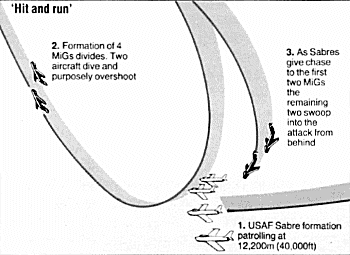
1. Soviet pilots who engaged in or who trained their North Korean allies in the beginning of the war frequently sought refuge in Chinese airfields just north of the China-Korean border. NK MiGs would often launch in a group of four MiGs headed towards the UN aircraft. Two MiGs would accelerate to fly past the US aircraft hoping they would turn and engage them while the other two trailing MiGs would close in from behind. The initial MiGs would use their high energy state to climb away from their enemy or to re-engage the slower climbing UN aircraft. The trailing MiGs would engage if the UN aircraft turned after the initial MiGs (see Hit and Run diagram).

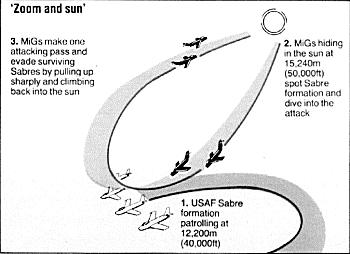
2. NK pilots would use the MiG-15's higher sustained altitude capability and flew formations above the UN aircraft. They would dive on the UN aircraft, attacking, and then pull up and return to their formation (Boom and Zoom or 'yo-yo' maneuver). Often these flights involved seasoned pilots while training inexperienced NK pilots who would remain behind in the formation until they developed increased proficiency with the MiG.

3. The MiGs would come in waves with long periods in between sorties. These periods were thought to be down-time for training activities or a reassessment of their tactics. Occasionally large high altitude NK formations were seen and were thought to be training events that included experienced and inexperienced pilots. These large scale formations (nicknamed 'trains' by Americans) would fly nearly the length of the country in a fighter sweep, with smaller flights of experienced pilots dropping out of the formation and attacking UN formations at lower altitude. If the MiG pilot got into trouble, he would race back towards the border.

4. The basic plane-group for the MiGs was a six-ship formation with three pairs of lead and wingman. The group would fly high with the first pair diving in on the UN aircraft. The second pair would follow to protect the first pair. The third pair would stay at altitude and assist if needed.
 

Attachments

  • MiG Hit and Run Korea.gif
    MiG Hit and Run Korea.gif
    20.6 KB · Views: 83
  • Zoom and Sun Korea.gif
    Zoom and Sun Korea.gif
    18.3 KB · Views: 80
Last edited:
I've read numerous books on Cold War histories, which included mention of Soviet air combat tactics, however I've not found one source that described the various air-to-air or air-to-ground tactics that the Soviets employed during the Cold War (either the USSR or their Warsaw Pact allies). This thread is an attempt to capture the different ideas that the Soviets may have used from 1945-1989, whether by the Soviets proper or by Soviet trained and supplied nations.

First, it is important to say that tactics change often and that they are very dependent on a given situation, which can involve the evolution of technology, strengths and weaknesses of allied and enemy's aircraft performance (e.g. T/W, AAM performance, force size, etc.). However, with Soviet pilots utilizing Ground Control Intercept (GCI) the tactics may have been relatively rigid and very standardized.

"It has been my experience that nations, and even separate air arms within a given nation, differ in air combat tactics as widely as they do in other areas. In fact, they often disagree even on what constitutes a "tactical doctrine." For example, I have found that asking two U.S. pilots for their tactics in a given situation elicits three different answers. By contrast, it is my understanding that three Russian fighter pilots will all give the same answer. Probably neither of these extremes is optimum." (Robert L. Shaw, Fighter Combat - Tactics and Maneuvering, 1985).

Just as examples

During the Korean War the Russian's would use the high/low split. When engaged by F-86s a number of the MiGs would pull up into a climb while others would turn nose low to engage the F-86s. The US pilot would have to choose between the MiGs to engage. If they followed the low MiGs the climbing MiGs would turn into the F-86s. If the F-86s climbed after the ascending MiGs the nose low MiGs would use their energy to maintain their best rate maneuver to close in on the F-86s.

During the Vietnam War North Vietnamese MiGs would fly a 'wagon wheel' defense over a defended area and when one of the MiGs was engaged by a US fighter the trailing MiG in the wagon wheel would attack.
GCI tactics maybe rigid but Soviets had to make up for their lack of AEWC aircraft
I don’t see any way around it , esp as more sophisticated aircraft and weapon systems needed to be deployed
 
Any Western book on Soviet tactics from 1986 is going to be a whole lot of SWAG (scientific wild ass guesses).

I'm not sure if there's been any Russian authors tackling the subject, but you'd want a book written after the end of the Cold War so the author can access sources in Russia.
 
There are some books out there in Russian. I have an English version (which I poorly translated to English using an electronic translator) of V. Babich's Fighters Change Tactics.

The other books are: Fighters Attack, by Col. A.B. Krasnov and Tactics in Combat: Examples, G.V. Zimin. All three discuss air combat tactics and the changes that were taking place in the 1970s and early 1980s.
 
An interesting question.
I tended to assume that in any conflict with the USSR both NATO and Warpac fighters would be spending their time hacking down incoming strike missions in areas not covered by their own SAMs etc.
I know that the US had two wings of F15s in Holland and W Germany tasked with air superiority. By the late 80s Poland based Su27s were presumably focussed on defeating them. But F16s and Mig29s would be defending against incoming Mig27s and Su24s or Jags and Tornados.
 
I guess this topic really has not much public facing info.

For MiG-29 for example it seems tactics was exactly just this

1. Get to atleast same altitude and height
2. Fire once at Dr.max1
3. Crank to around halfway of diamond moving to side
4. Un crank to fire at Dr.max2 (NEZ)
5. Crank again until closing to WVR to fire fox 2 as you merge

Then, what you do in BFM/WVR/merge is entirely up to both pilot and the sub-unit level tactics the pilot would’ve talked about with their unit and practiced as a team.

Atleast; this is how it seems to me. For example if they got more dogfight experience at Mary they would incorporate this but for vast majority they wouldn’t.

For MiG-29 for example, you don’t have many close combat sensor for locking a guy you don’t see and HUD only points you to point at them.
 
Hi,

I guess this topic really has not much public facing info.

For MiG-29 for example it seems tactics was exactly just this

1. Get to atleast same altitude and height
2. Fire once at Dr.max1
3. Crank to around halfway of diamond moving to side
4. Un crank to fire at Dr.max2 (NEZ)
5. Crank again until closing to WVR to fire fox 2 as you merge

This thread on Flugzeugforum.de has a Russian diagram which I guess is historical:

https://www.flugzeugforum.de/threads/planung-von-luftgefechten.106985/
In this thread, someone linked this folder with German diagrams, which he found in the Militärarchiv Freiburg archives, scanning and uploading them:

https://drive.google.com/file/d/1BOG9z2i1qSzEcgduOlEYPbHj4f_VOnVc/view
A commenter on Flugzeugforum remarked that these looked like the "Methodik" (methodics) of the GDR air force's JG 9. Apparently, each Geschwader prepared a comprehensive set of tactical and operational documentation specifically for their own use. The commenter considers the Russian diagram to be of a more general nature, like it might have been used for the training of air force officers.

Regards,

Henning (HoHun)
 
Hi,


This thread on Flugzeugforum.de has a Russian diagram which I guess is historical:

https://www.flugzeugforum.de/threads/planung-von-luftgefechten.106985/
In this thread, someone linked this folder with German diagrams, which he found in the Militärarchiv Freiburg archives, scanning and uploading them:

https://drive.google.com/file/d/1BOG9z2i1qSzEcgduOlEYPbHj4f_VOnVc/view
A commenter on Flugzeugforum remarked that these looked like the "Methodik" (methodics) of the GDR air force's JG 9. Apparently, each Geschwader prepared a comprehensive set of tactical and operational documentation specifically for their own use. The commenter considers the Russian diagram to be of a more general nature, like it might have been used for the training of air force officers.

Regards,

Henning (HoHun)
Very in depth! It’s for MiG-23 tactics so also applies to MiG-29 very well!
 

Similar threads

Back
Top Bottom