
You are using an out of date browser. It may not display this or other websites correctly.
You should upgrade or use an alternative browser.
You should upgrade or use an alternative browser.
SAAB L23
- Thread starter Justo Miranda
- Start date
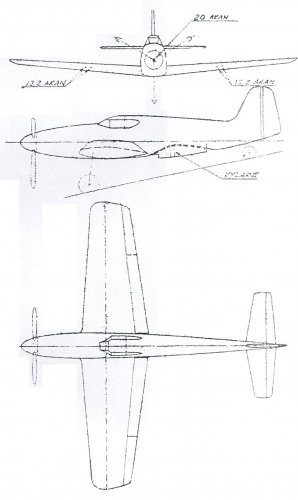
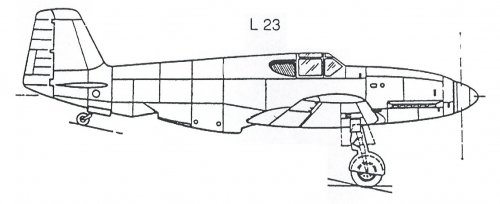
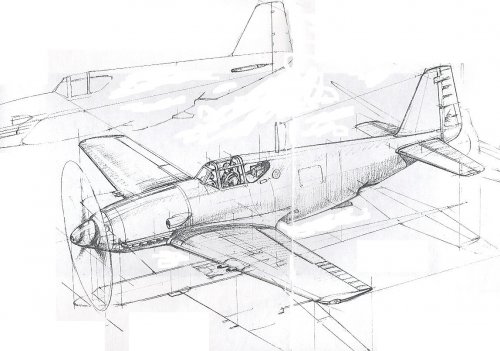
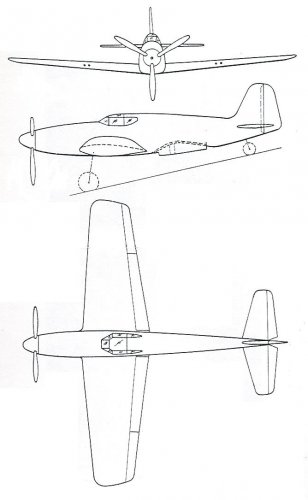
lark said:Any sources ?
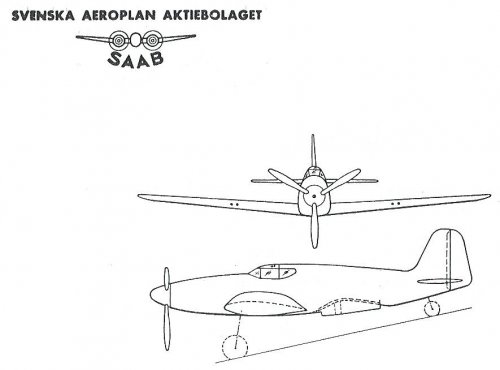
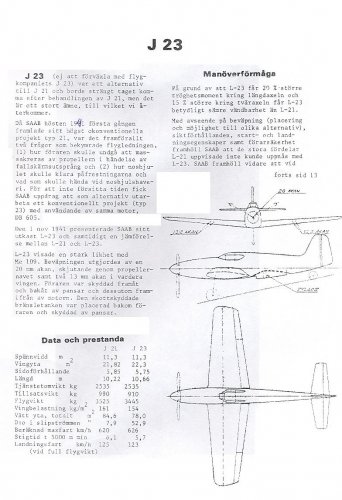
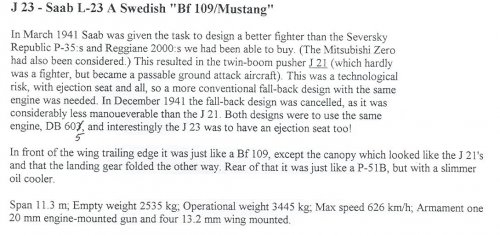
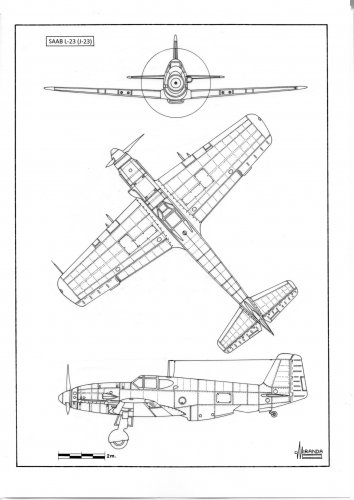
Part of the drawings come from SAAB (Linköping 1946)
and the rest from an unidentified Swedish magazine.
All of them via Lennart Petersson five years ago.
Attachments
Kim Margosein
ACCESS: Confidential
- Joined
- 9 February 2007
- Messages
- 101
- Reaction score
- 18
Many thanks for all of these drawings, Justo. Now, where can I get my hands on about 4 Re 2005 kits cheap?
Kim M
Kim M

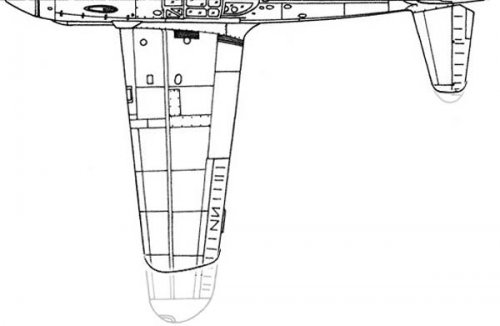
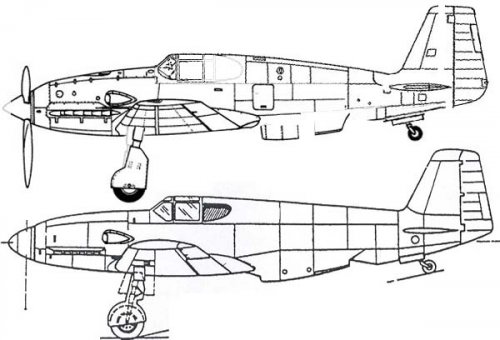
Apophenia said:Kim, maybe a marriage of Ki-61 and P-51 for the L23?
Nice find!
The alikeness is astonishing...
Thanks Iverson 


- Joined
- 26 May 2006
- Messages
- 38,289
- Reaction score
- 20,430
From old site on Net,
at the beginning of 1941 - after the abandonment of the J 19 aircraft project and in the face of the deepening Flygvapnet equipment crisis - the SAAB aircraft factory received another order to develop a modern fighter aircraft, intended to replace the obsolete J 7 fighters (British Bristol "Bulldog" Mk II/Mk IIA) and J 8 (also British Gloster "Gladiator" Mk I) and J 8A ( "Gladiator" Mk II), and ultimately also J 9 (American Republic EP-106), J 11 (Italian FIAT CR-42bis "Falco" ) and J 20 (also Italian Reggiane Re-2000).
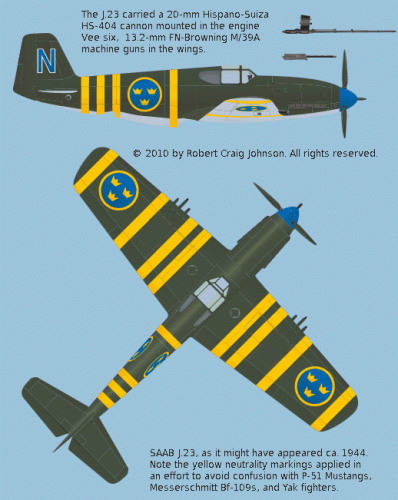
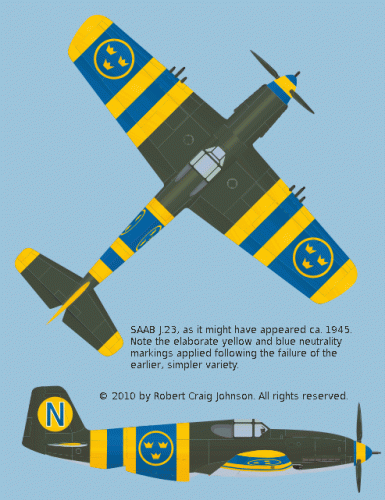
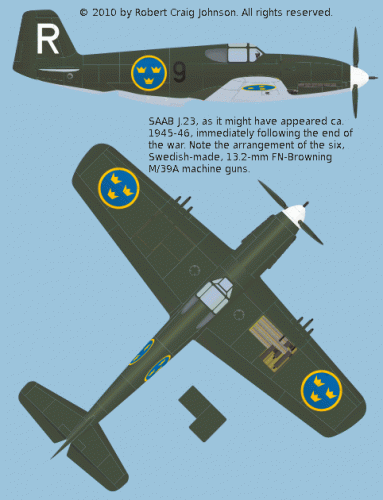
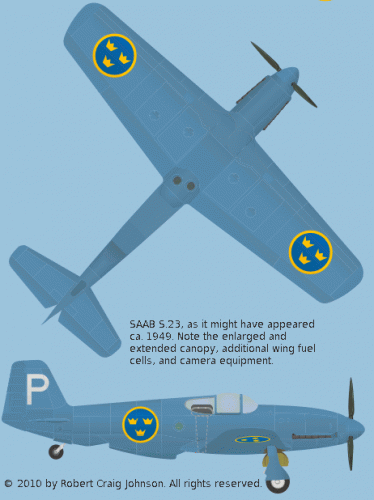
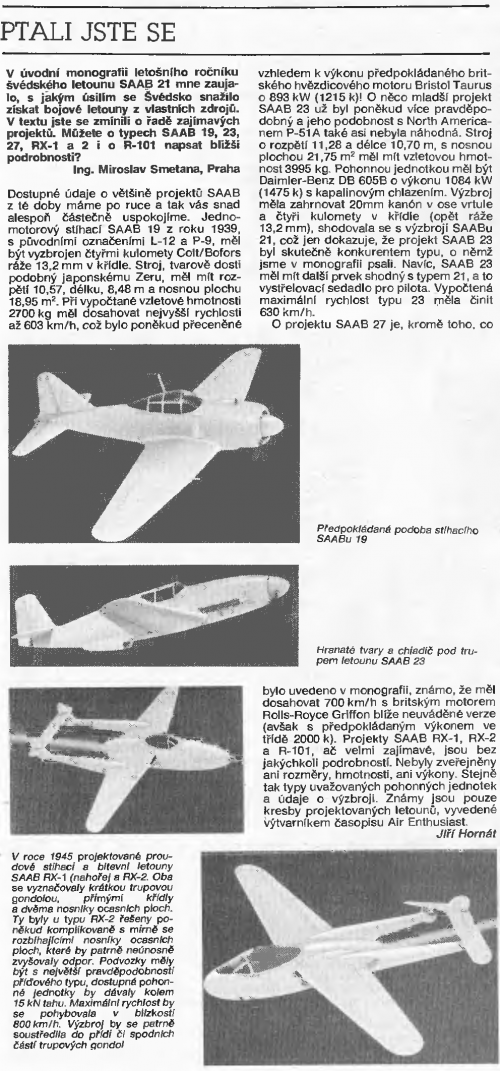
SAAB designers soon began developing a highly ambitious design for a twin-aisle fighter, the L-21, later known by its military designation J 21. However, due to the significant technical risk of failure with this unconventional design, preliminary design work began simultaneously on a conventional L-23 fighter. It was to be an elegant, low-wing, cantilever monoplane with an enclosed cockpit and retractable landing gear with a tailwheel. It was to be powered by the same engine as the L-21/J 21, the German Daimler-Benz DB 605, which gave the front fuselage a resemblance to the German Messerschmitt Bf 109. The cockpit equipment was also to be similar to that designed for the J 21, including a firing seat for the pilot (sic!). The armament was also identical, consisting of a single cannon in the fuselage and four machine guns in the wings. The air intake for the liquid cooler was placed under the rear part of the fuselage, similarly to the American North American P-51 "Mustang" fighter .
The new aircraft received the military designation J 23 , but work on it was discontinued in December 1941. From the outset, this project was considered only a reserve in case of problems with the J 21, but after the successful development of the latter, the second fighter was no longer needed. Furthermore, by the middle of the war, Sweden's neutrality no longer seemed threatened, and until the J 21 entered service, the J 9, J 20, and the ad hoc FFVS J 22 fighters were completely sufficient to defend the country's airspace .
at the beginning of 1941 - after the abandonment of the J 19 aircraft project and in the face of the deepening Flygvapnet equipment crisis - the SAAB aircraft factory received another order to develop a modern fighter aircraft, intended to replace the obsolete J 7 fighters (British Bristol "Bulldog" Mk II/Mk IIA) and J 8 (also British Gloster "Gladiator" Mk I) and J 8A ( "Gladiator" Mk II), and ultimately also J 9 (American Republic EP-106), J 11 (Italian FIAT CR-42bis "Falco" ) and J 20 (also Italian Reggiane Re-2000).
SAAB designers soon began developing a highly ambitious design for a twin-aisle fighter, the L-21, later known by its military designation J 21. However, due to the significant technical risk of failure with this unconventional design, preliminary design work began simultaneously on a conventional L-23 fighter. It was to be an elegant, low-wing, cantilever monoplane with an enclosed cockpit and retractable landing gear with a tailwheel. It was to be powered by the same engine as the L-21/J 21, the German Daimler-Benz DB 605, which gave the front fuselage a resemblance to the German Messerschmitt Bf 109. The cockpit equipment was also to be similar to that designed for the J 21, including a firing seat for the pilot (sic!). The armament was also identical, consisting of a single cannon in the fuselage and four machine guns in the wings. The air intake for the liquid cooler was placed under the rear part of the fuselage, similarly to the American North American P-51 "Mustang" fighter .
The new aircraft received the military designation J 23 , but work on it was discontinued in December 1941. From the outset, this project was considered only a reserve in case of problems with the J 21, but after the successful development of the latter, the second fighter was no longer needed. Furthermore, by the middle of the war, Sweden's neutrality no longer seemed threatened, and until the J 21 entered service, the J 9, J 20, and the ad hoc FFVS J 22 fighters were completely sufficient to defend the country's airspace .
Similar threads
-
-
-
-
 Breguet S 10 (Bre 694 for the Swedish air force)
- Started by blockhaj
- Replies: 11
-
 Swedish Missiles and Missile Projects.
- Started by Tzoli
- Replies: 62