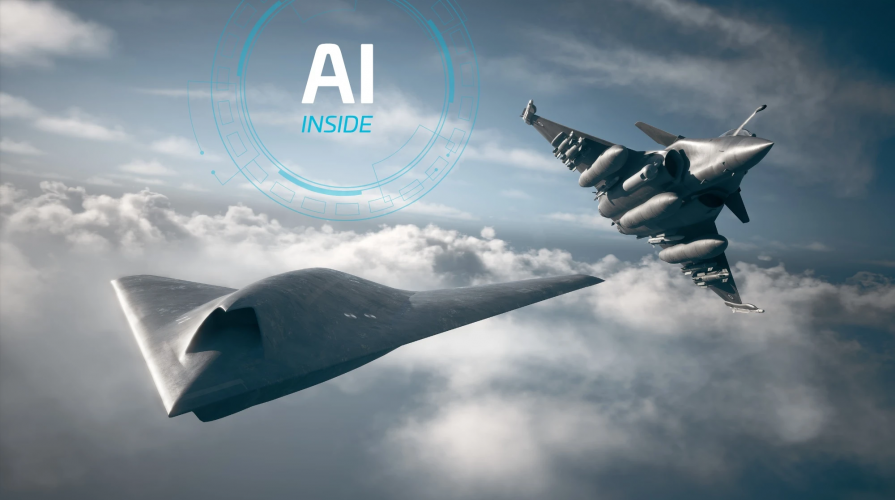
Sorry, but Dassault already has an active UCAV program of strategic importance for France's deterrence.
And it’s actually funded, with around €1 billion already allocated over a ongoing 4 year period (2024-28)
Comparatively, how much actual funding and R&D effort is being invested in Saab’s program ?

Dassault is just terrible at marketing, unlike Saab. #AIPowered

Their gov just launched their future fighter project that we suspect will be unmanned for a little under €300M if my mem stands right.

I agree with the second proposition.
 
Funding for the ukrainean Gripens is making progress.

https://www.reuters.com/business/ae...gripen-deal-defence-minister-says-2025-11-06/
Comically enough, the russians might pay for them (with their frozen assets).

"Jonson said that Sweden had presented the deal to the so-called coalition of the willing, a group of 16 European countries determined to help fund Ukraine's war against Russia, and that some of them might be willing to help fund the planes.
"It could be that countries who have subcomponents in the Gripen system may have extra incentives to help finance the deal," he said.
Gripen is fitted with engines from General Electric, and also many components made in Britain.
Jonson said Sweden was pushing hard in negotiations with other EU countries to use 200 billion euros of frozen Russian assets to fund Ukraine's war effort.
Swedish Prime Minister Ulf Kristersson told Reuters in October that the jet deal with Ukraine was "very realistic" but that a lot of work remained and first deliveries could take place in three years' time."
 
In a Swedish article on FDI frigates for sweden, what do you think this could be ?

https://www.svt.se/nyheter/inrikes/spelet-bakom-sveriges-miljardkop-av-nya-fregatter-storpolitik
Naval Group (France) – The French company builds the FDI frigate in Brittany. Their bid offers a fully French solution, and the company claims it can deliver a frigate by 2030. Sources with insight say that a deeper collaboration involving the Gripen fighter jet could be part of the deal if it goes through.
 
In a Swedish article on FDI frigates for sweden, what do you think this could be ?


Naval Group (France) – The French company builds the FDI frigate in Brittany. Their bid offers a fully French solution, and the company claims it can deliver a frigate by 2030. Sources with insight say that a deeper collaboration involving the Gripen fighter jet could be part of the deal if it goes through.

French gov not opposing the release of Russian funds to let them build Gripen for Ukraine? (don´t forget French influential position on EU central bank that would have a play in the scheme).
 
French gov not opposing the release of Russian funds to let them build Gripen for Ukraine?
France, Italy and Belgium among others oppose this because it would obliterate the last semblance of trust into European banks. So it's unlikely to happen, not impossible, but unlikely.

More likely is that these countries will contribute to a loan to Ukraine/Sweden out of their own pocket.
 
France, Italy and Belgium among others oppose this because it would obliterate the last semblance of trust into European banks. So it's unlikely to happen, not impossible, but unlikely.

That's a few mischaracterizations of the confiscation situation rolled into one. Firstly, the confidence of Russians (or their allies in their military aggression, such as they may be - e.g. North Korea) in the European banking system should not and does not feature highly in anyone's priorities within the Union (save, perhaps, for some stragglers who can be overridden). Second, the current plan seems to involve the securitization of the frozen assets to provide a (practically) indefinite loan to Ukraine which is a far cry (at least in terms of jurisprudence) from outright confiscation.

The "opposition" of the countries varies, i.e. is conditional and in no way non-negotiable. In France, the position of the president (stricter) and parliament (more amenable) seem to differ, but none is categorically opposed to every solution of utilization. Italy's government, in turn, wants international law to be respected, a principle with which the EU hasn't abandoned to any such degree that Russia manifestly has and can surely be satisfied to a requisite degree. Belgium is understandably the most exposed to risk through Euroclear but its objections are related to spreading said risk, not aiding Ukraine by any available means.

It's a process which almost certainly will result in some kind of practical utilization of the funds in the defense and rebuilding of Ukraine, quite possibly including the Gripen deal. It is still but a tool in the kit, for the damage wrought in Ukraine by Russia far exceeds its internationally sanctions-frozen assets (and in the light of the emergence of the age of individual trillion-scale "compensations", seems a somehow paltry sum in comparison).

Sources:

"Confiscation of immobilised Russian sovereign assets" (PDF), EU Parliament briefing, September 2025
"EU has a plan to use frozen Russian assets to fund Ukraine - how will it work?", Guardian explainer, October 23, 2025
"Russian assets dispute triggers crisis meeting between EU Commission, Belgium", Politico (EU), November 4, 2025
 
the confidence of Russians (or their allies in their military aggression, such as they may be - e.g. North Korea) in the European banking system should not and does not feature highly in anyone's priorities within the Union
You are fully aware (well you probably aren't, but people like Macron are) that setting the example of confiscating large sums in assets and then simply handing them out destroys the very principle of the trust based banking system. If you do not trust a bank with your money/assets, you will not utilize it, you will avoid business through them outright.

This would alienate many states in Africa, Latin America and West, South, Central and South East Asia. These countries would see their assets in Europe under constant threat and would become more hesitant to invest in their own European based assets and the European economy as a whole.

The pretense of international law is ultimately just a veil to hide the unwillingness to deal with the fallout such a decision could bring.

She sheer fact that some of the largest EU members are so averse to this idea should be telling, if you have an interest in the matter.
 
setting the example of confiscating large sums in assets and then simply handing them out destroys the very principle of the trust based banking system.

Invading countries without provocation destroys that trust (or should've already) on a more fundamental level. The EU is under no obligation to shield and protect the assets of such aggressors or to insulate foreign state leaders' finances from their actions. It is rather a matter of trust and banking stability that such situations are steered well clear of. Maybe this is a clarifying moment in that regard, challenging as it may be.

To state the obvious again (should one have not done a cursory reading of the sources I provided) this is not de jure a confiscation. This is not about expropriating money under any pretenses but a highly specific case, with precedents and hopefully setting a further one, about repercussions when it comes to unprovoked state aggression against another. If states ("in Africa, Latin America and West, South, Central and South East Asia") and their rulers can't abide by these most simple of standards the EU should treat them with the utmost prejudice anyway and in no shape or form create destabilizing and corrupting dependencies with them. If this turns out to be a form of deterrence as well then all the better.

It is of course understandable how, as viewed from an authoritarian mindset or society, a confiscation (or, more accurately, a highly specific securitization of frozen assets to support a victim of an attack by, say, buying fighters such as the Gripen for them) even in such extremis might potentially give carte blanche to do the same for practically any excuse other than only bloody unjustified war.
 
Considering the assets are indefinitely frozen, I dont see why structuring a loan against them to facilitate funding the Gripen E and Gripen derived UCAVs would be an issue. I can understand the haggling in the meantime but seems like something thats going to happen eventually. In the grand scheme of things $300bn is nothing compared to the multi trillion dollar global financial ecosystem. Major economies are not going to stop holding reserves in reputable Western institutions because Russia's assets were frozen and a loan created on top. The political economic benefits of continuing trade with Western institutions is more lucrative regardless of how these frozen assets are ultimately resolved.
 
If states ("in Africa, Latin America and West, South, Central and South East Asia") and their rulers can't abide by these most simple of standards the EU should treat them with the utmost prejudice anyway and in no shape or form create destabilizing and corrupting dependencies with them.
I think you don't realize that the European sense of self righteousness isn't shared by the majority of the world. And that systems like banking aren't founded on morality.

You're clearly very emotional about the topic, but the finance system isn't a tool to enforce the own morals standards on an international level. It's a tool to make and exchange money in order to keep the economy prosperous. If I was a wealthy Gulf state with questionable human rights record but plenty of money, this is the kind of delusional and self righteous thinking that would see me rather invest and deal with the Chinese for example than with the EU. And this scenario is something the French for example have tried to avoid for decades, with France having sought to position itself as an alternative to the like of the US, Russia or China on the international stage, be it with military contracts, financial investments or economic cooperation. If the EU is attaching strings of even greater magnitude to making business with them than the Americans, then there is no reason to not rather make business with the Americans instead, as they have more to offer from the get go, same with the Chinese.

Ruining your reputation on the financial international stage over morality points is not something the world at large will respect but more so laugh at. Because who could possibly be so naive and short sighted?
 
Well, without waxing too philosophical about defense (and other) economics, just so we're a bit clearer as to where we stand on this. When it comes to Gripen, after all, it's a very tangible matter. Perun on YouTube is in the habit of doing rather good video essays - wartime expropriations, asset freezes and cross economical purposes between the financial sector and national security are right in his wheelhouse; I understand he takes suggestions?
 
You are fully aware (well you probably aren't, but people like Macron are) that setting the example of confiscating large sums in assets and then simply handing them out destroys the very principle of the trust based banking system. If you do not trust a bank with your money/assets, you will not utilize it, you will avoid business through them outright.

This would alienate many states in Africa, Latin America and West, South, Central and South East Asia. These countries would see their assets in Europe under constant threat and would become more hesitant to invest in their own European based assets and the European economy as a whole.

The pretense of international law is ultimately just a veil to hide the unwillingness to deal with the fallout such a decision could bring.

She sheer fact that some of the largest EU members are so averse to this idea should be telling, if you have an interest in the matter.
And what about the romanian gold then?
https://www.politico.eu/sponsored-c...onal-bank-of-romania-that-was-sent-to-moscow/
Now let`s be serious about the threats with the angry men from other continents. The dictators from Africa, Latin America etc. store their money predominantly in the banks of the neutral Switzerland. And on the other hand even if you are a bad guy but you don`t invade an european contry your money will be safe. Nobody in Europe would be very concerned about a conflict between two african or asian states.


In the future the swedish fighter could be produced in Ukraine itself.
https://united24media.com/latest-ne...-jet-joint-production-with-saab-by-2033-13217
Ukraine has strong previous experience both in the production of aircrafts and also jet engines, the localisation of the production should not be an issue.
 
Last edited:
Switzerland isn't really used as a banking haven anymore as they have relaxed some of their secrecy rules. Same with the Channel Islands banks. Its mainly Cyprus and Malta that are used for hiding illicit funds nowadays. About 2/3rds of the Russian state funds which were frozen were at EuroClear in Belgium with about 10% each in the UK and Japan and a negligible amount in the US.
 
Yes but during the Cold War the swedes were neutral, they had to be a plausible deterrent by themselves. Now they only have to hold for several days, until the rest of the NATO mobilises and sends their own troops.

The Gripen was brilliantly designed to combat a numerical superior invader, using dispersed operation.
View: https://www.youtube.com/watch?v=HWYLgEU_92M


I think that this is the reason Ukraine also chose this aircraft.
 
Last edited:
Dispersed operations are not the apanage of Swede.
Switzerland, for example, was at the apex of it, with a similar doctrine and defense posture, and did the same with their fleet of Mirage, Hornet and Tiger!

Gripen is certainly a great airframe but is not unique. Let's not make too much simplification.
 
Dispersed operations are not the apanage of Swede.
Switzerland, for example, was at the apex of it, with a similar doctrine and defense posture, and did the same with their fleet of Mirage, Hornet and Tiger!

Gripen is certainly a great airframe but is not unique. Let's not make too much simplification.

By "apanage", I presume that you mean something along the line of 'the exclusive domain of' (as opposed to 'prerogative').

As you've said, operating fighters from roadways is widely practiced. The difference between operating your example aircraft types versus Gripen (of any mark) is the provision of manually-operated winches for reloading stores by a minimal ground crew.

Roadway operations is a cool trick for most Western fighters while the Gripen was designed for such austere conditions operations from the get-go.
 
A Gripen in every kitchen.
;)
I mean, if I won one of the ludicrous powerball lottery jackpots (billion dollars give or take), a Gripen would be on my shopping list. Along with some mechanics who would like to live in the USA for a while.


the current plan seems to involve the securitization of the frozen assets to provide a (practically) indefinite loan to Ukraine which is a far cry (at least in terms of jurisprudence) from outright confiscation.
Yes, securing the loan via the frozen assets would be reasonable and not tap-dance too hard on the legal toes.

The whole reason private banks are trusted at all is that they tell nations to come back with a warrant to perform an action like confiscating money.
 
Dispersed operations are not the apanage of Swede.
Switzerland, for example, was at the apex of it, with a similar doctrine and defense posture, and did the same with their fleet of Mirage, Hornet and Tiger!

Gripen is certainly a great airframe but is not unique. Let's not make too much simplification.
Switzerland did a very different thing though. Both in the past (different approach to dispersal and especially hardening) and now (when it's outright less ambitious). If anything, because geography matters.

In the past the hardening part was more special; dispersal was more or less normal for the era. F-5s themselves were a rugged type, and in 1960s everyone and their mother thought that any airfield strike begins with a tactical nuke. Plus WW2 operations weren't even that far in the past, eating from field kitchen hadn't turned into defcon 1 emergency just yet.

For modern era, and especially among western aircraft, Gripen is most certainly unique. Dispersal is still strong with fulcrum airframe, aspects of hardening adoption exist within F-ck-1(out of production) and Tejas. None of them are western, and none went so far as to design whole compact mobile support package - and aircraft to match (arguably the opposite is true).

That's it.
It doesn't mean others can't operate dispersed - during CW years, bloody Bears on their looong chassis routinely operated from makeshift ice strips in extre crosswinds to ensure timely doomsday delivery. Doesn't mean they were designed for it, were good or even remotely safe at it.
The Gripen was brilliantly designed to combat a numerical superior invader, using dispersed operation.
Wild assumption opponents can dare to fight back.
 
Last edited:
https://www.flightglobal.com/flight...give-ukraine-wings-for-victory/165233.article
A FlightGlobal opinion on Ukraine's prospective fighter acquisition, doesn't take any firm positions but is cautiously optimistic. Takes a somewhat short-term perspective itself despite critiquing those for whom three years into the future seems an utterly unpredictable time span, highlighting the possibility of first deliveries happening next year already. Solid nonetheless albeit it's obviously hard to write too much on this w/o speculating on confidential aspects or medium (to long) term developments.
 
Sorry, but Dassault already has an active UCAV program of strategic importance for France's deterrence.
And it’s actually funded, with around €1 billion already allocated over a ongoing 4 year period (2024-28)
Comparatively, how much actual funding and R&D effort is being invested in Saab’s program ?

Dassault is just terrible at marketing, unlike Saab. #AIPowered

Sorry, I take that back ... but it's #AIInside this time...

https://www.dassault-aviation.com/f...veraine-au-service-du-combat-aerien-du-futur/
 

Attachments

  • image.png
    image.png
    1.3 MB · Views: 45
One thing that occurred to me is that with more French cooperation there could also be Mica integration. Given the increased range of Mica over Iris-T, it might well make a better sidearm for ground attack missions. Also Hammer integration and in general more EU sovereignty.
 

Similar threads

Back
Top Bottom