Not entirelyIf I understand correctly, isn't the RM16 - the F414 variant for the Gripen E/F - made in Sweden?

Not entirelyIf I understand correctly, isn't the RM16 - the F414 variant for the Gripen E/F - made in Sweden?
Can't really go to that depthThanks, partially then. Which parts, please?
* Swiss: Did not allow Gripen to participate in the second tender after it won the first tender.

Fair enough.Can't really go to that depth
Which instantly makes the numbers invalid.Because while the price of the F-35 appears to be similar to that of the Gripen E, the cost of maintaining the F-35 is so steep that you can have 3 Gripen for the same price.
The first tender lost was Norway. According to the Norwegian calculations, the Gripen E would have been more expensive even if SAAB had given away the Gripens free of charge. the maintenance cost of Gripen was considered much much higher than the cost Sweden experience for running the Gripen.
Guess what? Now with the real cost known, the Norwegians believe that their 56 F-35As will cost them a lot more. A LOT MORE. NOK326B ($31,24B) during the next 30 years. That is $558M per aircraft or $18,6M per year.
If it flies 200 hours per year, that is $95k per flight hour.
They do include the cost of running the base in that number.
I also wonder how things would have turned out if Saab had gone with a scaled down FS2020 (say ~3/4 scale) with NG avionics and ITAR-free systems including a 90-100kN EJ200. Instead of reusing the Gripen airframe.I suppose I was thinking of SAAB's offer to South Korea (but I suppose that was FS2020 derived). The idea of partnering with SAAB to produce our own airframes around Gripen avionics would be popular in Canada, but the price tag and timeframe likely wouldn't be.
Would have taken a lot more development, IMO.I also wonder how things would have turned out if Saab had gone with a scaled down FS2020 (say ~3/4 scale) with NG avionics and ITAR-free systems including a 90-100kN EJ200. Instead of reusing the Gripen airframe.
You mean using an EJ2x0 Stage 1? ~103kN afterburning, 72kN MIL?Could have been much like a 5th gen F-16 / Mirage 2000. Although Thrust/Weight would have been a tad low... but probably OK for a stealth fighter with low-drag internal carriage.
The numbers on Norway comes from a Norwegian government report.But what would do a Grip E force against Su-57s or J-20Next? ... Making saving plans is a great thing to do while you are not invaded.
The number that are raised by @A.P.Richelieu are coming from where? Most countries that evaluated the Gripen Vs the Lightning choose the latter on Cost AND efficiency basis (not just cost Vs Efficiency).
A Stealth strike force is more lean, less subject to attrition and more deadly that one that is not. It´s hard to see how cost effective a Gripen can be facing similar environment. I read the argument with Simulated training flights. But that is because Stealth is a thing you want to protect, hence not train full scale a couple hundred miles only from your potential adversaries.
It is important to try to make sense beyond just the key words.
If you do not trust the Gripen E to detect them first, then you can let the F-35s detect the perfidious commie b-rds and inform the Gripens (flying silent with full EW) through the data link allowing the Gripens to launch meteors in an ambush.But what would do a Grip E force against Su-57s or J-20Next? ... Making saving plans is a great thing to do while you are not invaded.
We are not talking about purchase price, It is total cost of ownership.You can use other open source numbers to prove that Gripen is more expensive.
It's really difficult to do a "fair" comparison when you don't have access to any of the real numbers. Hence it's better to just look at what is published from the various source selection competitions.
Denmark had to upgrade their main F-16 base for $190M to support specifically the F-35.Which instantly makes the numbers invalid.
You're going to operate that base regardless of what fighter is based there, so you should not be including the general operational costs for the base in F-35 operational costs.
You should include the F-35-specific bits that are on that base, like any intermediate or depot level maintenance units that are specific to the F-35.
Considering the Swiss decided to purchase the non-working F-35 Block 4 after evaluating the Block 3F, it certainly looks like politics to me.Not true.
Saab was told their JAS 39E pre series model was not mature enough for the evaluation, i.e. the Swiss AF required a ready into service aircraft for the evaluation. Saab could not provide that, so they decided to quit.
In the first tender from 2011, the F-35 was not a participant at all. That program was to replace the F-5E fleet so requirements were lower.
A SAAB representative said today that they do not have anything signed yet. Such announcements often happen anyway. There may still be groups within Colombia which must give their OK.
Considering the Swiss decided to purchase the non-working F-35 Block 4 after evaluating the Block 3F, it certainly looks like politics to me.
SAAB believed they could complete all the tests, but were not allowed to do so. A few tests would use the Gripen C.How is it politics if Saab could not meet the specs?
The Block 3F was good enough for the evaluation. Doesn't mean that's the standard that needs to be introduced later. A better standard is possible.
Swiss AF tested F-18A/B back then for example.
All of that norwegian and subsequent stuff is very much meaningless. What do we know for a fact is that Finland evaluated the finished products in the F-35 and the Gripen E and found that not only was the F-35 more capable but it was also cheaper to acquire, operate and upgrade across the lifetime of the aircraft. Acquiring a less capable aircraft in the form of Gripen E would have required significantly more investment over the lifetime of the aircraft in the aircraft itself and in supporting systems to keep it relevant against evolving threats.Because while the price of the F-35 appears to be similar to that of the Gripen E, the cost of maintaining the F-35 is so steep that you can have 3 Gripen for the same price.
No, SAAB was told by the Swiss that they should not bother.Saab believed initially when the competition was launched that they could meet the requirements. But at day X they realised they couldn't demonstrate the required capabilites which is why they stayed at home. If they weren't "allowed" (whatever that means) they would have sued.
The F-35s that were sent to Payerne were operational aircraft and demonstrated the required capabilites. Block 4 was not a requirement.
The Norwegians concluded that the F-35 was more than twice as expensive as they expected.All of that norwegian and subsequent stuff is very much meaningless. What do we know for a fact is that Finland evaluated the finished products in the F-35 and the Gripen E and found that not only was the F-35 more capable but it was also cheaper to acquire, operate and upgrade across the lifetime of the aircraft. Acquiring a less capable aircraft in the form of Gripen E would have required significantly more investment over the lifetime of the aircraft in the aircraft itself and in supporting systems to keep it relevant against evolving threats.
Why would that be any different for Canada, other than perhaps Canada being an example of underinvesting in their aircraft and having the oldest and least upgraded Hornets of the major operators...?
I guess the problem is it's impossible to make true FS2020 with NG avionics.I also wonder how things would have turned out if Saab had gone with a scaled down FS2020 (say ~3/4 scale) with NG avionics and ITAR-free systems including a 90-100kN EJ200. Instead of reusing the Gripen airframe.
Could have been much like a 5th gen F-16 / Mirage 2000. Although Thrust/Weight would have been a tad low... but probably OK for a stealth fighter with low-drag internal carriage for 4 AAMs (+ optional wingtip AAMs).

I have never seen FS2020 being ever mentioned in any newspaper in Sweden.I guess the problem is it's impossible to make true FS2020 with NG avionics.
They had to either commit to developing stealth aircraft(it'll change a lot), or they could make a mini-KF-21.
Second option was already clearly beyond budget, first option was further still...
Valid, but I'm more from the point that if SAAB would have had more budget to tinker their airframe, they would do it.I have never seen FS2020 being ever mentioned in any newspaper in Sweden.
I think it is best ignored as an unsubstantiated rumour.
The czech report compares their known cost of operating Gripen with the estimated cost of operating the F-35, numbers coming from the US. They concluded that the F-35 was more expensive. But not by much.Beyond unsubstantiated allegations such as those above, we have a long history of discussing along the same argumention line for long here. Perhaps the reader will be interested to see factually based responses (I think we have the Swiss evaluation report somewhere - perhaps the a Rafale thread(?)).
Here is a long reply from Czech MoD to similar allegations. Burlt more material should be available through the Search function.
FS2020 or Flygsystem 2020 was considered old news in 2013.What is this FS2020 I've seen mentioned in several recent posts?
Wishful thinking, but it would be nice if Sweden and Korea worked together to develop an "affordable" 6th gen based on the KF-21. Maybe go from the F414 to a European or a joint Volvo/Hanwha solution.FS2020 or Flygsystem 2020 was considered old news in 2013.
Then it made it to a Wiki article. Since then, some people have believed it is for real.
At most, it was an internal project at SAAB to study the stealth technology (and that is not confirmed), but not a funded project to even create a prototype.
Now the Swedish parliament has funded a prestudy at SAAB to prepare for a decision before 2030 on
whether to:
Some people like to call this FS2020. SAAB has not called it FS2020 in any news flashes I have seen.
- Develop a 6th generation fighter in Sweden
- Join a consortium like the UK Tempest of the French/German FCAS.
- Buy a 6th generation fighter when available.
If they were, they would call it FS2050 which is when such a fighter is deemed necessary.
Sweden already joined the Tempest project to get access to some of its technologies for use in Gripen.


Sweden is gonna wake up broke for sure!https://breakingdefense.com/2025/04/colombia-picks-saab-gripen-for-next-fighter-jet/
I suspect that the Gotlandsdricka and other alcoholic beverages are being broken out for celebrations right now!

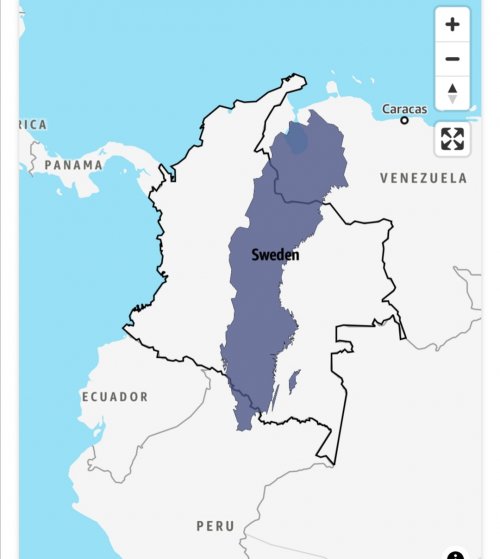
Sweden has lost one Gripen to birdstrikes in 30 years. A Gripen C ran into a flock of Cormorants sucking in 5-6.One should buy a global map before typing
View attachment 765583
Sourced from:
https://www.mylifeelsewhere.com/country-size-comparison/colombia/sweden
Also you have quite a lot of Crane and Goose in Sweden and Hungary, two countries that fly Gripen among large birds.
What Columbia would really have needed is some Mirage 2000. But some genius cut it as a way to sell more. The Gripen E is just filling the void here like in many other places.
There is some distortion in that map. Orthographic projections, with Sweden and Colombia at or near the map's centre are slightly different. Maps from wiki.One should buy a global map before typing
If you think just changing the engine would make the Gripen ITAR free, I've got a news for you.Getting out of ITAR would have been worth the development costs at SAAB, IMO.
I don't know, they were very eager to sell their engines to Koreans for use in KF-X, which is way closer to a direct competitor to Eurofighter than Gripen.Moreover, why supply an engine to a cheaper Eurofighter competitor?