ROC Navy - Taiwan - Future Guided Missile Destroyer - NCSIST

Triton

Donald McKelvy
Senior Member
Joined
14 August 2009
Messages
9,704
Reaction score
3,492
Website
deeptowild.blogspot.com
Published on Jan 25, 2017

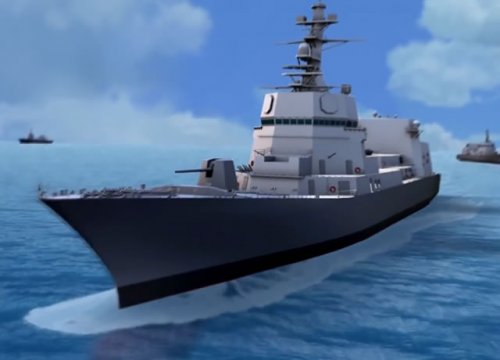
Republic of China (Taiwan) Navy (ROC Navy) future Guided Missile Destroyer (DDG). Video by NCSIST.
Taiwan's National Chung-Shan Institute of Science and Technology (NCSIST) released an animation video showing the future guided-missile destroyer project for the Republic of China (Taiwan) Navy (ROC Navy) in combat. Renderings of this new project surfaced in June last year (as we reported). This new destroyer project is in line with Taiwan's new naval acquisition plan which was unveiled in late 2015. The new plan called for four new destroyers (among other vessels).

https://youtu.be/UQnbj7UsYVo
 
What are the anti-air and anti-ship missiles?
 
A DDGN? I don't see any funnels!
 
Petrus said:
What are the anti-air and anti-ship missiles?

http://www.navyrecognition.com/index.php/news/defence-news/2017/january-2017-navy-naval-forces-defense-industry-technology-maritime-security-global-news/4839-video-roc-navy-taiwan-future-guided-missile-destroyer-revealed.html

The destroyer is fitted with a Taiwan-designed Sea Oryx RAM-like weapon system on top of the helicopter hangar (last year rendering showed a Phalanx CIWS in this location) (visible at 0:22 in the video).

For Anti-surface warfare, the future destroyer is fitted with 16x anti-ship missiles (the video shows the new Hsiung Feng III missiles at 02:36).

For air-defense, in addition to the 16x short range SAM from the Sea Oryx system, there are 4x modules of VLS consisting of 8x cells each (for a total of 32 missiles) (visible at 0:50 in the video). Early design from last year showed a different configuration: One module forward and two in the middile of the hull (located in between the anti-ship missile launchers). The surface to air missiles depicted in the video could well be the new ship-based variant of the Tien Kung III which was tested for the first time in later 2016 by NCSIST.

Finally, the destroyer appears to be fitted with a BAE Systems 5 Inch Mk 45 Mod 4 naval gun system (0:55 in the video).
 
http://www.navyrecognition.com/index.php/news/defence-news/2017/january-2017-navy-naval-forces-defense-industry-technology-maritime-security-global-news/4839-video-roc-navy-taiwan-future-guided-missile-destroyer-revealed.html
 

Attachments

  • ROC_Navy_Future_Destroyer_DDG_Taiwan_NCSIST.jpg
    ROC_Navy_Future_Destroyer_DDG_Taiwan_NCSIST.jpg
    28.7 KB · Views: 363
Pretty comprehensive history of the project

future-ffg2.jpg

future-ffg-2017-2.jpg

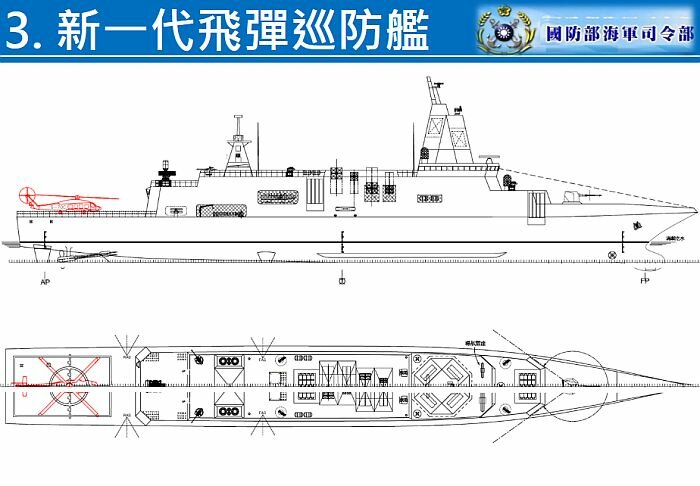
Translated:
Ship name/User country New generation missile frigate/Republic of China
Chengzhao Country/ Chengzhao Factory
Dimensions (meters) Total length 138 Vertical length 125. Overall width 16.8 Design draft 4.5m
Displacement (ton) Designed displacement 4530
Power system/shaft horsepower
Speed (knots)
25 or more

Endurance (sea mile)
4500/16 knots

Detection/Electronic Warfare System
Fixed phased array radar *4
Three-dimensional air search radar *1
Jamming rocket launcher
The rest is unknown
Sonar Bow sonar*1
Unknown active/passive towed array sonar *1
Fire Control/Combat System

Crew
189

Shipborne Weapons
MK-75 76mm 62-diameter fast gun *1
Eight-unit vertical launcher (VLS) module *3 (loaded with Sea Bow III and Sea Sword II air defense missiles)
Triple-mounted 324mm MK-32 torpedo launcher * 2 (using MK-46 torpedo)
Quadruple Hsiungfeng II/III anti-ship missile launcher * 2
MK-15 Block 1B Close-in Weapon System (CIWS) *1
Remote control machine gun *2
Carrier aircraft S-70(CM)-1 anti-submarine helicopter *1

To be honest I mostly mean to sneer at the project. Is there navies that don't demand ships that is utterly impractical for the strategic situation?
 
The Taiwanese navy was still heavily influenced by the USN at the time it has to be said, including the latter navy's frankly quite delusional 'destroyers, not cruisers/systems not platforms' dogma which was still all the rage at that point in history.
 
To be honest I mostly mean to sneer at the project. Is there navies that don't demand ships that is utterly impractical for the strategic situation?
Taiwan still is a maritime nation, entirely dependent on shipping.

Taiwanese strait or no, it needs oceangoing capability, every day.
 

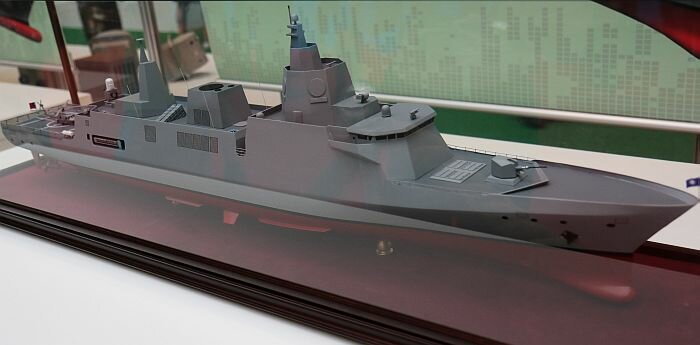
NCSIST's wishes have been fulfilled. 6000t, up from 4500t. An important stepping stone for the development of replacement ships for Kee Lung class.
That is about the size I was expecting. Not quite as big as the Constellation class, but I suspect that's due to reduced fuel and stores load.
 
It would be more reasonable to compare the size with Spanish F100, which have sort of links with their previous frigate design
 

If this comes to fruition, it will replace the 6000t class indigenous AAW frigate programme... and with that Taiwan will repeat the same mistake they have made decades ago of abandoning their own projects and indigenous designs and opting for imported designs, which landed them where they are right now. But on the flipside, they can't tolerate much risk of developing their own dedicated AAW frigate at this moment of time, even more so considering the programme history which has had fair amount of obstacles in its path, so I can't completely blame them.

Though it really comes down to if Japan actually sells the design, and is guaranteed to continue their support, of course.
 
Investing in any kind of large surface combatant, foreign or indigenous, seems like a supremely short sighted decision. More so meant to fill the pockets of the decision makers in question rather than contribute to a potential defense of the Island.
 
Investing in any kind of large surface combatant, foreign or indigenous, seems like a supremely short sighted decision. More so meant to fill the pockets of the decision makers in question rather than contribute to a potential defense of the Island.
They have no choice. They depend on sea communications very heavily. They need ocean-capable fleet to protect their trade & communication lines, otherwise they could be brought to knees by any serious disruption. As any island nation, Taiwan needed not merely coast defense, but ocean-capable navy.
 
They have no choice. They depend on sea communications very heavily. They need ocean-capable fleet to protect their trade & communication lines, otherwise they could be brought to knees by any serious disruption. As any island nation, Taiwan needed not merely coast defense, but ocean-capable navy.
What Taiwan needs are USVs and UUVs which can introduce an associated risk to PLAN vessels operating around Taiwan which would seek to blockade or cut communications. An "ocean capable" Navy that's within range of the PLAN, PLAAF, PLARF and to a degree even PLAGF while in harbor is essentially a dead Navy. A Navy that wouldn't survive a single hour of all out hostilities and would have ultimately proven to be a vanity project and waste of limited resources just to fill pockets and have bragging rights. Naval mines, USVs, UUVs, long range low cost drones and missiles, fast attack craft and corvettes, that's what the ROCN would need in order to fend off the PLA for more than a few days. And what they need to inflict damage and casualties, which is the only option they have to get the PRC to back off.

Large frigates or even destroyers that cost several hundred million are just not a worthwhile investment, because these are lost assets upon deployment. While in peace time corvettes are more than sufficient to protect territorial waters and nearby shipping.

I fairly recently touched on the topic on the relevant thread on the SinoDefenceForum, which read as follows:
The main take away for the ROC or any force faced with a larger opponent should be to focus on low cost, high volume munitions.

IADS is, for all it's merits, incredibly susceptible to being overwhelmed by large volumes of cost effective drones/munitions. These may be slow and vulnerable, but they are ultimately creating a scenario where the economical impact of interception becomes untenable for any opponent.

Meaning for the ROC priorities shouldn't be frigates, and jets and expensive batteries. But hardned launch sites, mobile launchers, concealed launchers, USVs, UUVs, Mines and minelaying capabilities, underground production facilities, less capable but cheaper indigenous ballistic and low flying cruise missiles. Essentially having all the tools in place to inflict maximum pain over as long a period as they're able to muster.

Now, that's not a gurantee for success, countries like China or Russia are not as feeble and risk averse as the US or Europe, which reel and squirm at triple digit casualties. But the potential to be a pain in the ass and inflict sufficient damage is a deterrent by itself.

For a smaller country it is nearly impossible to outright win against a super power that decides they're ripe for a beating. But it's not impossible for them to get the superior power to back off after sufficient military and economic casualties. Furthermore, which is to be considered, the ROC would most likely seek to inflict maximum damage to PRC economic interests and energy infrastructure. And as both are in close proximity to each other, it's a two way street. It's very easy for the PLA to target anything, anywhere on Taiwan. But it's also manageable for ROC forces to hit PRC targets. The ROC and PRC both have a lot to lose and the first side that has nothing left to lose has no reason holding back.

Now, after laying all of this out I'd like to point out two things: for one the obsession in Taiwan with vanity projects of questionable usefulness. They seek to emulate the ROK or Japan with regards to their military procurement, when they should focus much more on an asymmetrical approach. Large, low volume, expensive systems are ultimately easy pickings for the PLA. And one ultimately questions if the sole intentions are either bragging rights or embezzlement of funds and money laundering. The other thing I'd like to point out, and this will probably trigger some, is that Ukraine and now the Gulf States have showcased that it is not possible to hide behind even the supposedly most sophisticated air defense systems when the opponent fields a large number of disposable but still useful drones and a variety of missiles. Meaning, the PRC would be wise in such a scenario to rely on their offensive capabilities, as their defensive capabilities would ultimately be overwhelmed and taken out. Which is why the PRC and ROC would have to ideally slug it out with drones and missiles immediately in the case of a conflict. And if the ROC manages to inflict enough damage before their offensive capabilities are fully exhausted or degraded by superior PLA firepower, then they may get the PLA to back off for while again.

Now on a last note, I personally don't see either side heading towards an armed confrontation with the other in the near future. But these are the lessons the ROC should be learning from the last major conflicts involving large powers. If they don't, then they just sabotage themselves. Low cost drones and missiles are not as sexy as US imported jets, tanks or missiles, but they'd be much better at deterring an amphibious assault than any F-16, M1 or Patriot ever could be.

 
Last edited:
What Taiwan needs are USVs and UUVs which can introduce an associated risk to PLAN vessels operating around Taiwan which would seek to blockade or cut communications. An "ocean capable" Navy that's within range of the PLAN, PLAAF, PLARF and to a degree even PLAGF while in harbor is essentially a dead Navy. A Navy that wouldn't survive a single hour of all out hostilities and would have ultimately proven to be a vanity project and waste of limited resolution just to fill pockets and have bragging rights. Naval mines, USVs, UUVs, long range low cost drones and missiles, fast attack craft and corvettes, that's what the ROCN would need in order to fend off the PLA for more than a few days. And what they need to inflict damage and casualties, which is the only option they have to get the PRC to back off.

Large frigates or even destroyers that cost several hundred million are just not a worthwhile investment, because these are lost assets upon deployment. While in peace time corvettes are more than sufficient to protect territorial waters and nearby shipping.
PLAN is not required to establish blockade of the island. In a "hot" conflict trying to protect Taiwan's shipping is a folly to begin with, provided sufficient political will is present among Chinese leadership. What is important for them is creating the same threat to mainland China. Which, granted, can be done asymmetrically with USV and UUV vessels, but only within immediate vicinity of Taiwan itself.
For anything else, like commerce raiding on international shipping routes, they will require blue water navy.
 
Last edited:
Do the Taiwanese actually think they can out build the freaking PLAN. Just look at the rate of induction for large panel AESA alone.

I could also see this project getting killed of in the next years with how the Taiwanese government is warming up to China, but that's my surface level of observation.
 
Do the Taiwanese actually think they can out build the freaking PLAN. Just look at the rate of induction for large panel AESA alone.

I could also see this project getting killed of in the next years with how the Taiwanese government is warming up to China, but that's my surface level of observation.
It's not a question of building the PLAN, it's providing additional forces to assist in US/Japan/other allies efforts in the war and or buying time. There is no scenario in which Taiwan has a chance of going at it alone vs China.

What Taiwan needs are USVs and UUVs which can introduce an associated risk to PLAN vessels operating around Taiwan which would seek to blockade or cut communications. An "ocean capable" Navy that's within range of the PLAN, PLAAF, PLARF and to a degree even PLAGF while in harbor is essentially a dead Navy. A Navy that wouldn't survive a single hour of all out hostilities and would have ultimately proven to be a vanity project and waste of limited resources just to fill pockets and have bragging rights. Naval mines, USVs, UUVs, long range low cost drones and missiles, fast attack craft and corvettes, that's what the ROCN would need in order to fend off the PLA for more than a few days. And what they need to inflict damage and casualties, which is the only option they have to get the PRC to back off.

Large frigates or even destroyers that cost several hundred million are just not a worthwhile investment, because these are lost assets upon deployment. While in peace time corvettes are more than sufficient to protect territorial waters and nearby shipping.

I fairly recently touched on the topic on the relevant thread on the SinoDefenceForum, which read as follows:
Taiwan already has numerous relocatable shore batteries and corvettes with large numbers of ASM which covers the USV role.
 

Similar threads

Back
Top Bottom