- Joined
- 22 January 2006
- Messages
- 4,434
- Reaction score
- 2,796
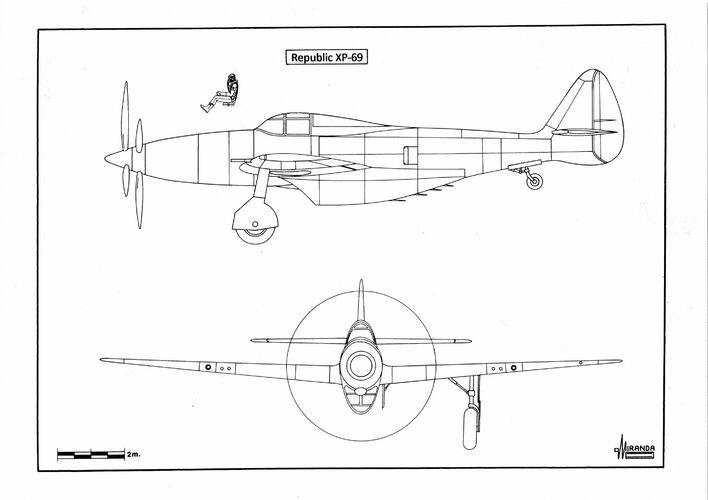
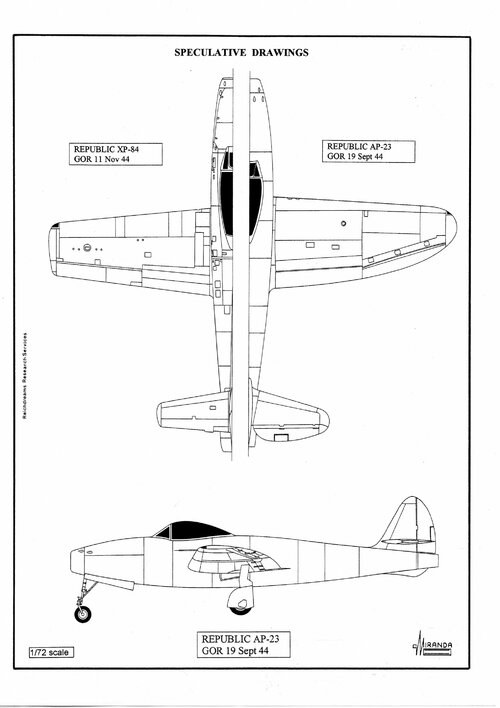
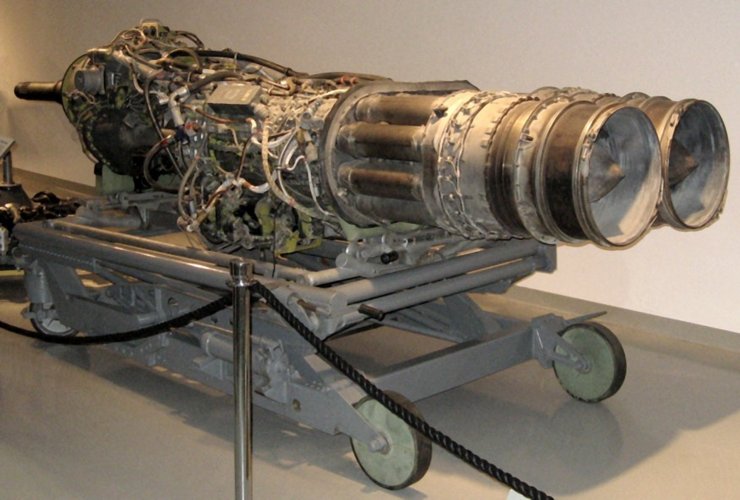
Looking at this drawing...where the jet exhaust was supposed to be placed?From Le Fana Horse 16.

Looking at this drawing...where the jet exhaust was supposed to be placed?From Le Fana Horse 16.
HiLooking at this drawing...where the jet exhaust was supposed to be placed?From Le Fana Horse 16.

The “floating wingtip” idea from which Project Tip-Tow evolved had originally been developed by Richard Vogt, a German aeronautical engineer known for unusual, off-the-wall concepts. Vogt’s idea was a way of having one’s aerodynamic cake and eating it too: By extending the overall aspect ratio of an airplane’s wing, floating wing panels would add lift and improve aerodynamic efficiency, and could carry extra fuel. Yet because they wouldn’t be firmly attached to the aircraft structure and would support themselves by aerodynamic lift, the panels wouldn’t increase wing loading. Theoretically, Vogt’s concept could be extended beyond floating wing panels to encompass entire aircraft serving as “wing extensions.”


@hesham : noticed you reaction with a dissatisfied smiley. Is there something wrong?

I think that's not the meaning of setnese,floating wingtip.
In the summer of 1950, the next set of wingtip coupling experiments were ready to be flight tested, known as Project MX 1018 or Tip Tow. The Republic Aviation Corporation of Long Island, NY had modified a B-29A bomber and two straight-wing F-84D fighter jets. The outer wing panels of the B-29 were replaced with a towing or retrieving mechanism, similar to the C-47/Q-14 mechanism in that it had a lance device and an extended capture piece associated with it. It consisted of a hydraulically actuated cylinder or retractable boom that would extend out from the wing of the B-29, the F-84 then flew forward with a lance to hook up to the receiver at the end of the boom. The connection would lock (though motion
in pitch, roll, and yaw was viable) and then pull the F-84 in to be locked at an aft position, that had been rubber sealed. At that point, the F-84 was only capable of roll about the longitudinal axis for the wingtip connection. The capability to roll about this longitudinal axis is the aforementioned flapping motion. It was hoped that a simple method relating the lance rotation or flap angle to elevator movement could provide automated flight control.
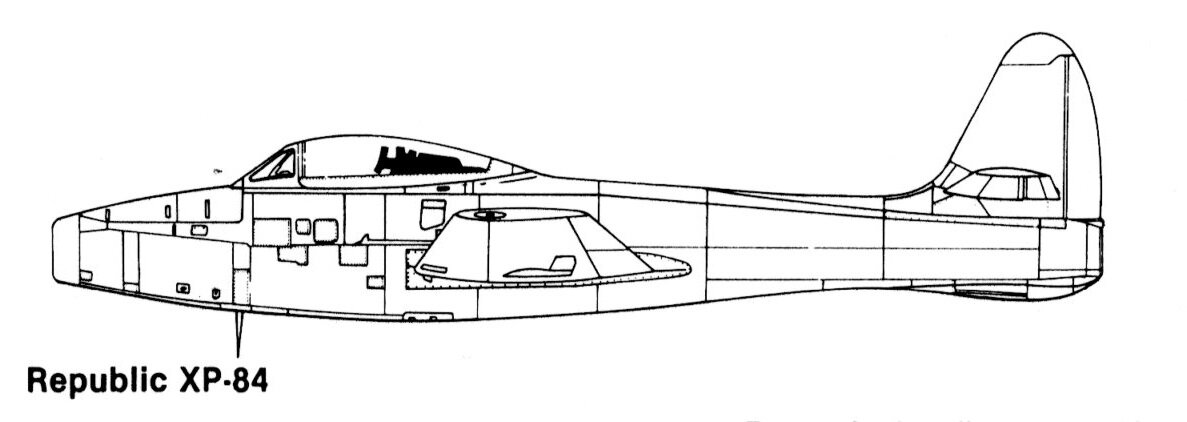
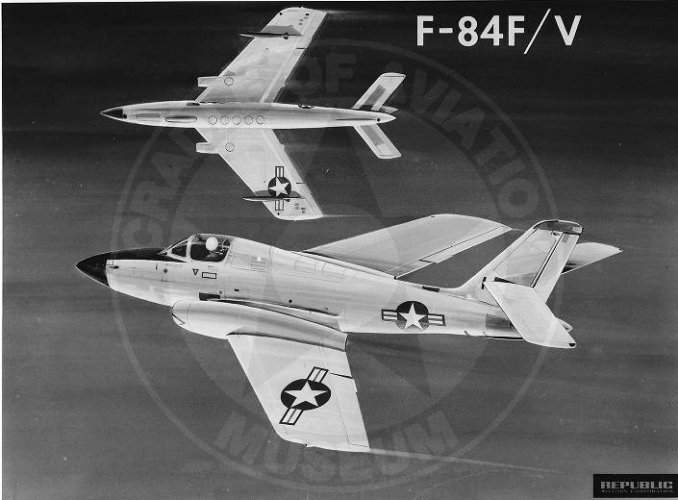
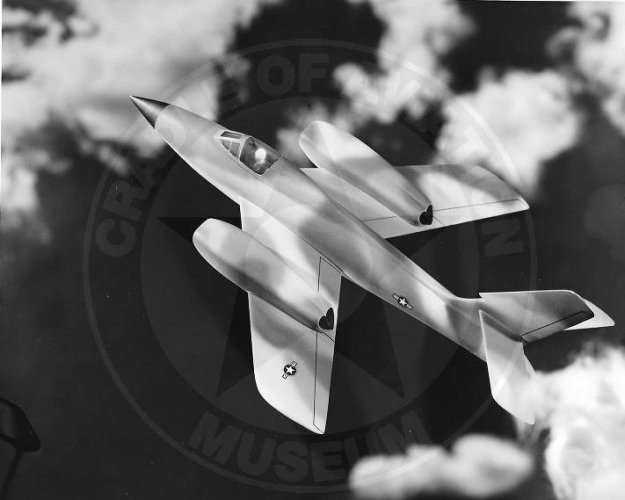
Three F-84 concept pictures, which I found at the Cradle of Aviation Museum web archive.
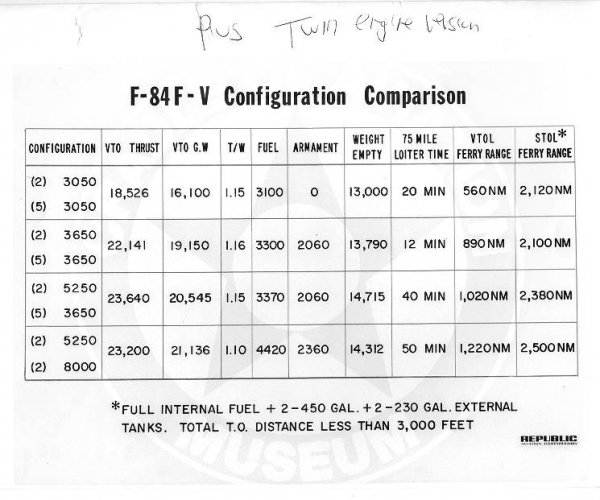
https://cdm16694.contentdm.oclc.org/digital/collection/p16694coll109/id/16452https://cdm16694.contentdm.oclc.org/digital/collection/p16694coll109/id/16419https://cdm16694.contentdm.oclc.org/digital/collection/p16694coll109/id/16408F-84F-V config comparison:
https://cdm16694.contentdm.oclc.org/digital/collection/p16694coll109/id/16363Source:
https://cdm16694.contentdm.oclc.org/digital/collection/p16694coll109/search/searchterm/F-84/If this is the false topic or these pictures have been posted before, please let me know.
Well I suspect they are linked to the Beech twin tests I mentioned; those were floating wingtips as distinct from Tom-Tom. Though related I see them with different aims: Tom-Tom was more to do with the benefits of carrying escort fighters in this way whereas I'd expect a "floating wingtip" to be more for load alleviation and range extension. I may be mis-remembering things but I'm sure that carriage of fuel in (jettisonable?) floating wingtips was proposed too...

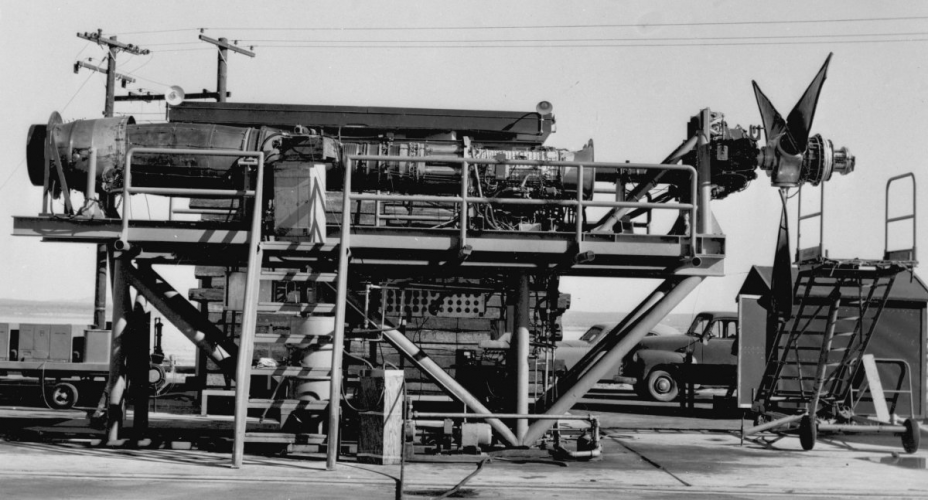

*Facepalm*The afterburning turboprops traded shaft horsepower for thrust; ultimately not worth pursuing...
View attachment 796319
Afaik, there was no variable afterburner exhaust nozzle, so the additional afterburner back pressurre on the turbine caused a drop in shaft horsepower.
The first test pilot even told the engineers "There's not enough of you and you're not big enough to put me back into that plane"Hi! XF-84H flight test movie.
F-0281 XF-84, F-105 Flight at Edwards Air
The Republic XF-84H Thunderscreech is considered the loudest aircraft ever built.Its propeller blades rotated faster than the speed of sound, even at idle. They were so loud that the noise could be heard from up to 25 miles away.The constant sonic booms would make ground crews sick, and one crew member even had a seizure.The Thunderscreech first flew in July 1955. The program was canceled after just seven flying hours.
We got so many planes canceled because of the T40...
*Facepalm*
The first test pilot even told the engineers "There's not enough of you and you're not big enough to put me back into that plane"
You'd have to get really creative to make the shockwaves quiet enough to not concuss your pilot into early-onset dementia.
I was fortunate to see a tape with audio of the Thunderscreech many, many years ago. Its effect on the ears and well being was not understated. The airframe should have been declared illegal after the first run-up due to it being a significant health hazard!!! If they had them during Vietnam, a 4 ship low pass over the jungle would have caused the Cong running out of the jungle with white flags!I am sure it was a really loud aircraft but I would not be surprised if all these stories are a little bit exaggerated. There are other propeller aircrafts where the propeller tips go supersonic under certain conditions. The XF-88 was also tested with a supersonic propeller and there are no comparable dramatic stories about it.
The Thunderscreech's idea was to make the entire blade supersonic, from root to tip.I am sure it was a really loud aircraft but I would not be surprised if all these stories are a little bit exaggerated. There are other propeller aircrafts where the propeller tips go supersonic under certain conditions. The XF-88 was also tested with a supersonic propeller and there are no comparable dramatic stories about it.

The Thunderscreech's idea was to make the entire blade supersonic, from root to tip.

Curiously, I can't recall many accounts of the XF-88 prop testbed that don't mention the horrendous noise.I am sure it was a really loud aircraft but I would not be surprised if all these stories are a little bit exaggerated. There are other propeller aircrafts where the propeller tips go supersonic under certain conditions. The XF-88 was also tested with a supersonic propeller and there are no comparable dramatic stories about it.
Am I the only one who views YouTube videos as trash?The videos are too much here,and about the same aircraft ?!.

Not all but, most with commentary seem to demonstrate the worst forms of, "Someone told me this so you have to believe me". Definitely no standard for standards at all.Am I the only one who views YouTube videos as trash?
Am I the only one who views YouTube videos as trash?