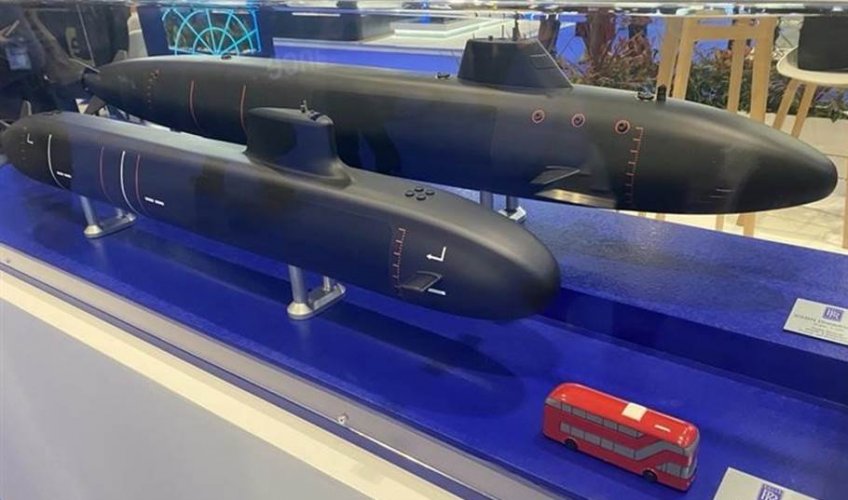
Clearer pic of the model:
View attachment 793507

1000007669.jpg

Model representation of Dreadnought-class SSBN (background) and SSN AUKUS (foreground) compared with the size of a double decker bus (right). Credit: John Hill.

Just more models but a little surprised by the squarish cross-section of the SSN-AUKUS model.
 
View attachment 810171

Model representation of Dreadnought-class SSBN (background) and SSN AUKUS (foreground) compared with the size of a double decker bus (right). Credit: John Hill.

Just more models but a little surprised by the squarish cross-section of the SSN-AUKUS model.
Very Astute in style, but I'm unsure as to the validity of that model. The renders are more round.
 
As I understand it, the AIP install is barely enough for the hotel load and ~6-10kts. So you're not going to get much recharging out of the AIP without more or less drifting.
Ah huh. There are those who know, and those who don't, and those who do know aren't allowed to talk about it. ;)
 
I expect the Collins LIFEX will be cancelled after the first 3 boats when they realize how expensive and time consuming these upgrades are for just a few more years of operational life.

For what it's worth, AU$11 billion could buy 5 Blacksword Barracuda (Orka) SSKs based on the Dutch contract. Double crewed and with far more sea days than 3 operational Collins. Or likely a larger number of Japanese or Korean subs. But now it's too late - an interim SSK purchase would have had to be decided 3-4 years ago. Unless Japan has a few used SSKs to spare...
 
I read an article the other day talking about using heat-pipe reactors, effectively micro-reactors, to allow continuous battery charging and allowing for full nuclear performance in bursts.
Yes that article took information from a discussion on this forum. They even used some of my data.

We were talking about the eVinci 5 MW micro reactor that uses the heat pipes. It would be a direct fit for the larger conventional subs. It would fit where the diesel generators or AIP system is located in a conventional sub. It would connect up to the same electrical connection and all the same batteries would be used. A direct swap.

5 MW would be heaps for these 4,000ton conventional subs. It would allow for 20+ knot cruise.

Now add 15,000nm/70 day range, carriage for 30 torpedoes etc, and you’re getting much closer to SSN performance than in the past… at 10-20% of the cost.
That 15,000nm range will be at a snails pace. Probably 6 knots or so. And that's a problem. It takes more than 100 days to travel 15,000nm at such a slow speed. No where near the performance of a SSN. A 5 MW microreactor on the other hand.

The only reason nuclear reactors never worked on small vessels is because they didn't scale down. Historically a 10MW reactor would be 30% of the size and 50% of the cost of a 100MW reactor. In a smaller ship the reactor then takes up a larger percentage of the volume and puts the cost up close to that of the full size ship.

The microreactors finally scale down perfectly. 10% the power, 10% of the size and 10% of the cost.
 
But now it's too late - an interim SSK purchase would have had to be decided 3-4 years ago. Unless Japan has a few used SSKs to spare...
This Australian submarine fiasco has to be one of the biggest procurement disasters in history. It stems from Australia requirement for local manufacturing. They have now relaxed this requirement on newer purchases. Japan said this would be a big issue with the initial contract and is one of the reasons France won the deal.

If only Japan proposed a Mogami frigate style deal just to get their foot in the door. First 2 subs built in Japan, the rest built in Australia. Australia would already have their first new sub in service. Any delay on the Australian side would have been covered by the 3rd and 4th subs being built in Japan.

The perfect Australian sub fleet would look like
8 Taigei-class submarines
2 Virginia-class submarines

The conventional subs patrol close to Australia while the two nuke subs do long distant missions.
 
This Australian submarine fiasco has to be one of the biggest procurement disasters in history. It stems from Australia requirement for local manufacturing. They have now relaxed this requirement on newer purchases. Japan said this would be a big issue with the initial contract and is one of the reasons France won the deal.

The biggest of a long list of one procurement disaster after another going back to the 60's

Regards,
 
I expect the Collins LIFEX will be cancelled after the first 3 boats when they realize how expensive and time consuming these upgrades are for just a few more years of operational life.

For what it's worth, AU$11 billion could buy 5 Blacksword Barracuda (Orka) SSKs based on the Dutch contract. Double crewed and with far more sea days than 3 operational Collins. Or likely a larger number of Japanese or Korean subs. But now it's too late - an interim SSK purchase would have had to be decided 3-4 years ago. Unless Japan has a few used SSKs to spare...
The ships Japan would have available to buy would be the Oyashio-class boats built in the late 1990s-early 2000s. They're pretty small, only 2750 tons surfaced, 3500tons submerged.
 
This Australian submarine fiasco has to be one of the biggest procurement disasters in history. It stems from Australia requirement for local manufacturing. They have now relaxed this requirement on newer purchases. Japan said this would be a big issue with the initial contract and is one of the reasons France won the deal.
This seems to be the wrong framing the cause wasn't the requirement for local manufacturing it was a complete lack of foresight by successive governments to commit to a continuous shipbuilding program.

If the Howard government had just continued the Colins production lines in the 2000s like the Japanese we wouldn't be in this situation. We spent a fortune under the Hawke/Keating governments setting up the ASC and a skilled local workforce to build the Collins-class, only to let it waste away.

It took six years and a change of government between the contruction of the last Colins and the 2009 Rudd white paper saying we need new subs and thankfully also an increase from six to twelve. But the GFC slowed things down, Rudd got knifed, and the Gillard government slashed defence spending chasing a budget surplus.

When the Liberals got back in with Abbott, he specifically excluded the ASC from the next submarine contract. Not to mention at the time, the original Swedish designers of the Collins Saab Kockums were actually owned by their German rival ThyssenKrupp, which is why they were boxed out and the deal basically ended up as a race between the Japanese, Germans, and French.

By this point it's been like ten years since the last Colins so perhaps Abbott's handshake deal with Abe for Japanese Soryu-class subs would have been the only option left. But that 'Captain's call' led to Abbott getting knifed by Turnbull, who then initiated the tender process that the French won.

So while I agree that moving straight to a Soryu/Taigei-class was probably the easiest choice of recent history, the need for all this nonsense could have been avoided completely if we had just committed to a "Son of Collins" evolution earlier. The whole point of spending the money to set up local production is completely lost if you just let it rot away.
 
Is AUKUS a bad deal for Australia?

"It's a submarine deal with no submarines"... quite the punchline! Key quotes from Trumbull at bottom.

Another way to look at this is that between now and 2039 the USN will be retiring every single Los Angeles SSN, the 3 Seawolf SSNs and the 4 Ohio SSGNs. That's 26 subs retired. A critical part of the plan is that they hope to successfully life extend half a dozen Los Angeles SSNs to serve 42-44 years. Otherwise all those SSNs are retiring by ~2035. And there is no slack left for further life extensions - they're already maxed out.

To offset these retirements the plan is to build 27 Virginia SSNs by 2039, at a rate of 2x per year. Problem #1 is they haven't proven that they can build that many subs concurrently, especially while prioritizing the Columbia SSGNs. Problem #2 is that on top of accelerating the build rate to 2x, they also need to accelerate each sub's construction timeline by 20-30%, all while building bigger, more complex subs with Virginia Payload Modules. That's not likely to happen... they'll be lucky to deliver 20 Virginias by 2039.

Now add the fact that the USN SSN force level is already at a historically low ebb of 47-48 SSNs, versus a requirement of 66 SSNs. There's no room to fall any lower.

So where's the extra capacity to transfer 3 SSNs to Australia in 2032, 2035 and 2038?

I'm worried we won't get any submarines. It's a submarine deal with no submarines.

AUKUS pillar one, what do the Americans get? They get 3 billion US dollars from Australia to support their shipbuilding programs. They get a naval base, submarine base, and a dockyard in Perth of enormous value to their navy. And their plan is to rotate some attack submarines, Virginia class submarines from Perth. Australia is meant to get three and possibly five Virginia class submarines, several second-hand ones with at least 20 years life left and the balance being new from the US.

But the US is not producing enough Virginia class submarines for their own needs. And what I'm saying now is absolute fact. You can read all about it in the Senate Armed Services Committee. They're producing about 1.2 a year. They need to be producing two. Their goal has been to get up to two for quite some years, but they have not been able to lift the production rate up be above 1.2. Congress when it authorized the AUKUS arrangement legislated that no boats can be sold to Australia unless the president certifies that the sale will not degrade the undersea capabilities of the United States. Admiral Caldwell, the Chief Naval Operations repeated the other day in testimony that the Americans have to get to 2.33 boats being delivered a year for them to be able to meet Australia's needs. They are literally producing half as many.

So, you know, you go back five or six years, they were proposing a sort of gradual increase like that. Now, because it's just bumped along the bottom and they've now got the SSBNs to build, to get to 2.33 you're talking about a vertical takeoff, which of course isn't going to happen. So, I don't think we'll get any Virginias. I don't think we can complain because the Americans will say we've been completely upfront with you. We told you about this. You knew the risks. You took it on. It was a terribly bad deal. Really stupid deal.

So, people used to say, "Oh, will Donald Trump like it?" Trump will look at it and say, "Wow, how did that guy Biden do a deal as good as this? These Australians are amazing. A there any more deals I can do with them? They've got so much money and so so little sense."

 
The Deputy Prime Minister and Secretaries welcomed the proposed approach to streamline Australia’s acquisition of Virginia-class submarines (VCS), simplifying supply chain management, operational and maintenance requirements, and maximising cost efficiencies. This approach would enable Australia to acquire three in-service VCS in lieu of a mixture of new and in-service VCS variants.
Probably won't be getting those nice new block VIIs after all.

https://www.minister.defence.gov.au...int-statement-aukus-defence-ministers-meeting
 
Latest GAO report, p. 167: Virginia production is not meeting its recovery plan, despite additional investments. Still stuck at 1 SSN per year, half the Navy target. Production timelines continue to lengthen... heading in the wrong direction?

https://www.gao.gov/assets/gao-26-108457.pdf
The VCS construction rate has generally stabilized, with shipbuilders working at a one-per-year pace as of June 2025—half the rate of the Navy’s two per year goal.

(...) The projected delivery dates for the first 10 Block V submarines [note: 2028-2033] continue to worsen, slipping by an average of almost 3 years since original contract award [note: +5 month additional delay in last 12 months according to SCN budget materials]. Late material deliveries from suppliers and limited availability of experienced workers due to competition in the labor market drive these trends. The Navy plans to improve performance by investing billions of dollars in the supply chain and shipbuilder wages, among other mitigation efforts.

In April 2025, the Navy issued a modification to the Block V contract to add two submarines. The Navy used cost-reimbursement terms for these two submarines, placing additional cost risk on the government compared to fixed price terms. The Navy expects these two submarines will take longer to build than the four preceding Block V submarines [note: these 2 subs scheduled for 2034 delivery are taking ~5% longer to build according to SCN budget materials].

Recovery plans are not progressing as intended.
The program developed a report to track its progress towards building submarines at a rate of two per year. However, the report’s construction progress metrics indicate the program is already underperforming its recovery plans.
 
Last edited:
Latest GAO report, p. 167: Virginia production is not meeting its recovery plan, despite additional investments. Still stuck at 1 SSN per year, half the Navy target. Production timelines continue to lengthen... heading in the wrong direction?

https://www.gao.gov/assets/gao-26-108457.pdf
Submarine production is also the LAGGING indicator that the problem is fixed.
 
Submarine production is also the LAGGING indicator that the problem is fixed.
No the problem is that construction schedules and delivery dates are still trending in the wrong direction, with continued delays and no acceleration in sight. If the problem was being fixed they would be holding firm on the contracted schedules or even accelerating build times.
 
This article by a well informed critic of AUKUS (Adm Peter Briggs) shows in detail how difficult it will be to maintain old US SSNs in service, requiring the local production of literally thousands of spare parts.

https://johnmenadue.com/post/2026/06/second-hand-submarines-a-sovereign-flaw/
Yes, but we need the infrastructure and workforce that will provide to support the AUKUS boats.

If we had maintained adequate infrastructure and workforce to sustain the existing fleet, we would not be in the situation we are currently in.
 
Yes, but we need the infrastructure and workforce that will provide to support the AUKUS boats.

Sure, if the AUKUS boats arrive.

As many have pointed out now, build rates and certification requirements make the delivery of any Virginia-class boats increasingly unlikely.

Briggs has a point too that, if the stars align and they do arrive, they're far more likely to be Block IIIs than Block IVs. The lagging build rates mean they'll only be about halfway through the (slower to build) Block Vs by 2035 and short of their planned fleet strength, so the Block IVs will still represent the bulk of their fleet's cutting edge boats.

If we had maintained adequate infrastructure and workforce to sustain the existing fleet, we would not be in the situation we are currently in.

If we'd simply gone ahead with the Attack class, we wouldn't be in the situation we are currently in. We already had the workforce and the necessary infrastructure. There wouldn't have been a need (iirc) for the Collins LOTE either!

And of course, if we'd determined that nuclear power was an absolute must have (and I agree there are some strong arguments for this) there was a far simpler, better sized for Australia's needs solution for that too, available at a fraction of the price.

Sorry for the rant but I've quite lost patience with the debate. I honestly can't see how any Australian in their right mind can be supportive of the AUKUS deal given what we know.
 
If we'd simply gone ahead with the Attack class, we wouldn't be in the situation we are currently in. We already had the workforce and the necessary infrastructure. There wouldn't have been a need (iirc) for the Collins LOTE either!

And of course, if we'd determined that nuclear power was an absolute must have (and I agree there are some strong arguments for this) there was a far simpler, better sized for Australia's needs solution for that too, available at a fraction of the price.

Sorry for the rant but I've quite lost patience with the debate. I honestly can't see how any Australian in their right mind can be supportive of the AUKUS deal given what we know.
SSN is a must, it's sure. But the cost have been so under evaluate... as the industrial capacity available. Add that Australia is a noob in nuc industry, so all to be built or nearly.
A nice solution would have been to reduce the Attack deal, for just 6 units, and then discuss with USA, GB, France? about a SSN solution.
Now you have the pants on the knees....
 
The bigger hurdle was the political angle, Australians are deeply distrustful (rightly or wrongly) of nuclear power.

In terms of required nuclear industry though I'd argue that the requirements are actually quite modest. LEU can be purchased from and spent fuel reprocessed by a number of players in the international market, certainly by France.

Australia's initial requirement may be limited simply to a facility that would allow for the storage of new and spent fuel elements as well as the configuring and testing of new reactor cores and the disassembly of spent ones.

This, along with the transport internationally of nuclear materials, is already largely within the abilities of Australia's current civilian nuclear authority ANSTO.

Australia could have an almost completely sovereign nuclear propulsion capability and the ability to build its own SSNs. And, should it choose, a nascent nuclear power industry.
 
The bigger hurdle was the political angle, Australians are deeply distrustful (rightly or wrongly) of nuclear power.

In terms of required nuclear industry though I'd argue that the requirements are actually quite modest. LEU can be purchased from and spent fuel reprocessed by a number of players in the international market, certainly by France.

Australia's initial requirement may be limited simply to a facility that would allow for the storage of new and spent fuel elements as well as the configuring and testing of new reactor cores and the disassembly of spent ones.

This, along with the transport internationally of nuclear materials, is already largely within the abilities of Australia's current civilian nuclear authority ANSTO.

Australia could have an almost completely sovereign nuclear propulsion capability and the ability to build its own SSNs. And, should it choose, a nascent nuclear power industry.
The main enrichers are URENCO and the Russians, so the options there are somewhat limited. It doesn't seem strategically wise to be reliant on Russian uranium for your SSN.

I think that Australia developing a nuclear industry wouldn't be insane, given that like 1/3 of Uranium reserves are Australian, but it seems somewhat absurd to argue that building out this industry would be less expensive than AUKUS. And if nothing else there's no real reason that AUKUS precludes the much more expensive project of building a civilian nuclear industry. Hell, Aus could probably make money as a LEU/HEU exporter given how much of a mess enrichment re-scaling has been in Europe and the US after we shut down capacity post-cold war.

That said, it seems like it would be more sensible to just license the Rolls Royce SMR or one of the French or South Korean power plant reactor designs, versus trying to reinvent the wheel.

Speaking of the French, there is some question of the speed and bandwidth of French designed SSN production/technology transfer, given that the Brazilian program started in 2008 and isn't expected to deliver until 2037.

IDK I know it's fashionable in AUS to shit on AUKUS, but it doesn't seem like there's a realistic way to get more capability sooner for less money.
 
Speaking of the French, there is some question of the speed and bandwidth of French designed SSN production/technology transfer, given that the Brazilian program started in 2008 and isn't expected to deliver until 2037.

IDK I know it's fashionable in AUS to shit on AUKUS, but it doesn't seem like there's a realistic way to get more capability sooner for less money.
The Brazilian SSN is a homegrown development, so not really surprising that it's taking ages. The French tech transfer was not related to the nuclear propulsion.

The better metric is the conventional Scorpenes which were delivered with tech transfer in about 12 years. A country like Australia with a more mature shipbuilding industry should be able to go faster... for example, Indonesia's PT Pal is expecting to deliver its Scorpenes in 6-7 years. Also on an SSN the nuke propulsion modules would likely be built abroad, as will be the case for Aukus SSN.

No question in my mind that as late as 2020/21 Australia could have contracted for Barracuda SSN deliveries starting in ~2030 if timing had been important, and for a fraction of the cost of the Aukus program. e.g. 1st hull built in France (2030), with significant Aus content on hull 2 (~2032), and hull 3 fully built in Aus (~2035) except for the reactor module.
 
The Brazilian SSN is a homegrown development, so not really surprising that it's taking ages. The French tech transfer was not related to the nuclear propulsion.

The better metric is the conventional Scorpenes which were delivered with tech transfer in about 12 years. A country like Australia with a more mature shipbuilding industry should be able to go faster... for example, Indonesia's PT Pal is expecting to deliver its Scorpenes in 6-7 years. Also on an SSN the nuke propulsion modules would likely be built abroad, as will be the case for Aukus SSN.

No question in my mind that as late as 2020/21 Australia could have contracted for Barracuda SSN deliveries starting in ~2030 if timing had been important, and for a fraction of the cost of the Aukus program. e.g. 1st hull built in France (2030), with significant Aus content on hull 2 (~2032), and hull 3 fully built in Aus (~2035) except for the reactor module.
Australia has no submarine building industry and building subs is pretty different than building surface ships. It just seems like 'grass is always greener'-ism? Suffren-class are running what, the equivalent of 3.5 billion AUD per boat without counting the money on the new facility at Osborne, training up the workers, etc which is budgeted at what, 30 billion for the work SSNA requires? I don't know, it just seems like there's no realistic comparison. Very much like the Canadian Gripen saga, much is being promised with little in the way of serious cost benefit evaluation.
 
Suffren-class are running what, the equivalent of 3.5 billion AUD per boat
Suffren unit cost is €1.6B ($1.8B USD) vs. $3.3B USD for the last Block IV Virginias... a little over half the cost. That's as apples to apples as I can make it (production unit cost excluding R&D, similar production batches and inflation adjusted in constant 2025 currency). Overall not a bad deal.

Building in Australia adds cost obviously... that's true across all programs from Hobart to Hunter and Attack to Aukus SSN. If cost benefit was a serious driver perhaps Australia might have opted for the pragmatic Dutch approach... foreign build with some local sourcing (where it makes sense) and 100% local maintenance.
 
Suffren unit cost is €1.6B ($1.8B USD) vs. $3.3B USD for the last Block IV Virginias... a little over half the cost. That's as apples to apples as I can make it (production unit cost excluding R&D, similar production batches and inflation adjusted in constant 2025 currency). Overall not a bad deal.

Building in Australia adds cost obviously... that's true across all programs from Hobart to Hunter and Attack to Aukus SSN. If cost benefit was a serious driver perhaps Australia might have opted for the pragmatic Dutch approach... foreign build with some local sourcing (where it makes sense) and 100% local maintenance.
The problem is that you're stuck with a significantly lower capability SSN with roughly similar capital investment into facilities, training, shipyards, workforce etc etc etc vs SSNA. My guess is that if you broke down the $325 billion headline number into development vs procurement vs capital investment vs sustainment vs operations, you're looking at upwards of 75% of that (maybe even over 90%) being the same whether you go with a home grown design, a French design built in AUS, or the mix of US built and AUS built subs that they chose. The actual procurement cost of the three VAs and 5 SSNA is likely well under 50 billion dollars, and probably around 35 (depending on SSNA costs). So even if equal numbers of Suffren would be around 20 billion dollars vs 35, you're losing a LOT of capability and interoperability with the USN and RN and direct access to their technical base and production chains in exchange for saving 4.5%.

I'm not Australian, so I can't say if it's a good deal to lose more than 1/5th of endurance (70 days of stores vs 90), 20% of torpedo tube stores (20 vs 25), the VPTs (12 TLAM or whatever else you can imagine and pay for integrating), access to US and UK UUV integration, having to train on a new weapons suite and combat system (SYCOBS vs BYG-1 / F21 vs Mk.48), in exchange for 4.5% savings over the lifetime of the program? And that's without looking at the lifetime operating costs of Suffren vs VA Block IV / SSNA, which may be a point in favor of VA Block IV (it was one of the main targets for upgrade vs Block III)
 
I can't say if it's a good deal to lose more than 1/5th of endurance (70 days of stores vs 90), 20% of torpedo tube stores (20 vs 25), the VPTs (12 TLAM or whatever else you can imagine and pay for integrating), access to US and UK UUV integration, having to train on a new weapons suite and combat system (SYCOBS vs BYG-1 / F21 vs Mk.48), in exchange for 4.5% savings over the lifetime of the program? And that's without looking at the lifetime operating costs of Suffren vs VA Block IV / SSNA
That's what a proper Analysis of Alternatives would evaluate.

One scenario might be a short high intensity conflict against Chinese naval assets. The measure of effectiveness might favor having a sub in the right place at the right time, so the high availability and extra 30% sea time of a double crewed Barracuda might be attractive. 70 vs 90 day endurance would factor less than magazine depth (24 vs 25 tube launched weapons, basically identical).

Another scenario would be land attack after a long patrol, where the Virginia's 12 Tomahawks and 90 day endurance would favor it over the small number of tube-launched cruise missiles on a Barracuda (likely no more than 3-6) and 70 days endurance. Another scenario would be special missions with a dry deck shelter... that might be a draw, though extra sea time might again be valuable.

The AoA would also evaluate acquisition and maintenance costs. Acquisition costs would favor Barracuda. Maintenance would be hard to evaluate, though it's very unlikely that a Suffren costs more to operate given the Marine Nationale's limited budget and optimized maintenance cycles (only 10 weeks/year for annual maintenance, 18 month docking every 10 years). For what it's worth, a Rubis docking & refueling required 1 million man hours, less than half a Virginia docking (2.2 million hours for SSN 780's first EDSRA).

Personally I doubt that infrastructure costs would dominate all the other costs. Likely the long term cost of dismantling and storing HEU fuel would somewhat favor LEU fueled subs.

Finally, an AoA would assess risk. Based on Astute's dismal availability, USN shipbuilding woes, and the delayed delivery timeline which creates a potential capability gap that the Collins LIFEX may not bridge, that's perhaps the biggest problem with the Aukus strategy... it just isn't very credible.
 
The bigger hurdle was the political angle, Australians are deeply distrustful (rightly or wrongly) of nuclear power.

In terms of required nuclear industry though I'd argue that the requirements are actually quite modest. LEU can be purchased from and spent fuel reprocessed by a number of players in the international market, certainly by France.

Australia's initial requirement may be limited simply to a facility that would allow for the storage of new and spent fuel elements as well as the configuring and testing of new reactor cores and the disassembly of spent ones.

This, along with the transport internationally of nuclear materials, is already largely within the abilities of Australia's current civilian nuclear authority ANSTO.

Australia could have an almost completely sovereign nuclear propulsion capability and the ability to build its own SSNs. And, should it choose, a nascent nuclear power industry.
There is apparently a good amount of non-obvious details in US reactor design. Some of them can be found quickly, they were identified in the late 1950s (and are why the US flipped on the idea of selling Skipjacks). Others get into the design of life-of-ship reactors and how to burn up your neutron poisons while carrying a very high load of fissionables.


I think that Australia developing a nuclear industry wouldn't be insane, given that like 1/3 of Uranium reserves are Australian, but it seems somewhat absurd to argue that building out this industry would be less expensive than AUKUS. And if nothing else there's no real reason that AUKUS precludes the much more expensive project of building a civilian nuclear industry. Hell, Aus could probably make money as a LEU/HEU exporter given how much of a mess enrichment re-scaling has been in Europe and the US after we shut down capacity post-cold war.
1) most naval nuclear propulsion requires HEU. Weapons grade HEU, 95+% U235. Good luck getting approval to enrich that high in Oz. Also, once you are enriching that high, you know someone is going to seriously look at making nuclear weapons.

2) Even the French reactors require enrichment to about 20%, and also force a refueling refit every 8-10 years. Yes, the French subs have an easy access designed in so you're not doing hull cuts, but you're still talking about a ship out of service for a full deployment cycle every decade.
 
Astute woes have many components, but prime amongst them is infrastructure and personnel.
While the UK has a good number of drydocks, most be in poor condition and only a few rated for nuclear submarines.
Essentially under resourced and under invested infrastructure going back decades.

This was why the Major government planned on focusing on Devonport.
 
The main enrichers are URENCO and the Russians, so the options there are somewhat limited. It doesn't seem strategically wise to be reliant on Russian uranium for your SSN.
There's the French firm Orano as well which, given the nature of a deal we're talking about, would be a more logical choice. But as you point out, it's a global industry and there are multiple service suppliers.

I think that Australia developing a nuclear industry wouldn't be insane, given that like 1/3 of Uranium reserves are Australian, but it seems somewhat absurd to argue that building out this industry would be less expensive than AUKUS. And if nothing else there's no real reason that AUKUS precludes the much more expensive project of building a civilian nuclear industry. Hell, Aus could probably make money as a LEU/HEU exporter given how much of a mess enrichment re-scaling has been in Europe and the US after we shut down capacity post-cold war.

That said, it seems like it would be more sensible to just license the Rolls Royce SMR or one of the French or South Korean power plant reactor designs, versus trying to reinvent the wheel.
That's if Australia wanted to develop it's own enrichment capability and nuclear industry, and yes, that would cost a fortune and face a massive uphill political battle, but I wasn't talking about that.

1) most naval nuclear propulsion requires HEU. Weapons grade HEU, 95+% U235. Good luck getting approval to enrich that high in Oz. Also, once you are enriching that high, you know someone is going to seriously look at making nuclear weapons.

2) Even the French reactors require enrichment to about 20%, and also force a refueling refit every 8-10 years. Yes, the French subs have an easy access designed in so you're not doing hull cuts, but you're still talking about a ship out of service for a full deployment cycle every decade.
Not completely true, the US opted for HEU reactors in order to avoid expensive and dirty mid life refuelling. Moving to HEU removes that need and instead moves the expensive, (and now really) dirty job of reactor removal and disposal to the boats end of life. The French K15 reactor uses LEU enriched to less than 6%. Refuelling is typically scheduled to coincide with the boat's ten year major overhaul schedule.

The problem is that you're stuck with a significantly lower capability SSN with roughly similar capital investment into facilities, training, shipyards, workforce etc etc etc vs SSNA.
70 vs 90 days isn't really a 'significantly lower capability' unless they're operating extremely remotely or far from resupply, and the Barracuda's sensors, systems and stealth are all state of the art.
 
Peter Briggs again talking about the advantages of LEU reactors and the French approach vs the US/UK designs:
Beyond the industrial mechanics, the choice of fuel introduces distinct long-term sovereign regulatory and non-proliferation obligations. International safeguards focus on standard, high-level radioactive waste management rather than military proliferation risks. Spent LEU fuel remains well below the 20 per cent Uranium-235 proliferation threshold, meaning it is classified as non-weapons-usable material. It can be reprocessed or stored under the same conditions as used power station fuel. In contrast, spent HEU fuel retains highly enriched, weapons-grade material. For Australia, this means the spent fuel will require permanent, high-level defensive infrastructure, stringent physical security and specialised verification protocols to mitigate long-term proliferation risks.

The AUKUS agreement provides Australia with an unprecedented naval capability and binds the nation to an intensive industrial and regulatory pathway. The HEU sealed-reactor strategy avoids the short-term requirement for domestic refuelling infrastructure but demands the eventual creation of an advanced industrial infrastructure to handle thousand-tonne monolithic waste packages.

By contrast, the LEU model can yield a more manageable, standardised end-of-life disposal, with significantly lower non-proliferation overhead. This would be a relief to our near neighbours as well as all Australians.

https://johnmenadue.com/post/2026/0...e-another-look-at-frances-nuclear-submarines/
 

Similar threads

Back
Top Bottom