Speaking of the French, there is some question of the speed and bandwidth of French designed SSN production/technology transfer, given that the Brazilian program started in 2008 and isn't expected to deliver until 2037.
It was clear that the french assistance for the brazilian SSN wasn't for the nuc part. If it is late, it is a brazilian slowness.
This deal was inked at a time where nuc technologies were less deployed. AUKUS is a big change in the west. After Australia, now South Korea wants its SSN, probably with US tech. Next will be Turkey.
 
The Brazilian SSN is a homegrown development, so not really surprising that it's taking ages.
There are some forged parts in all nuc reactor that are very complex to study and produce.
France is producing these first components now, for the future nuc carrier that will be operationnal late 30's.
 
So even if equal numbers of Suffren would be around 20 billion dollars vs 35, you're losing a LOT of capability and interoperability with the USN and RN and direct access to their technical base and production chains in exchange for saving 4.5%
I don't understand how you calculate these 4,5%.
 
Another scenario would be land attack after a long patrol, where the Virginia's 12 Tomahawks and 90 day endurance would favor it over the small number of tube-launched cruise missiles on a Barracuda (likely no more than 3-6) and 70 days endurance.
The Barracuda SSN is tailored made for french navy.
For cost reduction (an idiot one according to me) the launch tubes are only 4, where a smaller Scorpene has 6.
It would be easy to study a longer Barracuda with 6TLT, more torpedoes inside, more endurance.

But no vertical tubes for cruise missile.
 
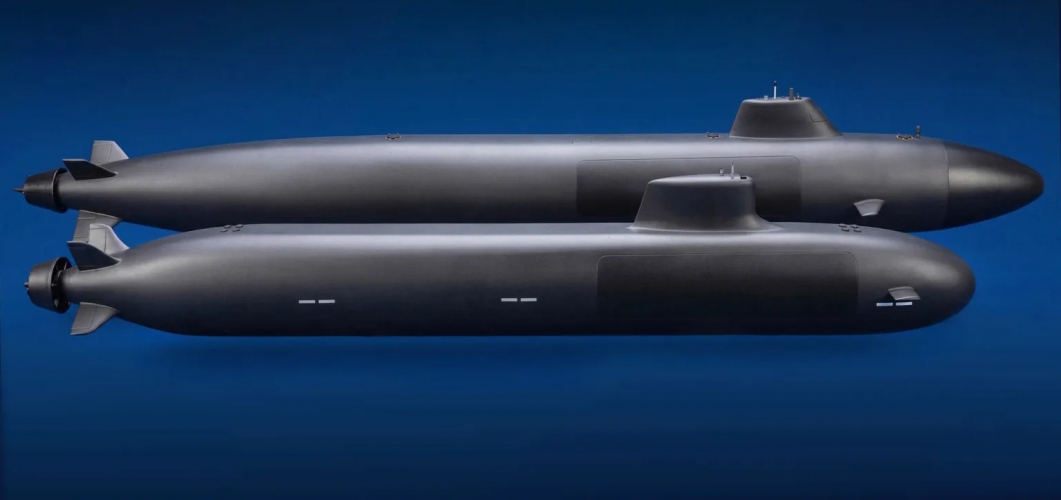
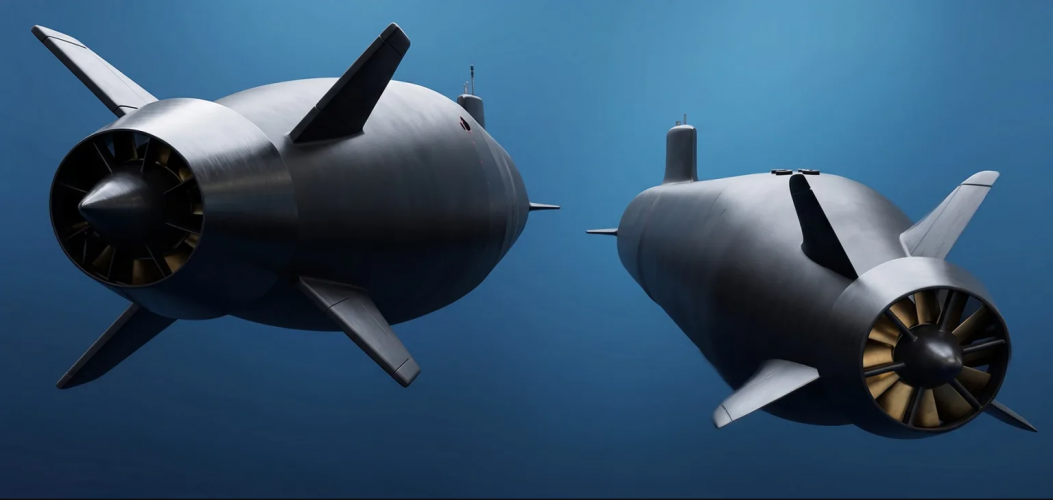
Found these renders (I guess based on those display models next to a bus for scale, see previous page) over at Navy Lookout blog:

Screenshot 2026-04-17 140341 - Copy.png

Screenshot 2026-04-17 140326 - Copy.png

https://www.navylookout.com/the-evo...arine-reactors-and-rolls-royces-central-role/

As of now it seems the RN & RAN will be operating the same SSN model...has there been anything to suggest the Australian version might have a different configuration? Like a different combat-management system or something? The plan for RAN is to operate Virginias for a while so a CMS derived directly from that (as opposed to whatever the RN uses) might enable a smoother transition.

Just thinking out loud.

??? 4 to 5 % I think. At least in civilian french reactors.

I think I've heard that the new K22 PWR (meant for L'Invincle-class SSBNs & the France Libre/PANG) uses 11-14%. Can't find the source now. I think that qualifies as high-assay LEU but don't quote me on that.

Earlier French reactors (K15) were lower if I'm remembering right.
 
Subs will be pointless in the next 5 ~10 years. All the fanboys want them, yet they are not writing the cheques.

As you seeing in Ukraine/Iran the map is moving very quicky from multibillion$$, 20-year BS systems to low cost unmanned, mass produced.

You don’t need to sink a submarine to neutralize it you only need to make its operating environment too dangerous, pretty simple.

"Drone ahead captain"......................

Stealth is no longer a binary state. It’s a probabilistic envelope, and that envelope is collapsing.

Subs cannot be replaced quickly completely opposite of the new warfare economy of banging out 1,000's "widgets" over the weekend.

So why do Subs have 5 ~ 10 years, unmanned surface and subsurface swarms becoming fully autonomous.

Persistent maritime ISR becomes globally accessible as it almost is now.

AI‑driven kill chains compress to seconds, and coastal A2/AD zones become drone‑saturated.

https://www.wsj.com/opinion/ukraine-is-redefining-modern-warfare-697bad15

https://www.atlanticcouncil.org/in-...-kill-zone-how-ukraine-rewired-naval-warfare/

https://www.businessinsider.com/ukraine-splits-weapons-making-warns-europe-must-do-the-same-2026-6

Been 4 years of the war in Ukraine and less in Iran and the landscape is changing at a pace few can grasp.

Ukraine and Iran had supposedly nothing, against great superpowers and yet.............................

Regards,

 
70 vs 90 days isn't really a 'significantly lower capability' unless they're operating extremely remotely or far from resupply, and the Barracuda's sensors, systems and stealth are all state of the art.
Take a look at where Australia's naval bases are in relation to where their patrol zones are (WW2 descriptions are acceptable here), and see what that 70 days out does to your time on station.


As of now it seems the RN & RAN will be operating the same SSN model...has there been anything to suggest the Australian version might have a different configuration? Like a different combat-management system or something? The plan for RAN is to operate Virginias for a while so a CMS derived directly from that (as opposed to whatever the RN uses) might enable a smoother transition.

Just thinking out loud.
I think the Oz boats will have a different CMS. Either that or the UK is getting cleared for Mk48 information, and knowing the US they're not willing to share that without the UK paying for it.


Stealth is no longer a binary state. It’s a probabilistic envelope, and that envelope is collapsing.
Stealth has ALWAYS been a probabilistic thing.
 
The Astute Combat Management System is a new version of the Submarine Command System used on other classes of British submarine.

All of the Astute-class submarines will be fitted with the advanced Common Combat System.

Presumably the CMS interface and open architecture design will be retained. US specific elements may be added, I suspect in software rather than hardware unless there's a specific feature not replicable by virtual simulation or translation and the interface open to RAN or RN standards.
 
Take a look at where Australia's naval bases are in relation to where their patrol zones are (WW2 descriptions are acceptable here), and see what that 70 days out does to your time on station.
Crew swap & resupply in Darwin... saves 10 days on the roundtrip vs. Perth. Singapore or Guam would be even better... once you factor that in, 2x 70 days gives you a higher time on station % than 1x 90 days.
 
Last edited:
Crew swap & resupply in Darwin... saves 10 days on the roundtrip. Singapore or Guam would be even better... once you factor that in, 2x 70 days gives you a higher time on station % than 1x 90 days.
So you have to treat the choke points on the Darwin approaches as ASW bastions, with appropriate seabed sensors and some attention from the new Hunter class.
 
70 vs 90 day endurance
It might be possible to extend that endurance by using the DDS.
With all the these discussions about hybrid navies, a large UUV carrying additional provisions could meet an SSN, allowing it to replenish its stores without ever having to surface.
 
Probably easier to drop provisions from an aircraft.
The fuel is another matter.
 
Subs will be pointless in the next 5 ~10 years. All the fanboys want them, yet they are not writing the cheques.

As you seeing in Ukraine/Iran the map is moving very quicky from multibillion$$, 20-year BS systems to low cost unmanned, mass produced.

You don’t need to sink a submarine to neutralize it you only need to make its operating environment too dangerous, pretty simple.

"Drone ahead captain"......................

Stealth is no longer a binary state. It’s a probabilistic envelope, and that envelope is collapsing.

Subs cannot be replaced quickly completely opposite of the new warfare economy of banging out 1,000's "widgets" over the weekend.

So why do Subs have 5 ~ 10 years, unmanned surface and subsurface swarms becoming fully autonomous.

Persistent maritime ISR becomes globally accessible as it almost is now.

AI‑driven kill chains compress to seconds, and coastal A2/AD zones become drone‑saturated.

https://www.wsj.com/opinion/ukraine-is-redefining-modern-warfare-697bad15

https://www.atlanticcouncil.org/in-...-kill-zone-how-ukraine-rewired-naval-warfare/

https://www.businessinsider.com/ukraine-splits-weapons-making-warns-europe-must-do-the-same-2026-6

Been 4 years of the war in Ukraine and less in Iran and the landscape is changing at a pace few can grasp.

Ukraine and Iran had supposedly nothing, against great superpowers and yet.............................

Regards,
Deeply saddened to say that I agree with this - drifting, long-endurance USVs with passive sonar and tethered buoy antennas can be bought in large numbers and act as early warning systems that don't end the lives of dozens when found.
I suspect we are much better of pumping out Ghost Sharks than we are buying grubby old second hand nuclear submarines.
$300 billion might be better spent elsewhere.
 
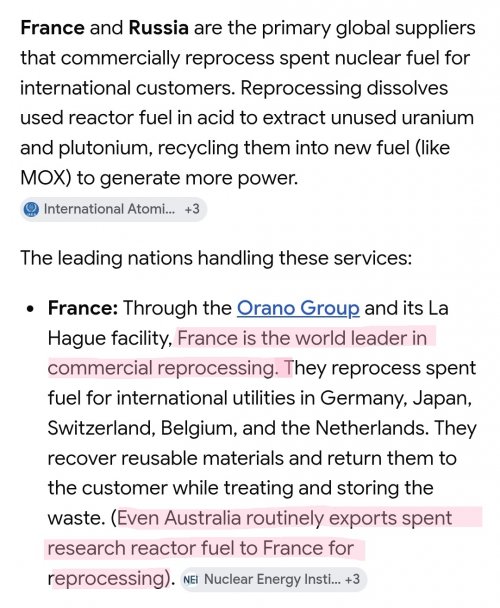
There's the French firm Orano as well which, given the nature of a deal we're talking about, would be a more logical choice. But as you point out, it's a global industry and there are multiple service suppliers.

Screenshot_20260710_211844_Chrome.jpg
 
Last edited:
It doesn't matter what is built or bought; we need infrastructure and a workforce pipeline. In many ways, it doesn't matter if the boats are nuclear or conventional; many of the skills needed are common between the two. Same as it doesn't matter if we build corvettes, frigates, destroyers, cruisers or small carriers, the trade and professional skills required are largely the same.

Japan, Italy and to a lesser extent Spain, continue to build something, anything, and maintain their infrastructure and workforce. Australia does not, but irrespective of what we buy or build going forward, this has to change.
 
It doesn't matter what is built or bought; we need infrastructure and a workforce pipeline. In many ways, it doesn't matter if the boats are nuclear or conventional; many of the skills needed are common between the two. Same as it doesn't matter if we build corvettes, frigates, destroyers, cruisers or small carriers, the trade and professional skills required are largely the same.

Japan, Italy and to a lesser extent Spain, continue to build something, anything, and maintain their infrastructure and workforce. Australia does not, but irrespective of what we buy or build going forward, this has to change.
Hear, hear!
 
It doesn't matter what is built or bought; we need infrastructure and a workforce pipeline. In many ways, it doesn't matter if the boats are nuclear or conventional; many of the skills needed are common between the two. Same as it doesn't matter if we build corvettes, frigates, destroyers, cruisers or small carriers, the trade and professional skills required are largely the same.

Japan, Italy and to a lesser extent Spain, continue to build something, anything, and maintain their infrastructure and workforce. Australia does not, but irrespective of what we buy or build going forward, this has to change.
This is 100% true.

I've worked with submarine sonar for a quarter of a century and the manning problems aren't easily solved. Your big shortfalls are rarely in your electricians/welders/etc, you can honestly train these up to do basic construction tasks relatively quickly. The sticky part is development of the actual SMEs who have a better holistic understanding of the platform and its systems overall, who understand how different subsystems interact and how to solve complex problems and clear the big blockers.

It's also tricky because you can't easily tell who is going to excel and who isn't. This talent comes from all corners... from the trades, from design and engineering, from integration. In my observation it's the people who are interested and motivated that move the needle and become your rockstars more often than the people with the greater (on paper) raw knowledge/talent.

This isn't something that happens quickly, it takes some time to develop that knowledgebase--and honestly the primary way you learn is by fixing broken #$@% over and over (and over.)

Alas, there really aren't any shortcuts. It's a tough pill to swallow, but you gotta hire a lot of talent and you gotta build a lot of stuff. It's really the only way forward.
 
Wrong. French naval propulsion reactors use commercial enrichement-level oxyde fuel. American (and consequently English copies thereof) use HEU metal fuel, which makes transfer to a non-NW state, even a client-state, a serious non-proliferation issue.
I think we can write off the Non-Proliferation Treaty, sadly.

After the events of 2014 and especially 2022, the only chance of your country maintaining its borders is if your country has nukes. Not "is allied with a country with nukes that they're dual-key sharing with you." I mean "we have single sovereign decision rights to these weapons and WILL use them as we see fit."
 
I think we can write off the Non-Proliferation Treaty, sadly.

After the events of 2014 and especially 2022, the only chance of your country maintaining its borders is if your country has nukes. Not "is allied with a country with nukes that they're dual-key sharing with you." I mean "we have single sovereign decision rights to these weapons and WILL use them as we see fit."
AUKUS nearly killed NPT....
 
AUKUS nearly killed NPT....
One of the more amusing things I have read lately...

The NPT is not a factor for the transfer of nuclear propulsion,
The NPT is a multilateral treaty aimed at limiting the spread of nuclear weapons including three elements: (1) non-proliferation, (2) disarmament, and (3) peaceful use of nuclear energy. These elements constitute a “grand bargain” between the five nuclear weapon states and the non-nuclear weapon states.

  • States without nuclear weapons will not acquire them
  • States with nuclear weapons will pursue disarmament
  • All states can access nuclear technology for peaceful purposes, under safeguards
https://www.nti.org/education-cente...-on-the-non-proliferation-of-nuclear-weapons/

and the IAEA has no issues with the AUKUS arrangement as all three nations continue to follow the safeguards and meet treaty obligations.
Its naval nuclear propulsion programme was proceeding in full compliance with the AUKUS partners' respective international obligations
https://www.iaea.org/sites/default/files/gc/gc69-or10.pdf
 
One of the more amusing things I have read lately...

The NPT is not a factor for the transfer of nuclear propulsion,

https://www.nti.org/education-cente...-on-the-non-proliferation-of-nuclear-weapons/

and the IAEA has no issues with the AUKUS arrangement as all three nations continue to follow the safeguards and meet treaty obligations.

https://www.iaea.org/sites/default/files/gc/gc69-or10.pdf
Ozair, transferring nuclear tech for the propulsion of nuke subs DOES fall under the NTP. The key words highlighted:

The NPT is a multilateral treaty aimed at limiting the spread of nuclear weapons including three elements: (1) non-proliferation, (2) disarmament, and (3) peaceful use of nuclear energy. These elements constitute a “grand bargain” between the five nuclear weapon states and the non-nuclear weapon states.


  • States without nuclear weapons will not acquire them
  • States with nuclear weapons will pursue disarmament
  • All states can access nuclear technology for peaceful purposes, under safeguards

Nuke subs are weapons.
 
Russia doesn't sell anything nuclear powered to anyone. Aside from the fact that Iran could develop a full on nuclear bomb if they had the desire to do so. Cuba is even more ridiculous.
 
Ozair, transferring nuclear tech for the propulsion of nuke subs DOES fall under the NTP. The key words highlighted:
If you read the treaty including my already bolded bit you will see the treaty clearly talks about nuclear weapons development and transfer while transfers and use of nuclear technology for energy purposes is allowed as long as treaty participants, of which all of AUKUS are, adhere to the guidelines and their respective treaty obligations.

Until Russia sells it's nuclear powered cruise missile to Cuba or Iran.
And that would be different as Forest Green said. The nuclear engine powering the missile would contribute to the explosive power of the missile in the form of a dirty bomb.

Russia doesn't sell anything nuclear powered to anyone.
No, they just lease subs to India...
 
Russia doesn't sell anything nuclear powered to anyone
Russia does loan a nuclear powered attack sub to India.

Aside from the fact that Iran could develop a full on nuclear bomb if they had the desire to do so.
We were talking about propulsion, not bombs.

Rest assured, i don't think Russia would sell nuclear powered weapons to Iran or Cuba.
I just meant that people's definition of the NPT seems to change depending on which country they're talking about.
 
And that would be different as Forest Green said. The nuclear engine powering the missile would contribute to the explosive power of the missile in the form of a dirty bomb.
No, it would just make it a dirty bomb ... but it's already a dirty propulsion system anyway so...
 
No, it would just make it a dirty bomb ... but it's already a dirty propulsion system anyway so...
No one will accept radioactive fallout being disseminated, a submarine doesn't do that. It wouldn't be a particularly cheap missile to fire either. It's also a weapon, in that it's a missile. A submarine is a launch system not a weapon, just like a silo. Selling a silo would not be an NPT breach.
 
Russia does loan a nuclear powered attack sub to India.
The big difference is that India is a nuclear power and operates nuclear powered (and nuclear armed submarines) anyway. Not to mention that Russia retains control of the sub.

We were talking about propulsion, not bombs.
Something that's also to be deemed highly unlikely. Not only because that's one of Russias most well kept state secrets, but also because Russia has no ally that's as close to them as the whole five eyes ordeal. Technical assistance to a close partner like the DPRK is in the cards, but something like what the US does with the UK or AUS, straight up selling reactors and SLBMs? Never.

Rest assured, i don't think Russia would sell nuclear powered weapons to Iran or Cuba.
I just meant that people's definition of the NPT seems to change depending on which country they're talking about.
If that was the point you wanted to make, I think you could have worded it clearer.
 
Russia doesn't sell anything nuclear powered to anyone.

Indian example noted above already. Rosatom as a state company is also involved in several countries, perhaps most notably in Bushehr, Iran (China and India as well). Russia, especially before the illegal full scale invasion of Ukraine, managed to capture a sizable part of global nuclear fuel supply chains (Tenex, TVEL, Uranium One), something that democracies are in the process of disentangling from (uranium being at least somewhat fungible in terms of use). And then there's North Korea of course, with the evident transfer of submarine power units from Russia, other (public "civilian") nuclear co-operation, technology transfers and Russia's hindering of NK nuclear visibility and controls from the UN security council.

With its large uranium deposits Australia is in fact in an influential position with all this. AUKUS and the nuclear submarines can certainly be seen as efforts to secure these supply chains.
 
Russia doesn't sell anything nuclear powered to anyone.

Not to mention that this is a classic "off the cuff" remark that can be argued ad infinitum but left unchallenged can and many times, unfortunately, will leave a really wrong impression.
 
Russia doesn't sell anything nuclear powered to anyone. Aside from the fact that Iran could develop a full on nuclear bomb if they had the desire to do so. Cuba is even more ridiculous.

Have a look at the DPRK nuclear program, specifically the new rockets.
 
NNo
Take a look at where Australia's naval bases are in relation to where their patrol zones are (WW2 descriptions are acceptable here), and see what that 70 days out does to your time on station.


I think the Oz boats will have a different CMS. Either that or the UK is getting cleared for Mk48 information, and knowing the US they're not willing to share that without the UK paying for it.


Stealth has ALWAYS been a probabilistic thing.
Not to forgett, the Germans managed to built submarine bunkers in the Normandy which were almost indestructible. All the drones used in Ukraine are shurly uncapable of destroying such a bunker.
 
Not to forgett, the Germans managed to built submarine bunkers in the Normandy which were almost indestructible.
Still in use as sheltered "drydocks" for repairing fishing boats today, even. They've only needed the rails replaced a few times due to saltwater corrosion.


All the drones used in Ukraine are shurly uncapable of destroying such a bunker.
These days, you can send a drone (or cruise missile) in through the main doors. Don't need to break through a bunker to destroy what's inside it.

Also, I suspect that the BROACH warhead was designed around something like those sub pens.
 

Similar threads

Back
Top Bottom