Ainen
I really should change my personal text
- Joined
- 25 August 2011
- Messages
- 2,844
- Reaction score
- 4,949
Because we were there at the time and BVR was being emphasised in everything we were told. Shoot BVRAAM, disengage in a supersonic turn, re-engage, shoot BVRAAM, disengage in a supersonic turn, re-engage, shoot ASRAAM from well outside Archer range, and only merge if there is no alternative.
That doesn't mean exceling at WVR combat wasn't valued, but rather that it's far better to have high-end WVR combat capability that you never need because your BVR capability is superlative. This approach wasn't someone's personal flight of fancy, but had been extensively modelled in comparison with other alternative CONOPS.
Remember, there's no 'shortcoming' to defend if you don't value ludicrously high-AoA. The test pilots I talked to considered the idea of deliberately manipulating yourself into a low-energy state to be idiotic - 'if he doesn't get you, his wingman will'.
And let's not forget, the RAF seriously considered removing the gun.
This would be very interesting as its own topic. Of all the jets that were designed at the end of the Cold War the actual intended role and philosophy of the Rafale is something of a mystery to me.
Don't quote me on it this, but from what I understand the design/philosophy deal-breakers for France were carrier capability and emphasis on multi-role from the ground up. Eurofighter design was primarily focused for air-to-air interception with capacity for multi-role.
The industrial/political concerns were probably the major drivers in the split though. France wanted to lead the project with 50% of the workshare, and insisted on using SNECMA M88s as the engines.
The impression I got is that it’s very hornet like, consolidation of several aircraft into one.
How it was mean to be use tactically in a little less clear on, my thoughts are that it was a kind of penetration fighter.
The Rafale requirement was indeed for multirole air superiority and low-level penetration, similar to Hornet or the F-15E (which didn't exist yet).
The air superiority mission is evident in certain design choices, especially in the cockpit (heavily reclined seat and F-16 style side stick to help the pilot fly high Gs). It's not a surprise since the French spent most of the 70s trying to come up with a French F-15 equivalent. The penetration mission was also a core requirement given the need to replace the Jaguar in the tactical role against Warsaw Pact forces... basically the French knew they needed something more like Tornado, with automatic terrain following and better fuel consumption than the Atar engines. You can also see the penetration mission's influence in the Mica missile design, with its high off boresight thrust vectoring capability and mini-IRST surveillance mode to help a striker flying low & fast defend itself in a scenario where it was jumped by enemy fighters.
So the French wanted both air superiority and penetration, which made them probably more aligned with RAF requirements than German requirements (which leaned much more towards air superiority only and high maneuverability for WVR combat). However there was a huge gap in expectations around aircraft size, with the French cost models being based on price per kilo which drove them towards the minimum size for a twin-engine fighter (which they thought was around ~8.5t empty), whereas the RAF wanted something Tornado sized (12t empty). In the end the French Jaguar replacement became the Mirage 2000D (initially intended more as a gap-filler in the strike/penetration role), but luckily the Rafale's multirole design requirement was already pretty set in stone by that point.
For what it's worth, the French histories barely mention workshare as the main problem. From their perspective the disagreements in the working teams were about how to translate design requirements, with 2 competing design concepts.
The French sponsored concept was smaller, cheaper, more multirole and easier to navalize (with the landing gear and intake location in particular helping to transfer structural loads during catapult launches and arrested landings, whereas what would become the Eurofighter design was fundamentally ill-suited from a structural load path perspective). In the end the gap in design choices was insoluble and the working teams from the 3 Panavia countries just decided to ignore the French PoV and sign off on their preferred design concept without finding a consensus design. The French and Spanish had 2 weeks to agree to their partners' design concept - the Spanish agreed, the French didn't.
A long line of quotes from Eurofighter FBW FCS and AOA topic.
Question:
Is it possible to describe AdA CONOPS regarding Rafale in a similar simple way? Especially in A2A domain.
Similar to how @DWG describes RAF views for future Typhoon on A2A combat.
Rafale is a rather unique design within its generation.
Some external observations and a summary of posts from @H_K from above:
- For strike, Rafale is a long-range penetrator, capable of long terrain-hugging flight with significant ordnance. Rafale is also designed with strong emphasis on self-escort. In this capacity, it's overall a "better mirage-2000D".
- Rafale has a visible design focus on a heavy, elaborate self-defense suit(SPECTRA).
- France spent a great deal to develop a full range of armament, suitable for low altitude employment, and its integration into both targeting and self-defense suit(AASM).
- Equally, France spent a significant amount of effort to catch up with the world level in ground targeting pods.
- Rafale is both a terrestrial and a deck aircraft (which made it incompatible with Eurofighter, and led to a separate aircraft).
- Substantial attention to frontal signature management (though arguably that's normal for a 1980s design).
For AA, Rafale has several outstanding features, which are unusual for the generation:
- elaborate optical suit in the form of OSF (unprecedented within generation); perhaps with a certain emphasis on short-medium range performance, visible in best IR/LRF gimbal limits in class. (yes/no?)
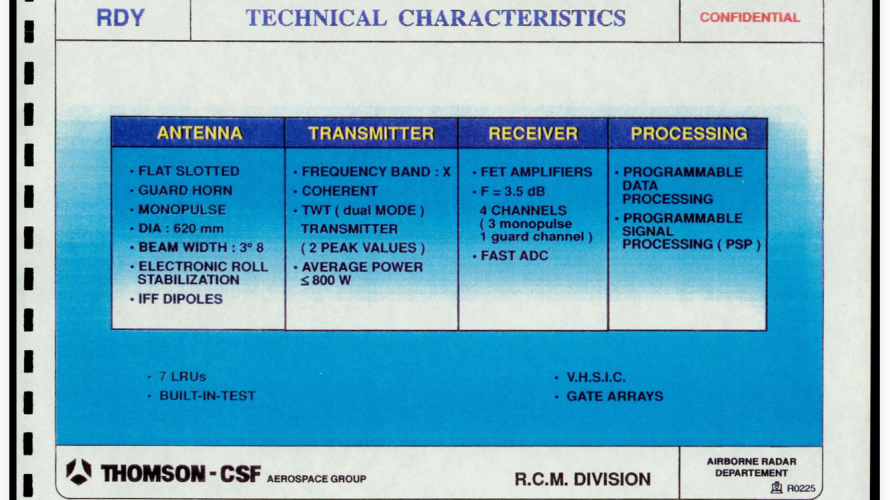
- relatively smaller radar, which the French, however, diligently keep updated in time (original PESA, when electronic scan was still rare; earliest AESA at first opportunity).
- Lighter main weapon in the form of MICA (both EM/IR) with very high offbore performance but relatively modest range (Meteor entered the picture later; was there always a plan for a longer range weapon to supplement MICA?). MICA performs as an additional IRST, too.
-Significant attention on datalinked LOAL shots (buddy feed) even beyond the aircraft's own sensory field.
Basically, from the outsider's perspective, it looks like Rafale is the direct opposite of the RAF Eurofighter - an aircraft designed to often fight in low, personal, and in a brawl.