

You are using an out of date browser. It may not display this or other websites correctly.
You should upgrade or use an alternative browser.
You should upgrade or use an alternative browser.
Project Orion's "Landing Boat"
- Thread starter Orionblamblam
- Start date


Alex_semenov1965
Alexandr Semenov
- Joined
- 23 November 2025
- Messages
- 39
- Reaction score
- 67
I wonder how they planned to land on atmosphereless bodies with the aerodynamic Landing Boat? Like Enceladus, which some people were planning to ski on (just kidding).
Edited later.
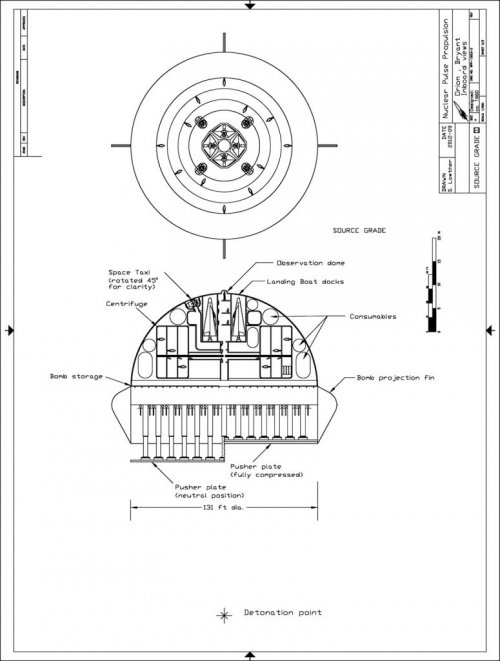
I understand that this was about the military version of Orion, which was supposed to fly only within the Earth-Moon system (though how would it land on the Moon then?). But in this reconstruction, which shows an early, "peaceful," exploratory version of Orion, clearly designed for flights to the outer planets, as far as I can see, only aerodynamic Landing Boats were planned.

Edited later.
I understand that this was about the military version of Orion, which was supposed to fly only within the Earth-Moon system (though how would it land on the Moon then?). But in this reconstruction, which shows an early, "peaceful," exploratory version of Orion, clearly designed for flights to the outer planets, as far as I can see, only aerodynamic Landing Boats were planned.
Last edited:
The military version of Orion was never going to land anywhere, they'd have just replaced the atmospheric landers with vacuum landers and depended on having some sort of ferry vehicle meet them near the Moon on return. The "civilian" version suggested landing the whole Orion drive with smaller bombs for the landing burn depending on the local gravity.
More in context lighting off an Orion drive in the Earth-Moon system would likely fry most orbital satellites and require any manned objects in Earth or Lunar orbit to seek shelter from the radiation. (Depending on a number of factors of course )
)
Randy
More in context lighting off an Orion drive in the Earth-Moon system would likely fry most orbital satellites and require any manned objects in Earth or Lunar orbit to seek shelter from the radiation. (Depending on a number of factors of course
)Randy
Alex_semenov1965
Alexandr Semenov
- Joined
- 23 November 2025
- Messages
- 39
- Reaction score
- 67
The military version of Orion was never going to land anywhere, they'd have just replaced the atmospheric landers with vacuum landers and depended on having some sort of ferry vehicle meet them near the Moon on return. The "civilian" version suggested landing the whole Orion drive with smaller bombs for the landing burn depending on the local gravity.
Reread the documents. Landing Boat t were provided everywhere.
More in context lighting off an Orion drive in the Earth-Moon system would likely fry most orbital satellites and require any manned objects in Earth or Lunar orbit to seek shelter from the radiation. (Depending on a number of factors of course
Randy
This is a myth. Another myth. For any serious electromagnetic strike, you need...
First, megaton explosions.
Second, explosions that generate large amounts of gamma radiation. For example, a very "clean" W-71 warhead, with a yield of 5 megatons, created almost no pulses, not even radar interference, despite the first and third conditions being met.
Third, they must occur at a certain altitude above the atmosphere, so that the necessary power is generated by gamma-ray deceleration in the upper atmosphere.
Reread the documents. Landing Boat t were provided everywhere.
The document is for the military "Deep Space Deterrent Force" hence really only needed aerodynamic landers since they would not be doing "side quests" like landing on the Moon.
This is a myth. Another myth. For any serious electromagnetic strike, you need...
First, megaton explosions.
Second, explosions that generate large amounts of gamma radiation. For example, a very "clean" W-71 warhead, with a yield of 5 megatons, created almost no pulses, not even radar interference, despite the first and third conditions being met.
Third, they must occur at a certain altitude above the atmosphere, so that the necessary power is generated by gamma-ray deceleration in the upper atmosphere.
False premise actually, EMP wasn't the problem the gamma burst of the planned pulse units was enough to ruin satellites of the given timer period which they found out with the high altitude testing. Even "clean" nuclear weapons still put out a large gamma burst on detonation.
Randy
Alex_semenov1965
Alexandr Semenov
- Joined
- 23 November 2025
- Messages
- 39
- Reaction score
- 67
Okay. Let's not argue, let's just go back to the basics. I suggest looking at Theodore Taylor's article in the April 1987 issue of Scientific American, "Third-Generation Nuclear Weapons." I have both the English and Russian versions of the article, but only the Russian version and the pictures from it are nearby.False premise actually, EMP wasn't the problem the gamma burst of the planned pulse units was enough to ruin satellites of the given timer period which they found out with the high altitude testing.
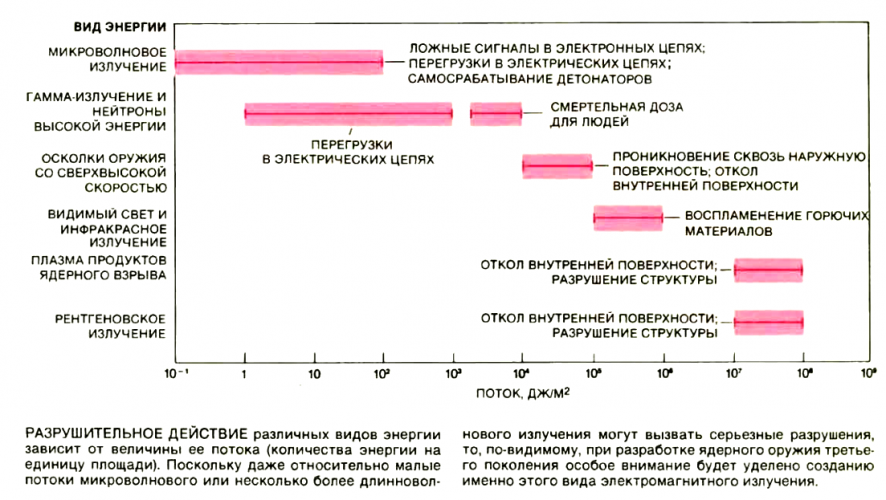
The destructive effect of various types of nuclear explosion energy.

The maximum destruction distance of different types of energy during their enhanced release and isotropic expansion. Colored - megaton explosion, gray - kiloton explosion.
What are you right about? That gamma rays (and neutrons) act almost as effectively and far in a vacuum as an electromagnetic pulse. On both graphs, they are the first two from the top.
What are you wrong about?
Still, the effective range (even with a megaton yield) is not so great that we can claim that all satellites and spacecraft in the Earth-Moon system would immediately burn up when Orion launches there. Even with an ENHANCED gamma-ray burst (or neutron explosion) of megaton yield, the gamma and neutron destruction radius is up to 10,000 km. A kiloton warhead has a destruction radius of approximately 200 km. The combined effect of neutrons and gamma radiation is also indicated. The maximum possible enhancement of the destructive factor is 20% (this is essentially for a non-nuclear bomb, which would still need to be manufactured in the megaton class).
In other words, fears that everything in the vicinity would burn out are an exaggeration.
I would like to draw your attention once again to the W-71 anti-missile warhead. This was a very clean third-generation bomb, specialized in producing X-rays. All other factors were suppressed as much as possible. Including gamma sources (from residual fission radiation), so much so that, with a 5-megaton yield, the charge not only didn't create a noticeable electromagnetic pulse, but the explosion cloud didn't significantly interfere with friendly missile defense radars.
That is, Orion's kiloton charges, SPECIALIZED for generating directed plasma flows (all other factors are maximally suppressed), won't cause any significant harm to anyone, other than the radiation release from fission products (which can also be minimized or even eliminated entirely).
Ultimately, I'm right, not you (although you've made significant adjustments). Orion won't harm anyone even if launched from Earth, say, near Novaya Zemlya or somewhere in the South Pacific.
Even "clean" nuclear weapons still put out a large gamma burst on detonation.
Powerful? Where from? Can you describe the mechanism? What reactions?

XP67_Moonbat
ACCESS: Top Secret
- Joined
- 16 January 2008
- Messages
- 2,322
- Reaction score
- 733
@Orionblamblam here's something of interest that just popped up on my Facebook feed.
View: https://www.facebook.com/story.php?story_fbid=3453654061448796&id=211443722336529
View: https://www.facebook.com/story.php?story_fbid=3453654061448796&id=211443722336529
Attachments

Similar threads
-
 Military Orions (nuclear pulse propulsion)
- Started by Orionblamblam
- Replies: 82
-

-
-

-