The fundamental problem with mix-and-match SAMs is that they are defensive weapons. The attacking force chooses the targets and delivery systems, so they can easily choose what strike weapons to use. The defending force is waiting for the enemy to launch their own aircraft or weapons, so they can't wait until they see the inbound raid to choose what missiles to load. Tactically speaking, the missile that can engage the most types of threats (UAVs, aircraft, TBMs, hypersonics, etc.) is going to be the best option, even if that missile costs a lot more than missiles specifically designed against each threat.
Tiered and layered systems provide overlapping coverage that allows the C2 to choose the optimal interceptor, which is already loaded. You don't need to observe and load that interceptor.
 
It doesn't make sense to have a half price pac3/mse missile that loses most of its anti ballistic capabilities and is primarily against air breathing threats. If one wants that - there's the pac-2. Which is still in production and is being bought by the US, no less. Number of missiles available for launch is a smaller issue against manned aircraft anyways. I guess in 10 or 20 years time unmanned jets might change that to an extent.

What the Patriot users REALLY need is a missile that can still intercept ballistic missiles, at like 80% of the efficiency of the MSE, but also at 50% or less of the cost. Case in point - Iran's barrages. Most of their BMs were not super advanced and hard to bring down. So one could argue that MSE usage for those was overkill in a fair number of situations.
 
What the Patriot users REALLY need is a missile that can still intercept ballistic missiles, at like 80% of the efficiency of the MSE, but also at 50% or less of the cost.

This is what Lockheed claims the PAC-3 ACE is
 
It doesn't make sense to have a half price pac3/mse missile that loses most of its anti ballistic capabilities and is primarily against air breathing threats. If one wants that - there's the pac-2. Which is still in production and is being bought by the US, no less. Number of missiles available for launch is a smaller issue against manned aircraft anyways. I guess in 10 or 20 years time unmanned jets might change that to an extent
You forgot that the PAC3 types can be load 4 per every pac2 on the launchers.

So instead of each launcher only have 4 missiles with PAC2.

It can now have up to 16 with AA PAC3s.

The average Patriot battery has 8 launchers per radar. So I stead of say, 24 pac2s and 24 pac3s for a total of 48 missiles.

You can now have 96 to 128 missiles in a battery depending on launcher type, older ones can only carry 12 pac3 mses to the newer 16.

Plus you can mix match as well so can have like 48 of each or however the mission threat needs.

Either way once you stop and look at it number wise an pure AA pac3 size missile make more sense then a upgraded Pac1/2.
 
On the PAC-3 Advanced Capability Effector, JJ Gertler had this to say on the July 23 Air Power Podcast:
Ignore JJ and his clerarly wrong / bad take. He was likely winging it without doing actual research.

PAC-3 ACE is designed against air breathing threats, CRBM's and SRBMs. It likely to be envelop limited against the higher performing short and medium ranged threats. In comparison, the MSE has capability to handle threats with ranges approaching or even exceeding 1,500 km provided it has a sensor that can exploit its kinematic potential.

The fundamental problem with mix-and-match SAMs is that they are defensive weapons. The attacking force chooses the targets and delivery systems, so they can easily choose what strike weapons to use. The defending force is waiting for the enemy to launch their own aircraft or weapons, so they can't wait until they see the inbound raid to choose what missiles to load. Tactically speaking, the missile that can engage the most types of threats (UAVs, aircraft, TBMs, hypersonics, etc.) is going to be the best option, even if that missile costs a lot more than missiles specifically designed against each threat.
The fundamental equation is still solid. If the enemy is being forced to commit higher performance offensive systems to penetrate defenses then thats a good thing. PAC-3 ACE isn't a substitute for the PAC-3 MSE, it sits somewhere between an AIM-9X / Tamir class IFPC interceptor and a full fledged MSE and THAAD combination. Lockheed was previously marketing IAI's Barak 8 interceptor solution in that space. PAC-2 GEM/T is a legacy missile that hasn't been in the official Army acquisition roadmap for well over a decade (setting aside the emergency purchases now) and its limits on magazine size, and non-active seeker limit growth with IAMD and RIG-360. So PAC-3 ACE could be that high-low mix from Lockheed. Of course this $2 Million solution is Lockheed's proposal but the Army has its own nacent efforts to explore low cost Patriot interceptors costing half as much as that though we will see how serious the service is towards that effort in terms of funding it commits to it in its next budget and FYDP update. That said, the timing on Lockheed's PAC-3 ACE isn't a coincidence coming just months after the Army revealed its LCI plans which allow both component level solutions and fully developed AUR LCIs.

There is also no 80% the capability or 50% the cost going on here. That is mostly a completely made up number and not real world performance charecterization. What is more likely to be true is that the ACE is designed to have 100% of the MSE's capability against a more limited CRBM/SRBM threat set. And keep most of hte ABT defeat capability. That is still a far better option than the GEM/T (against missiles and drones) at less or lower its cost.

The Army is also rushing development and demo of a containerized PAC-3 plus RIG-360 solution with Lockheed already on contract for two such systems. This seems a great solution to thicken the force when majority of Patriot Bns are on IBCS, IFCN and RIG-360.
 
Last edited:
Northrop Grumman is set to be onboarded as a second source PAC-3 MSE solid rocket motor supplier -

Under these landmark agreements, the Department of War is driving significant capacity increases across two critical defense programs. First, for the PAC-3 Missile Segment Enhancement (MSE), this framework agreement establishes a second source for Solid Rocket Motors (SRMs). By providing a steady demand signal for a second source, the Department of War is driving stability and competition into the supply chain, creating a more resilient industrial base. Additionally, the agreement ramps up production of ignition safety devices for PAC-3. Second, for THAAD Component Production, this framework agreement will quadruple the production of THAAD interceptor structural components. This includes critical parts such as mid-body shells, muzzle covers and rail car assemblies.

https://www.war.gov/News/Releases/R...greements-with-northrop-grumman-to-ramp-prod/
 
Those are called theater or tactical BMs.
That is a term covering a much broader set of threat systems.

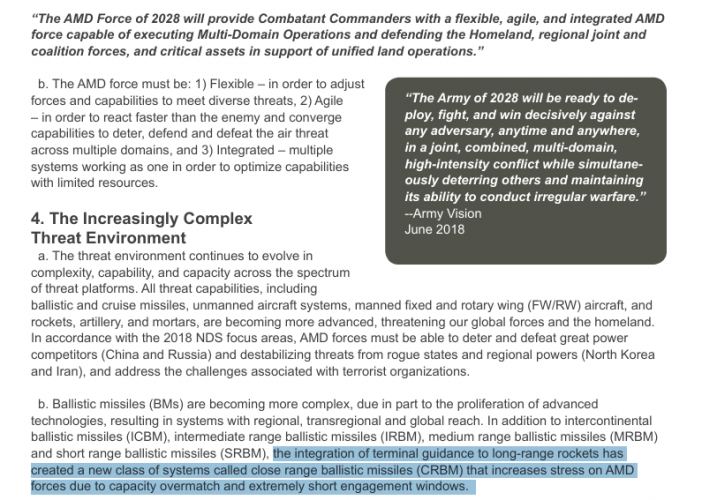
The CRBM distinction is on account of the proliferation of large diameter rockets with ranges in the 100-300 km range that feature terminal guidance and thus present a significantly greater threat than shorter range unguided rockets of the past. Their lower apogee and short time of flight further adds to the complexity. For the Lower Tier systems (Iron Dome, IFPC and Patriot), the Army has increasingly begun referencing lower tier TBM threats as Close, Short and medium Range to highlight both the lower and upper end of the threat systems. One of the challenges Army had with Tamir on Iron Dome was its inability to cover the entire intended CRBM threat. Rafael has since upgraded the interceptor it is building now to cover all large diameter rockets the Army classifies as threats in this category. This is one area where IFPC and Patriot has to have an overlap.

1785789702364.png
 
Last edited:
That is a term covering a much broader set of threat systems.

The CRBM distinction is on account of the proliferation of large diameter rockets with ranges in the 100-300 km range that feature terminal guidance and thus present a significantly greater threat than shorter range unguided rockets of the past. Their lower apogee and short time of flight further adds to the complexity. For the Lower Tier systems (Iron Dome, IFPC and Patriot), the Army has increasingly begun referencing lower tier TBM threats as Close, Short and medium Range to highlight both the lower and upper end of the threat systems. One of the challenges Army had with Tamir on Iron Dome was its inability to cover the entire intended CRBM threat. Rafael has since upgraded the interceptor it is building now to cover all large diameter rockets the Army classifies as threats in this category. This is one area where IFPC and Patriot has to have an overlap.

View attachment 819907
Wasn't aware they pulled another term out of their asses to justify funding.
 
The challenge of small and large caliber rockets isn't something new. Even guided MLRS type of munitions are not new. The Israelis literally built the Iron Dome to confront this challenge and the US Army has had a requirement out for low cost high volume systems to defeat medium and large caliber rockets for well over 10 years now. CRBM is not a term or class of missiles that someone just made up yesterday to justify more funding.
 
Wasn't aware they pulled another term out of their asses to justify funding.
CRBMs were previously often called LRR - Long Range Rocket.
A bit confusing to precede Short Range BM with Long Range Rocket.
So it's a natural evolution.
 
View: https://x.com/sentdefender/status/2086629713037123688

According to a report by The Atlantic, citing a Republican official in Congress, one of the primary holds-ups in the Trump Administration’s decision to license the production of air defense launchers and missiles to Ukraine, particularly the PATRIOT Surface-to-Air Missile System, has been the system’s designers Raytheon and Lockheed.

The official states that the two defense contractors “will officially frame their concerns around IP theft and tech transfer,” but “their real worry is that the Ukrainians will find a way to improve the PATRIOT and then produce them at scale faster and for much less money than what the existing production lines in the U.S. could do,” threatening manufacturers in the United States.
(Apparently the article is this one, but I can't be bothered to subscribe to The Atlantic: https://www.theatlantic.com/international/2026/08/ukraine-ally-trump-patriot-missile/688226/)
 
Last edited:
So basically Raytheon and Lockheed-Martin are being wankers?
Well, it's their IP.
And besides fever of the moment, Ukraine is quite notorious for IP leaks to less-than-desirable places (from US perspective). It's the cradle of key DPRK and Iranian missile programs, after all.

I frankly doubt this was ever a serious proposal. Rather, it was specifically put on to be rejected to push for Starlink service over Russia instead.
 
Last edited:
Well, it's their IP.
And besides fever of the moment, Ukraine is quite notorious for IP leaks to less-than-desirable places (from US perspective). It's the cradle of key DPRK and Iranian missile programs, after all.
With Iranian drones in Ukrainian skies and DPRK soldiers on Ukrainian soil, leaking anything to Iran or DPRK is not going to help Ukraine in any way.
 
With Iranian drones in Ukrainian skies and DPRK soldiers on Ukrainian soil, leaking anything to Iran or DPRK is not going to help Ukraine in any way.
And still, most Iranian (and Yemeni) land attack cruise missiles flying around are very specifically coming from Ukraine. Which are ironically more advanced than those that Ukraine itself is now able to produce. The same happened with ICBM technology, which is the reason US has to spend a fortune on Trump's yellow dome.

There is no aerospace tech Ukraine possesses that it didn't sell off somewhere; the next one won't be any different.
 
most Iranian (and Yemeni) land attack cruise missiles flying around are very specifically coming from Ukraine. Which are ironically more advanced than those that Ukraine itself is now able to produce.
I conclude no newly produced missiles are now delivered by Ukraine to Yemen or Iran.
When was the last delivery?
 
I conclude no newly produced missiles are now delivered by Ukraine to Yemen or Iran.
When was the last delivery?
Not much was delivered even back then. They sold off missiles/engines with blueprints, and made (almost) no real money on that.
Last big scandals date to late 2010s(early Zelensky times), i.e., well under the new management.
You appear to be confusing Ukraine with Russia.
I am not; it's well documented. Given the scale of consequences and self-own here, sometimes it's better to look at the facts.
 
Last edited:
In that case I repeat ...
leaking anything to Iran or DPRK is not going to help Ukraine in any way.
... and your argument that LM and Raytheon could be held back by ...
Well, it's their IP.
And besides fever of the moment, Ukraine is quite notorious for IP leaks to less-than-desirable places (from US perspective). It's the cradle of key DPRK and Iranian missile programs, after all.
... seems less of an argument to me. Times change. YMMV.
I can sort of understand this:
their [LM, Raytheon] real worry is that the Ukrainians will find a way to improve the PATRIOT and then produce them at scale faster and for much less money than what the existing production lines in the U.S. could do
But then POTUS promised something he could not deliver.
 
Last edited:
... seems less of an argument to me. Times change. YMMV.
They don't?
Ukraine didn't had anything to benefit even back then, it just happened as it was a poor country making a quick buck.
If anything, it's much poorer now than it was back then.
... seems less of an argument to me. Times change. YMMV.
Did they though. It's broadly the same case - another country asks for their golden goose, with added risk of the tech going to wrong countries and them being held accountable (as Ukraine obviously won't be).
 
Well, it's their IP.
And besides fever of the moment, Ukraine is quite notorious for IP leaks to less-than-desirable places (from US perspective). It's the cradle of key DPRK and Iranian missile programs, after all.

I frankly doubt this was ever a serious proposal. Rather, it was specifically put on to be rejected to push for Starlink service over Russia instead.

It was put out because the POTUS babbles the first thing that pops into his head. Anyone with any knowledge or experience would know 1) there would be enormous industry push back and 2) he would change his mind the next day.

Those interceptors are IP, and what’s more, the industry is scaling up production. Ukrainian production could easily undercut IS production due to there being a cheaper labor force. Additionally as noted, once Ukraine has the full technical information on those missiles, there is no assurance that information stays there. Ukraine is still riddled with pro Russians and left over agents, plus a laundry list of countries would pay a huge amount of money for the information.
 
You appear to be confusing Ukraine with Russia.
At least in the 2000's I remember quite a few cases of Ukrainian assistance to Iran with missile tech. Nothing official, so plain corruption.
Ukraine overall is still quite corrupt despite several reforms.
I don't know about any IP leaks recently, but it's understandable why allies are worried.
One solution to that is sending old and obsolete systems, and developing new ones specifically for Ukraine lacking critical IP. Which is what's being done. Admittedly there are also other reasons to do that.
 
But then POTUS promised something he could not deliver.

There are two things required for a US developed system to be licensed to another entity (US or foreign). One is the willingness of those that hold the IP to the said system and its components to agree to partnership and licensing and the other is US government approval. The White House indicated its willingness to sanction the latter (something the previous administration is alledged to not have allowed). Nothing more than that. I fail to see an economic upside for Lockheed, L3Harris and other PAC-3 suppliers to open yet another licensed production arrangement in Ukraine for the PAC-3 MSE.Or the PAC-2 GEM/T for which Raytheon already has partnerships in Europe (which it would have to dilute).. But then I do not know what checks Ukraine was willing to write for either of those systems.
 
Yes... at what cost.
The U.S. has burned through hundreds of THAAD and Patriot interceptors since a shaky ceasefire went into effect on April 8,

Arrogance. Pure and simple.
The Shahed threat from Iran was known YEARS in advance, and the Ukrainians had successfully addressed it using a combination of sensors, guns, helicopters, and finally drones.
They offered this technology to the US, but were turned down for a variety of stupid and short sighted reasons. US Relied on high speed, high reliability but extreme cost interceptors.
So instead of reserving Patriots and Standard missiles for ballistic missiles, and using Ukraine's technology for drones, the US and their Gulf Allies burned billions of dollars worth of high end interceptors swatting $50K Shaheds.
I'm very curious to know the breakdown of interceptions: exactly how many Patriots were used to swat how many Shaheds ? I suspect we'll never know.

Now Lockheed saying New Patriot Half the price....
 
The Shahed threat from Iran was known YEARS in advance, and the Ukrainians had successfully addressed it using a combination of sensors, guns, helicopters, and finally drones.
Ukraine routinely leaked shaheds in dozens per night even at height of interceptor drone effectiveness. Should US have intercepted that badly, entirety of middle east would by now turn into a smoking wreck.

And that was their highest, around this winter. Their current intercept rates, with high percentage of jet drones/affordable mass missiles, and war shifting to soft targets, are outright bad.

Best Ukraine could ever claim is affordable damage limitation against prop drones, and affordable here is relative (somebody else paying tens of billions for SAM bill is indeed affordable).

While US situation is desperate, at least American volume solutions (APKWS, Koyote) aren't one trick ponies, and are fully effective against Shahed-238, etc. Their leakage was orders of magnitude lower.
 
I'm very curious to know the breakdown of interceptions: exactly how many Patriots were used to swat how many Shaheds ? I suspect we'll never know.

The US has had deployed CsUAS equipment in CENTCOM for about a decade now. It has progressively been growing that equipment and inventory there while the number of Patriot missiles, in theater, or FU's has not grown. So if your point is that the US Army was completely blind to the fact that the Group 3/4 threat is fast growing and did nothing about then that is demonstrably false. It has been literally pushing CsUAS gear to theater right off the factory (in some cases harming those programs and the training pipeline). The Army has used up a large number of Coyote and APKWS based solutions in OEF just as it had in the theater in the past. In the XXXX most likely. But it did not have adequate number of those systems for which one can blame past administrations and acquisition decisions made by them to keep CsUAS investments at much lower level than what was demanded.

A bigger problem has been Counter Cruise Missile or point defense against G3/4. That's where the PAC-3 or PAC-2 expenditures are likely to be high. The Army presently lacks a dedicated Short-Med range Counter Cruise Missile system. IFPC will take about a decade to proliferate across the force structure, again in large part due to decisions made by prior administrations to divest of SHORAD (which Army air defenders had warned against at the time). The CsUAS systems are themeselves getting missile upgrades that would have the speed, altitude and range coverage needed to address G3/4 targets aimed against high value assets without resorting to more expensive AIM-9 or PAC-2/3 based solutions. That's one problem with the cheap stuff to include the slower Coyote and the Army is accelerating the next generation counter uas missile effort to fix that.
 
Last edited:
AIM-9X is hardly cheap but it at least exists in quantity. Hopefully a low cost dedicated interceptor will be forthcoming, along with more IFPC units. The Guam deployment apparently will be a mixed battalion that includes IFPC.
 
AIM-9X is hardly cheap but it at least exists in quantity. Hopefully a low cost dedicated interceptor will be forthcoming, along with more IFPC units. The Guam deployment apparently will be a mixed battalion that includes IFPC.

AIM-9X is a huge bottleneck. On the surface producing 1200-1500 a year and scaling to 2,500 a year by late 2027 might seem like a lot of missiles but the missile is also used by nearly three dozen users. Army can't really exchange a missile with the AF or Navy in a hot war. It has some Army specific enhancements for the IFPC variant and the system uses cannisterized rounds. So it remains a huge constraint in scaling deployability of IFPC in the near to medium term. The Army wishes to start IFPC second interceptor production in 2029 so that will ultimately relieve the 9X and allow the Army to control its own rates a lot better.

But a bigger challenge is standing up the people, and training which takes time. It isn't like we have the legacy SHORAD force structure swapping out old gear for new. Most of this IFPC force structure is going to be stood up with units taking a few years to get to a point where they can deploy with their new equipment. With the first several years (nearly 5+ years) of HW being routed to the Guam Defense System, and then to the Army MDTF to protect the LRHW and MRC batteries it will be the mid 2030s before any IFPC force gets into air base air defense or integrates organically with Patriot outside the one-off (for now) composite battalion of Guam. That is if the Army funds additional force structure which is not guaranteed (partly why the Air Force is branching out on its own kinetic capability in defiance of policy guidelines).

The current Coyote Block 2 lacks the speed to be an effective point defense solution against Shahed type threats where reaction times are small and target value high. A faster missile capable of getting to altitude faster has been in the Army's requirement for CsUAS for a number of years now. The FY'26 reconcilliation bill funds that and so does the POM and Blue Halo and others have the next gen CUAS (Freedom Eagle etc) on offer. This integrates with LIDS for now but could very easily also integrate with IFPC providing more options and a sub $200K intercept against Group 3 and faster group 3/4 targets.
 
Last edited:

Similar threads

Back
Top Bottom