I believe, the whole idea of nuclear fusion reactors will become outdated before the first commercial fusion reactor can be built. Here is another MSR project, which is intended to run on nuclear waste:
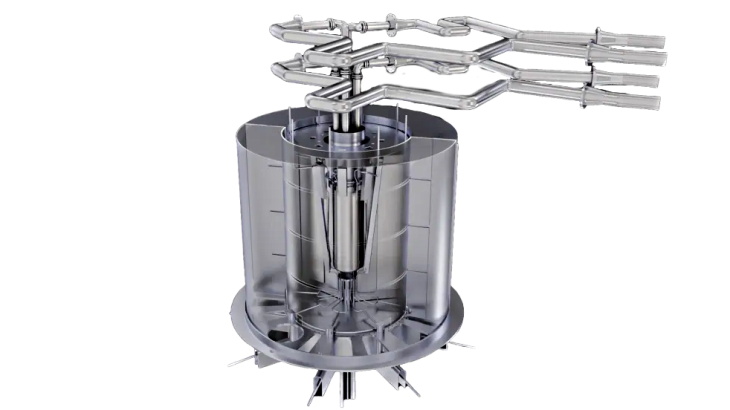
French molten salt reactor developer Stellaria has signed a pre-order agreement with data centre developer and operator Equinix. Under the agreement, Equinix has secured the first power capacity reservation on the Stellarium, the reactor that Stellaria plans to deploy starting in 2035.;
www.world-nuclear-news.org
The traditional advantages of a fusion reactor (little nuclear waste, safety, and cheap fuel) can all be matched or surpassed by MSR reactor which far far ahead in terms of TRL.
I believe, the whole idea of nuclear fusion reactors will become outdated before the first commercial fusion reactor can be built. Here is another MSR project, which is intended to run on nuclear waste:
French molten salt reactor developer Stellaria has signed a pre-order agreement with data centre developer and operator Equinix. Under the agreement, Equinix has secured the first power capacity reservation on the Stellarium, the reactor that Stellaria plans to deploy starting in 2035.;
www.world-nuclear-news.org
The traditional advantages of a fusion reactor (little nuclear waste, safety, and cheap fuel) can all be matched or surpassed by MSR reactor which far far ahead in terms of TRL.
then you have the very heavy ignition system that is two orders of magnitude more powerful than needed for D-3He or whatever.
We're not talking single-digit megawatts, we're talking hundreds of megawatts!
A few days ago, you'll remember, someone shot up the physics lab at Brown University in Rhode Island and they still haven't caught the guy. Providence to Boston isn't that far of a drive...
“It is a bit surreal that the place where you go to share memes or trash-talk about NFL teams is being useful for something of this magnitude,” a user whose post led to a critical tip told MS NOW.
A few days ago, you'll remember, someone shot up the physics lab at Brown University in Rhode Island and they still haven't caught the guy. Providence to Boston isn't that far of a drive...
Sometimes, the most incredible things are the most true.
(I hate it when bright people go bad.)
I saw what I believe was a clever A.I. slop-vid where a coyote image was "running" just behind a roadrunner image in a nature scene.
I mean image of the actual animals--as bathtub-ginned up by A.I. I should say. Remember, Kong had good CGI fur 20 years ago when Jack Black was tracking him as Denham.
Now, I seem to remember coyotes actually can in fact catch those and other birds on occasion.
A.I. imagery is so good now that you have to be a generalist with a little knowledge about a lot of subjects to catch not the footage flaw but the biology flaw. Shuttle Tydirium flying over L.A. is more of a sore thumb. A robo hair-cutting kiosk or nature scene? Not so much.
On fusion
As to the veracity of this very video--that I leave to the brighter specialists here to discern.
Are they full of themselves as the Brown U assailant?
Or brilliant nonconformists?
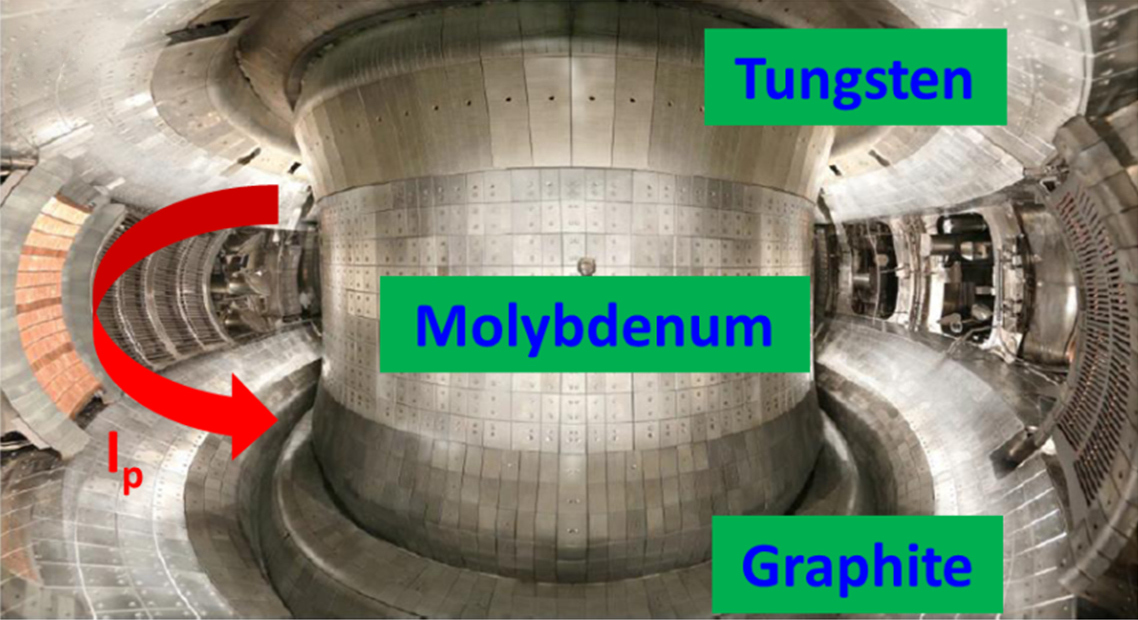
Getting a significant energy return from tokamak-based nuclear fusion reactors depends for a large part on plasma density, but increasing said density is tricky, as beyond a certain point the plasm…
To build a social acceptance model, the workshop brought together 22 community participants and 34 engineering students who were part of a U-M course on the community-engaged design of energy technologies.
A research team led by Prof. Huang Qunying from the Hefei Institutes of Physical Science of the Chinese Academy of Sciences (CAS) and the Shenyang National Laboratory for Materials Science has achieved nearly defect-free bonding between China low activation martensitic (CLAM) steel and an oxide dispersion-strengthened (ODS) alloy using the hot compression bonding (HCB) method.
Los Angeles CA (SPX) Feb 27, 2026 - A national strategy for research on liquid metals in fusion energy systems is taking shape in the United States following a two day meeting at the Department of Energy's Princeton Plasma Physics Lab
www.spacewar.com
The meeting focused on how liquid metals could protect the components that face the extreme heat of fusion plasmas and at the same time enhance overall system performance.
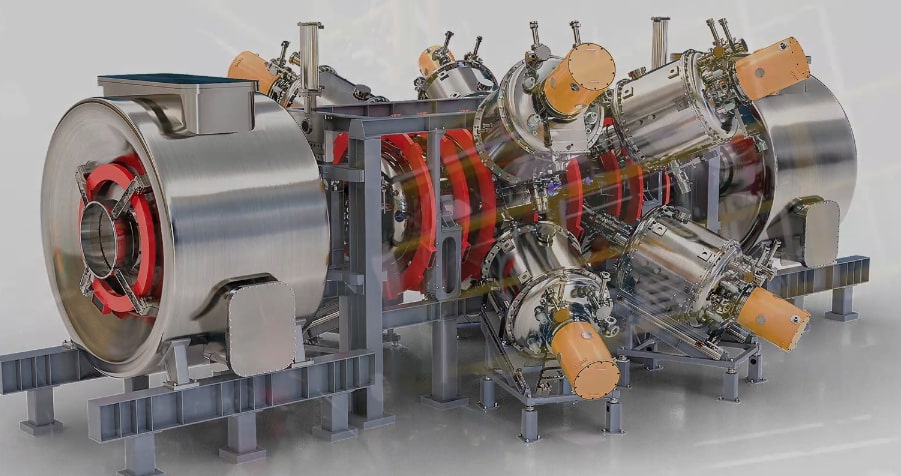
New Zealand-based fusion energy startup OpenStar Technologies says it has become the first commercial company in the world to successfully create and confine plasma using a levitated dipole reactor. ;
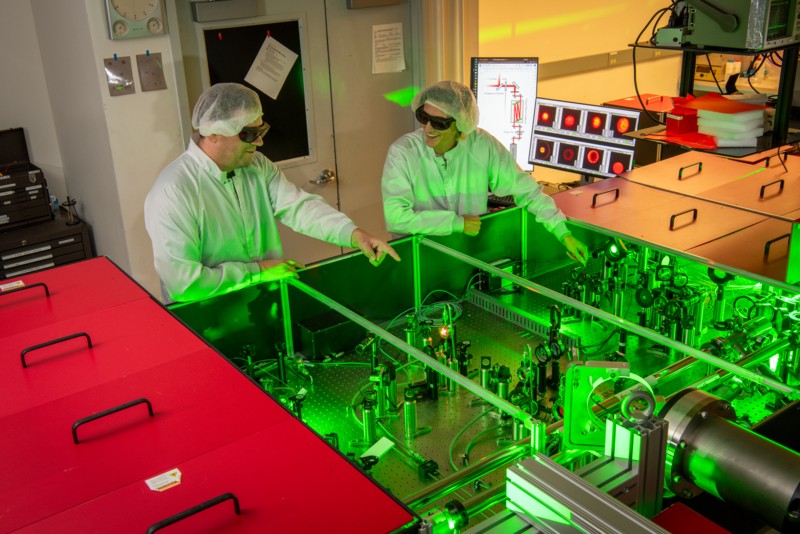
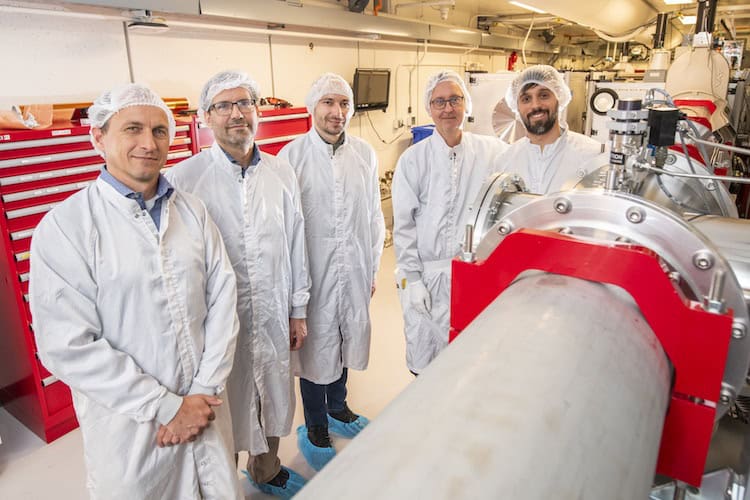
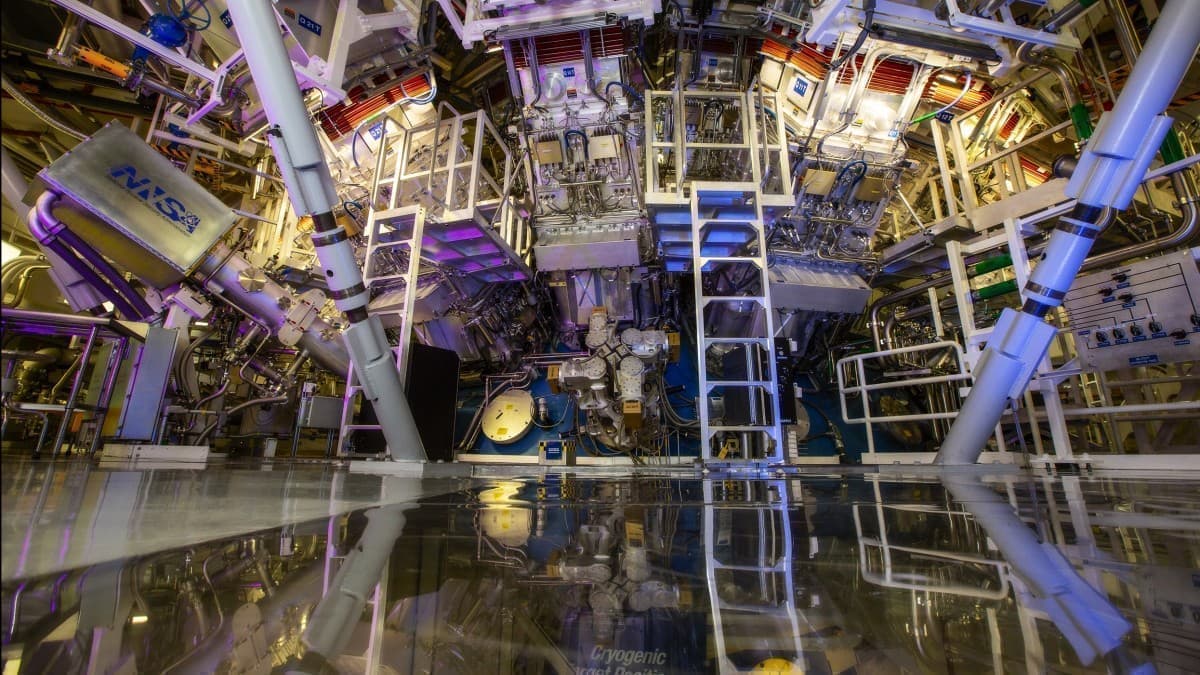
ARC compresses two of the laser facility's beamlines to deliver kilojoules of laser energy in picoseconds. ARC is currently the most energetic short-pulse laser in the world. Using this intense burst of energy, ARC creates high-energy (MeV) X-ray radiographs of materials of interest. Such experiments help scientists understand how those materials react to extreme conditions.
This work establishes the technology basis for a future capability that would radiograph explosively driven hydrodynamics experiments at the sub-microsecond time scale, such as those performed at LLNL's Site 300. The benefit of a laser approach is increased spatial resolution over current high-energy flash X-ray techniques.
In 1952 there were only twenty years left to achieve it, in 2026 it is still twenty years away from achieving it…errare humanum est sed perseverare, diabolicum.
In 1952 there were only twenty years left to achieve it, in 2026 it is still twenty years away from achieving it…errare humanum est sed perseverare, diabolicum.
scientists at ETH Zurich have created magnets that are small enough to fit in the palm of your hand yet powerful enough to rival some of the world's most powerful magnets....
The team built two kinds of magnets that produce magnetic fields of 38 or 42 tesla but have an outer diameter of just 63 millimeters and a bore of 3.1 mm, as they describe in a paper published in Science Advances. To give you an idea of how strong they are, the current record-holding magnet at the National High Magnetic Field Laboratory in Florida has a strength of 45.5 tesla and requires 20 megawatts of power....The researchers tested two prototype magnets and, when they pumped more than 1,000 amps of current through them, achieved magnetic fields of 38 and 42 tesla. "We have demonstrated that magnetic fields of up to 42 T can be achieved using all-HTS magnets, highlighting their potential for compact and accessible high-field magnet technology."
A recent study in Advanced Science reports an innovative, low-cost polymer heat exchanger that could transform how industries manage heat. The device was developed by a Rice University research team led by Daniel J. Preston, assistant professor of mechanical engineering.
Nowhere near enough to handle plasma...but perhaps they could be useful in some other manner.
Fusion power is not a computing issue.
We've done calculations and Simulations with every generation supercomputer from Cray to today. Now at Exaflop level performance, we saw 1000 increase in computing power per decade and still minimal understanding outputs.
Its not computing its physics.
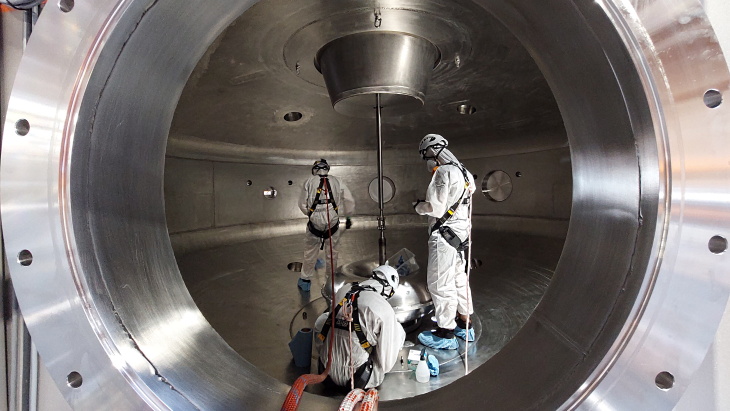
The sun despite its power, overall volume is quite large, hence its actual energy density is not much, about on par light bulb or compost heap. Commercial grade reactor with plasma density for useful power would need to be 6x more volumous than Epcot Spaceship earth
Fusion power is not a computing issue.
We've done calculations and Simulations with every generation supercomputer from Cray to today. Now at Exaflop level performance, we saw 1000 increase in computing power per decade and still minimal understanding outputs.
Its not computing its physics.
The sun despite its power, overall volume is quite large, hence its actual energy density is not much, about on par light bulb or compost heap. Commercial grade reactor with plasma density for useful power would need to be 6x more volumous than Epcot Spaceship earth [SNIP ECKS BAWKS HUEG JPEG]
This is really about how weak gravity is as a containment compared to electrostatic and electromagnetic containment methods. Fortunately for you these are the preferred methodologies Humanity has decided to use for nuclear fusion, mostly on account of not having discovered a substance or system that turns electrons into gravitons yet!
This is really about how weak gravity is as a containment compared to electrostatic and electromagnetic containment methods. Fortunately for you these are the preferred methodologies Humanity has decided to use for nuclear fusion, mostly on account of not having discovered a substance or system that turns electrons into gravitons yet!
It doesn't matter if this fusion process has a Q of a thousand. It's just not practical to develop a power plant that has to run 24/7 365 days a year based on exploding pellets of gold and hydrogen every few seconds, tens of thousands of times a day. It's not impossible, but it runs into economical and sustainability issues, the same that nuclear has. This like instead of using the typical controlled nuclear fission reaction of all modern nuclear plants, you make a "nuclear power plant" that ran by denotating mini nuclear fission bombs to boil water. Not impossible, but...
the enormous amount of energy just to maintain the reaction..and. its like saying we burn 500 tons of coal to run a machine whose energy equivalent to 501 tons.
Uranium processing and mining consumes 24,000 kw-h per kilogram produced. But that kilogram of fuel will produce 24 MILLION Kw-h in its use. So energy output vs consumption is 1000 to 1. Fusion ratio attempted to achive in laboratory conditions of 1 to 1 a miracle. 1.01 to 1 It's not a technological triumph. The Sun makes fusion look easy.That’s because it cheats—with gravity, 15-million-degree heat caused pre-burn by intense friction, and built-in containment. On Earth? We need massive machines to do the same thing. The sun has a volume 1.4x10^33 Cubic centimeters, but power output of 270 watts per cubic meter or 0.00027 watts/cubic centimeter. A 500 Megawatt reactor would need plasma volume of 1.8 Trillion cc volume, 26x Volume of EPCOT.
If/when Human's figure out how to quantize gravity, then maybe.
The phenomenon of fission was discovered in the autumn of 1938. The first self-sustaining chain reacting system, Chicago Pile-1, was made critical four years later in December of 1942. Done on Chalk boards. First power producing reactor EBR-I in 1950s; just 18 years after the discovery of fission. Within 10 years after that, fission power was beginning to contribute substantially to meeting the energy needs of various countries. The phenomenon of deuterium fusion was discovered in 1933, and it has yet to have its CP-1. At this point, we simply do not have enough engineering data to answer questions such as "what configuration will a workable fusion power reactor be constructed in? what materials will it be built from? what is the minimum economic scale of a fusion power plant?" And how do we keep the enormous neutron flux and X-rays from destroying the machines?
Other industrial/practical issues.
Quantities of deuterium/tritium; ideal fuel abundant require huge manufacturing facilities that industry simply hasn't built yet. Since tritium is produced in Fission reactors, it's self defeating prophecy.
Tritium has to bred in fission reactors in large amounts. Canada processes up to 2,500 tonnes (2,500 long tons; 2,800 short tons) of heavy water a year, and it separates out a mere 2.5 kg of Tritium. Global production is only 20 kg a year. So making many metric tons is either back order or building many hundreds reactors; solving energy concerns anyway.
To sum up fusion Think of a miniature Golf Course
.
In this case the hill or Volcano hole. The Ball is a hydrogen nucleus, the HOLE is the target atom, the volcano mound is scattering effect of alike charge. You cant steer the ball, you have to have enough balls. And you need enough energy/temp to get it up the hill. And you have to fence them (Containment) to keep the particles inside and from dissipating. Density, temperature, and confinement. Fission is so much easier. Fission is the same golf metaphor, except now the land is flat, no volcano (neutrons have no charge), the target nucleus is 10x the size of a golf ball (Neutron), so the holes the size of a dinner plate. There's a hundred million holes all over the field (Uranium density), Temperature is 1000x lesser, therefore approachable with Current technology, Containment is irrelevant (except to protect you), the balls are moving slowly and every time a ball goes in the hole 2-3 more come out. Fusion is so hard we worked on it for 70 years, still doesn't work, Army of Ph.D scientists, engineers....Petaflop scale supercomputers, Machines that costs tens of billions of dollars and they still dont break even. Fission is so simple we solved it 70 years ago on Chalkboards, reactors designed on slide rules and PAPER. Fission is so simple you can take a bunch of high school kids who never saw a reactor before in their lives, train them in ONE year and they can run a nuclear sub.
High energy neutrons from fission reactions operate 0.1 to 20 Million electron-volts. Fusion can produce neutrons at 100 MeV those high energy neutron has kinetic energy traveling 14,000 to 40,000 km/s or greater. Basically 13% speed of light. But unless they're breeding fuel with Collission they're simply bouncing around inside to either pockmark and degrade reflector or can stifle energy output of fusion by striking adjacent atoms robbing potential reactivity. Fusion produced neutrons are extremely high energy, thus conventional reflector will degrade over time no matter how thick you make it there are simply too many. Fission reactors stray neutrons make up about 1% mass atomic reaction. In fusion about 20%. Another issue neutrons aren't the only concern, so are high energy X-Rays
Sum up the difference imagine going to a bowling alley, fission you bowl the ball they strike the pin and adjacent pins may be triggered to fall. Fusion imagine a small army throwing balls at point blank against the pins and never stopping. its like a doctor testing your knee reflex with a sledge hammer
This site uses cookies to help personalise content, tailor your experience and to keep you logged in if you register.
By continuing to use this site, you are consenting to our use of cookies.




 www.ms.now

 www.nextbigfuture.com

 tae.com


 despite its power, overall volume is quite large, hence its actual energy density is not much, about on par light bulb or compost heap. Commercial grade reactor with plasma density for useful power would need to be 6x more volumous than Epcot Spaceship earth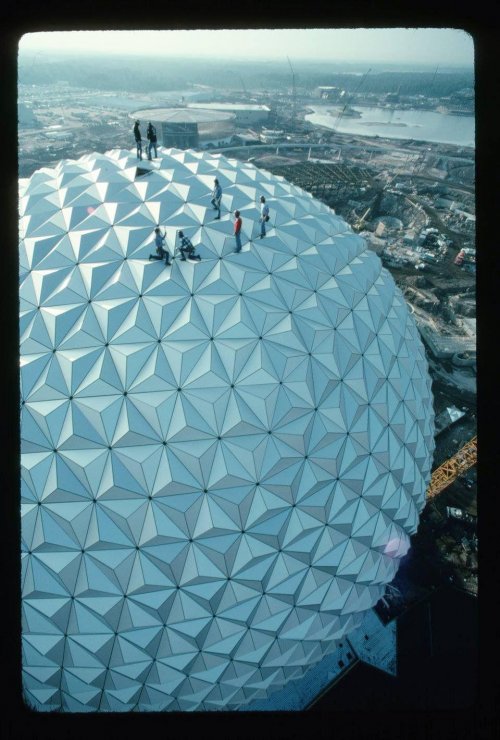




 oilprice.com


