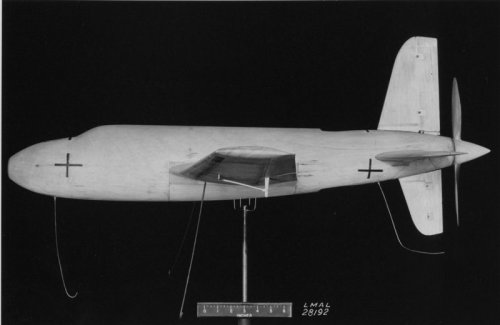
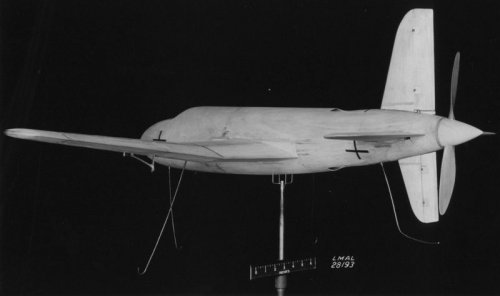
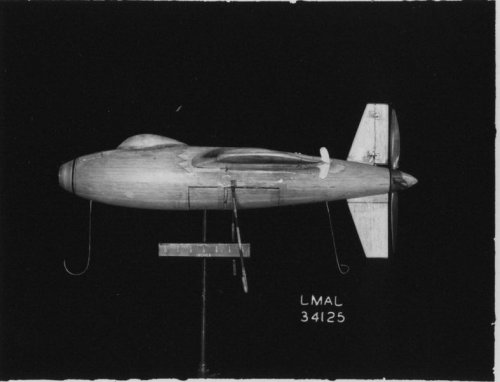
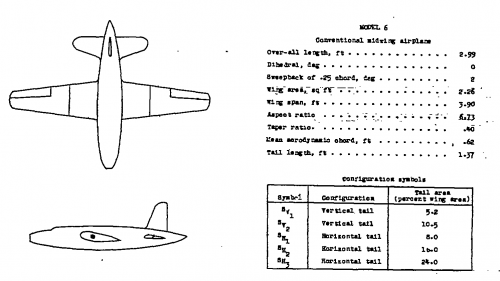
Northrop N-6 fighter project from NACA

Great find. Are you positive about identification? "Project 6" could very well be Northrop Model N-6, described as a "single-engined interceptor/fighter project for U.S. Navy", but we need to be sure.
 
Mentioned as the N-6 in MiniDocavia 21
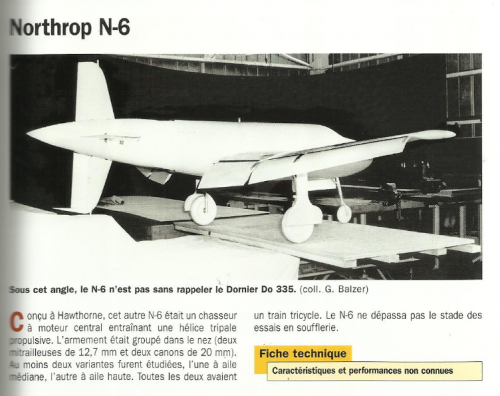
'Les Avions et Engins Northrop' by A. Pelletier - p.51 photo of the same model
with nosewheel undercarriage
 
Hesham, your link says the picture (windtunnel model) is dated May 1942. Could this have been considered for the pusher program that led to XP-54 (twin-boom), XP-55 (canard), XP-56 (tailless)? this N-6 would add another layout (aft of a normal tail)... Great find yes!
 
I think you are right my dear Tophe,

that is because in R-40C competition,that was 50 projects
and aircraft submitted to this tender,and may be the N.6
was one of them.
 
Again a great finding hesham, specially for me, since I'm an American pre-1945 project lover.

Thanks to Lark's post I noted some details from Minidocavia's N-6 entry:

No references about being a naval fighter design.

Design is dated 1941: should be a bit late, according to my sources, to consider it an R40-C entry. R40-C was issued in late 1939 with winning design scheduled to enter fighting units by 1942. You can find the 50 entries listed at American Secret Pusher Fighters of World War II by Gerald H Balzer page 15.

http://www.specialtypress.com/vstore/showdetl.cfm?DID=8&Product_ID=1847&CATID=1

Northrop submited 5 entries, all based in the N-2 design which became the XP-56.

The N-6 photo in Minidocavia is credited to Mr Balzer, but curiously this design is not included in his "Pusher Fighters" book.

So, anyone can email Mr Balzer and ask about Northrop N-6?. I'll see what I can do...

stay tuned ;)
 
Very , very interesting. Thanks hesham for spot this one.

Which is the scale of this kind of wind tunnel models ? We've here ruler in inches so we can calculate some measures.

Regards
Luis
 
Wow
If I did not know better, I would say that Northrop N-6 was strongly influenced by the Douglas XB-42 Mixmaster or the other way around.
Didn't Jack Northrop start at Douglas?

Regards Pioneer
 
Pioneer said:
Wow
If I did not know better, I would say that Northrop N-6 was strongly influenced by the Douglas XB-42 Mixmaster or the other way around.
Didn't Jack Northrop start at Douglas?

Regards Pioneer

Northrop's first self-named company was purchased by Douglas and became the El Segundo division. However, the N-6 was designed under Northrop SECOND eponymous company, independently from Douglas.
 
Jack Northrop did not start at Douglas. He worked there during the 1930s and several of the Douglas milestone designs were the result of Northrop's genius, not the other way around. Prior to his time at Douglas, he had designed the Northrop Alpha to Gamma series which were pioneering all metal aircraft designs. He had also earlier built a flying wing design (with tail) and also happened to design the Lockheed Vega. Absolutely one of the major pioneers and innovators of US aviation technology.

Best Regards,

Artie Bob
 
Artie Bob said:
Jack Northrop did not start at Douglas. He worked there during the 1930s and several of the Douglas milestone designs were the result of Northrop's genius, not the other way around. Prior to his time at Douglas, he had designed the Northrop Alpha to Gamma series which were pioneering all metal aircraft designs. He had also earlier built a flying wing design (with tail) and also happened to design the Lockheed Vega. Absolutely one of the major pioneers and innovators of US aviation technology.

Best Regards,

Artie Bob
Northrop also worked at Boeing-Seattle Plant 2 for a short time. SP
 
Here is another interesting design found in the NACA archives which bears some similarities with Northrop's Model 6 and Douglas's Mixmaster...
 

Attachments

  • Model 32-I.jpg
    Model 32-I.jpg
    35.8 KB · Views: 751
If I did not know better, I would say that Northrop N-6 was strongly influenced by the Douglas XB-42 Mixmaster or the other way around.

The XB-42 is a direct derivative of Douglas DS-312A design.

The N-6 could have been developed from Northrop N-2 (XP-56) experience. Remember the previous N-2 was a pusher design too.

Pusher designs were thought to be a good configuration for "fighters of the future" in late 30's because allowed a mighty firepower concentration in the aircraft nose. That configuration was selected for several R-40C entries and early 40's designs. The turbojet invention prevented most of it to left the drawing board.
 
For an air-cooled radial engine?

In my opinion, if it was conceived by 1941-42 the logical choice was to be one of the powerful-liquid cooled engines then in development (which later proved to be a failure).

The wind tunnel model is poor detailed so I think that's the reason no intakes are present.
 
So, anyone can email Mr Balzer and ask about Northrop N-6?. I'll see what I can do...

I'm sorry I found no way to contact Mr Balzer from specialitypress website. Mistery unsolved by the moment.

My guess:

Northrop was engaged in XP-56 development at that time. If this N-6 was not intended to be a replacement, which seems ilogical to me, we should consider other roles for it. The N-6 looks bigger than the N-2 (XP-56), unless considering a more powerful engine, N-6 permormance would be under N-2 expected figures.
I suggest the N-6 could be an attack type or a long range "Pacific theater" fighter-bomber. A sort of "US Do-335" if you want.
 
pometablava said:
For an air-cooled radial engine?

In my opinion, if it was conceived by 1941-42 the logical choice was to be one of the powerful-liquid cooled engines then in development (which later proved to be a failure).

The wind tunnel model is poor detailed so I think that's the reason no intakes are present.

It looks to me like their is an annular opening at the nose and a slot in the ring cowling behind it. Or a dark band. Maybe it's some sort of nose mounted annular radiator?
 
I have studied these wind tunnel models of pusher aircraft at some length due to their relation to some projects I'm working on.

One thing I've noticed from my research in the 1939-1945 era (and before and after, for that matter) is that certain design characteristics and shapes were specific to individual aircraft manufacturers/design staffs, ie Northrop flying wings and tailless aircraft, Boeing rounded-nose bombers and square wingtips and the distinctive tail shape, Douglas bug-eye canopies/wing shape and location/pusher props and tail squarish tail shapes, etc.

These wind tunnel models just scream DOUGLAS to my eye. The shoulder-mounted high-aspect square-tipped wing, the shape and disposition of the top and bottom vertical stabilizers, the shape of the fuselage and nose, etc.

Thus, for my humble opinion, these wind tunnel models represent experiments by Douglas that began at least with the DS-321A and expressed itself in metal with the XA/B-42 and XB-43.

AlanG
 
ACResearcher said:
These wind tunnel models just scream DOUGLAS to my eye. The shoulder-mounted high-aspect square-tipped wing, the shape and disposition of the top and bottom vertical stabilizers, the shape of the fuselage and nose, etc.

Thus, for my humble opinion, these wind tunnel models represent experiments by Douglas that began at least with the DS-321A and expressed itself in metal with the XA/B-42 and XB-43.

AlanG


My dear Alan,


I disagree with you,the Northrop N-6 is very close to this wind tunnel model,and here it is from Les Avions et engins Northrop book.
 

Attachments

  • N-6.png
    N-6.png
    516 KB · Views: 713
Last edited:
Let's not forget that the Douglas El Segundo division took over where the old Northrop stopped.

It is possible that the new Northrop company and Douglas El Segundo pursued similar designs that were sketched out under the old company.
 
Skyblazer said:
Let's not forget that the Douglas El Segundo division took over where the old Northrop stopped.

It is possible that the new Northrop company and Douglas El Segundo pursued similar designs that were sketched out under the old company.


May be that's right my dear Skyblazer.
 
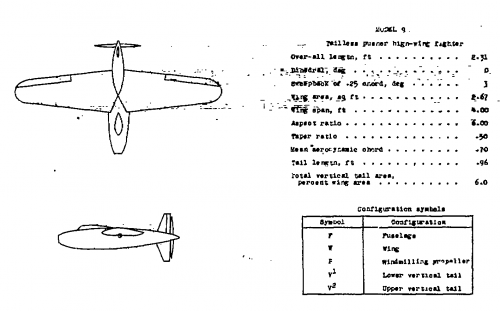
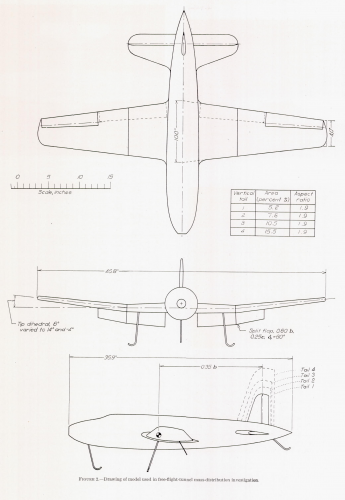
both of the designs in this thread pop up in a few other naca reports

http://hdl.handle.net/2060/19930081690
 

Attachments

  • mys 1.png
    mys 1.png
    43.3 KB · Views: 408
  • mys 2.png
    mys 2.png
    29.8 KB · Views: 340
more

http://hdl.handle.net/2060/19930091848
http://hdl.handle.net/2060/19930092561
 

Attachments

  • myst 3.png
    myst 3.png
    1.8 MB · Views: 358
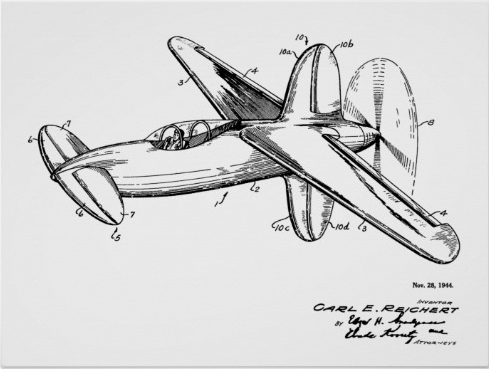
Very related design;

https://www.zazzle.com/1944_pusher_airplane_patent_art_drawing_print-228680210099507484
 

Attachments

  • 1.png
    1.png
    118 KB · Views: 208
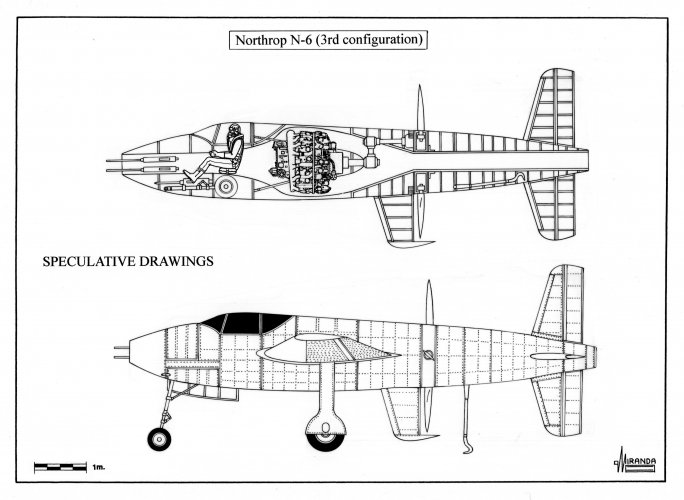
Northrop N-6​


During the summer of 1940 the need to improve the performance of the new Grumman F4F-3 was revealed, when the Wildcat entered squadron service on December 31, 1940, its speed was 35 mph lower than that of the Supermarine Spitfire Mk. I which used a V-12 engine with 170 hp less than the radial P&W R-1830-76, chosen by the U.S. Navy for its reliability and ease of maintenance aboard aircraft carriers.

Also, Messerschmitt's latest model, the Bf 109 E-3 armed with 20-mm cannons exceeded the speed of the Wildcat by 18 mph, using a V-12 engine with 25 hp less than the P&W.

The problem was the parasitic drag generated by the radial engine and the only thing that Grumman's designers could do to bridge the technological gap with the Europeans was to continue using more powerful radial engines.

The brute force solution recommended by the Bu Aer demanded a structural reinforcement of the Wildcat airframe, a larger diameter propeller to absorb the greater engine power that demanded the redesign of the landing gear and an increase in the wing surface to compensate for the excess weight.

The result was a larger, heavier aircraft with few aerodynamic refinements.

The Grumman F6F Hellcat began to be designed in September 1940 with an experimental Wright XR-2600-10 radial engine rated at 1,600 hp driving a three-bladed Curtiss Electric propeller.

Jack Northrop knew that the only way to overcome Grumman's proposal was to offer the US Navy a faster fighter with excellent STOL characteristics and armed with 20-mm cannons.

The N-6 was designed using drag reduction pusher technology (developed by Douglas for his project DS-312A) with a shoulder wing with 60-degrees zap-flaps.

The experience gained by the French with their Wibault 74 and Dewoitine D-373 naval fighters had already shown during the thirties that the maneuverability of the parasol-type wing was inferior in dogfighting to that of low-wing monoplanes, but at that time the only possible adversary for American naval fighters was the fast dive bomber Junkers Ju 88, because the US Navy aircraft carriers operating in the Atlantic Ocean would only be used in neutrality or convoy escort missions away from European coasts. No possibility of fighting with the Axis fighters

In late 1940 the U.S. Navy signed a contract for the development of a Northrop naval fighter with radial engine mounted inside the fuselage, behind the cockpit, and pusher configuration.

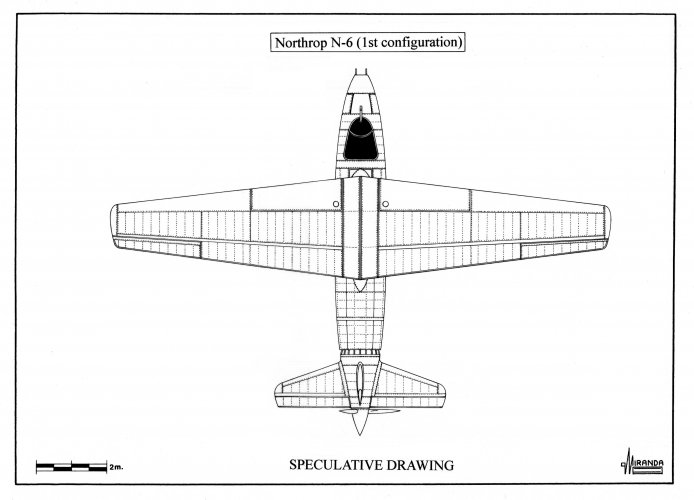
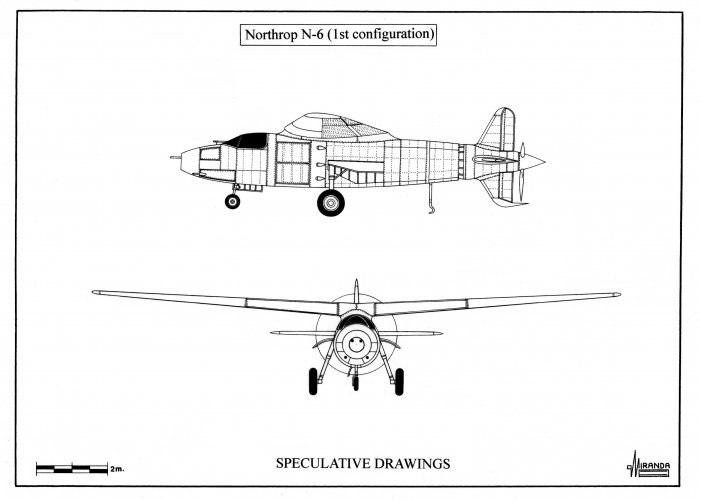
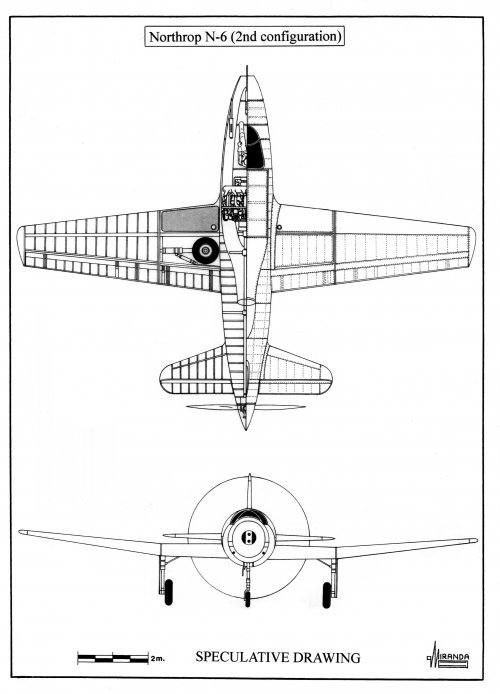
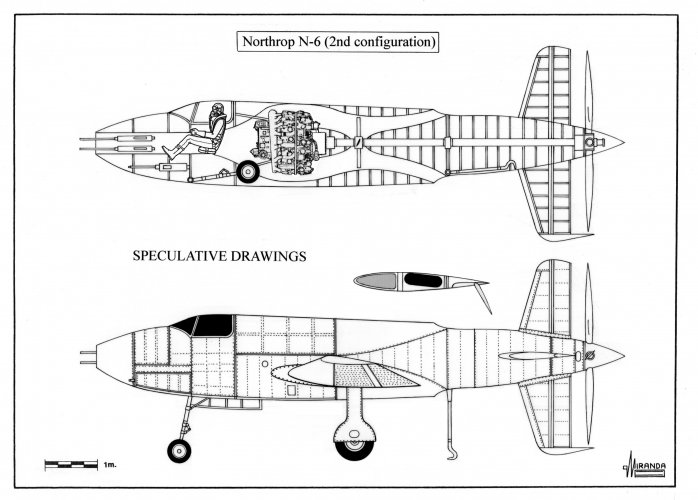
The N-6 was proposed in three configurations:

-Shoulder wing with XR-2600-10 engine and pusher propeller.

-Medium wing with R-2800-21 engine and pusher propeller.

-Medium wing with pusher propeller mounted in the fuselage behind the wing.

First Configuration technical data

Wingspan: 14.30 m, length: 10.21 m, height: 2.94 m, wing area: 28 sq. m, fuselage diameter: 1,480 mm, engine diameter: 1,397 mm, power plant: one Wright XR-2600-10, 14-cylinder air cooled radial engine, rated at 1,900 hp, driving a three-bladed Curtiss Electric pusher propeller with 2,200 mm of diameter, proposed nose armament: two 0.5-in heavy machine guns and two 20-mm cannons, cooling system: nose air intake and tail mounted annular exhaust ring, main landing gear members retracting into the rear fuselage.

Second Configuration technical data

Wingspan: 13.05 m, length: 10.00 m, height: 3.8 m, wing area: 27 sq. m, fuselage oval section: 1,560 x 1430 mm, engine diameter: 1,342 mm, power plant: one Pratt and Whitney R-2800-21, 18-cylinder air cooled radial engine, rated at 1,850 hp, driving a three-bladed Hamilton Standard pusher propeller with 3.050 mm of diameter, proposed nose armament: two 0.5-in heavy machine guns and two 20-mm cannons, cooling system: nose air intake and two tail mounted exhausts, main landing gear members retracting into the wings.

Third Configuration technical data

Wingspan: 13.05 m, length: 10.00 m, height: 3.8 m, wing area: 27 sq. m, fuselage oval section: 1,560 x 1430 mm, engine diameter: 1,342 mm, power plant: one Pratt and Whitney R-2800-21, 18-cylinder air cooled radial engine, rated at 1,850 hp, driving a three-bladed Hamilton Standard pusher propeller with 3.050 mm of diameter, proposed nose armament: two 0.5-in heavy machine guns and two 20-mm cannons, cooling system: nose air intake and tail mounted exhaust, main landing gear members retracting into the wings.

 

Attachments

  • 719.jpg
    719.jpg
    526.1 KB · Views: 76
  • 720.jpg
    720.jpg
    466.2 KB · Views: 75
  • 715.jpg
    715.jpg
    828.1 KB · Views: 75
  • 710.jpg
    710.jpg
    708.8 KB · Views: 78
  • 740.jpg
    740.jpg
    701.6 KB · Views: 84

Similar threads

Back
Top Bottom