Many thaks to Flaterick to pointing out my patent research thing. I would not have said it myself.
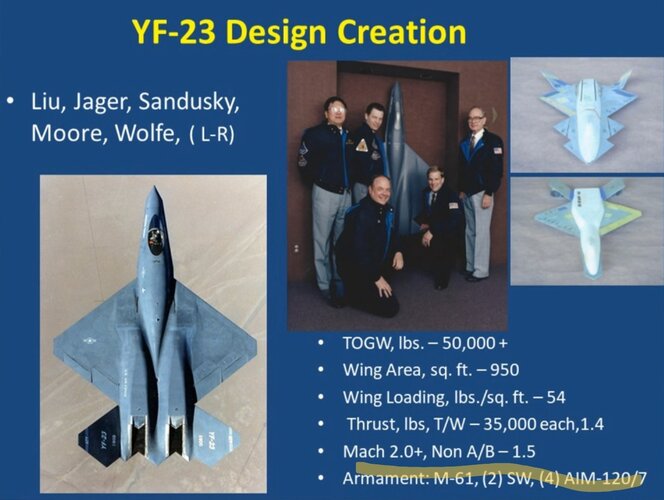
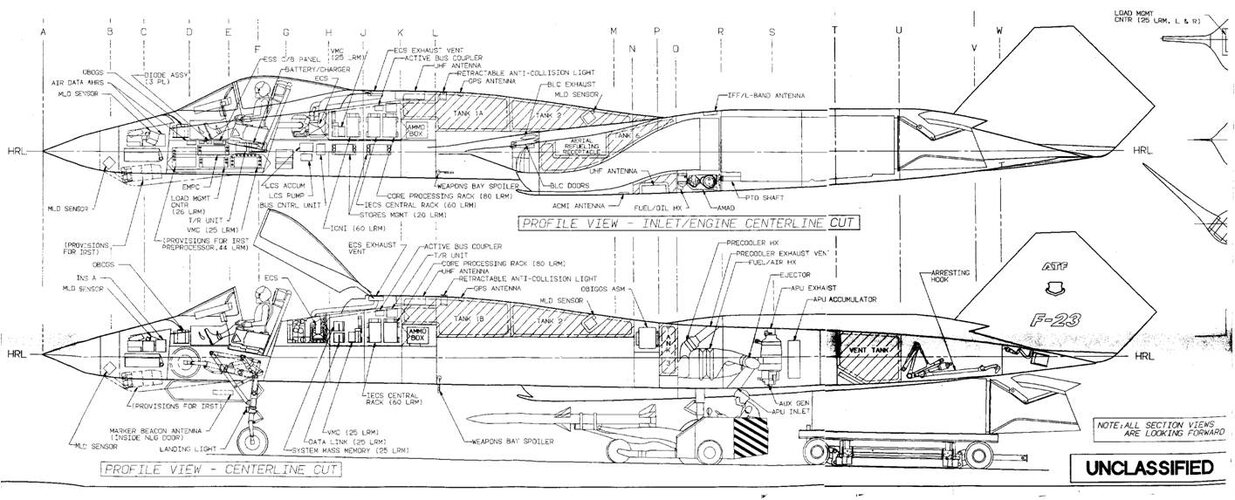
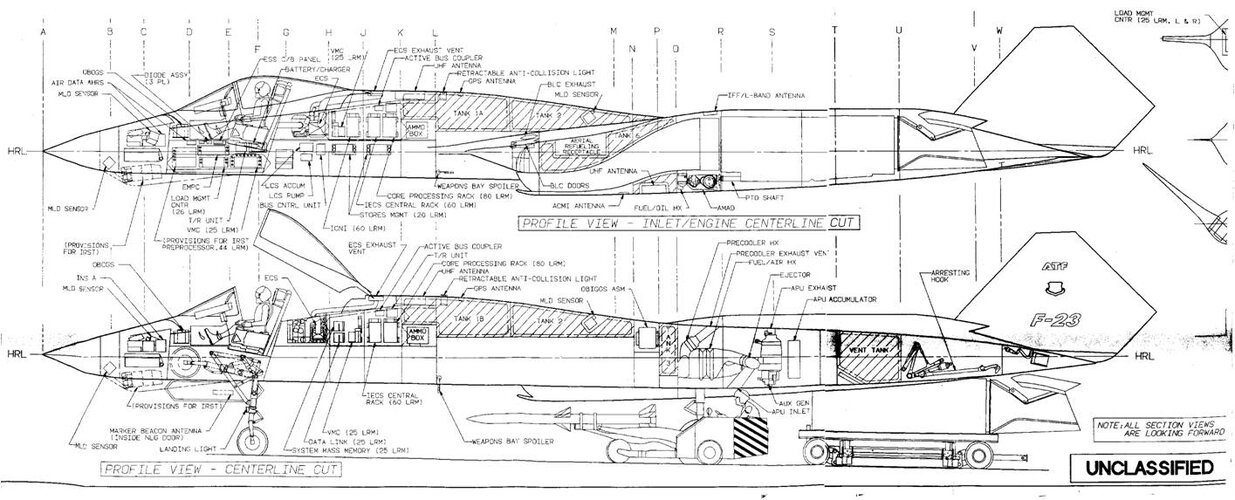
Still elmayerle had a very good in Reply #21 . YF-23 design allowed not only aft and fore movement of the Bays but also increase in depth. There are no engines or airducs on top of the bay, only fuel and minor systems..
Looking at the F-23A as an aircraft designer I would say: yes its longer but since when lengthening the airplane is more risky than making it shorter, because the F-22A is indeed shorter and thinner in its middle section where you have weapons, fuel, air intakes, gun magazine. Packing the same stuff in less space is more riskier to me. Also lets not forget that F-22A had completely redesigned main weapons bay doors.
Now if we recall some of the problems the F-22 design went trough.
1. Overheating rear fuselage in Supercruise. Compare the rear of YF-22 and F-22A.How thinner it is on the production model. The F-23 with widely spaced engine blocks would not have had the problem of overheating.
2. Shockwaves in the Engine inlets requiring a strengthen forward fuselage after Raptor 01. No wonder, the air intakes on the A model are obviously shorted than the prototype. The F-23A has inlets way more optimized to handle supersonic airflow and the adoption of the concept by the F-35 only proves it.
3. F-22 was always criticized by not being able to carry big bombs. The latest FB-22 proposal features bulged up main weapon doors so it can house the 2000lb JDAM, yet the fuselage is the same is used with no lengthening to reduce cost. The YF-23 had a deeper bay and would have no problem fitting the 2000lb JDAM.
4. The 1994 redesign due to signature problem, costing probably a year delay in the F-22 program. Looking at the F-22A and you ca see it borrowed a lot of the Black Widow features: he shape of the nose, the way the aircraft brakes, the probes measuring AoA on the side of the radome, the minimum number of edges every panel, the topside of the engines, the clipping of the all moving tails. Yet the F-23A design features stealth/performance blending from the next level, like the inlet cone design.
5. Weight. The inability for the F-22 design to meet it weigh target is attributed to the failure of its designers to meat their goal of 50% Composites in the Airframe(2 as well). From the news article flaterick send me it is clear that the F-22A proposal in material is similar to the YF-23 design (one step behind). Also the F-23A featues not only 50% composits but BMI termosets account for a higher percentage out of that than the same BMI termoset do out of the total composits used on the F-22A, which are only 24%.(Flight International March 1997)
To me the F-23A would have had easier time meeting its weight target. As far as risk goes the change between Lockheeds 1985 winning design and the YF-22 tells me all I need to know about confidence in concept and the ability of USAF to choose their aeroplane based on their flying qualities. Same with the Rockwell F-X submition looking so much like SU-27. I hope the PAKFA does not turn out the be looking like the YF-23. I am going to be massively upset with defense secretary Rice, who chose the F-22
Regards, to all
P.S. I hope you are all enjoyng this discusion as much as I am