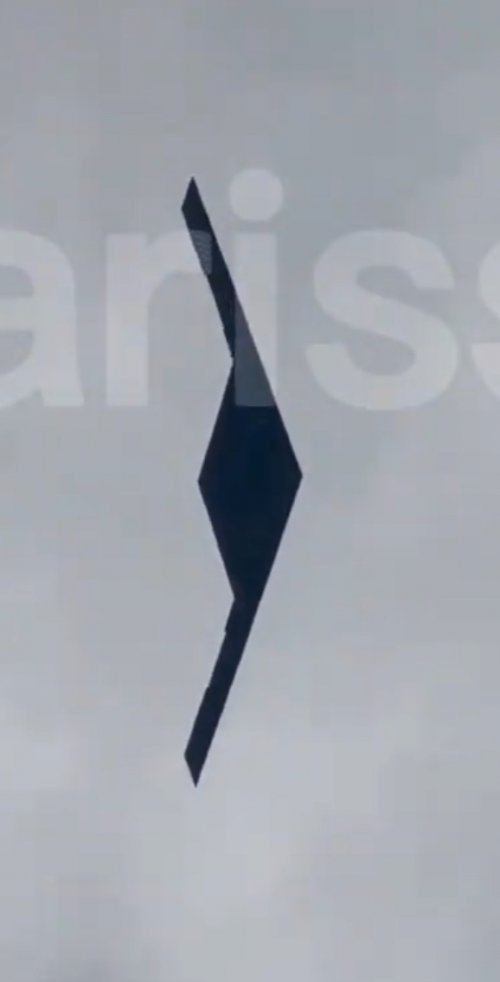
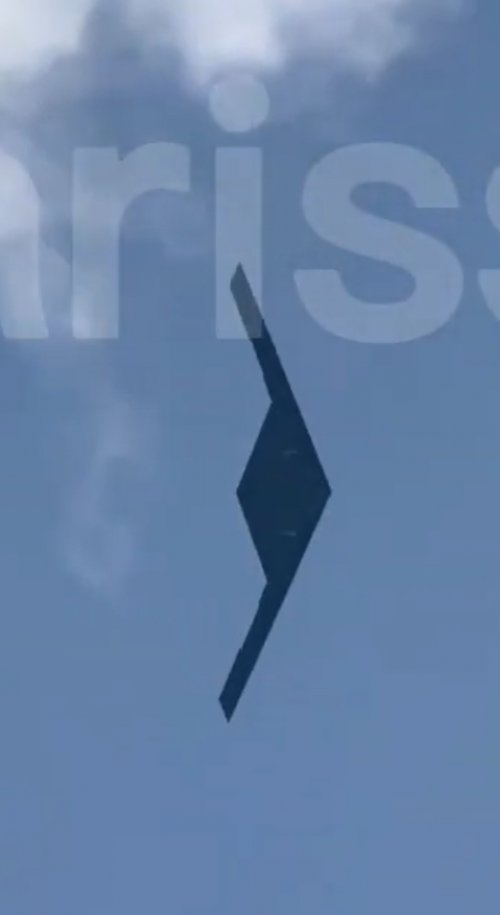
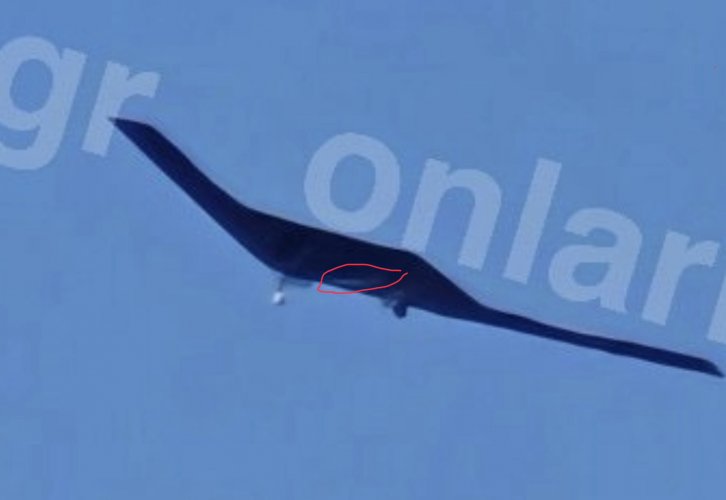
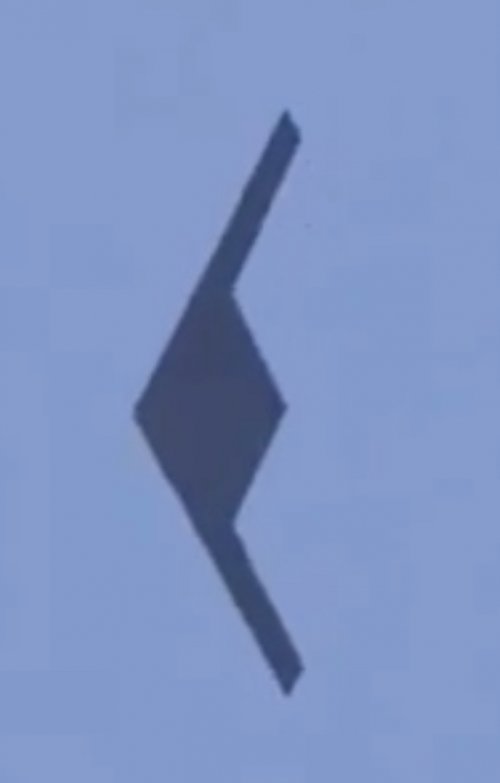
So, there are at least two, maybe even three Stealth Drones flying around. Exiting times!
More than that


So, there are at least two, maybe even three Stealth Drones flying around. Exiting times!

Thank you for your information, I trust you have very good sources.
Do you have any idea where they do their first flights? The NG hangar at Groom seems quiet, with no more than 25 people working there based on the number of cars (and I’m generous at assuming 2 persons per car - unlikely in the USA). I guess that could be enough for a flight test team, but then they would have to do the complete assembly in Palmdale and do first flights out of there.
I also think regular C-17 or C-5 flights from Palmdale to Groom Lake would be noticed.

It could be, but it seems these shelters are easily accessible and do not have additional security as we’ve seen with other suspected RQ-180 hangars. Of course, that might have changed if they deployed there recently.During this conflict? I'm not so sure about that, Iran already struck Nakhchivan and it might have prompted a move.
Larissa underwent infrastructure upgrades over the last couple years, including adding two shelters at the east end of the base that are a fair bit bigger than the MQ-9s deployed there. Not out of the realm of possibility.
View attachment 805934

What makes you believe that a country who pioneered the military usage of drones in the 21st century, has a robust tech sector, established MIC and unprecedented access to confidential US material couldn't develop something as basic as a stealthy, flying wing ISR drone?The Israeli’s are known to operate the RA-01, which they almost certainly could not develop themselves
Our esteemed member Quellish claimed, to my surprise, that the Israeli’s did not have the infrastructure, and probably not the technology for low observable aircraft.What makes you believe that a country who pioneered the military usage of drones in the 21st century, has a robust tech sector, established MIC and unprecedented access to confidential US material couldn't develop something as basic as a stealthy, flying wing ISR drone?
Everyone and their mom developed at least a prototype of similar drones since the 2010s.
They don't need the infrastructure to develop it domestically. They can utilize US infrastructure and ranges to aid in their design processes. A stealth helicopter is something that's cost prohibitive and overly expensive for major players like the US as well, abandoning the RAH-66 and only having had an alleged small number of modified UH-60s. A helicopter is an entirely different undertaking than a medium sized ISR drone. The US, Russia, UK, France and others like the less established Turkey have produced similar craft. Not to mention the elephant in the room that's China which has several dozen different low observable drone designs. Developing such a system, with access to US infrastructure and possible various pieces of intel (obtained consentually or not) should make it fairly easy for a country like Israel to develop such an aircraft. Especially as they have the sensor and avionics side of things nailed down all by themselves anyway. Which leaves just the airframe, the easier side of things.Our esteemed member Quellish claimed, to my surprise, that the Israeli’s did not have the infrastructure, and probably not the technology for low observable aircraft.
While I don’t know about the technology, they definitely don’t have ranges to develop stealth technology.
I was reinforced in this belief when I saw video footage of the 2024 Masyaf strike. I had long suspected Israel to use stealth helicopters, but if this raid didn’t justify their need, I think it’s safe to say they don’t have them.
So, even a country as advanced as Israel has its limitations.
And a stealth drone is far from ‘basic’.


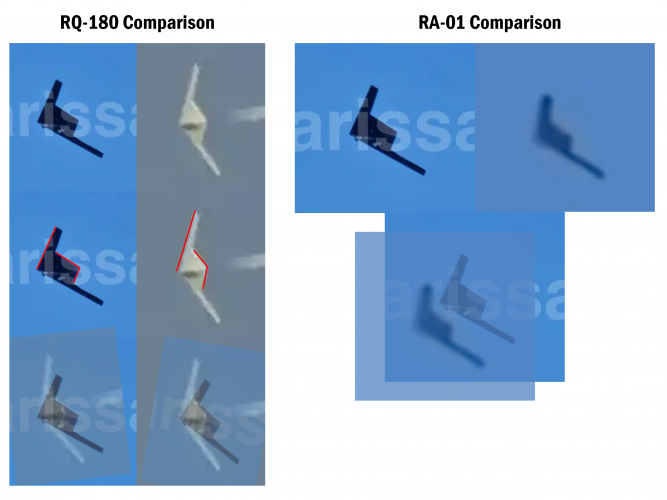
Interesting control surfaces number/placement/movement that seems mimic Raider's ones (vice versa to be correct)Huh…

Well well from this angle it certainly does look like the presumed RQ-180 we saw on the pictures made an emergency landing…Huh…
Don't be distracted by the color. That's a rookie mistake.Also the wrong color
Don't be distracted by the color. That's a rookie mistake.
They don't need the infrastructure to develop it domestically. They can utilize US infrastructure and ranges to aid in their design processes.
I think you got the power dynamics at work reversed, but that's okay.Not without a lot of public paperwork like export licenses. Giving a foreign company or organization access to sensitive export controlled data is a big deal, and cannot be done secretly AND legally. LO observable testing facilities are considered very sensitive and export controlled. As far as sharing VLO technology, I know of only 2 countries the US has shared with, and in both cases it has been very restricted and controlled.
If it's the RQ-180, why shouldn't it be used? The RQ-170 was deployed during "peace time" and conventional ISR and strike UAVs like the Reaper, Heron, Hermes etc. have been proven extremely vulnerable with unacceptable rates of attrition. So utilizing a much more survivable and persistent drone ultimate seems logical.With a F35 hit by the Iranians, and the Americans actually using probably their most advanced stealth drone, it seems that despite claims, air superiority over Iran has not yet been reached.
Unless the RQ-180 is the communications hub that some people have said it’s true purpose was.
Depends on what "air superiority" definition one has in mind, and what does it in practice actually mean. It's unlikely for anyone to accomplish a total control of a given air & ground space (with respect to GBAD), creating risk-free environment. One hit out of thousands of sorties doesn't necessarily invert the narrative (implying the battlespace is suddenly hotly contested).With a F35 hit by the Iranians, and the Americans actually using probably their most advanced stealth drone, it seems that despite claims, air superiority over Iran has not yet been reached.
As far as sharing VLO technology, I know of only 2 countries the US has shared with, and in both cases it has been very restricted and controlled.

A LOT of people, not just here, are either willfully or innocently unable to distinguish between air superiority and air supremacy as terms of art, similarly unable to grasp that you can have superiority or supremacy in a particular corridor or block without blanket domination of an entire national airspace.Depends on what "air superiority" definition one has in mind, and what does it in practice actually mean.

When's the last time an Iranian aircraft took to the air? Exactly.With a F35 hit by the Iranians, and the Americans actually using probably their most advanced stealth drone, it seems that despite claims, absolute air superiority over Iran has not yet been established.
I can tell I'm going to regret bringing this up, but I feel I have no choice. You've decided that this cannot be, because you aren't aware of it. That's... an interesting entitlement or sense of authority. All due respect.
First, a paint change from white to black represents a minor modification, even if it invalidates Shikaka’s nickname. Second, the extended outboard wing sections align more closely with the previous imagery of Northrop’s aircraft, not RA-1. Third, the “RQ-180” likely features weapons bays, as Aviation Week has previously reported, which also aligns with the deep internal bays shown in the configuration of the Lady of Larissa.
Aircraft trackers noted that two Air Force C-17s operated unusual flights on Feb. 25 and March 9 from Edwards AFB, California, to Larissa Air Base. The flight in February flew to the Greek base via Gander, Canada, and Ramstein Air Base, Germany, while the recent flight also routed via Gander with a stop at Spangdahlem Air Base in Germany. Perhaps more significantly, a larger Lockheed C-5M, which is thought may be capable of transporting the “RQ-180” in one piece, also flew to Larissa on Feb. 25 in company with the first C-17, routing from Tinker AFB, Oklahoma, via Spangdahlem.

Well consider how big some classified satellites are believed to be.“…a larger Lockheed C-5M, which is thought may be capable of transporting the “RQ-180” in one piece”
Wait, what?
From the quoted link:
IMOHO, a very lightly loaded wing resulting from a low mass/high span aircraft• A highly loaded airfoil with extended, slender outboard sections, the hallmarks of a wing capable of handling large aeroelastic deflections.
From the quoted link:
IMOHO, a very lightly loaded wing resulting from a low mass/high span aircraft
The bulged center body indicates a mass distribution axially maximized to have wing straight deflection (hence better RCS capability). See Northrop/Scaled Composite test a/c that exactly used that configuration, but with a manned tubed fuselage.
I would argue that a stealth helicopter is one of the single most complex things to develop. Arguably more complex than nuclear submarines.Our esteemed member Quellish claimed, to my surprise, that the Israeli’s did not have the infrastructure, and probably not the technology for low observable aircraft.
While I don’t know about the technology, they definitely don’t have ranges to develop stealth technology.
I was reinforced in this belief when I saw video footage of the 2024 Masyaf strike. I had long suspected Israel to use stealth helicopters, but if this raid didn’t justify their need, I think it’s safe to say they don’t have them.
So, even a country as advanced as Israel has its limitations.
And a stealth drone is far from ‘basic’.
America’s most highly classified spy plane — an aircraft so secretive we don’t even really know what it’s called — seems to have just broken cover over Greece, potentially making an emergency landing at Larissa National Airport and air base.