Northrop Grumman "RQ-180"

So I'm feeling a number somewhere between ~9 and ~24 as the likely number of RQ-180s in service.
There were nine preproduction airframes. One crashed in December 2016 and some have likely been retired. I wouldn't be surprised to find that one was relegated to the FTU ("schoolhouse") at Beale for ground training and familiarization purposes. The first production model joined the fleet in January 2017 and by late 2020, there were supposedly five or six more with others on the way.

Developmental testing took place at Groom Lake and apparently continued long after operational testing began at Edwards AFB in 2014.
 
I was asked by a former NG colleague if I was interested in returning to the company around the 2007 timeframe to work flight test on a new program but my clearance had expired, but I was working on the Phase I of Stratolaunch Roc (Lofty) at the time. I left NG in 1996.
 
Why the UAV improvements at TTR for the RQ-170 if it’s largely based at Creech Afb? Or is it merely being controlled at Creech and are the aircraft themselves based at Tonopah?

RQ-170 was originally based entirely at TTR until the move to Creech in 2009-2011
There is still a detachment at TTR
 
RQ-170 was originally based entirely at TTR until the move to Creech in 2009-2011
There is still a detachment at TTR

As far as I can see both squadrons (30th and 44th) that operate the RQ-170 have moved back to Creech. But you’re better at this stuff than I am, so I’m happy to be corrected.

I also wonder why the USAF would want RQ-170’s at both TTR and Creech. It doesn’t make sense logistics wise. The only reason I can think of if there are other RQ-170’s based at TTR is that those are operated by the CIA.

Based on the numbers of cars parked, a lot seems to be going on at the two buildings on the north side at TTR between the Blue and White hangars, next to the massive UAV mast.

The hangars next to the tower also seem UAV-related. They’re big, too.

Some shadowy UAV is flying out of Tonopah. It might be the RQ-180, or something new. I’ll go for the latter as it has long been said that the RQ-180 is based at Edwards. Existing hangar space and the new hangars they’ve built seem suitable for an RQ-180.
 
Why the UAV improvements at TTR for the RQ-170 if it’s largely based at Creech Afb? Or is it merely being controlled at Creech and are the aircraft themselves based at Tonopah?
Or RQ-180 is retire it could be possible , or never become operational it could explain why we see nothing on it.
 
There were nine preproduction airframes. One crashed in December 2016 and some have likely been retired. I wouldn't be surprised to find that one was relegated to the FTU ("schoolhouse") at Beale for ground training and familiarization purposes. The first production model joined the fleet in January 2017 and by late 2020, there were supposedly five or six more with others on the way.

Developmental testing took place at Groom Lake and apparently continued long after operational testing began at Edwards AFB in 2014.
I always thought that was a lot of preproduction airframes for a program that was not going to be that large in terms of aircraft. Most of those preproduction airframes likely were modified into operational aircraft. The transition to a supposed faster ISR aircraft suggests that the RQ-180 is likely at the end of it production run. B-21 production is going to be ramped up also on supposedly the same production line.

If there is anywhere near a squadron they are doing a good job of keeping it under wraps.
 
I always thought that was a lot of preproduction airframes for a program that was not going to be that large in terms of aircraft. Most of those preproduction airframes likely were modified into operational aircraft.

If there is anywhere near a squadron they are doing a good job of keeping it under wraps.

We don't really know how many RQ-180 airframes were ordered. As for the number of preproduction vehicles, remember that the first seven Global Hawk aircraft were built under a DARPA-sponsored Advanced Concept Technology Demonstration (ACTD) program. Some of those ACTD prototypes were used operationally. The same approach may be true for the RQ-180.

Operating units for the RQ-180 include:

427th Reconnaissance Squadron, Beale AFB (operational reconnaissance, aircraft may not be collocated)
74th Reconnaissance Squadron, Beale AFB (Formal Training Unit)
Det. 2, 9th Operations Group, Edwards AFB (OT&E)
417th Test & Evaluation Squadron, Edwards AFB (OT&E)
Mad Hatters, CTF at Groom Lake, NV (DT&E)
Det. 4, 9th Operations Group, Andersen AFB, Guam (deployment support)
 
Northrop merged with Grumman in 1994 so were you originally working for Grumman or Northrop?
I started when it was Northrop (ASD, Pico) in 1986 then left Northrop Grumman at the B-2 CTF EAFB in 1996 (B-2 flight testing was coming to an end and no new programs until the 2000's). So with my time at N/NG, I was involved with B-2, ATA, YF-23, TSSAM, a couple others.
 
I always thought that was a lot of preproduction airframes for a program that was not going to be that large in terms of aircraft. Most of those preproduction airframes likely were modified into operational aircraft. The transition to a supposed faster ISR aircraft suggests that the RQ-180 is likely at the end of it production run. B-21 production is going to be ramped up also on supposedly the same production line.
As far as I know, I'm the only one assuming that there will be both a subsonic penetrating ISR (either RQ-180 or that plane's successor) and a supersonic penetrating ISR ("son of Blackbird") to support the B-21 program.

But the issue of P-ISR flight time was noted clear back in B-2 development.
 
It seems to me having a long loiter time inside the target area is going to be more advantageous, especially if your penetration bomber is also subsonic. But there likely is a use case for a supersonic recon capability as well for the most contested airspace. Surveillance vs reconnaissance, as was discussed earlier or in another thread.
 
I started when it was Northrop (ASD, Pico) in 1986 then left Northrop Grumman at the B-2 CTF EAFB in 1996 (B-2 flight testing was coming to an end and no new programs until the 2000's). So with my time at N/NG, I was involved with B-2, ATA, YF-23, TSSAM, a couple others.
The YF-23 was the most beautiful and high tech fighter ever built .
 
As far as I know, I'm the only one assuming that there will be both a subsonic penetrating ISR (either RQ-180 or that plane's successor) and a supersonic penetrating ISR ("son of Blackbird") to support the B-21 program.

But the issue of P-ISR flight time was noted clear back in B-2 development.
There is some rumors about a supersonic B-21 companion it would make a some sens , a strike family like that could open a dominance strike mission.
 
The YF-23 was the most beautiful and high tech fighter ever built .
The basic YF/F/FB-23 design opens up possibilities. Look at the Su-27 and the new European fighter platforms, each has a little bit of the 23 in them. Just like Donald Douglas Sr stated many decades ago at a symposium with some of the aerospace industry big boys in attendance that every airplane flying during that time period had some Jack Northrop in it, kind of rings true today involving N/NG, primarily the NG flying wing family (B-2, B-21, X-47A/B) as examples. You never know if the USAF NGAD and USN F/A-XX (if they get built) at least may capture some of the 23 design features, you never know.
 
The basic YF/F/FB-23 design opens up possibilities. Look at the Su-27 and the new European fighter platforms, each has a little bit of the 23 in them. Just like Donald Douglas Sr stated many decades ago at a symposium with some of the aerospace industry big boys in attendance that every airplane flying during that time period had some Jack Northrop in it, kind of rings true today involving N/NG, primarily the NG flying wing family (B-2, B-21, X-47A/B) as examples. You never know if the USAF NGAD and USN F/A-XX (if they get built) at least may capture some of the 23 design features, you never know.
I hope so, in fact with actual avionics an YF-23 like could be the famous 6th gen fighter we need.
 
As far as I know, I'm the only one assuming that there will be both a subsonic penetrating ISR (either RQ-180 or that plane's successor) and a supersonic penetrating ISR ("son of Blackbird") to support the B-21 program.

But the issue of P-ISR flight time was noted clear back in B-2 development.
I think there is definitely a need for a persistent, stealthy, ISR platform that can also serve as a network node. This will help the B-21 to hunt down mobile IRBMs and air defense systems.
 
I think there is definitely a need for a persistent, stealthy, ISR platform that can also serve as a network node. This will help the B-21 to hunt down mobile IRBMs and air defense systems.
The B-21 still do that it don't have a need for that .
 
The B-21 still do that it don't have a need for that .
Disagree. B-2 recognized a need for persistent stealthy target finders separate from the bombers. There has been considerable talk about CCAs for the B-21s, but an unmanned bomber or other aircraft that size doesn't save any money compared to a manned plane.
 
Disagree. B-2 recognized a need for persistent stealthy target finders separate from the bombers. There has been considerable talk about CCAs for the B-21s, but an unmanned bomber or other aircraft that size doesn't save any money compared to a manned plane.
Isn't this what the space stuff is for?
 
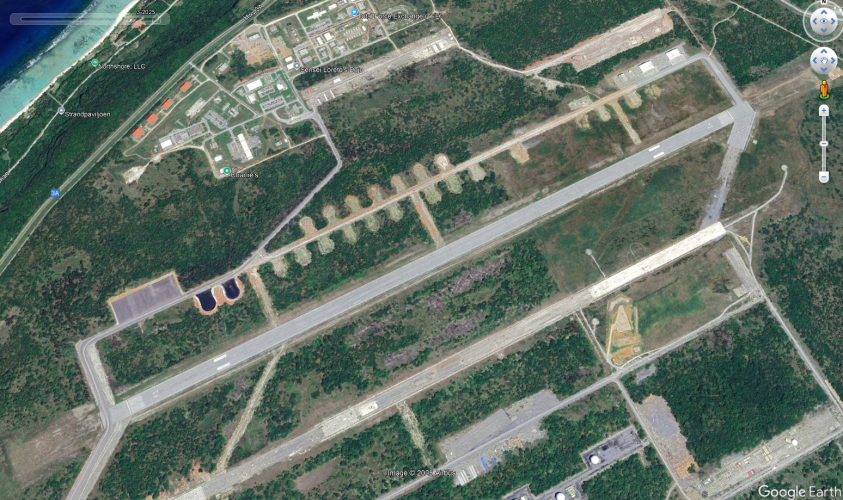
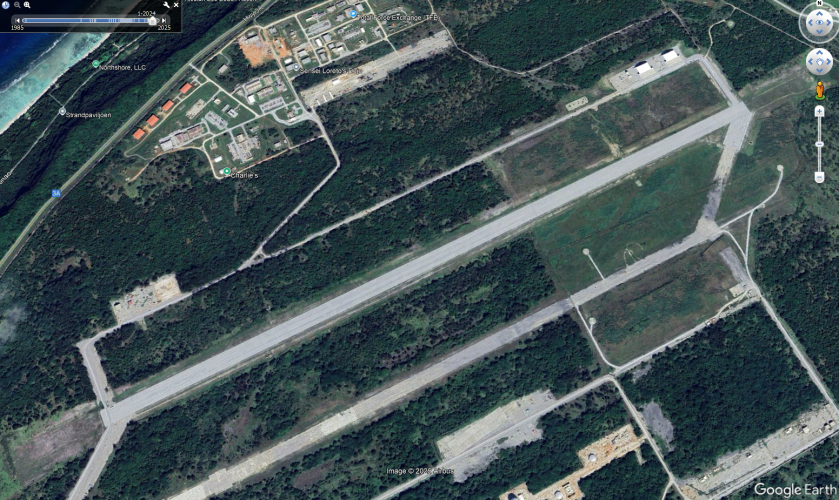
Lots of construction going on at a suspected lair of the RQ-180, Andersen Northwest Field in Guam. It doesn't seem to be RQ-180 related. In fact, the original hangars (if it was actually based there) seem derelict on satellite pictures, and have been for at least a year

I must say that since the few sightings some years ago it's somewhat strange it hasn't been spotted since. I really wonder whether it's still around. I hope I'm wrong.

In any case, if it ever was based at Andersen Northwest Field, I think we can confidently conclude that it's no longer there.
Schermafbeelding 2025-05-17 192031.png Schermafbeelding 2025-05-17 192048.png
 
I don't think Google maps is a reliable way to find a covert "anything". You can paint a runway to match the surrounding jungle and you would never find it on Google maps.
 
I started when it was Northrop (ASD, Pico) in 1986 then left Northrop Grumman at the B-2 CTF EAFB in 1996 (B-2 flight testing was coming to an end and no new programs until the 2000's). So with my time at N/NG, I was involved with B-2, ATA, YF-23, TSSAM, a couple others.
You may have crossed paths with "elmayerle". He's mentioned working on TSSAM as well.
 
Lots of construction going on at a suspected lair of the RQ-180, Andersen Northwest Field in Guam. It doesn't seem to be RQ-180 related. In fact, the original hangars (if it was actually based there) seem derelict on satellite pictures, and have been for at least a year

I must say that since the few sightings some years ago it's somewhat strange it hasn't been spotted since. I really wonder whether it's still around. I hope I'm wrong.

In any case, if it ever was based at Andersen Northwest Field, I think we can confidently conclude that it's no longer there.

When you are interested in a military facility such as Northwest Field it is generally easy to locate contracts that describe what is going on there.

Last year the Air Force awarded a contract (FA524025C0001) to demolish Hangar 1 and 2 at Northwest Field. There have since been additional contracts awarded for typhoon repairs (FA524024D0008) , observation towers, taxiway repairs, and others. There have also been contract opportunities for portable office spaces, handwashing stations, and others. In general the Air Force and Navy seem to be drawing down their use of Northwest Field and are repurposing the facility.

Northwest Field was being used to support training and development of Agile Combat Employment. I'm sure plenty of lessons were learned from that and those will be used elsewhere, like at Tinian.
 
I don't think Google maps is a reliable way to find a covert "anything". You can paint a runway to match the surrounding jungle and you would never find it on Google maps.
You and I won’t. But intelligence agencies will know straight away, or they’ll find out eventually.

Umm al Melh is a great example of a base that’s virtually hidden, and that’s without camouflage.
 
Space only provides occasional snap shots of an area. A penetrating UAV would offer long term realtime surveillance.
Actually that might be a symptom of not having enough satellites… With a ~1000 satellite constellation like the proliferated architecture NRO is doing right now (assuming ~20 satellites per launch like its starlink V2 mini bus, ~10 launches per year, and ~5 years of continuous launches to 2029 like NRO stated), having a constant ~5 minute revisit time for every single square inch on the planet surface is within reach (assuming a push-broom sensor with the iFOV to cover a ~400km wide swath, slightly pushing the public state of the art for < 1m resolution optical imaging but should be within reach).
 
Last edited:
https://www.nytimes.com/2025/09/05/us/navy-seal-north-korea-trump-2019.html

Typically, Special Operations forces have drones overhead during a mission, streaming high-definition video of the target, which SEALs on the ground and senior leaders in far-off command centers can use to direct the strike in real time. Often, they can even listen in on enemy communications.

But in North Korea, any drone would be spotted. The mission would have to rely on satellites in orbit and high-altitude spy planes in international airspace miles away that could provide only relatively low-definition still images, officials said.

Those images would arrive not in real time, but after a delay of several minutes at best. Even then, they could not be relayed to the mini-subs because a single encrypted transmission might give the mission away. Everything had to be done under a near blackout of communications.

If true, and assuming the Chinese keep watch of the North Korean skies, it seems to indicate to me that the Chinese have a way of locating RQ-170’s or RQ-180’s. Typically the RQ-170 is perfectly equipped for these sort of missions, and the RQ-180 as far as we know, too.

The only reason not to have a stealth drone overhead for recon and intel is because they knew it would compromise the mission.

Since the RQ-170 crash in Iran back in 2009 the Iranians surely must have figured out a way to detect it, and if they know, the Chinese and Russians certainly know as well.

I have suspected for a while now that the RQ-180 is no longer active. It’s been too long since any sightings, no proof of a unit who operates it or where it’s based, nor any infrastructure associated with the program.

Back in 2019 the RQ-180 was operational as far as we know. If it’s equipped for these kind of missions, surely it would have been there, overhead and providing intel.

So either the RQ-180 has a different mission goal, or it wasn’t operational, or it couldn’t be be used because the Chinese can detect it. We don’t know which one it is, but I suspect the latter as the most plausible.

Another piece of (circumstantial) evidence why I suspect the RQ-180 isn’t around anymore.

 

Similar threads

Back
Top Bottom