
You are using an out of date browser. It may not display this or other websites correctly.
You should upgrade or use an alternative browser.
You should upgrade or use an alternative browser.
Northrop Grumman B-21 Raider (LRS-B)
- Thread starter TomS
- Start date

- Joined
- 30 May 2023
- Messages
- 664
- Reaction score
- 1,436
I think the B-21 is designed for continuous system and subsystem level improvement and should serve for a long time. Even if its LO erodes in the face of adversary sensor gains, it’s still a long legged aerodynamic stand-off weapon truck, albeit one likely limited to high altitude mission profiles, so long as the USAFs goals of dramatically addressing sustainment and operating costs through design, materials, manufacturing and scale are achieved.
Scott Kenny
ACCESS: USAP
- Joined
- 15 May 2023
- Messages
- 19,572
- Reaction score
- 28,042
Exactly!No. They want to replace capability, not airframe #s. One B-21 is not the equivalent of one B-2, B-1B, or B-52.
LRSO or other cruise missiles:
- B-21 can carry 8. B-52 can carry 20. Therefore you need 2.5x the number of B-52s in B-21s for hauling LRSOs or other cruise missiles around. This will be the last replaced airframes.
- If/when B-1s get their external pylons back they will carry 12+8, just like the B-52s do, therefore you need 2.5x the number of B-1s in B-21s. Until then, it's 1 for 1 since B-1s can only carry 8x cruise missiles internally.
- B-2s, if they are capable of carrying cruise missiles at all, would carry 16. So you'd need 2x the number of B-2s in B-21s.
IIRC it was an Air Force Times article, by B-1 flight crew. Supersonic sprint across the region, slow to subsonic to release weapons.I have heard this story before but I have never found a source for it. And more recently I have heard that the B-1 is not even rated/cleared to carry most conventional weapons at supersonic speeds.
I wonder if perhaps this is an urban myth, though I could easily see B-1s arriving much faster than A-10s just with high subsonic speeds.
CSAF Wilsbach:
“At some point in the future, we’ll consider additional buys,” Wilsbach said. “So one of the things we’re talking to Northrop about is how could we do that in a way that doesn’t stretch out. So let’s just assume that maybe you wanted to double the buy to go from 100 to 200. Can Northrop do that? That’s a big question to ask because, what I don’t want to do is, [say] ‘OK, I’ve got 100 and now the next 100 comes but by the time we get the last one it’s 2060. It’ll be obsolete by then, right? If we’re going to buy some more, we’ve got to figure out a way to compress.”
https://www.airandspaceforces.com/fix-fly-defend-wilsbach-aims-readier-air-force/
“At some point in the future, we’ll consider additional buys,” Wilsbach said. “So one of the things we’re talking to Northrop about is how could we do that in a way that doesn’t stretch out. So let’s just assume that maybe you wanted to double the buy to go from 100 to 200. Can Northrop do that? That’s a big question to ask because, what I don’t want to do is, [say] ‘OK, I’ve got 100 and now the next 100 comes but by the time we get the last one it’s 2060. It’ll be obsolete by then, right? If we’re going to buy some more, we’ve got to figure out a way to compress.”
https://www.airandspaceforces.com/fix-fly-defend-wilsbach-aims-readier-air-force/
Tje better question is how many LRSOs will there be? If it's 800, you only need 100 x B-21s.Exactly!
LRSO or other cruise missiles:
- B-21 can carry 8. B-52 can carry 20. Therefore you need 2.5x the number of B-52s in B-21s for hauling LRSOs or other cruise missiles around. This will be the last replaced airframes.
- If/when B-1s get their external pylons back they will carry 12+8, just like the B-52s do, therefore you need 2.5x the number of B-1s in B-21s. Until then, it's 1 for 1 since B-1s can only carry 8x cruise missiles internally.
- B-2s, if they are capable of carrying cruise missiles at all, would carry 16. So you'd need 2x the number of B-2s in B-21s.
IIRC it was an Air Force Times article, by B-1 flight crew. Supersonic sprint across the region, slow to subsonic to release weapons.
Scott Kenny
ACCESS: USAP
- Joined
- 15 May 2023
- Messages
- 19,572
- Reaction score
- 28,042
Plus however many for penetrating missions.Tje better question is how many LRSOs will there be? If it's 800, you only need 100 x B-21s.
The current LRSO capacity is 1440x. 20x LRSO per B-52 times 72x B-52s. That would need 180x B-21s just to carry the (maximum) cruise missiles.
So I'm still thinking more like 300 total B-21s built. ~120 or more to replace B-1 and B-2, and another 180 to replace B-52s.

FighterJock
ACCESS: Above Top Secret
- Joined
- 29 October 2007
- Messages
- 7,243
- Reaction score
- 8,557
B-21 to replace the B-52? I still more or less think that it will be another brand new bomber that will replace the BUFF.
Scott Kenny
ACCESS: USAP
- Joined
- 15 May 2023
- Messages
- 19,572
- Reaction score
- 28,042
If it happened it'd be the very tail end of B-21 production, likely starting in about 2040.B-21 to replace the B-52? I still more or less think that it will be another brand new bomber that will replace the BUFF.
FighterJock
ACCESS: Above Top Secret
- Joined
- 29 October 2007
- Messages
- 7,243
- Reaction score
- 8,557
The competition for the new bomber would likely start in 2035 Scott Kenny then production in around 2040 so that there are no delays between the ending of the B-21 production and the start of the new bomber.
Scott Kenny
ACCESS: USAP
- Joined
- 15 May 2023
- Messages
- 19,572
- Reaction score
- 28,042
That would be ideal.The competition for the new bomber would likely start in 2035 Scott Kenny then production in around 2040 so that there are no delays between the ending of the B-21 production and the start of the new bomber.
I'm not expecting it to happen, not least because the B-52s don't need to be replaced until 2050-2060.
But if we could squeeze some growth of the USAF bomber fleets, replacing F-15Es with B-21s would be another option for extending production of the B-21.
In a spectacular but silent way, the Raider just won its first battle: standoff Vs Bombing.
https://www.reuters.com/world/us-ha...recision-missiles-during-iran-war-2026-08-04/
Today, everyone at any level of decision-making circles within reach of the DoD would understand that's it's far more sustainable to plink with a hammer than nail with an arrow.
https://www.reuters.com/world/us-ha...recision-missiles-during-iran-war-2026-08-04/
Today, everyone at any level of decision-making circles within reach of the DoD would understand that's it's far more sustainable to plink with a hammer than nail with an arrow.
In a spectacular but silent way, the Raider just won its first battle: standoff Vs Bombing.
https://www.reuters.com/world/us-ha...recision-missiles-during-iran-war-2026-08-04/
Today, everyone at any level of decision-making circles within reach of the DoD would understand that's it's far more sustainable to plink with a hammer than nail with an arrow.
I get a paywall on that link, but if it is similar to the article with the almost exact title in DefenseNews, then it is discussing ATACMS and PrSM. I personally doubt heavy ATACMS usage only because I think it lacks the range from most realistic firing positions, and PrSM exhaustion was already a known thing - it is a new weapon with very little inventory. PrSM production however is pretty aggressive, so depletion is a very short term concern in this case. Compared to to PAC3 usage, or even Tomahawk, this is a non issue.
But yes, the use of cheap unpowered munitions was exactly why the program leaned into a low signature penetration platform rather than a stand off bomber. I hope it bomb bays and racks are optimized for glide munitions; it seems to me you could get a huge amount of stand off from JDAM-ER and SDB from 50,000 feet.
@Josh_TN : It's exactly that. You don't miss anything. Glide bombs and other stand-in weapons are included in the comparison that I just made. I would recommend reading or watching Mitchell Institute's reports and videos on this for those that haven't yet. For example:
https://www.mitchellaerospacepower....the-balance-of-stand-in-and-stand-off-forces/
https://www.mitchellaerospacepower....the-balance-of-stand-in-and-stand-off-forces/

- Joined
- 21 April 2009
- Messages
- 14,360
- Reaction score
- 9,457
B-21 bomber, F-47 next-generation fighter ahead of schedule, top Air Force general says
Read more at: https://www.stripes.com/branches/ai...-f-47-fighter-ahead-of-schedule-22446302.html
Read more at: https://www.stripes.com/branches/ai...-f-47-fighter-ahead-of-schedule-22446302.html
Last edited:
Scott Kenny
ACCESS: USAP
- Joined
- 15 May 2023
- Messages
- 19,572
- Reaction score
- 28,042
B-2 is reported to be able to carry 40x 500lb JDAMs per bay, in 2 racks of 4x5.But yes, the use of cheap unpowered munitions was exactly why the program leaned into a low signature penetration platform rather than a stand off bomber. I hope it bomb bays and racks are optimized for glide munitions; it seems to me you could get a huge amount of stand off from JDAM-ER and SDB from 50,000 feet.
Given everything else we know about the B-21, it's safe to assume that the B-21 can carry at least that many 500lb JDAMs. It is also highly probable that the B-21 bomb bay is longer than the B-2 bay to be able to carry cruise missiles internally, so it may be able to carry a third rack bringing the 500lb capacity up to 60 weapons.
But where it falls apart is 1000lb or 2000lb weapons. A cruise missile length bomb bay may just be long enough to carry 16x 1000lb weapons (2 rings of 8 on the rotary launcher), but I don't know if the data connections would support that many. Otherwise, 8x 2000lb on the rotary.
Also, there's no reports that I remember on SDBs out of a B-2, so I'd assume no more SDBs than 500lb at this time. Hopefully someone was smart and designed a rack to carry many SDBs for the B-21.

- Joined
- 1 April 2006
- Messages
- 12,279
- Reaction score
- 15,098
Intereresting math I'd say.B-2 is reported to be able to carry 40x 500lb JDAMs per bay, in 2 racks of 4x5.
Given everything else we know about the B-21, it's safe to assume that the B-21 can carry at least that many 500lb JDAMs.
Scott Kenny
ACCESS: USAP
- Joined
- 15 May 2023
- Messages
- 19,572
- Reaction score
- 28,042
How so? 40 bombs per bay on the B-2, 80 total, and we know that the B-21 bay is not smaller than one B-2 bay.Intereresting math I'd say.
B-2 is reported to be able to carry 40x 500lb JDAMs per bay, in 2 racks of 4x5.
Given everything else we know about the B-21, it's safe to assume that the B-21 can carry at least that many 500lb JDAMs. It is also highly probable that the B-21 bomb bay is longer than the B-2 bay to be able to carry cruise missiles internally, so it may be able to carry a third rack bringing the 500lb capacity up to 60 weapons.
My hope/guess is that B-21’s IWB was sized for three GBU-38 nose to tail or two B-61. That would really optimize it for both the conventional and nuclear missions. 60 is probably a lot though; I was thinking 4x4 per rack, three racks, and enough space to employ a wing kit.
But where it falls apart is 1000lb or 2000lb weapons. A cruise missile length bomb bay may just be long enough to carry 16x 1000lb weapons (2 rings of 8 on the rotary launcher), but I don't know if the data connections would support that many. Otherwise, 8x 2000lb on the rotary.
I think 2000 lb is over rated outside of penetration munitions. Is there anything a mk84 can do that 3-4 mk 82 could not do as well or better? Outside of some particularly hard infrastructure targets or bunkers, I would not think so. And with an opponent stocked full of point defenses, I would lean towards more munitions/targets rather than the bigger boom, unless the target was just largely invulnerable to mk82.
Also, there's no reports that I remember on SDBs out of a B-2, so I'd assume no more SDBs than 500lb at this time. Hopefully someone was smart and designed a rack to carry many SDBs for the B-21.
I have seen a photo of SBD on a BRU-61 mounted to the rotary launcher. That yields a rather underwhelming 64 weapons, but it does provide more stand off and penetration than mk82. Also it would not be difficult to adopt a new bomb rack for B-2, and there was a 7 billion maintenance/upgrade contract that included new weapons integration. No idea if SDB was part of that; probably a Quellish question he wouldn’t answer.
I would assume B-21 was designed around SDB usage from the get go.
I also wonder if RAACM might be compatible with SBRA, given that it is advertised as having a GBU-38 form factor and being compatible with any aircraft that can use JDAM. Obviously that is a lot of marketing, but it isn’t out of the realm of possibility that a B-2 might carry 80 RAACMs.
Spoke to a buddy of mine today who works at EAFB at NASA-Armstrong, B-21 pretty damn quiet as compared to the B-2.
I could see that, given that it is assumed to use a modified commercial engine design with a relatively high bypass.
Probably not super relevant in its operational environment, but probably easier on the ground crews.

- Joined
- 16 April 2008
- Messages
- 10,595
- Reaction score
- 18,148
I get a paywall on that link, but if it is similar to the article with the almost exact title in DefenseNews, then it is discussing ATACMS and PrSM. I personally doubt heavy ATACMS usage only because I think it lacks the range from most realistic firing positions,
I think we saw that they were firing ATACMS from Kuwait and from LCS flight decks in the middle of the Gulf.
Scott Kenny
ACCESS: USAP
- Joined
- 15 May 2023
- Messages
- 19,572
- Reaction score
- 28,042
Again, the B-2 BRAs are 4x5 for 20 per rack. So if there's length for a third BRA, you're talking 60.My hope/guess is that B-21’s IWB was sized for three GBU-38 nose to tail or two B-61. That would really optimize it for both the conventional and nuclear missions. 60 is probably a lot though; I was thinking 4x4 per rack, three racks, and enough space to employ a wing kit.
IIRC the USAF generally agrees with you. The USN seems to be the main user of 1000lb weapons.I think 2000 lb is over rated outside of penetration munitions. Is there anything a mk84 can do that 3-4 mk 82 could not do as well or better? Outside of some particularly hard infrastructure targets or bunkers, I would not think so. And with an opponent stocked full of point defenses, I would lean towards more munitions/targets rather than the bigger boom, unless the target was just largely invulnerable to mk82.
I'd certainly hope so, but I don't know if that would be quad racks on the rotary for 32, 3x twin racks in tandem on the rotary for 48, or some modification of the BRA.I would assume B-21 was designed around SDB usage from the get go.
Agreed here.I also wonder if RAACM might be compatible with SBRA, given that it is advertised as having a GBU-38 form factor and being compatible with any aircraft that can use JDAM. Obviously that is a lot of marketing, but it isn’t out of the realm of possibility that a B-2 might carry 80 RAACMs.
And that would just be giggle-worthy.
(edit: spelling)
Last edited:
I think we saw that they were firing ATACMS from Kuwait and from LCS flight decks in the middle of the Gulf.
Had not seen the LCS thing; thanks.
Again, the B-2 BRAs are 4x5 for 20 per rack. So if there's length for a third BRA, you're talking 60.
My reasoning is weight limits and also the extra vertical height a glide kit will give a mk82. If you want wings, 4 seems like a more reasonable stack. And on top of that, JDAM-ER appears to weigh 600# plus, so 48 would probably be an over loaded situation for B-21.
But if I was designing it, I would leave the volume for these high capacity payloads even if it means lower fuel load. We know B-2 can handle two GBU-57, so clearly overloaded configurations that involve less fuel during takeoff are possible. I would guess B-21 keeps some very mass restricted payload options available even if they are not practical for maximum range operations.
Scott Kenny
ACCESS: USAP
- Joined
- 15 May 2023
- Messages
- 19,572
- Reaction score
- 28,042
600*60 is "only" 36,000. Also, I'm seeing 507lbs for GBU-62 Quicksink (which is a different fuze than normal bombs, same JDAM-ER wings), and that brings us down to 30,470.My reasoning is weight limits and also the extra vertical height a glide kit will give a mk82. If you want wings, 4 seems like a more reasonable stack. And on top of that, JDAM-ER appears to weigh 600# plus, so 48 would probably be an over loaded situation for B-21.
It may be a B-52 situation, where they take off with a light fuel load due to the massive bombload.
That said, point taken about the extra height the wing kit needs. IIRC, the Bomb Rack Assembly for the B-2 stores the bombs sideways, so the hanging lugs slide down the rack instead of kick straight down. May have to use the 750lb numbers for the JDAM-ER load.
Unfortunately, the racks only hold 18x 750lb bombs per bay in the B-2. So assuming that 50% longer bay like we've been talking, it'd be 27x JDAM-ERs for the B-21. And I do not like that number.
Meh, just launch with a light fuel load and refuel once in the air.But if I was designing it, I would leave the volume for these high capacity payloads even if it means lower fuel load. We know B-2 can handle two GBU-57, so clearly overloaded configurations that involve less fuel during takeoff are possible. I would guess B-21 keeps some very mass restricted payload options available even if they are not practical for maximum range operations.

dark sidius
ACCESS: Top Secret
- Joined
- 1 August 2008
- Messages
- 1,628
- Reaction score
- 1,727
https://aviationweek.com/defense/bu...s-air-force-starts-search-bomber-succeed-b-21
Saddly behind paywall
Saddly behind paywall
How do we know for a fact that the B-21How so? 40 bombs per bay on the B-2, 80 total, and we know that the B-21 bay is not smaller than one B-2 bay.
Bay is not smaller than B-2 or have equal carrying capacity? If anything, given that we do actually know for a fact that B-21 is smaller than a B-2 (132ft span va 172ft span), I’d wager that the B-21 have less carrying capacity than a B-21 and likely less total weapons bay volume as well.
I think there is a misunderstanding; B-2 has two bomb bays and B-21 has one, and I think Scott is arguing that the B-21 should have at least the capacity of a single B-2 bomb bay (40 bombs) not the capacity of an entire B-2 bomber (80 bombs).
- Joined
- 28 January 2008
- Messages
- 1,653
- Reaction score
- 4,228
I would assume the single B-21 bay is the size of one of the B-2s. The other B-21 doors more then likely engine bay and ECS/hydro bay doors. The smaller ones could have other weapons utility possibly. I doubt the 21 would only carry one of the 30K bombs, doesn't make sense. I'm sure the 21 depending on the mission could have a nice mix within the main bay, new weapons showing up all the time. The B-2 bays are large when you are standing in them. I was also engine run qualified and would have to run tests for the weapons bay door drive system and rotary launcher drive system, could not use hydro ground carts during that time for the weapons bay doors, very high PDU flow demands, maybe things have changed now for ground carts but the drive systems are also very reliable.I think there is a misunderstanding; B-2 has two bomb bays and B-21 has one, and I think Scott is arguing that the B-21 should have at least the capacity of a single B-2 bomb bay (40 bombs) not the capacity of an entire B-2 bomber (80 bombs).
- Joined
- 1 April 2006
- Messages
- 12,279
- Reaction score
- 15,098
Once moreIf anything, given that we do actually know for a fact that B-21 is smaller than a B-2 (132ft span va 172ft span),
Attachments
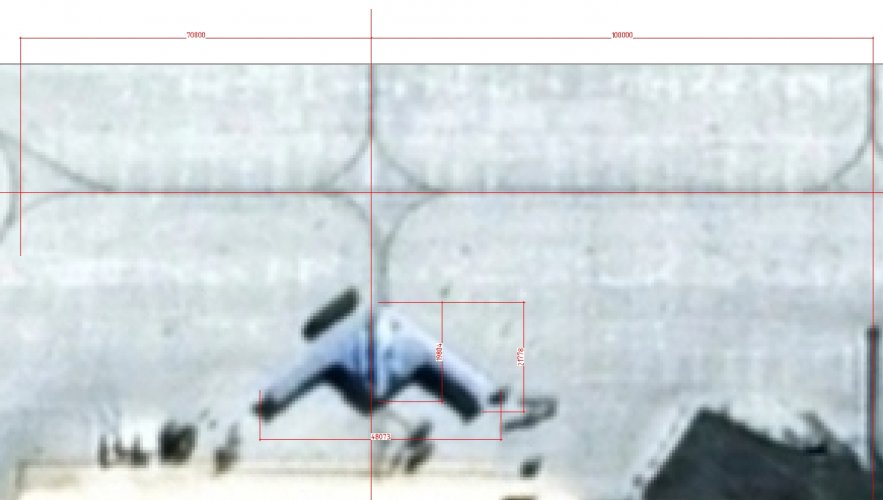

Forest Green
ACCESS: USAP
- Joined
- 11 June 2019
- Messages
- 14,534
- Reaction score
- 31,602
It looks to me like a very blurry image. Where do the measurements come from?
With 100m being ~5.81 large squares, aircraft is ~2.65 large squares, which gives 45.6m (vs 52.4m for B-2), assuming the 100m is correct. For height it's 1.24 large squares or 21m (same as B-2).
This has a different take on measurements.
https://aviationweek.com/defense/aircraft-propulsion/b-21-raider-designed-low-risk
With 100m being ~5.81 large squares, aircraft is ~2.65 large squares, which gives 45.6m (vs 52.4m for B-2), assuming the 100m is correct. For height it's 1.24 large squares or 21m (same as B-2).
This has a different take on measurements.
https://aviationweek.com/defense/aircraft-propulsion/b-21-raider-designed-low-risk
Attachments

Last edited by a moderator:
Not James Stockdale
ACCESS: Secret
- Joined
- 29 August 2025
- Messages
- 243
- Reaction score
- 464
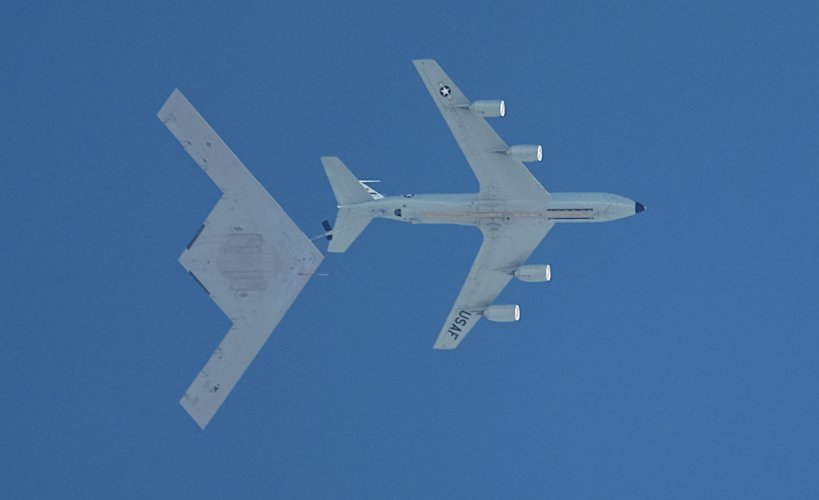
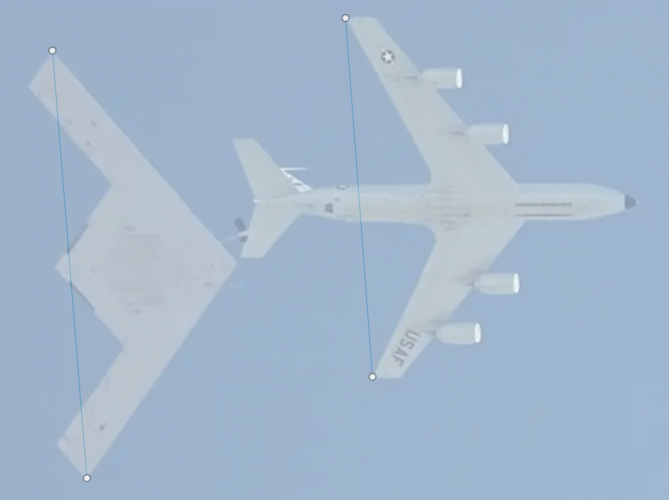
When the B-21 was first spotted refueling from a KC-135 near Edwards, the estimates then were a 150 - 155 ft wingspan.
- Joined
- 1 April 2006
- Messages
- 12,279
- Reaction score
- 15,098
Fast forward two years backIt looks to me like a very blurry image. Where do the measurements come from?
https://www.secretprojects.co.uk/threads/northrop-grumman-b-21-raider-lrs-b.25915/post-704236
I presume you can use ruler in Google Earth
They are absolutely wrong.This has a different take on measurements.
https://aviationweek.com/defense/aircraft-propulsion/b-21-raider-designed-low-risk
Forest Green
ACCESS: USAP
- Joined
- 11 June 2019
- Messages
- 14,534
- Reaction score
- 31,602
Which agrees with 45.6m quite well.When the B-21 was first spotted refueling from a KC-135 near Edwards, the estimates then were a 150 - 155 ft wingspan.
View: https://x.com/NatSecLedger/status/2086406752451375595?s=20
Last edited:
- Joined
- 1 April 2006
- Messages
- 12,279
- Reaction score
- 15,098
It doesn't agree with standart taxiway gaps though. Everyone who saw rollout photos could get quite accurate wingspan muich earlier, on the Cerberus maiden flight day even without complicated photogrammetry efforts. Using later and geolocating rollout hangar and media platform position, other osinters would have numbers at rollout day.Which agrees with 45.6m quite well.
Forest Green
ACCESS: USAP
- Joined
- 11 June 2019
- Messages
- 14,534
- Reaction score
- 31,602
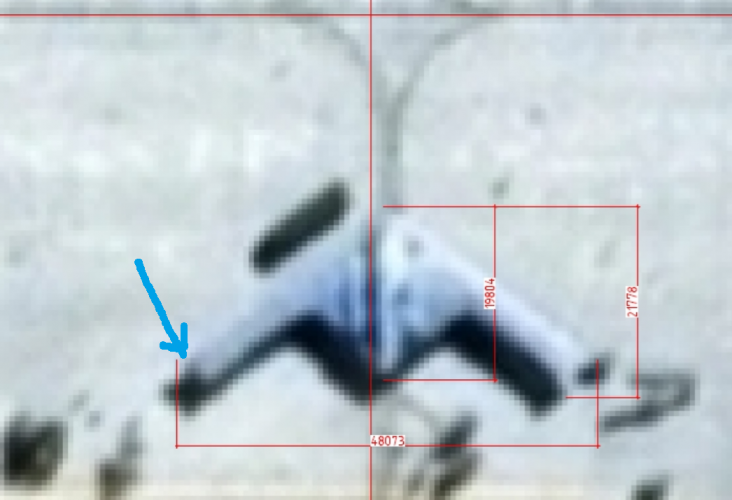
But it absolutely does, see image.It doesn't agree with standart taxiway gaps though.
https://www.secretprojects.co.uk/threads/northrop-grumman-b-21-raider-lrs-b.25915/post-932645
It would need to be a whole 1.5 small squares out to get to 48m and it defintely isn't... unless you add gaps.
Attachments
This probably has much higher resolution (much less quantization error when detecting wing tips)... My measurements give 47.7 meters (156.5 feet). No idea where the 150 feet lower bound estimate comes from...
Attachments
Last edited by a moderator:

