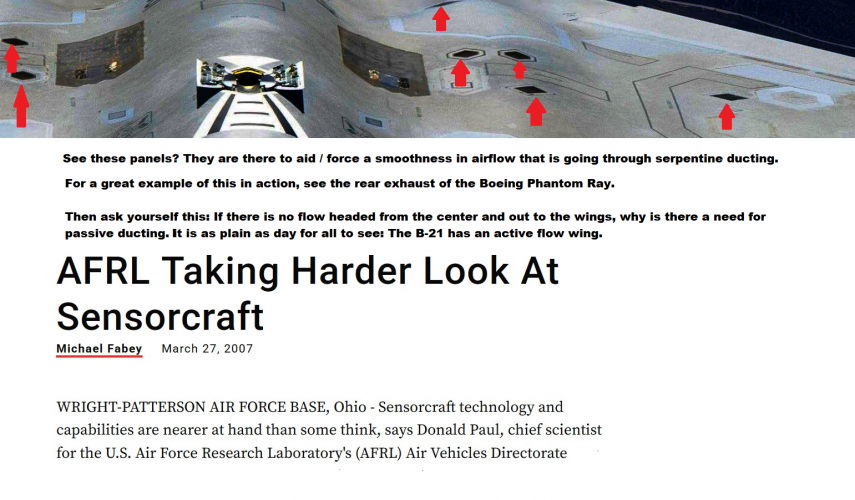
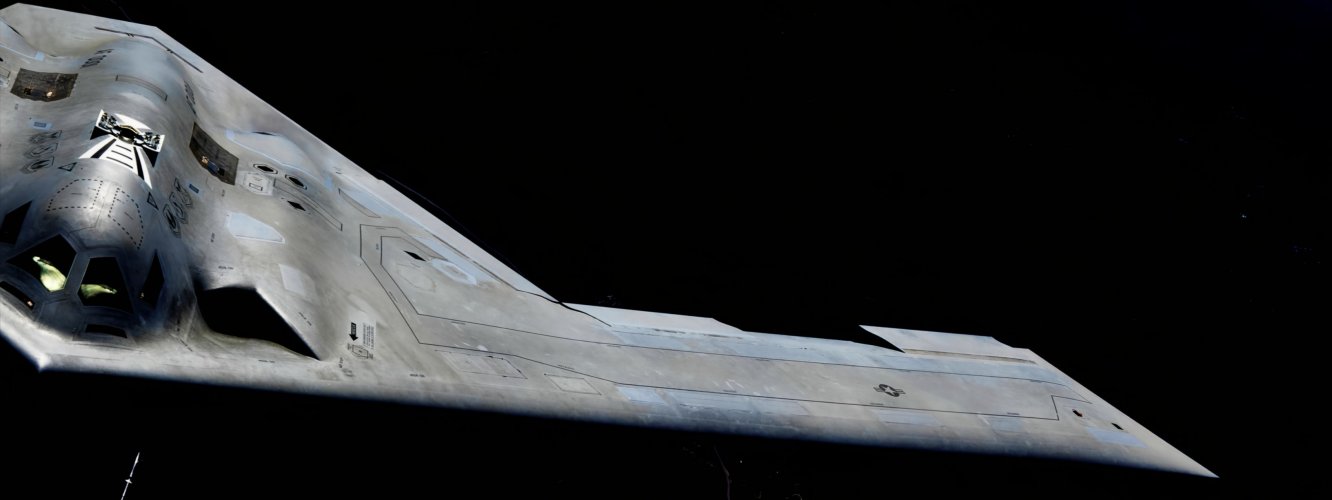
I think those are access panels. To the left, looks like antennas.
Certainly busy across all that real estate!

And all of it - From the skins to the wings, is near 26 years in the making. And folks still think that the tech 'isn't ready'. Lordy me are you all in for a shock.

https://apps.dtic.mil/sti/pdfs/ADA428754.pdf


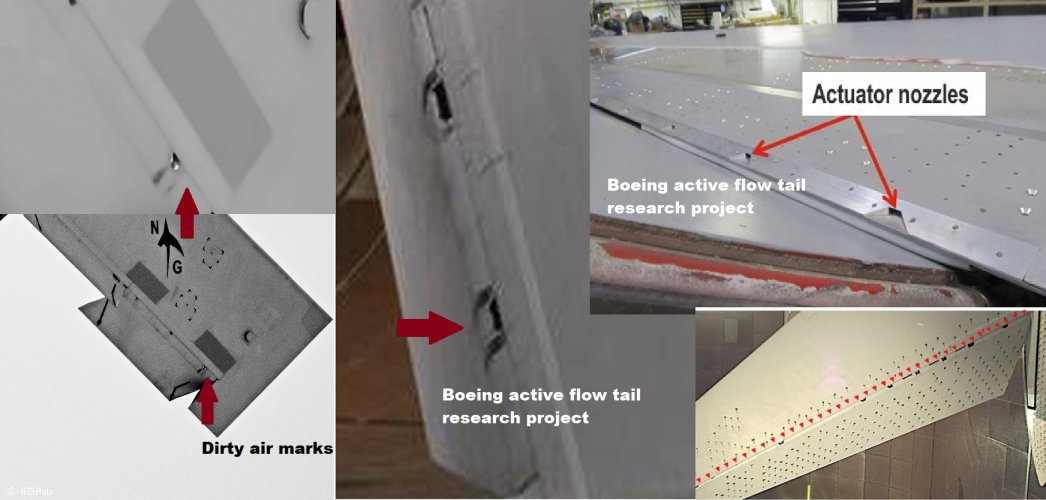
Update: The ventral exhausts with heat sensitive paint for testing we see in the photo were to make sure that the B-21 can refuel with the third stream open and operational at air speeds low enough to enable air-to-air refueling.

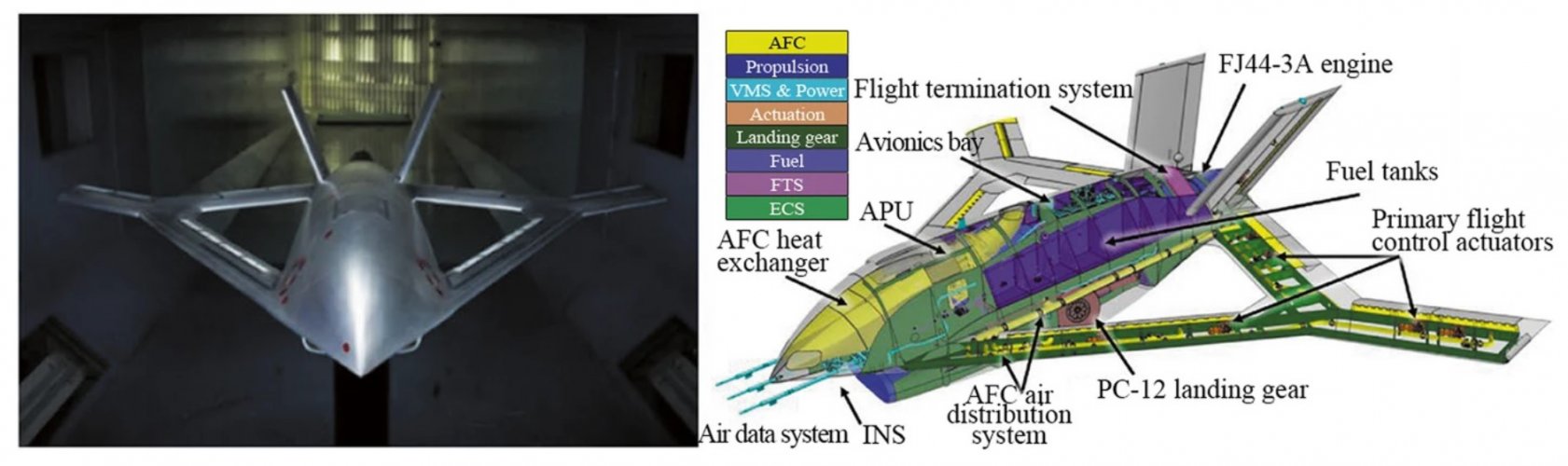
I will add snippets here because you have all missed the aviation leap of the decade - and the answers are scattered through the DoD and NASA research papers.

* Now go look at DARPA CRANE. See that APU exhaust? Look at the massive exhausts either side of the upper fuselage on the B-21. It has a third powerplant onboard for the required supply.

DARPA doing it this way means that they do not have to force Northrop Grumman to share their intellectual property (Anyone remember Boeing and DICE?!)

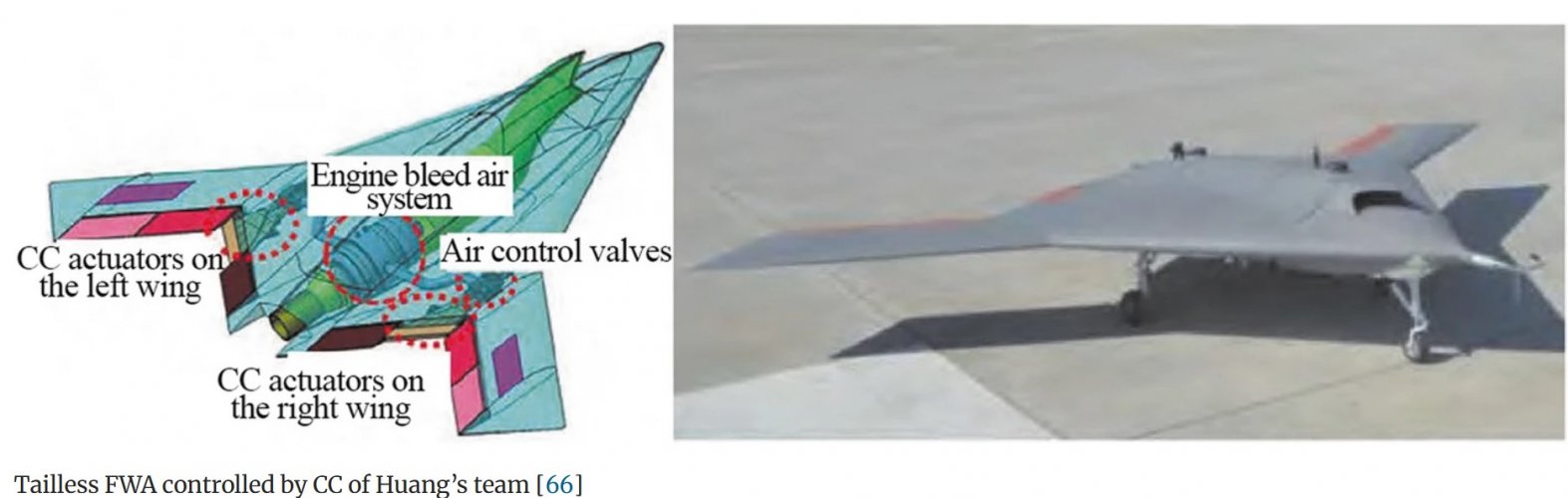
Then we deep dive into Chinese research and see that they are pretty much pacing the US efforts, and have been active on the active flow front since 2015 / 2016)
 

Attachments
  • denoise.jpg
    denoise.jpg
    168.2 KB · Views: 292
  • ducting.png
    ducting.png
    1 MB · Views: 68
  • blownactivewing.jpg
    blownactivewing.jpg
    311.1 KB · Views: 66
  • next up.jpg
    next up.jpg
    160.7 KB · Views: 54
  • Chinacatchingup.jpg
    Chinacatchingup.jpg
    127.2 KB · Views: 57
Last edited:
Certainly busy across all that real estate!
Lots of vents and different antenna types (including pop-out antennas top and bottom), I assume strategically positioned for maximum antenna performance. B-2 antennas primarily along the length on the top of the center section. It's funny, B-2's still suffers from excessive fuel flowing down the center section hump after refueling disconnect, I'm surprised this condition is not fixed, was a problem when I was at the CTF from 91 to 96.
 
Agree here. IF the air-bleed effector systems were of a high enough TRL I would absolutely expect the B-21 to use them because they'd allow for not deflecting the control surfaces.

Or there's space saved in the airframe for it and NG intends to do a B-21B with the effectors in addition to the physical surfaces, and maybe to be followed by a B-21C without mechanical surfaces at all and effectors only.
View: https://www.youtube.com/watch?v=nsEvK4CtMfY

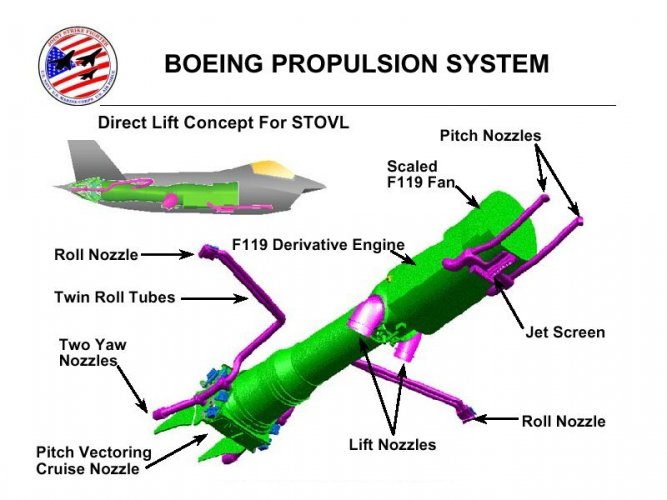
Apparently the X-32 had them so I wouldn't expect they would be particularly risky technology by today's standards.
As always, I am talking out of my arse, but I think if you use bypass air, and considering the top end of jet-engine pressure ratios of ~30, neither the pressures and temps are that extreme even for regular equipment. The concern as always with thrust vectoring is that the efficacy depends on engine thrust not airspeed, so I'd guess it's not particularly good for high speed manuevers, but probably the B-21 doesn't need that.
(I am not confirming or denying that such a system exists on the plane, but doesn't seem unfeasible to include one)
 
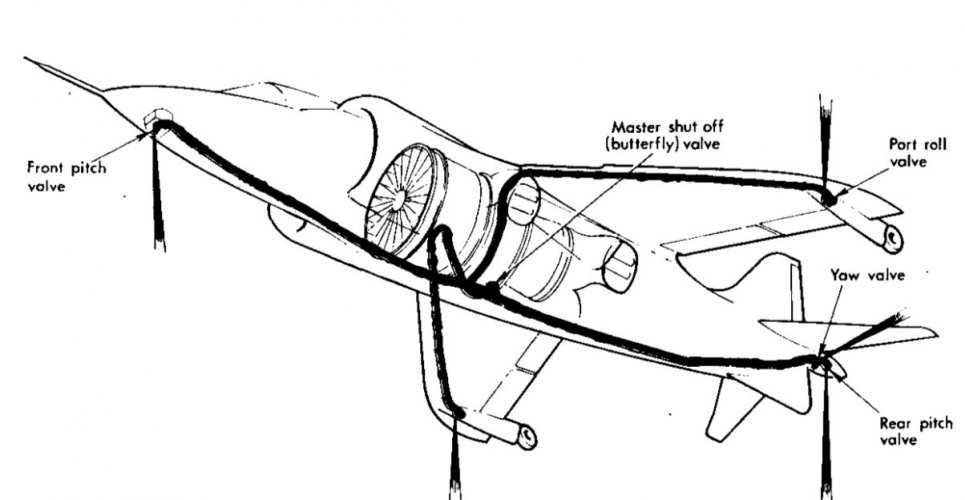
Roll posts, yes, just like the Harrier has.

But there's a notable difference between roll posts and air-bleed effectors replacing control surfaces!
The X-32's system is quite a bit more elaborate than that of the X-35, and went beyond just those roll nozzles. Jump to around 10:15 in the video - apparently it multiple nozzles that worked in the roll, pitch and yaw axes. I am not sure what's the difference between this and the system you're describing.
 
What the global difference between X-32B and Harrier reaction control system?
Do you understand the difference between it and active flow control system that TerraFirma/Smythers maniacally trying to put onboard of B-21?
 

Attachments

  • jsf-boeing-chart3.jpg
    jsf-boeing-chart3.jpg
    72.4 KB · Views: 148
  • 20260511_041008.jpg
    20260511_041008.jpg
    67.6 KB · Views: 137
Last edited:
As always, I am talking out of my arse, but I think if you use bypass air, and considering the top end of jet-engine pressure ratios of ~30, neither the pressures and temps are that extreme even for regular equipment.
Bypass air is typically only at a pressure ratio of < 2 (civilian engine, single stage fan), which might not be enough for fluidic control purposes. If using the bleed air though, at a pressure ratio of 30, -20C air becomes ~400C, which is a huge problem for composite or aluminum structures, requiring heavy steel pipes and heavy shielding…
 
The B-21 is not using ducted air for control, it's using standard control surfaces. Now, I'm pretty sure B-21 is using conditioned air for core avionics with some liquid cooling probably for Radar and DMS.
 
Bypass air is typically only at a pressure ratio of < 2 (civilian engine, single stage fan), which might not be enough for fluidic control purposes. If using the bleed air though, at a pressure ratio of 30, -20C air becomes ~400C, which is a huge problem for composite or aluminum structures, requiring heavy steel pipes and heavy shielding…
It’s worse than that for takeoff and landing operations: +40C inlet temps can result in 600C compressor discharge bleed air temps. Of course, you can take mid-compressor bleed at lower pressure and temperatures. On the F-16 powered by F100 engines, the ECS system ran on 13th stage bleed at lower power setting, then transitioned to 7th stage bleed at high engine power
 
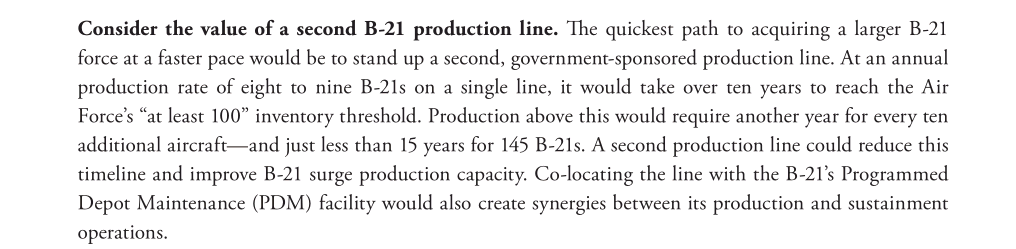
Currently, there is only one production line; the decision on another production line is expected in fiscal year 2028.
Have there been any rumors about potential locations? I would suggest Cecil Field in Jacksonville. Anything in DFW would probably compete for labor with Plant 6 and Majors. Maybe there is enough space on the south side of Houston.
 
Last edited:
It will be interesting to see what happens in 2028 in regards to the new Northrop B-21 production line.
 
Will that include raising the total number of B-21s to 200? I can dream Forest Green.
Look like it to me.

Fast production is good but what about the ordance inventory?
If we can't keep it supplied at high sorty rate some will end up "sitting" around or something else.
 
There’s probably no shortage of JDAM or SDB, which will probably be the primary weapons.
 
What about the other J-series weapons Josh_TN?
JSOWs nobody seems to still use, though both the BROACH warhead and the cluster would have specific use cases.
JASSMs are big and in relatively low but constant production
JAGMs are not really fast-jet weapons.
And we're not sure about the viability of AIM-260 JADMs on a maneuverability-limited flying wing.
 
Have there been any rumors about potential locations? I would suggest Cecil Field in Jacksonville. Anything in DFW would probably compete for labor with Plant 6 and Majors. Maybe there is enough space on the south side of Houston.
Sorry, the location of the second production chain is still unclear; it will not be determined and implemented until fiscal year 2028.
 

Attachments

  • Screenshot_2026_0517_020410.png
    Screenshot_2026_0517_020410.png
    74.3 KB · Views: 372
Last edited by a moderator:
Sorry, the location of the second production chain is still unclear; it will not be determined and implemented until fiscal year 2028.View attachment 812572
The PDM role is planned for Tinker, but the OC-ALC facility is already very busy. There is quite a bit of vacant land on the east side of S Douglas Blvd outside the current base perimeter that could fit a new facility as large as Plant 42.
 
I’d squint hard at the logistics vs security/risk trade as it relates to co-locating the second line with the currently planned central depot, but if a second line brings along a second central depot, then that could make a ton of sense, if the corporate and private funding is there.

The second site is going to be an incredibly valuable thing for a Rep or Senator to land in their district or state - thousands of direct jobs, ten of thousands of indirect jobs, high tech, strategic national security prestige, etc - so that will be “fun” to see play out.
 
There’s probably no shortage of JDAM or SDB, which will probably be the primary weapons.
Perhaps. What people don't seem to realize yet we are increasing payload capacity by 8-10x (not counting manned fighters) with all the coming CCA, B21 and new strategic bombers.
I doubt B21 will do direct overhead bombing unless it's penetrators so there should be a shift to all the new cheap standoff cruise missiles.
JDAM-LR probably will be popular with bombers, though.
 
No way that would be the case. Launching cheap cruise missiles with dubious stealth characteristics and subpar (cheap) communication sets from a billion dollar strategic stealth bomber would be like squawking your position.
 
What about the other J-series weapons Josh_TN?
AGM-158 inventory took a big hit apparently, but it also has a production rate approaching a thousand per year. And B-21 would be fairly inefficient delivery platform for those I would imagine.

The whole point of a penetration bomber vice a cruise missile stand off platform was to use smaller, less expensive PGMs that increased salvo size and total inventory over cruise missiles like JAASM. I suspect glide bombs of various sizes and configurations will be the B-21s standard load, because they are relatively plentiful, increase salvo size, and take maximum advantage of the high cruise/service ceiling of a blended wing body. A JDAM-ER probably outrages anything short of a strategic SAM from 50,000 feet. SDB even more so.
 
I would also not exclude the possibility of CoAspire’s RAACM /FAMM-L being compatible with B-2 or B-21. It has a roughly GBU-38 form factor and supposedly a JDAM like interface; it might well be compatible with SBRA or whatever the B-21 equivalent is.
 
Perhaps. What people don't seem to realize yet we are increasing payload capacity by 8-10x (not counting manned fighters) with all the coming CCA, B21 and new strategic bombers.
I doubt B21 will do direct overhead bombing unless it's penetrators so there should be a shift to all the new cheap standoff cruise missiles.
JDAM-LR probably will be popular with bombers, though.

See above posts; you can do a lot with a glide bomb at 50,000 feet. If I were designing the bomb bay and racks of B-21, I would include additional volume for wing kits at the expense of total war load, my opinion. And with something like SDB-1, mass is likely to become the limiting factor well before volume.

That said, I could easily see FAMM-L integration being a highly desirable for soft relocatable targets spread across a wide area, or alternatively for anti ship use.
 
CoAspire’s RAACM definitely going to replace most ranged 500 lb uses.
Currently, Mk82 500 lb and Mk84 lb are the main ordnances being dropped while Mk83 1000 lb seems to have fallen completely out of the picture.
RAACM-ER will likely replace larger expensive cruise missiles for mass but I'm not certain since I'm sure about its final form yet?
 
Addendum: also I think CCA is going to bring almost nothing to the table in terms of air to ground payload. The current program is strictly A2A. And even if there is a black program or an eventual public one, my guess is that it will focus on delivery of mini and micro PGMs rather than JDAM or even SDB. Think Hatchet or GBU-69.
 
CoAspire’s RAACM definitely going to replace most ranged 500 lb uses.
Currently, Mk82 500 lb and Mk84 lb are the main ordnances being dropped while Mk83 1000 lb seems to have fallen completely out of the picture.
RAACM-ER will likely replace larger expensive cruise missiles for mass but I'm not certain since I'm sure about its final form yet?

USN/USMC still use mk83 almost exclusively to my knowledge. I believe USAF opted for mk82 and mk84 and largely phased out the mk83 middle ground. FAMM-L is not a replacement for any of those since it has a dramatically smaller warhead, but it should be compatible with a lot of aircraft and add a standoff option for soft point targets.
 
I’d squint hard at the logistics vs security/risk trade as it relates to co-locating the second line with the currently planned central depot, but if a second line brings along a second central depot, then that could make a ton of sense, if the corporate and private funding is there.

The second site is going to be an incredibly valuable thing for a Rep or Senator to land in their district or state - thousands of direct jobs, ten of thousands of indirect jobs, high tech, strategic national security prestige, etc - so that will be “fun” to see play out.
Which helps push for a second location away from the main one.

Because ain't nobody setting up new businesses in California.


Currently, Mk82 500 lb and Mk84 lb are the main ordnances being dropped while Mk83 1000 lb seems to have fallen completely out of the picture.
RAACM-ER will likely replace larger expensive cruise missiles for mass but I'm not certain since I'm sure about its final form yet?
USAF prefers the Mk84, USN prefers the Mk83. Friend of mine was an Aviation Ordnanceman, a "redshirt" on the flight deck. He said the USN did occasionally use Mk84s, like when they bombed one of the terrorist BBEGs. 2000lb to send a message.
 
USAF prefers the Mk84, USN prefers the Mk83. Friend of mine was an Aviation Ordnanceman, a "redshirt" on the flight deck. He said the USN did occasionally use Mk84s, like when they bombed one of the terrorist BBEGs. 2000lb to send a message.

What's the reasoning? Logistics? Tactical consideration?
 
I have never sailed, so not truly informed, but I think the USAF decided to standardize on big and small while the USN decided one size fits all was easier for a carrier magazine.

I also think bring back weight plays a role. But USAF uses mk82/84 while USN tends to use 83. This is not absolutely the rule, but it seems to be the trend.
 

Similar threads

Back
Top Bottom