Better is generally something that is backed by arguments in aerospace. Better on what? Better how? At this stage, to my humble knowledge, Airbus hasn´t completed a demonstration for their core mission objective: high speed passenger transport. Cheyenne did.
Better propulsive efficiency.

Cheyenne flew ~207 knots clean in level flight. Small fuselage cross section, no pylons, no gun, no gun turret or anything to slow it down. At that point it hit a brick wall - the propulsion curve was near vertical and no amount of power could make it go much faster.

Racer has flown 240 knots with a much larger fuselage cross section. NGRC would have an even bigger fuselage causing even more issues with a rear pusher prop. But of course those idiots at AH wouldn’t know anything about what they’re doing, is that what you’re implying?
 
I see you still haven´t left your prone to kick off aggressive behavioral habits behind you. Still the same.
Where do I imply such things when I answer to your own personal view of the problem? Chill off.
 
Somewhere someone asked why the "V" tail on the NGTRC demonstrator has upward pointing end caps. While looking for other information I found the attached paper. Some of the more aero-engineer inclined might find it of some interest.

I would like to ask if anyone knows what is going on with the NGTRC Demonstrator. To my knowledge it has not made it off the test stand yet. If anyone has heard different please let us know.
 

Attachments

  • NGTRC 1.pdf
    884.2 KB · Views: 44
I would like to ask if anyone knows what is going on with the NGTRC Demonstrator. To my knowledge it has not made it off the test stand yet. If anyone has heard different please let us know.
I was wondering the same thing. Back in March 2025 Leonardo said they expected NGCTR first flight « this autumn ». (After much delay)

One would think they would launch a PR campaign with more details once first flight was imminent… but no news.
 
Last edited:
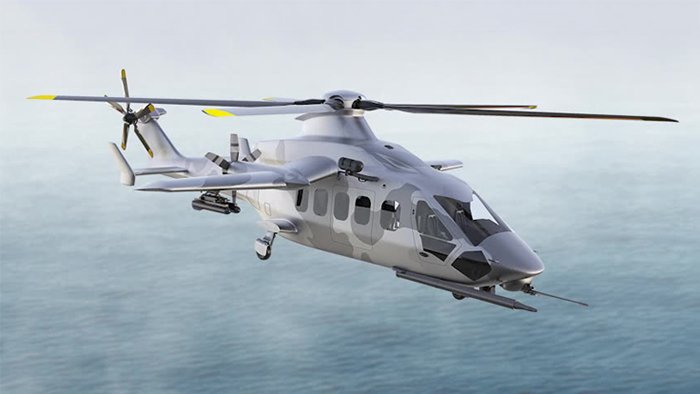
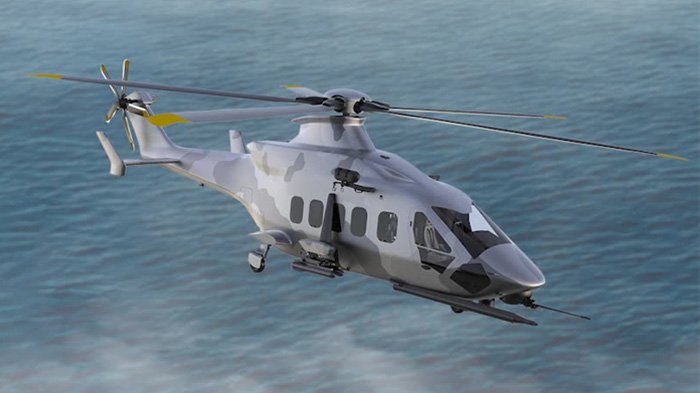
there are significant differences with the renders released at the end of November, notably the gull wing and H-tail.
Indeed. These new renders also look much better (more detail, aerodynamic configuration looks plausible).

The close resemblance between the 2 options (compound vs traditional helicopter) continues to suggest that AH is pushing for a common platform that can be derived into 2 variants.

Airbus NGRC.png
 
I don't know if I ever saw a clear answer in the X3 thread if the side propellers be disengaged and brought to a halt quickly? Otherwise, I'd really dread the safety concerns with those even with the side doors put so far forward like that.
 
I don't know if I ever saw a clear answer in the X3 thread if the side propellers be disengaged and brought to a halt quickly? Otherwise, I'd really dread the safety concerns with those even with the side doors put so far forward like that.
With weapons and pylons in the way, it's less likely someone would try to duck under the wings. Personally, I'd do a significant anhedral like the Hind's wings if they're not going to duct the props.
 
I don't know if I ever saw a clear answer in the X3 thread if the side propellers be disengaged and brought to a halt quickly? Otherwise, I'd really dread the safety concerns with those even with the side doors put so far forward like that.
They've added a tail rotor which means that the side propellers are no longer needed for anti-torque and can be disengaged in the hover via a clutch.

IMHO this is still far from a finalized design concept. It's missing aerodynamic refinements that one would expect from AH, such as the H175's canted tail rotor and the H160's biplane stabilizer.
 
Last edited:
With weapons and pylons in the way, it's less likely someone would try to duck under the wings. Personally, I'd do a significant anhedral like the Hind's wings if they're not going to duct the props.
To be honest, if they're going to go with even the current configuration of the X3, people would have to deliberately walk past the wing and then make a hard turn to the back to hit the props. If they'd extend the wing slightly further the prop would be shielded from all but the most foolhardy. You'd have to go out of your way to get into it.
 
To be honest, if they're going to go with even the current configuration of the X3, people would have to deliberately walk past the wing and then make a hard turn to the back to hit the props. If they'd extend the wing slightly further the prop would be shielded from all but the most foolhardy. You'd have to go out of your way to get into it.
People running into machine-gun fire to exit or enter the helicopter are extremely foolhardy in behavior.


Maybe too much aerodynamic interference without the fenestron ?

It actually reduces rotor lift losses.
 
There was an oddity in the video, the takeoff is shown with the pusher props turning, suggesting they might not have integrated the discussed clutch...
 
I cannot imagine a rational for the tail rotor (weight, complexity, drag, etc.) if it is not to allow the props to be clutched out for ground operations. Surely thrust and reverse thrust (beta) should be adequate to compensate for the torque at takeoff and landing even though it is near the CG of the aircraft. Curious.
Keep in mind those who made the video are likely not engineers on the program. It would not be the first promotional video where something was done wrong.
 
Yes, I shared the same opinion. That's why I mentioned an oddity.
But still, someone paid for it (the video), scripted, reviewed and use it as as a presentation media. That would suggest Airbus is aware of its content.
 
In Germany we have a saying "Viel hilft viel" (A lot helps a lot), I suppose that was the rationale of the Airbus design team when it came to sticking as many rotors on the design as possible. I fail to see the advantages over a coaxial design with a pusher prop. It's definitely just as, if not even more, mechanically complex. And the safety question, regardless how often there are solutions proposed simply remains in the room. Having two oversized blenders on head level in close proximity to the doors simply calls for that one chance that someone accidentally runs into it. I've seen videos of people getting off'd by regular helicopters in situations that were less suited for that particular outcome.

If outright speed is a driving factor, then there's no way around the tiltrotor. Which will always beat a conventional helicopter. If it's about having a less maintenance intensive and less costly workhorse of a helicopter, then the conventional layout is the go to. The coaxial with pusher prop and this compound design proposed by Sikorsky and Airbus respectively introduce a lot of complexity for less tangible gain. And especially the Airbus design simply has this big, fast spinning safety hazard that needs to be addressed. I also find it hard to imagine that this kind of layout wouldn't interfere with other parts of helicopter operations.
 
I also find it hard to imagine that this kind of layout wouldn't interfere with other parts of helicopter operations.
Well potentially you can have 2 variants, conventional and compound.

The conventional variant would eliminate the wing and side propellers, making it better for utility and sling load operations with maximum lift capability, plus ship-based operations. The compound allows for a ~50% speed increase and lower fuel consumption, making it better for long-range and special forces / rescue missions, but with a penalty in terms of empty weight and hover efficiency that makes it less suitable for missions that require maximum payload.

Both variants could have high commonality in terms of parts, maintenance and pilot training.
 
In Germany we have a saying "Viel hilft viel" (A lot helps a lot), I suppose that was the rationale of the Airbus design team when it came to sticking as many rotors on the design as possible. I fail to see the advantages over a coaxial design with a pusher prop. It's definitely just as, if not even more, mechanically complex. And the safety question, regardless how often there are solutions proposed simply remains in the room. Having two oversized blenders on head level in close proximity to the doors simply calls for that one chance that someone accidentally runs into it. I've seen videos of people getting off'd by regular helicopters in situations that were less suited for that particular outcome.

If outright speed is a driving factor, then there's no way around the tiltrotor. Which will always beat a conventional helicopter. If it's about having a less maintenance intensive and less costly workhorse of a helicopter, then the conventional layout is the go to. The coaxial with pusher prop and this compound design proposed by Sikorsky and Airbus respectively introduce a lot of complexity for less tangible gain. And especially the Airbus design simply has this big, fast spinning safety hazard that needs to be addressed. I also find it hard to imagine that this kind of layout wouldn't interfere with other parts of helicopter operations.

Absolutely agree.

However, I wonder what's the issue with a swivelling tail rotor. Most likely the least complex solution to realise a compound helo, but it seems no one is considering it anymore. Sikorsky had a proof of concept demonstrator flying long time ago, and Karem proposed one for FARA, but that's about it.
Almost forgot about that one, early Boeing JMR concept...
 

Attachments

  • Boeing future rotor2.jpg
    Boeing future rotor2.jpg
    169.4 KB · Views: 123
Last edited:
I'm still having a hard time believing that any of these are "next generation technology" - same old high-speed rotor technologies that have been doodled about with for 40-50 years and which have gone nowhere fast (pun semi-intentional).

The future has been a compound helicopter since the Fairey Gydrodyne of 1947.... will 2047 be the time it happens? I'm not holding my breath.
 
The future has been a compound helicopter since the Fairey Gydrodyne of 1947.... will 2047 be the time it happens? I'm not holding my breath.
It's still going to be more expensive (>>10% UPC) than a conventional helicopter so people will continue to ask whether it's really worth it.
 
Military have no choices. Indirect fire has drastically increased the range of its lethality pushing aero mobility farther out the FLOT. Range is then a necessity that has to be paired with speed for tactical planning relevance*. The result is an unavoidable increase in appropriation cost of the platform, something totally compensated by the increase of its efficiency in operation and lowered attrition rate across all users**.

Europe has battled the inevitable trying to push away the stealth revolution with its irrational disdain for the F-35. Let´s hope that we will not see a repeat of this error that already had to be paid dearly (Ukraine).

*there is no point rushing from bases 100nm away at 100+kts if the enemy is maneuvering faster (including by sensing your moves and acting against).
**Direct fire and operational relevance, including for dismounted infantry
 
Last edited:
Airbus Helicopters CEO on the program
https://www.latribune.fr/article/de...ussi-bien-dans-le-civil-que-dans-le-militaire
Through NATO’s R&T programs (NGRC) and the European Union’s (ENGRT), have states already chosen the main directions for the new troop transport helicopter, the successor to the NH90?

No program has been launched yet; we are still in a prospective phase for the future military helicopter, whether high-speed or conventional. At present, everything remains open. Will it be a new program with a new architecture, or an evolution of the NH90? The only certainty is that European industry must be involved in this program within the ENGRT framework and the European Defence Fund. We are in an equal partnership with Leonardo, with the objective of maturing and developing all the technological building blocks.

On the NATO side, a committee made up of a number of nations has begun reflecting on operational requirements, but this work remains completely open. The committee has consulted industry. Airbus Helicopters responded as part of a consortium in which Leonardo is not present. We were selected: our proposal satisfied this NATO committee. We responded on the basis of a mixed fleet in relation to the full set of requirements for high speed, range, payload capacity, and performance. We consider that this response lies midway between the evolution of traditional helicopters and new, specific architectures (tiltrotors) designed to address the need for high speeds beyond 200 knots.


The two options clearly have very different acquisition costs.

Nations will have to make their own choices. However, what we tell them is that if they were to confirm a requirement for high speed, the tiltrotor is not the right answer. High speed comes with financial costs in acquisition and sustainment, as well as impacts on weight and potentially on reliability. The price to be paid does not seem to us to be the best compromise. In this context, we instead propose so-called compound architectures, such as our Racer demonstrator. It offers the best trade-offs in terms of weight, performance, range, speed, operating costs, and acquisition cost. If there is a requirement for high speed, Racer allows us to be a credible solution.
 
Last edited:
No one should be surprised at the Airbus rational and position.

Think we have all been predicting this for the last ten years.

Ironically I think Bell won the FLRAA competition partially because the V-280 was the less risky approach when compared to the Sikorsky coaxial compound.
 
Airbus Helicopters unveils their concepts

https://www.airbus.com/en/newsroom/...neration-rotorcraft-concepts-for-nato-studies

IMG_5676.jpeg

Airbus' proposal to NATO, developed in collaboration with RTX businesses Collins Aerospace and Raytheon, and MBDA, includes two concepts: a high-performance conventional helicopter alongside a novel high-speed compound concept, ensuring operational efficiency and fleet complementarity for military partners. Modularity and simplicity are core tenets of the Airbus NGRC proposal. The design philosophy aims to deliver platforms that are simple to manufacture, maintain, and upgrade, ensuring long-term affordability, thanks to its Modular Open System Architecture approach. The two concepts will be highly connected and will share commonalities in terms of maintenance, training, weapons and systems.

Cheers
 
Last edited:
A very practical approach with "modularity" allowing the core of the two aircraft to be the same. This also allows for considerable simplicity (in theory) of construction for the two aircraft types. Still I have to wonder if Airbus will be able to retain a common rotor system for the high speed flight of the compound. You could of course design to the compound aircraft, but then you might have over-engineered for the conventional helicopter which could make it more expensive than desired. Also it will be interesting to see how the wake from the propellors will interface with the tail rotor, if at all. This particular solution allows for a potential customers to get both aircraft types off the same line, at the same time.
 
While flipping through a magazine I noted an advert for an upcoming European Rotorcraft Forum. Prominently displayed as part of the advert (with no associated information) was this tilt rotor aircraft seen in the attached picture. Since it says Leonardo on the side, I am thinking this is either a newer rendition of their NGTR effort, or a previous design. What is striking to me is that it has proprotors and wing very reminiscent of the Karem TR efforts, which is who I though had come up with the design before noting the Leonardo logo. Anyway thought I would share.
Anyone have any more information?
 

Attachments

  • Leonardo NGTR concept.jpg
    Leonardo NGTR concept.jpg
    2.6 MB · Views: 86

It´s quite odd that they choose this specific render as marketing material. First, that airframe is really narrow as can be guessed from the gun, refueling boom and seating position. Then the sliding door is (should as we can't see any clear delimitation but guess by looking at the other model) right behind the the pylon on the wingless model...!! (how does the platoon get out?!)
I am not even mentioning the odd tail rotor position (I would intuitively have positioned it the other way if we consider this thing has one single pusher rotor (good choice Airbus - readers will know that I am not sarcastic)). And then there is the retractable gear (or the lack of it). Why? Why? Why ?!

To summarize, I don´t understand quite well how Airbus, a company with certainly enough RoI to afford enough designer and artist to look as the serious contender in this competition, is doing those messy things (not the first time I have flagged them on this program). Is that NGRC not a priority for their managers? Or is that the outcome is so sure that communication isn´t worth the effort? Or Is NRGC a joke? A contentious program you have to be part of but phony?

Humm*.

*European taxpayers would certainly like to be in the know
 
Last edited:
@TomcatViP - First I will pile on with the amount of weight at the nose of the aircraft. Even with distributed weight of fuel, that appears a very nose heavy aircraft.

Now that said, it is early in the game, so I will expect that the design will become a bit more practical in the coming months/years/decades.
 
Airbus is pitching two aircraft designs for the NATO Next Generation Rotorcraft competition, a conventional helicopter and a compound helicopter derived from the RACER. Only information they have released so far is the image.

pm_38_788_788613-syk8vv1n8d.jpg


Some details are apparent, it has a forward swept curved wing around the wing rotor and no lower strut (though as the wing is carrying weapons it is likely much stronger structurally)

Edit: Mods moved the post from the RACER thread.
 
Last edited:
More details on Airbus' NGRC concept below... emphasis on high commonality between the 2 platforms. 180 knots cruise for a conventional transport helicopter would be quite something!

https://www.flightglobal.com/helico...and-teases-modular-wing-design/166431.article
"Is it as fast as the Racer can go? No. But is it significantly faster than a legacy helicopter? Yes," he said, speaking to FlightGlobal at IQPC's International Military Helicopter conference on 24 February. But Sampson points out it will not have “speed for speed's sake”, balancing that requirement with the need for high levels of agility to enable nap-of-the-earth tactical flights.

Similarly, with the NGRC's initial attributes calling for a rotorcraft than can achieve a minimum of 180kt in cruise, the more conventional design would be “there or a little bit better”, the airframer indicates.

Airbus Helicopters does not specify the maximum take-off weight of either concept but indicates both will be below 16t.

While taking its overall design cues from the Racer, the new high-speed concept has several key differences. Rather than relying solely on the pusher-configured lateral rotors for its anti-torque performance, the concept also incorporates a conventional tail rotor. And instead of the Racer's distinctive V-shaped box-wing with the engines at the outermost point, the concept features a high-mounted monoplane design, with the lateral rotors sat much closer to the fuselage.

Reinstatement of the tail rotor was necessary to increase the anti-torque performance, given the position of the lateral rotors, and to provide an extra layer of survivability, Airbus Helicopters says. Additionally, the high-wing configuration facilitates access to the cabin and allows a door gun to traverse for self-protection; the integration of weapon stores is also simplified. “Racer is very difficult to militarise in its current form,” Sampson says. “This is an agreed proposal – it's gone through the design office process in order to confirm this would meet the requirements.”

Intriguingly, the manufacturer is also exploring whether it would be possible for the wings to be detachable, allowing a degree of interchangeability between the conventional and high-speed designs. “It would give us a common platform with commonality of parts and services,” says Sampson. Pressed on whether such a concept would be feasible, he adds: “We think we can build something like, that's clear.” And while recognizing there would be a trade-off between the benefits of the modularity and increased complexity, Sampson believes it could gain traction: “When we explain the concept to customers they are interested.”

Regardless of the modular wing concept, the two designs are intended to have a high degree of commonality. Airbus Helicopters declines to offer a precise figure but says it is at “a significant level”.
 

Similar threads

Back
Top Bottom