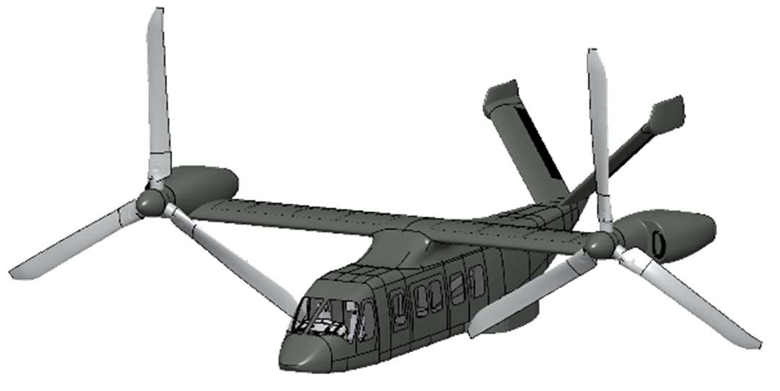
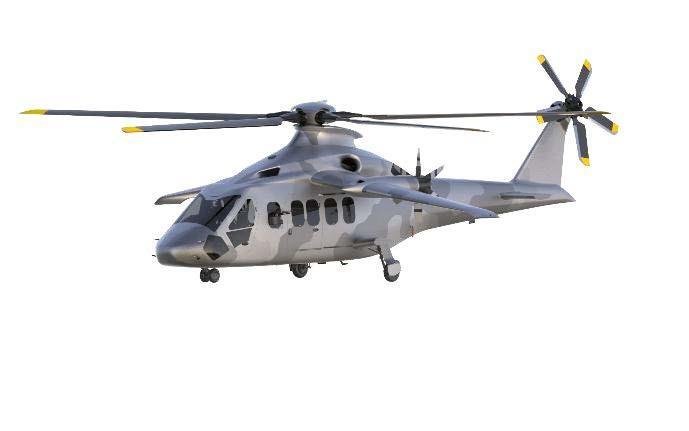
Please notice the mock-up around here. :cool:
Christoph Bergs from Military Aviation History said:
The Insane Capabilities for Future Combat Helicopters | NATO NGRC
Not too long ago, countries in NATO launched a new project (NGRC) to develop the helicopter of the future. Included are impressive, borderline ludicrous requirements, in order to really push for that "next big milestone". In this video I will provide insights on NGRC and also show you a really impressive flight demonstration of one of the three main contenders - the X-2 concept of Sikorsky!
Big thank you to all of you who have supported me to get to the point where I can get such access, it continuously impresses me what this community is able to achieve. I have also asked Sikorsky if any of you have questions on their design, that we could make a follow up sometime in the future. So ask away and let's try to get your questions answered directly from the source. [...]
Full Video:
View: https://youtu.be/BTP5-Nh3ir0?si=wy2qmOoP_Q2ukz-z
Link:
Code:
https://youtu.be/BTP5-Nh3ir0?si=wy2qmOoP_Q2ukz-z
 
I wonder if there's also a "mild hybrid" option, which would be a conventional helicopter with only some Racer features to improve range and fly at 180-200kts? e.g.
  • Include an optional box wing kit to increase lift and range. This also would have other benefits like providing attachment points for weapons. Make it detachable for easier air transportability.
  • Retain Racer's low drag rotor hub (which also provides some useful lift augmentation)
  • Other aerodynamic tweaks... assymetric tail boom and H160-style biplane stabilizer
  • Ecomode on 1 engine for long range cruise at 120-140kts
  • Include all the latest innovations in materials... composite fuselage, lightweight windshield, replace hydraulics with electric (e.g. landing gear mechanism) etc
But ditch Racer's complex lateral propellers and shaft lines, retaining a conventional tail rotor instead?
Time for the ultimate H-145M for the BW. Give it its Pioneerlab hybrid system and we got an worthy Tiger replacement xD
 
How are tilt-rotors still an adventure in Europe?
I apologize for not being more precise in my language. I intended my "adventure" comment toward Airbus. Clearly Leonardo is looking toward tilt rotor, if for no other reason than to capitalize on the decades long 609 (mis)adventure.
 
Clearly Leonardo is looking toward tilt rotor, if for no other reason than to capitalize on the decades long 609 (mis)adventure.
And they have very little to show for it so far, with AW609 certification not likely till next year.

https://www.flightglobal.com/helico...art-of-type-inspection-flights/162152.article
Leonardo's other tilt-rotor venture, the NGCTR demonstrator, is hardly better... late and rather disappointing in its technical scope with only some small technology improvements relative to AW609 (vs what was originally billed as a new 19-22 pax transport opening up new O&G and city-to-city markets). NGCTR's first flight has been pushed (again) to later this year, once they fix the flight control software (which is probably quite complex on a tilt rotor?).
 
Last edited:
I suspect that Fly By Wire is a challenge for all of the OEM. Does Airbus have a fielded Fly By Wire helicopter on the market? I don't know. I do suspect that Airbus has more experience with Fly By Wire than Leonardo. I do recall that Bell Flight has contended with the complexity in their 525 program, which has also seen delay. I suspect that Leonardo is using AW-609/NGRC as a means to burn down risk for the larger tilt rotor design. There may also be some investor concern on how profitable the larger Clear Skys effort will be, given how mature the infrastructure of Europe is. If Leonardo can keep cost down the capability to move more people in areas of less developed infrastructure (Africa, South Pacific, Central Asia) it might be very viable.

Cost sensitivity will be as significant for NGRC as any other program.
 
I suspect that Fly By Wire is a challenge for all of the OEM. Does Airbus have a fielded Fly By Wire helicopter on the market? I don't know. I do suspect that Airbus has more experience with Fly By Wire than Leonardo.
For NGCTR the FBW system apparently is extra complex due to the tilting nacelles, morphing wing elements (moving flaps) and V-tail. They've fitted an ejection seat (!) for the test pilot... which says something IMHO.

I believe AH's fly-by-wire experience is mostly from the NH90 program. The FBW system was outsourced to Liebherr in Germany and Goodrich Actuation Systems in France (formerly SAMM - Société d'applications des machines motrices).

Details on the NH90's fly by wire in the paper below:

Electrical Flight Control Technologies for Rotorcraft
https://dspace-erf.nlr.nl/server/api/core/bitstreams/a10d53de-e27c-46ac-8767-e207cf2b357b/content
 
For NGCTR the FBW system apparently is extra complex due to the tilting nacelles, morphing wing elements (moving flaps) and V-tail. They've fitted an ejection seat (!) for the test pilot... which says something IMHO.
I expect the complexity is why Leonardo has teamed with the Bell Flight on the program. If my memory is correct Leonardo has elected to only rotate the nacelle components associated with the prop rotors to reduce the complexity for NGRC. Not surprising there has been a significant body of work done on tilt rotor by Bell and the U.S. Government.
 
And they have very little to show for it so far, with AW609 certification not likely till next year.
As if the regulators don't keep adding "just one more thing" that they have to prove before they'll allow certification, and haven't been doing so for the last 20 years.

I suspect that the 609 will be "just one more year" from certification in 2078, when I would turn 100.


I suspect that Leonardo is using AW-609/NGRC as a means to burn down risk for the larger tilt rotor design.
I think that the Osprey is the point where tilt-rotors stop making sense as an aircraft type. Though maybe if the Osprey had kept the original rotor diameter instead of the reduced diameter the USN demanded...
 
I can only hope that the Congressional delegation from Pennsylvania and wherever P&W is making engines will apply pressure to the FAA to get on with it. Perhaps it would help if Leonardo painted "Extract Digit!" on the roof of the hangar. *


* With regards to my UK and Commonwealth comrades.
 
Perhaps an opportunity for Airbus to pitch 2 variants of the same common platform - a simpler conventional variant and a fast “Racer” variant? They recently implied that this was technically feasible.
Have been noodling on this idea of a single NGRC platform with 2 variants, conventional + fast.

First, here's what happens when you take an NH90 cabin and wrap a Racer-type platform around it.

The result is a somewhat bigger helo, in order to accommodate 1) a more streamlined fuselage and 2) a bigger rotor to carry the extra weight (estimated 1-2 tons empty weight penalty for X3 and Racer demonstrator) and offset the lift loss in hover from the upper wing interference.

Racer NGRC vs NH-90 100px=1m v4.png

The resulting helo is roughly the same size as a Sikorsky S92, i.e. ~13 tonnes TO weight and with a ~17.5m rotor diameter (minimum). But with a smaller cabin (15m3 vs. ~20m3)... illustrating the cost of speed.

Racer NGRC vs Sikorsky S-92 100px=1m v2.png

I haven't drawn the conventional variant, but removing the wing and some of the rear fuel tanks, replacing with a sponsoned main landing gear, would free up volume for a longer S-92 sized cabin (+4 troops, ~24 troops total). However, the larger cabin and lower structural weight (i.e. increased lift) would come at the price of shorter range. In addition, the rotor height might have to be lowered to stay within hangar height constraints for naval applications.

Anyway... thought it's interesting to illustrate some of the trade-offs.

PS. I've now added the conventional variant below.
 

Attachments

  • Racer NGRC 100px=1m v4.png
    Racer NGRC 100px=1m v4.png
    499.2 KB · Views: 69
Last edited:
Logical applications in my opinion. One of the crucial analytical efforts that must take place before final decisions are made is the frequency that the rotorcraft will be expected to operate beyond 185KM / 100NM. We all know that speed increases productivity over distances. 185KM appears to be the breaking point where the cost of speed buys its way into the design process. The question for Europe and NATO is do they expect to do longer distances on a regular basis? Tilt Rotor makes sense for the U.S. Army with the expectation of increased operations in the Pacific and Africa. Europe with the densest infrastructure geography may not have this requirement. However, there is likely a niche for medical evacuation and business that getting from one place to another in the least amount of time makes the expense more worthwhile.
Airbus will no doubt continue to measure the practicality of the extra weight and complexity of speed against what their governmental and civil customer base asks for.
 
One of the crucial analytical efforts that must take place before final decisions are made is the frequency that the rotorcraft will be expected to operate beyond 185KM / 100NM. We all know that speed increases productivity over distances. 185KM appears to be the breaking point where the cost of speed buys its way into the design process. The question for Europe and NATO is do they expect to do longer distances on a regular basis?
Indeed. One of the most surprising things about the initial NGRC requirements (see post #12 of this thread) was the 400nm mission radius. For a NATO helicopter operating in the European theatre that's seems quite excessive, but quite reasonable for missions in the Pacific (e.g. Okinawa to Taiwan or Luzon to Taiwan both require ~400nm).
 
C´mon guys, you can't expect we would let it go like this....

First, nobody in Europe keep stationing a significant amount of troops abroad. The French Army in Germany is a thing of the past and the 2000 isolated French in Romania, for example, certainly make for the best of it but won´t do much against a full scale offensive where the force maneuverability criteria discussed here is at play.
Secondly, war doesn´t start after a lengthy protocolar exchanges at the Société des Nations but are only preceded by covert actions and hybrid warfare that prevent effectively in many cases military preparation.
Thirdly, range is an essential component of battlefield defenses.

The result is that you have to counter any assaults from farther with reduced preparation and trough asynchronous and compromised intelligence feed. That lead to the problem of time sensitive planning and execution that can't be solved in term of aero mobility without RANGE (for reach) and SPEED (for coherence).

NGRC would fail pitifully if it doesn´t even try to address the realities compounded within the challenges faced by today combatants...
 
Last edited:
1751201644814.png 1751201563523.png Heres the thing last week when I attended Paris Air Show 2025.....and got the brief and walkaround of the Sikorsky S-97 Raider demonstrator and they had X" mock up cabin next to it, having a combo of medevac dustoff and troop seat. Can also sit in the cockpit and play around.

The cabin mock up is aimed specifically at NGRC ...so basically for the NATO peeps especially the NGRC folk at the show hot


Here are my photos below

1751201515975.png

1751201559854.png

1751201591916.png

1751201643227.png

cheers
 

Attachments

  • 1751201593293.png
    1751201593293.png
    6 MB · Views: 36
I think I mentioned this elsewhere, but will reiterate that 12 troops or eight litters without the 200 NM/370 KM radius would likely make the helicopter smaller than the Defiant. I think that the complexity considerations between the 'Defiant Junior' and the Racer are likely close to a draw, although I am sure that some will argue differently. It will come down to cost(s). RDT&E is amortized by both with their testbed aircraft. Procurement may come down to how desperate Lockheed Martin/Sikorsky is to get a new product to market (H-60 is soo 20th Century). Of course France and Germany have a solid political position with Europe, but if LockMart starts cutting deals with support from American political figures, it could be a challenge.
As much as I am a fan of tilt rotor aircraft, I see Leonardo as a long-shot with their Next Gen TR, at least for NGRC. For NATO nations I think there could be a niche' requirement for this platform for special operations actions across the Mediterranean, as several countries still have interest there, but unless the EU is going to federate and consolidate defense, a VTOL platform that can maneuver across the breadth and depth of Europe is unlikely to be realized as a necessity. Of course I am making this prognostication from the other side of the Atlantic, likely missing some of the nuisance of the program.
Regardless, this is going to be interesting, I'm getting my popcorn.
 
Last edited:
I think I mentioned this elsewhere, but will reiterate that 12 troops or eight litters without the 200 NM/370 KM radius would likely make the helicopter smaller than the Defiant. I think that the complexity considerations between the 'Defiant Junior' and the Racer are likely close to a draw, although I am sure that some will argue differently. It will come down to cost(s). RDT&E is amortized by both with their testbed aircraft. Procurement may come down to how desperate Lockheed Martin/Sikorsky is to get a new product to market (H-60 is soo 20th Century). Of course France and Germany have a solid political position with Europe, but if LockMart starts cutting deals with support from American political figures, it could be a challenge.
As much as I am a fan of tilt rotor aircraft, I see Leonardo as a long-shot with their Next Gen TR, at least for NGRC. For NATO nations I think there could be a niche' requirement for this platform for special operations actions across the Mediterranean, as several countries still have interest there, but unless the EU is going to federate and consolidate defense, a VTOL platform that can maneuver across the breadth and depth of Europe is unlikely to be realized as a necessity. Of course I am making this prognostication from the other side of the Atlantic, likely missing some of the nuisance of the program.
Regardless, this is going to be interesting, I'm getting my popcorn.

Bearing in mind over the last 3 year period I attended international Military Helicopter conference in London and does not matter whether its the Aeronautica Militare Italiana colonel or general or Marina admiral giving presentation, their last slide(s) always depict V-280 (MV-75 now) or Sikorsky X2....

and the other year AMI chief of staff stated he wanted the X2 tech to form the air force next generation helos

cheers
 
A good point. We also have to remember that Leonardo has teamed with Bell Flight for NGRC. If the MV-75 has a relatively good introduction into US service then I might have to rethink my position.

Right now, I still think that a tilt rotor platform will be above the price point that many European countries will find desirable, not to mention it does not benefit their workforce. By "their" I mean France and Germany. I cannot see Eastern Europe finding a rational for a tilt rotor. Northern Europe with North Sea concerns and longer distances might have a need.
 
Right now, I still think that a tilt rotor platform will be above the price point that many European countries will find desirable, not to mention it does not benefit their workforce.
Given likely budget constraints, I wonder what kind of performance Airbus could squeeze out of the existing Racer platform and drivetrain if it scaled up the fuselage to meet the NGRC specs (12-16 troops, 5m x 2m x1.6m cabin... i.e. approximately NH90 sized). This would probably require installing an NH90 main rotor to increase MTOW weight and payload (but the drivetrain is oversized anyway).

Something like this perhaps... say around 11 - 12t MTOW? Given that top speed is limited by the Aneto engines (2x 2500-3000hp?) and would have to drop somewhat keeping engine power constant, say from from ~210 knots to ~180 knots at sea level and ~240 knots to 210 knots at altitude (which should still meet NGRC minimum specs), would users find this a compelling value proposition?

Racer NGRC vs NH90 11ton 100px=1m v3.png
 
Last edited:
Right now, I still think that a tilt rotor platform will be above the price point that many European countries will find desirable, not to mention it does not benefit their workforce. By "their" I mean France and Germany.
That can be done via workshare agreements, and/or supplying components if the fuselages are built in Italy.


I cannot see Eastern Europe finding a rational for a tilt rotor.
Getting the staging bases out of artillery range isn't good enough?
 
That can be done via workshare agreements, and/or supplying components if the fuselages are built in Italy.


Getting the staging bases out of artillery range isn't good enough?
Someday the cost of a tiltrotor may be on par with helicopters, but so far that has not been true. Certainly if an increasingly Eurocentric NATO elects to go with a tiltrotor as the primary aircraft some of the Eastern European nations, like Poland, might buy in. I just don't see the less financially agile countries having the budget for it. To be fair, I am not sure they would elect to go with any new rotorcraft at the likely price we would expect to see.
Current mentality has it that high end military machines are now antiquated on the modern battlefield. This certainly gives rational to those who have marginal defense budgets to work with to put the money elsewhere.
 
NGRC update - first look at the 5 proposed concepts
1 tiltrotor, 2 conventional helos, and 2 compounds
https://www.flightglobal.com/helico...d-rotorcraft-and-17t-tiltrotor/165439.article
1. Leonardo opted for a large tiltrotor concept offering a 4t payload for its 17t MTOW and capable of carrying 16 troops. It appears to use a similar design to the Bell MV-75 – the US airframer was a partner in its consortium – whereby only its rotors tilt, rather than the full nacelles as on the Bell-Boeing V-22 Osprey. In common with the MV-75 it also features a V-tail configuration.
2. Airbus pitched two concepts: a conventional helicopter seemingly resembling a larger version of the airframer’s latest H160 medium-twin and a similarly sized compound design. In the latter case, this draws on the broad architecture of the Racer high-speed demonstrator but dispenses with its V-shaped box-wing in favour of a relatively long, conventional wing mounted high on the fuselage – presumably to aid safe access to the cabin and to allow a door gun to traverse. Like the Racer, forward flight is powered by twin pusher-propellers, but instead of relying on those lateral rotors for anti-torque control, the concept also incorporates a traditional tail rotor.
3. Sikorsky’s concepts also encompass a conventional helicopter – looking like a beefed-up version of its ubiquitous UH-60 Black Hawk – and a compound rotorcraft making use of its X2 co-axial and pusher-prop technology.​
 

Attachments

  • 1. NGRC Leonardo tiltrotor.png
    1. NGRC Leonardo tiltrotor.png
    144 KB · Views: 114
  • 2a. NGRC Airbus conventional.jpg
    2a. NGRC Airbus conventional.jpg
    20.1 KB · Views: 116
  • 2b. NGRC Airbus compound.jpg
    2b. NGRC Airbus compound.jpg
    18 KB · Views: 128
  • 3a. NGRC Sikorsky conventional.png
    3a. NGRC Sikorsky conventional.png
    123 KB · Views: 127
  • 3b. NGRC Sikorsky X2.png
    3b. NGRC Sikorsky X2.png
    141.5 KB · Views: 108
Honestly the only surprise for me is the Airbus high-speed layout includes a tail rotor. I think their rational for this is because of the concern regarding troops operating around open rotors that many here (to include myself) have expressed in regards to this layout. The propulsors could be shut down in flight and the aircraft becomes a conventional helicopter for operations near the ground.
Airbus conventional is a logical progression of their technology.
Sikorsky conventional design appears to build on H-60 and H-92 with some elements of their FVL technologies thrown in for good measure. X2 is not surprising.
Leonardo, likewise is what I expected them to promote.
An interesting note is that none of the concepts appear to have a rear ramp.
 
Honestly the only surprise for me is the Airbus high-speed layout includes a tail rotor. I think their rational for this is because of the concern regarding troops operating around open rotors that many here (to include myself) have expressed in regards to this layout. The propulsors could be shut down in flight and the aircraft becomes a conventional helicopter for operations near the ground.
In addition this new compound layout probably helps with shipborne operations, as the lateral props have been moved inwards and the outer wings could fold to reduce the footprint. I don't love it though... more weight & complexity.

Doesn't help that the Airbus concept drawings look fairly crude and ugly IMHO, like they were cobbled together by a junior design intern. Would have been nice to show some mission equipment like the sensor turrets, and wire cutters on the Sikorsky concepts. Also they don't look very aerodynamically refined... I'd have expected more elements from the H160 and Racer designs (e.g. biplane stabilizer, canted tail, asymmetric tail boom, low drag rotor hub etc), though some of these may just be hard to spot in these low resolution images.
 
Doesn't help that the Airbus concept drawings look fairly crude and ugly IMHO, like they were cobbled together by a junior design intern. Would have been nice to show some mission equipment like the sensor turrets, and wire cutters on the Sikorsky concepts. Also they don't look very aerodynamically refined... I'd have expected more elements from the H160 and Racer designs (e.g. biplane stabilizer, canted tail, asymmetric tail boom, low drag rotor hub etc), though some of these may just be hard to spot in these low resolution images.
Amen Sir, compound helios need not possess lateral props, a receipe for disaster in any fast rope situation. A ringed rear mounted pusher prop compound, coaxial rotor from Airbus would be good.
 
Last edited:
@H_K : Note that the image of Airbus compound included in the report does not lift the ambiguity of it having one or two pusher props ;)

As stated earlier, one would do the job enough.

The only sad aspect of the design is the stacking of all the rotating elements piled one on top of another due to the choice of having a shoulder mounted wing for the pusher rotor.
Now that they have an anti-torque rotor, the safety of passengers is less compromised... as the pusher prop can be deactivated during the landing phase and stationary flight (see Sikorsky pusher prop system). That means that you can lower the position of that prop, but also move that wing away from the main rotor and de-stack everything with a much more compact configuration in height.
Your Air transportation command would certainly appreciate.

But at the end, the NGRC program would have to answer if on overall what we see today was worth the expenses,
 
Last edited:
I don't think Airbus' compound and Sikorskys coaxial design have much of a chance really. The large coaxial seems rather mechanically complex and damn does it look tall. While the compound design from Airbus just screams "accident in the making" to me. Viable for controlled and curated civilian applications, but I don't see this being anything but a huge hazard in chaotic military situations.

The conventional Sikorsky, Airbus and the Leonardo design look promising. Obviously Leonardos pitch is also mechanically complex, like the compound and coaxial offerings. However the advantage in outright flight performance, range and speed may offset this, after all the MV-75 prevailed over the SB-1 for similar reasons. While the conventional Airbus and Sikorsky proposal build on the solid foundation of previous efforts, being a refined and modernized culmination of preceding work.

I personally find the end plates on the V-Tail of the tiltrotor quite interesting, these were absent on the MV-75, right?
 
I personally find the end plates on the V-Tail of the tiltrotor quite interesting, these were absent on the MV-75, right?
You are correct that the MV-75 does not have the same end plates. Find that rather curious as well. Perhaps for electronic sensing equipment?
If I had to bet on this today I would have to go with the Conventional Airbus design. Enough of Europe would be involved with the building of the aircraft to make it politically desirable. As much as I am a tilt rotor fan, I am inclined to believe that Europe would be less inclined to do full development of one of these, when they can get a more matured platform (MV-75) for those missions requiring that range and speed by the time they would want them. Of course they could be built at various Leonardo facilities around Europe.
 
The composite fuselage Son-Of-Blackhawk pitch by Sikorsky is interesting. They've indicated a new conventional airframe is coming to the commercial market, wonder how much it might share with this.
 
If I had to bet on this today I would have to go with the Conventional Airbus design.
My bet would be on BOTH Airbus designs. They’ve hinted that future operators might prefer to operate mixed fleets of conventional and fast helicopters with a high degree of commonality and easy pilot conversion. The conventional helicopter would be optimized for utility missions (more lift) and shipborne ops; the fast helicopter would be optimized for troop insertion, special ops and SAR/CSAR.

Plus those platforms look very similar IMHO, suggesting many elements could be shared (main and tail rotors, main fuselage, cockpit & landing gear etc). The compound would need more power and a heavier MGB however, with a different upper deck.
 
Last edited:
Amen Sir, compound helios need not possess lateral props, a receipe for disaster in any fast rope situation. A ringed rear mounted pusher prop compound, coaxial rotor from Airbus would be good.
It looks like the lateral props are now much smaller (since they don’t need to provide counter torque) which increases their ground clearance and moves them away from troops on the ground.

So I suspect even if left turning the props will be much less of a concern now.
 
It looks like the lateral props are now much smaller (since they don’t need to provide counter torque) which increases their ground clearance and moves them away from troops on the ground.

So I suspect even if left turning the props will be much less of a concern now.
V-22 downwash is so significant that a massive heavy weight rope anchor is necessary for descending troops. Although the lateral props are nowhere near that type of downwash and the lateral props may be stopped during rappelling, the fear would be that during winch up & rope down the rope may be blown into any large protrusions and become entangled/inhibited. Not a good situation in extremis.
 
Double-pushers like RACER and a tail rotor? Why?
Probably because this is more efficient than the alternatives which would require either a pivoting tail rotor (NH-3A Sea King) or a tail rotor AND a pusher prop at the tail (AH-56 Cheyenne).

Putting the pusher props on the wing gives them access to cleaner air flow (= higher propulsive efficiency) and creates a natural counterweight to the wing’s lift (= more structural efficiency). It also allows the pusher props to contribute to counter torque and allows for more exotic asymmetric tail shapes to generate additional counter torque (via sideways lift), both of which allow for a smaller tail rotor and provide extra safety redundancy in the event of tail rotor loss.
 
Last edited:
I don´t think you would have cleaner airstream under the main rotor. ;)
The main driver here is the shaft length plus some extra subtilities.

Cheyenne did use a tail pusher props to simplify mechanical linkage. The prop being in direct proximity to the anti-torque rotor. The pusher prop also helping to shape the airflow around the whole airframe.
 
Probably because this is more efficient than the alternatives which would require either a pivoting tail rotor (NH-3A Sea King) or a tail rotor AND a pusher prop at the tail (AH-56 Cheyenne).
If you look at the Cheyenne layout, there's a straight drive shaft from the main rotor mast to a 90deg split gearbox to drive the tail rotor and the pusher prop. Very simple mechanically.
 
If you look at the Cheyenne layout, there's a straight drive shaft from the main rotor mast to a 90deg split gearbox to drive the tail rotor and the pusher prop. Very simple mechanically.
Yes the Cheyenne layout is simpler mechanically. But very likely less efficient aerodynamically, especially as you increase fuselage cross section (troop transport helicopter) causing more turbulent airflow into the pusher propeller.

Pusher props on wings on the other hand should have clean air flow in cruise as the main rotor is unloaded by at least 50%, meaning less power needed, so smaller engines, less fuel consumption, lighter airframe etc. Also less counter torque needed in hover, so smaller tail rotor, meaning additional weight savings. Plus a lighter wing structure…

All this would have to be balanced against the extra weight of the more complex drive shafts and gearboxes… overall it wouldn’t be too surprising if the Airbus solution was better.
 
Better is generally something that is backed by arguments in aerospace. Better on what? Better how? At this stage, to my humble knowledge, Airbus hasn´t completed a demonstration for their core mission objective: high speed passenger transport. Cheyenne did.

Also you are under the illusion that magically the props under the main rotor are under clean airstream conditions. This is absolutely not the case, even with an unloaded rotor. See for example how many design perch the anti-torque above the main rotor.

Rotary wing aircraft are subjected to complex airflows and airframe interactions with it. The rotor flaps, tilt, blade lags, airframe flexes etc... There are no clean air or stable conditions to consider in this art. It´s all about dynamics, transitory states etc...
 
Last edited:

Similar threads

Back
Top Bottom