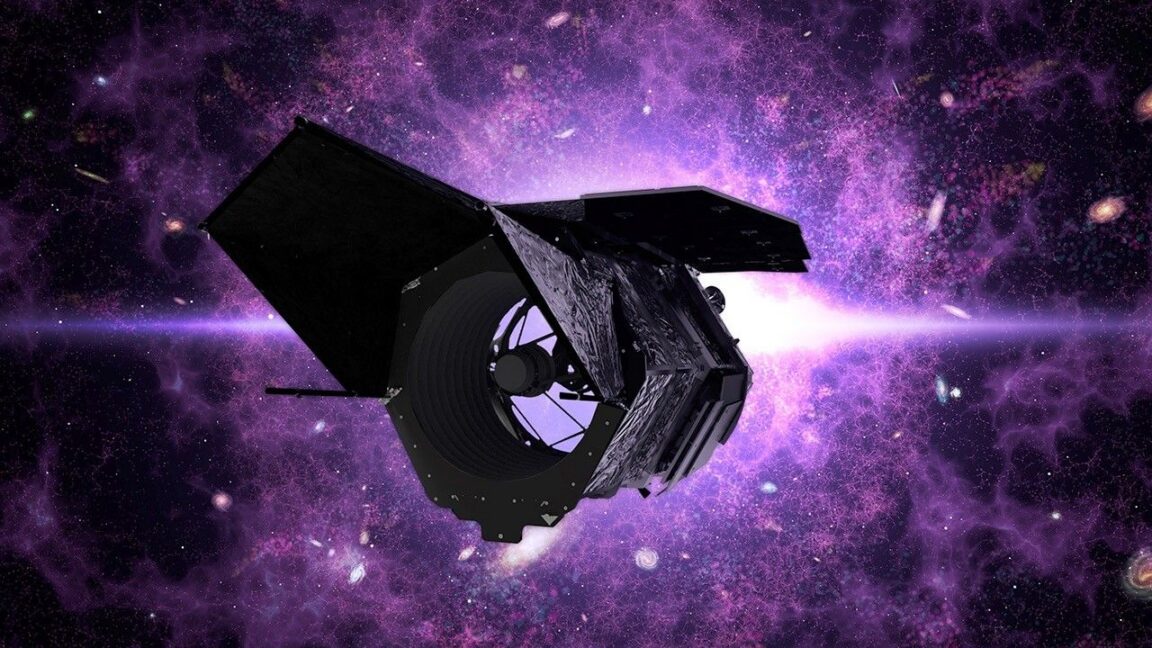
Nancy Grace Roman Telescope

Solar Panels for NASA’s Roman Space Telescope Pass Key Tests [Aug 26]

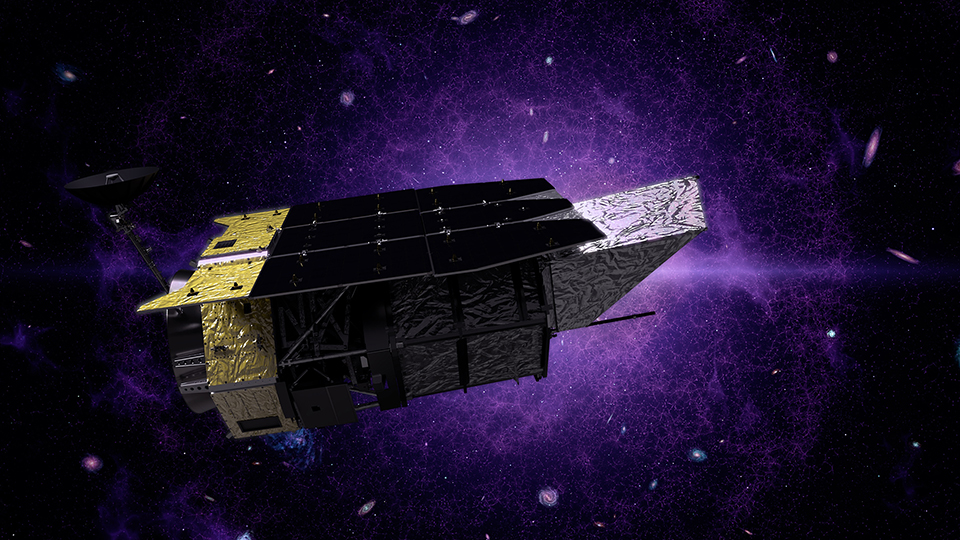
NASA’s Nancy Grace Roman Space Telescope’s Solar Array Sun Shield has successfully completed recent tests, signaling that the assembly is on track to be completed on schedule. The panels are designed to power and shade the observatory, enabling all the mission’s observations and helping keep the instruments cool.

The Roman team has two sets of these panels –– one that will fly aboard the observatory and another as a test structure, used specifically for preliminary assessments.

Engineers at NASA’s Goddard Space Flight Center in Greenbelt, Maryland, evaluated the test version in a thermal vacuum chamber, which simulates the hot and cold temperatures and low-pressure environment the flight panels will experience in space. Since the panels will be stowed for launch, the team practiced deploying them in space-like conditions.

Meanwhile, a vendor built up the flight version by fitting the panels with solar cells. After delivery to Goddard, technicians tested the solar cells by flashing the panels with a bright light that simulates the Sun.

“We save a significant amount of time and money by using two versions of the panels, because we can do a lot of preliminary tests on a spare while moving further in the process with the flight version,” said Jack Marshall, the Solar Array Sun Shield lead at NASA Goddard. “It streamlines the process and also avoids risking damage to the panels that will go on the observatory, should testing reveal a flaw.”

Next spring, the flight version of the Solar Array Sun Shield will be installed on the Roman spacecraft. Then, the whole spacecraft will go through thorough testing to ensure it will hold up during launch and perform as expected in space.
 
View: https://www.youtube.com/watch?v=PJKjpYKJwk4


Oct 2, 2024
In September 2024, the Nancy Grace Roman Space Telescope passed a key milestone and was approved for the next stage of construction. Work on the main systems that will make up the final spacecraft is finishing, and the team at NASA’s Goddard Space Flight Center is ready to begin integration, the process of connecting them together. This video celebrates the effort to reach the final stages of assembly.

To learn more about all these systems and where they fit into Roman, visit https://roman.gsfc.nasa.gov/interactive/


Launching no later than May 2027, Roman is NASA’s next flagship mission. An infrared survey telescope with the same resolution as Hubble, but 100 times the field of view, Roman is being built and tested at NASA’s Goddard Spaceflight Center in Greenbelt, Maryland. Partners from across the country are contributing to this effort.

Music credit: “The Call,” Torsti Juhani Spoof [BMI] Universal Production Music

Credit: NASA’s Goddard Space Flight Center
Producer: Scott Wiessinger (eMITS)
Videographers: Sophia Roberts (eMITS)
Scott Wiessinger (eMITS)
Jolearra Tshiteya (ASRC Federal)
Public affairs officer: Claire Andreoli (NASA/GSFC)
Editor: Scott Wiessinger (eMITS)
 
NASA Joins Telescope, Instruments to Roman Spacecraft [Jan 8]

Technicians have successfully integrated NASA’s Nancy Grace Roman Space Telescope’s payload – the telescope, instrument carrier, and two instruments – to the spacecraft that will deliver the observatory to its place in space and enable it to function while there.

“With this incredible milestone, Roman remains on track for launch, and we’re a big step closer to unveiling the cosmos as never before,” said Mark Clampin, acting deputy associate administrator for the Science Mission Directorate at NASA Headquarters in Washington. “It’s been fantastic to watch the team’s progress throughout the integration phase. I look forward to Roman’s transformative observations.”

The newly joined space hardware will now undergo extensive testing. The first test will ensure each major element operates as designed when integrated with the rest of the observatory and establish the hardware’s combined performance. Then environmental tests will subject the payload to the electromagnetic, vibration, and thermal vacuum environments it will experience during launch and on-orbit operations. These tests will ensure the hardware and the launch vehicle will not interfere with each other when operating, verify the communications antennas won’t create electromagnetic interference with other observatory hardware, shake the assembly to make sure it will survive extreme vibration during launch, assess its performance across its expected range of operating temperatures, and make sure the instruments and mirrors are properly optically aligned.

Meanwhile, Roman’s deployable aperture cover will be integrated with the outer barrel assembly, and then the solar panels will be added before spring. Then the structure will be joined to the payload and spacecraft this fall.

The Roman mission remains on track for completion by fall 2026 and launch no later than May 2027.
 
b]NASA's Roman Space Telescope Hardware Highlights: Summer/Fall 2024[/b]

View: https://www.youtube.com/watch?v=HZ_knAEx9xg


eb 25, 2025
Every day, the Nancy Grace Roman Space Telescope moves closer to completion. This video highlights some of the important hardware milestones from part of this journey. Components and systems are built separately, tested, and then integrated with larger parts of the spacecraft to carefully build the full observatory. Roman’s foundation is the primary structure, or spacecraft bus, which houses electronics and support systems. Like the chassis of a car, everything is built up from this aluminum hexagon.

This video, covering the summer and fall of 2024, opens with NASA’s Goddard Space Flight Center’s Space Environment Simulator. This thermal vacuum chamber is used to test Roman’s Instrument Carrier, which will hold and connect the instruments and mirror. Once the hardware is in place, the chamber evacuates the air and generates high and low temperature extremes to simulate the conditions in space.

Workers carefully deploy Roman’s High-Gain Antenna to ensure that it will operate as expected. The 5.6-foot (1.7-meter) dish is Roman’s primary means of communication and will be responsible for sending roughly 1.4 terabytes of data back to Earth each day.

The Outer Barrel Assembly is tested on Goddard’s 120-foot-diameter centrifuge. This structure will surround and protect Roman’s primary mirror from stray light. Engineers add weights to simulate additional hardware and tip the Outer Barrel Assembly at different angles over multiple spins to certify that it can withstand all the forces it will experience over its life.

The Wide Field Instrument (WFI), Roman’s primary science tool, arrives at Goddard after testing at BAE Systems where it was built. Workers push a sealed crate into the clean room where they can remove the WFI and test it to ensure it made the trip safely. The Optical Telescope Assembly is a combination of the 7.9-foot (2.4-meter) primary mirror, the smaller secondary mirror, and many additional optical elements designed to direct the focused beam of light to Roman’s two instruments. It was built and tested at L3Harris and is the last major piece of hardware to arrive at Goddard.

Its special shipping container will also house the completed Roman telescope when it leaves for launch. The Coronagraph Instrument is the first major component integrated, or connected, to the Instrument Carrier. The Coronagraph is a technology demonstration capable of directly image planets outside our solar system, was developed and built at JPL in California. The Optical Telescope Assembly is the next piece integrated. It has to be carefully aligned with the Coronagraph so that light from the mirrors can perfectly pass through an opening in the Coronagraph.

First comes mechanical integration, where the hardware is physically connected, and then comes electrical integration where all the various electrical systems are hooked up.

The final piece is the Wide Field Instrument, which had to go last because of its size and position. Engineers carefully align it with an opening in the Optical Telescope Assembly so light can pass from one to the other. With the addition of this final element, the instruments, mirrors, and carrier are now called the Integrated Payload Assembly.

A very large team of engineers and technical crew lift the Integrated Payload Assembly over the Spacecraft Bus and lower it into place. Mechanical integration takes several hours; electrical integration will take days. Now unified, the heart of the Roman spacecraft is complete.

To learn more about all these systems and where they fit into Roman, visit https://roman.gsfc.nasa.gov/interactive/
.
 
I agree with this comment on NSF regarding what’s happening to the project.

I think there's a simple explanation for why the administration is looking to kill this program. They want to close the Goddard Spaceflight Center, which is the primary NASA center for climate research and building climate oriented satellite missions. Roman and DaVinci are both Goddard projects; in the wrong place at the wrong time.
 
Oh hell, I got really confused there for a second and wondered why NASA was naming a telescope after that insufferable screeching hag that used to be on CNN.

Infuriating if it gets cancelled somehow...though if it's fully assembled and just awaiting launch, I wonder if they could arrange for it to be operated by the ESA? Or just stick it in a warehouse and throw a sheet over it until the present administration gets the boot.
 
Oh hell, I got really confused there for a second and wondered why NASA was naming a telescope after that insufferable screeching hag that used to be on CNN.
If it had been, Trump and Elon would be too scared to kill it....
 
Every day, the Nancy Grace Roman Space Telescope moves closer to completion. This video highlights some of the important hardware milestones from this journey. Roman now exists as two main pieces: a telescope section that includes the mirrors, instruments and support systems; and an outer section comprised of the solar panels and protective coverings. These two sections are tested separately prior to being joined together to create the complete observatory.

This video, covering the first half of 2025, opens with NASA’s Goddard Space Flight Center’s SES (Space Environment Simulator.) This thermal vacuum chamber can simulate the vacuum of space and the wide temperature range that Roman will experience there: from -310° Fahrenheit (-190° C) to 302° Fahrenheit (150° C).

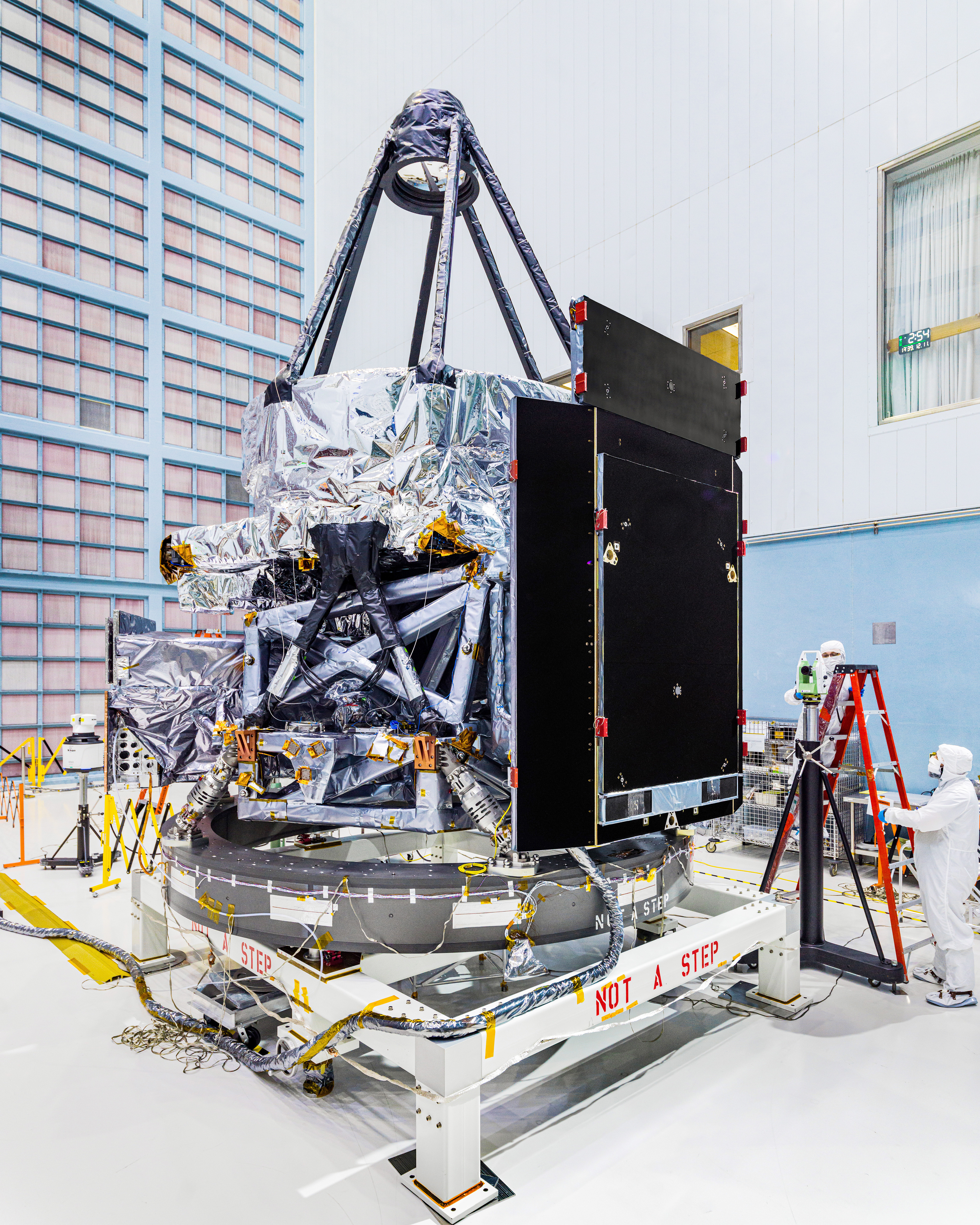
The test versions of the Solar Array Sun Shield panels are installed onto the Outer Barrel Assembly inside Goddard’s largest clean room in preparation for testing. Multiple copies of hardware often exist, typically for testing purposes; flight hardware is the version that will actually fly in space on the final spacecraft. The flight solar panels are the only ones covered with delicate solar cells. The Outer Barrel Assembly, which is flight hardware, will protect and shade the primary mirror. With the solar panels and a deployable front cover that functions like a visor, it forms the outer, protective section of the spacecraft.


Roman's telescope section is covered in a protective tent and pushed outside of the clean room using pressurized air to float it like a hovercraft. Technicians and engineers lift it onto one of two shaker tables where it undergoes vibration testing. Roman undergoes a series of tests along each axis with increasing intensity to simulate components of launch stress. For the most intense tests of each axis, the spacecraft systems are powered up to ensure that everything can handle the stress.

Finally, Roman’s outer section is lowered over a structure made to simulate the telescope portion. Then it is covered in a protective tent, pushed out of the clean room, and crane-lifted into the SES chamber. With the tent around it, it’s a very tight fit and requires several rotations to clear hardware in the chamber. The tent is lifted out and the chamber closed. This outer section underwent around a month of testing at low pressure and different temperatures. Because the main tent was getting ready for Roman’s other section, a more temporary covering protected the outer section on the way out, and then technicians pushed it, uncovered, the last stretch into the clean room, giving the best-possible view of it at the end.

View: https://youtu.be/ux75BfGL9aw?si=o6rcjncL_-douFL7
 
The Nancy Grace Roman Space Telescope: Years in the Making - Steps from Discovery

Jul 16, 2025
Speakers: Dr Kristen McQuinn of the Space Telescope Science Institute, Robyn Sanderson of the University of Pennsylvania

The Nancy Grace Roman Space Telescope is NASA’s next large strategic mission. In this event, Dr. Kristen McQuinn (Space Telescope Science Institute) will tell us how Roman is set to chart the depths of space and time and forge the path towards Earth 2.0. Additionally, Dr. Robyn Sanderson (University of Pennsylvania) will tell us how Roman has the potential to discover what dark matter is—or isn't—by observing nearby galaxies.

View: https://www.youtube.com/live/2NpN8aejyyA
 
JPL astrophysicist and NASA Exoplanet Science Ambassador, Anjali Tripathi. is interviewed by Neil deGrasse Tyson.

Jul 29, 2025 StarTalk Podcast

Could a new telescope one day spot city lights on exoplanets? Neil deGrasse Tyson and comedian Matt Kirshen answer questions about the frontiers of exoplanet science with astrophysicist and NASA Exoplanet Science Ambassador, Anjali Tripathi.

Anjali explains how we went from knowing zero to thousands of exoplanets and how NASA’s upcoming Nancy Grace Roman Space Telescope will blow that number into the tens of thousands. Learn how this flagship mission will use microlensing and coronagraph technology to directly image planets and analyze their atmospheres for biosignatures and maybe even signs of alien pollution.

We dive into how exoplanets form, what early planetary disks look like, and how Earth-like conditions have changed across time. Can life exist under ice? What about on moons? Could we one day spot alien city lights? Why are gas giants easier to find? How do biosignatures evolve over billions of years? And what happens to habitability when our own Sun balloons out?

Can planets form in donut shapes? How accurate are our measurements? And what if simulations predict strange things, like bug planets? We answer questions about binary star systems, moons as homes for life, and whether every solar system is truly a snowflake. You’ll also learn about planet detection methods, the possibility of seeing city lights from distant planets, and the philosophical limits of what science can tell us.


Timestamps:
00:00 - Introduction: Anjali Tripathi
3:33 - The Latest in Exoplanets
7:05 - Directly Imaging Exoplanets & Habitable Worlds Observatory
12:15 - Exoplanetary Formation & Finding Water
16:56 - Progress in Exoplanetary Research
18:22 - Can Planets Be Different Shapes?
20:50 - The Changing Habitable Zone
24:12 - Is Our Solar System Unique?
26:15 - Can We Ever See The Surface of Exoplanets?
28:40 - Exoplanet’s Distance to Their Star
30:52 - Life-Containing Moons
35:01 - Techniques for Discovery
39:24 - Validating Results
44:31 - Strange Simulation Results

View: https://www.youtube.com/watch?v=flE3ukF8hRo
 
Roman Deployment Test

View: https://www.youtube.com/watch?v=AVpWVkj2w6I


Aug 26, 2025
Technicians recently tested two major deployments for NASA’s Nancy Grace Roman Space Telescope: the Deployable Aperture Cover (DAC) and the Solar Array Sun Shield (SASS).

The DAC will protect Roman’s instruments before launch, then swing open once the telescope is in space. To simulate weightlessness, engineers used a gravity offload system precisely counterbalanced to reduce drag during deployment.

The SASS unfurled in true flight-like fashion, with its solar panels swinging into place under powerful spring tension. Each release was marked by the sharp pop of a non-explosive actuator.

Both deployments were successful, bringing Roman one step closer to its mission to study dark energy, exoplanets, and the distant universe. To learn more, check out the link in our Roman highlight.

Credit: NASA's Goddard Space Flight Center
Sophia Roberts: Videographer / Producer
Scott Weissinger: Videographer / Producer
Videographers: Sophia Roberts (eMITS) and Scott Wiessinger (eMITS)
Paul Morris: Editor
Public Affairs Officer: Claire Andreoli (NASA/GSFC)
 
Let's hope the US Congress keeps this satellite and others like it out of the hands of the Project 2025 anti-science arseholes trying to cancel it and other related projects.
 
Last edited:
NASA's Roman Could Bring New Waves of Information on Galaxy’s Stars

Summary

It’s clear as a bell: Roman can enlighten us on the stars located in the Milky Way’s galactic bulge.
In musical terms, stars are like a constantly playing handbell choir. The turbulence within their interiors creates a pattern of waves — steady oscillations, like a ringing bell — which cause changes in their overall brightness. Studying these fluctuations, a method known as asteroseismology, can provide details about the stars themselves, such as their age, mass, and size.

Building from NASA’s now-retired Kepler space telescope’s successful asteroseismic detections, a team of researchers has recently confirmed that asteroseismology will be possible with NASA’s upcoming Nancy Grace Roman Space Telescope. Their study also explores different models to provide an estimation of the number of stars that will be detectable via this method. Their results indicate the telescope will provide the largest asteroseismic sample ever collected.

 
View: https://twitter.com/NASARoman/status/1993407468920090779


NASA’s Roman Observatory Passes Spate of Key Tests [Nov 25]

NASA’s nearly complete Nancy Grace Roman Space Telescope has made another set of critical strides toward launch. This fall, the outer portion passed two tests — a shake test and an intense sound blast — to ensure its successful launch. The inner portion of the observatory underwent a major 65-day thermal vacuum test, showing that it will function properly in space. As NASA’s next flagship space telescope, Roman will address essential questions in the areas of dark energy, planets outside our solar system, and astrophysics.

“We want to make sure Roman will withstand our harshest environments,” said Rebecca Espina, a deputy test director at NASA’s Goddard Space Flight Center in Greenbelt, Maryland. “From a mechanical standpoint, our heaviest loads and stresses come from launch, so we use testing to mimic the launch environment.”

The vibration and acoustic testing were the final round of launch simulations for the outer portion of the Roman observatory, which consists of the outer barrel assembly, deployable aperture cover, and recently installed flight solar panels.

During acoustic testing, a large chamber with gigantic horns emulated the launch’s thunderous sounds, which cause high-frequency vibrations. Test operators outfitted the chamber and assembly with various sensors to monitor the hardware’s response to the sound, which gradually ramped up to a full minute at 138 decibels — louder than a jet plane’s takeoff at close range!

After moving to a massive shaker table, Roman’s outer assembly went through testing to replicate the rocket launch’s lower-frequency vibrations. Each individual test lasts only about a minute, sweeping from 5 to 50 hertz (the lowest note on a grand piano vibrates at 27.5 hertz), but NASA engineers tested three axes of movement over several weeks, breaking up the tests with on-the-spot data analysis.

Like in acoustic testing, the team installed sensors to capture the assembly’s response to the shaking. Structural analysts and test operators use this information not only to evaluate success but also to improve models and subsequent assessments.

“There’s a real sense of accomplishment when you get a piece of hardware this large through this test program,” said Shelly Conkey, lead structural analyst for this assembly at NASA Goddard. “I am proud of the work that our team of people has done.”

The core portion of the observatory (the telescope, instrument carrier, two instruments, and spacecraft bus) moved into the Space Environment Simulator test chamber at NASA Goddard in August. There, it was subjected to extreme temperatures to mimic the chill of space and heat from the Sun. A team of more than 200 people ran simulations continuously for more than two months straight, assessing the telescope’s optics and the assembly’s overall mission readiness.

“The thermal vacuum test marked the first time the telescope and instruments were used together,” said Dominic Benford, Roman’s program scientist at NASA Headquarters in Washington. “The next time we turn everything on will be when the observatory is in space!”

The team expects to connect Roman’s two major parts in November, resulting in a complete observatory by the end of the year. Following final tests, Roman will move to the launch site at NASA’s Kennedy Space Center in Florida for launch preparations in summer 2026. Roman remains on schedule for launch by May 2027, with the team aiming for as early as fall 2026.

21 new photos uploaded to Flickr
 
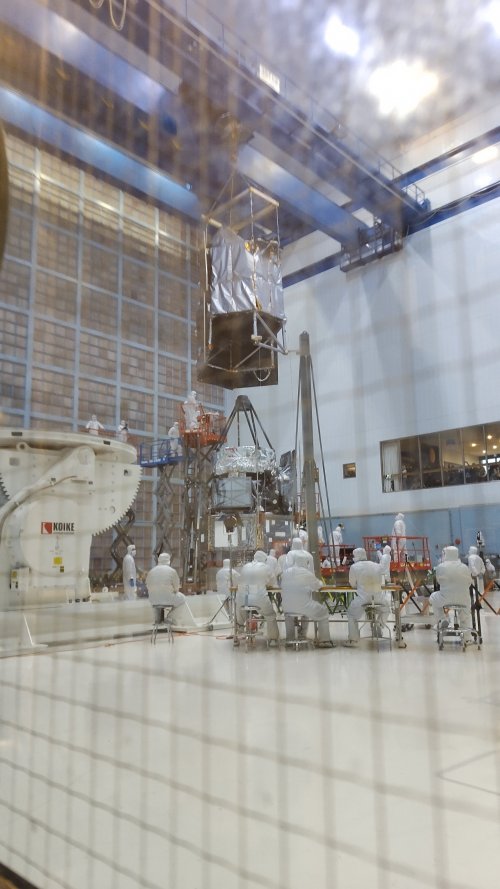
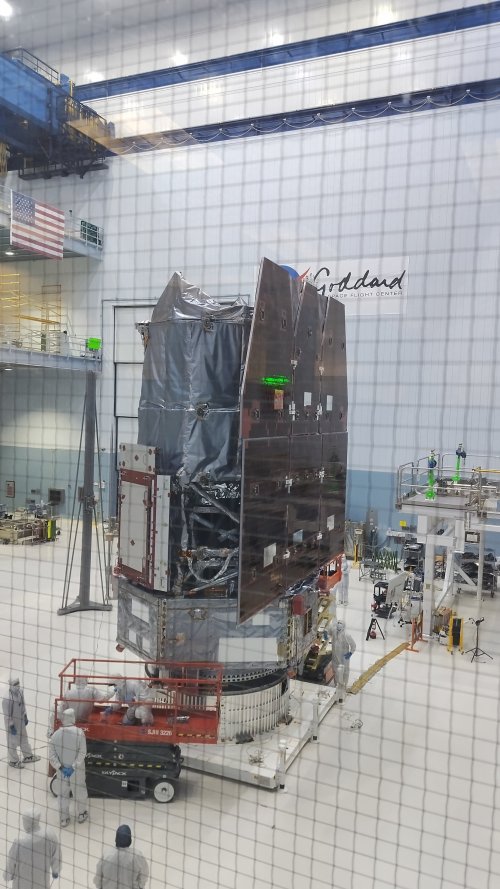
We lowered the OSD (Outer Barrel, Solar Array Sunshield, and Deployable Apeture Cover) onto the SCIPA (Spacecraft and Integrated Patload Assembly) last Tuesday.
 

Attachments

  • IMG_20251125_085837.jpg
    IMG_20251125_085837.jpg
    1.1 MB · Views: 18
  • IMG_20251125_110557.jpg
    IMG_20251125_110557.jpg
    1.1 MB · Views: 21
NGRST is on track for launch in May 2027. There may be more than 6 months of schedule margin:

https://www.space.com/space-nasa-co...ce-roman-space-telescope-exploration/missions

With physical construction complete, Roman now shifts into a lengthy campaign of environmental and performance testing under simulated space conditions designed to verify that the spacecraft can survive the stresses of launch and operate as intended once in space. After that, the telescope will be shipped to NASA's Kennedy Space Center in Florida this summer for final processing and integration with its launch vehicle. While the mission is slated to launch by May 2027, it could be ready as early as fall 2026, NASA officials said.
 
Fingers and toes crossed that it does not get cancled while it is on the pad waiting to be launched, that would just be crazy. :eek:
 
Last edited:
Excellent news for the Roman Space Telescope, even better that it remains on cost and schedule.
NGRST is on track for launch in May 2027. There may be more than 6 months of schedule margin:

The US National Reconnaissance Office donated the optics of two unused spy satellites to NASA in 2011. One of those, as the Nancy Grace Roman Space Telescope (formerly the WFIRST program), will be launched to a Sun-Earth Lagrange point sometime next year (maybe), so that astronomy can at last begin. To describe a sixteen-year timetable as "on track" and "on schedule" is a commentary on the inefficiency of modern NASA and on the credulity of some persons here.

...There was even hostility towards the two mirror donations. WFIRST was almost a casualty of such grousing.

Yes, bureaucratic pettiness. It was a condition of NRO's free donation that whatever NASA did with them, they cannot orbit Earth looking downward (as was their original spy mission). Many interesting suggestions were voiced for the second set of optics, such as to be sent to the Moon, Mars, or Jupiter, or to simply become a second Nancy Grace Roman. But to my knowledge, those valuable optics have been gathering dust in a NASA warehouse since 2011, and will continue to do so indefinitely. A shameful waste...
 
An unknowledgeable post
The US National Reconnaissance Office donated the optics of two unused spy satellites to NASA in 2011. One of those, as the Nancy Grace Roman Space Telescope (formerly the WFIRST program), will be launched to a Sun-Earth Lagrange point sometime next year (maybe), so that astronomy can at last begin. To describe a sixteen-year timetable as "on track" and "on schedule" is a commentary on the inefficiency of modern NASA and on the credulity of some persons here.
Do you know the typical time from project approval to launch is? Do you think NASA had plans laying around in 2011 ready to go ahead just in case some telescope elements were donated.
it wasn't approved until 2016. Contracts weren't awarded until 2018
Yes, bureaucratic pettiness. It was a condition of NRO's free donation that whatever NASA did with them, they cannot orbit Earth looking downward (as was their original spy mission). Many interesting suggestions were voiced for the second set of optics, such as to be sent to the Moon, Mars, or Jupiter, or to simply become a second Nancy Grace Roman. But to my knowledge, those valuable optics have been gathering dust in a NASA warehouse since 2011, and will continue to do so indefinitely. A shameful waste...
With what money? Or what other mission should be cancelled so that this can take its place?
 
Yes, bureaucratic pettiness. It was a condition of NRO's free donation that whatever NASA did with them, they cannot orbit Earth looking downward (as was their original spy mission). Many interesting suggestions were voiced for the second set of optics, such as to be sent to the Moon, Mars, or Jupiter, or to simply become a second Nancy Grace Roman. But to my knowledge, those valuable optics have been gathering dust in a NASA warehouse since 2011, and will continue to do so indefinitely. A shameful waste...

It sure is fun to have opinions, isn't it?

There are limits to NASA's astrophysics budget. Projects have to be phased. This isn't just because of NASA, but because Congress determines how much money NASA gets and at what rate.
 

Similar threads

Back
Top Bottom