Mizuno Shinryu
The plans of the Allies for the invasion of Japan were based on a first amphibious assault of fourteen combat divisions of soldiers and marines that, under the name of ‘Operation Olympic’, would land on the beaches at the south of Kyushu Island. The attack was to happen on November 1, 1945, and a second invasion wave ‘Operation Coronet’, would be launched against the Tokyo area, over the Honshu Island, on March 1, 1946.
The Japanese High Command understood that human losses were the Achilles’ heel of democracies and decided that, after the failure of the
kamikaze tactics to stop the invasion of Okinawa, the number of casualties infringed to the enemy in Kyushu was high enough. They could still negotiate a peace by exhaustion and avoid the cost of a final battle at Honshu. Therefore, they forgot the idea of sinking aircraft carriers and battleships and turned their attention to the humble Landing Craft Vehicles.
During the most critical moments of the amphibious assault, dozens of slow and unstable boats, cramped with troops, vehicles, explosives and fuel, desperately tried to reach the beach under the enemy fire. Some were reached by the artillery but most of them survived. The Japanese thought that this pattern could be altered and devise all kind of defensive strategies to convert Kyushu in a swamp of blood. They took advantage of the three-to-two local numeric superiority of the Japanese army and mobilized the civil population to perform
banzai charges.
At the sea, the 40 surviving submarines of the IJN waited their opportunity. Many
Shinyo suicide motorboats, loaded with 250 kg of explosive, got ready in caves and coastal refugees. It would have been more than enough to destroy the LCA.
Fukuryu divers would wait in submarine shelters built at 15 m of depth to attack the belly of the LCV with antitank hollow charges fixed to the end of long poles.
They were also building 20 suicides take off strips in Southern Kyushu, with underground hangars for the
Baikas and
Tsurugis, as well as 35 camouflaged airfields for the conventional
Tokko airplanes and nine seaplane bases. There were 2,500
kamikaze aircrafts in Korea, Honshu and Shikoki ready for ten days of non-stop attacks that would exhaust the defensive resources of the invading fleet and the loss of a third of their ships. But the decisive battle would be fought on the 2,000 yards of sea between the beach and the great supply vessels.
Having most of the interceptors at disposal busy defending the fleet, it was expected that just a few fighter-bombers of the Marines would operate at the landing area, attacking the coastal defences. In that scenario, a suicide attack by light bombers could cause much damage. Many training airplanes from the Flying Schools were modified to counteract that effect. They were Tachikawa Ki.9 and Yokosuka K5Y1 types with a bomb of 100 kg under the fuselage or with a single 200 litres drums full of gasoline and phosphorous, embedded in the rear seat.
Shinryu I
Based on the concept that a small and fast glider loaded with explosives could also have its opportunity against an LCV full of marines, a team of engineers of the Kokukyoku Test Centre built a glider propelled by three rockets. It would have been able to take off by its own means, carrying a bomb of 100 kg, and attack a target at a range of 4 km. It was to be mass manufactured by Mizuno/Fukaya using wood, fabric and an iron plate cladding for the rear area of the fuselage, where the rockets were housed.
The rocket in central position was the most powerful and with higher range and would be used for take-off. The other two would be used to maintain altitude until impact. The bomb was carried in the fuselage, behind the pilot, and had one impact fuse and another that was electrically activated by an extended probe in the nose glider.
Only one prototype was manufactured. The ‘Operation Olympic’ never happened thanks to the use of the nuclear bombs that put an end to the war saving a considerable number of lives to both sides.
Shinryu II
Grabbing the opportunity of having the new rocket engines developed by the IJN to propel the
Ohka, the engineers of Mizuno decided to develop their own rocket glider.
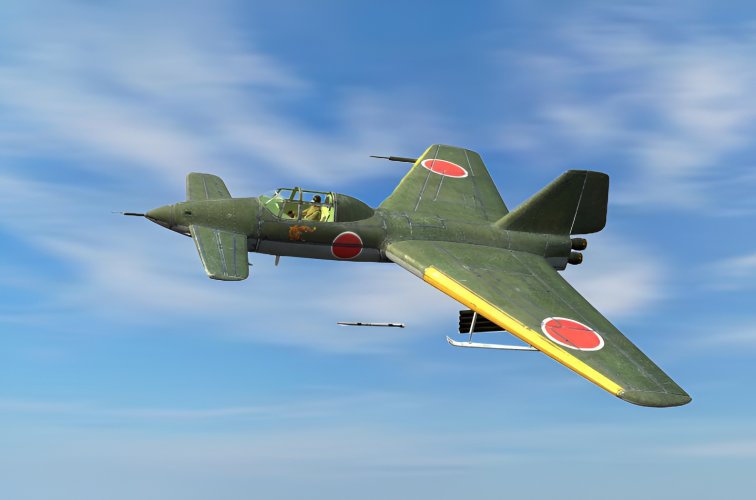
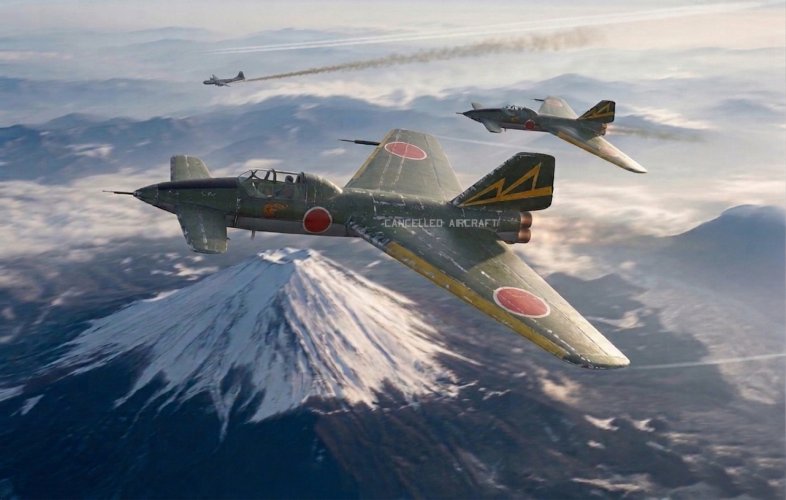
It had an unusual Canard configuration to facilitate the short take off and it was built of wood, plywood and iron plate, with four Type 2 rocket engines at the rear of the fuselage.
Three different versions would have been manufactured:
kamikaze, antitank and interceptor. The suicide version had no undercarriage, using the same rails and rocket cart system than the
Ohka 43-Otsu for take-off. It would have been able to carry a bomb of 250 kg in the fuselage, behind the pilot.
Like the suicide bombers D4Y4
Suisei and the Type 5
Shinyo motorboats, the
Shinryu II would have possibly been equipped with two or four barrage I.S.R. rockets of 12 cm that would have made more difficult for the enemy gunners to reach the target during the terminal dive.
The anti-tank version took off by its own means over a primitive landing gear of skids, helped by a Type 1 ventral rocket that was detachable. It is assumed that it used the four rocket engines in the fuselage to maintain its flight altitude during the attack. It used eight anti-armour hollow charge ROTSU rockets of 8 cm, housed in iron tubes welded to the undercarriage, with a minus 7-degree pitch so that they could be shot without losing any altitude or speed. The airplane had spoilers, and it was expected to survive to be able to land and refuel for the next attack.
Although this version has been described as anti-tank, as it used that type of armament, it seems more realistic to assume that it would have been used to attack the LCA. The interior of the island would have had thousands of suicide commands waiting for the Shermans with magnetic demolition charges of 10 kg of the
lung mine type.
The interceptor was equipped with oxygen, pressurised cockpit and reflex gunsight. It was towed by a conventional piston fighter that took it off above 8,000 m releasing it over the stream of bombers. It was armed with eight Ro.3 rockets that exploded by means of a time fuse at a predetermined distance, releasing shrapnel and incendiary pellets in a conic pattern.
Like its German counterpart W.Gr 21, the Ro.3 was not very accurate and lost altitude very fast. For that reason, the launching tubes were fixed at a plus 7-degree pitch, calculated so that the parabolic path of the rocket would be compatible with the performance of the reflector gunsight.
All versions of the
Shinryu II had machine guns with ammo tracer to help the correction of the attack trajectories. These would also be of use to the interceptor to defend from the escort fighters, evade them thanks to its manoeuvrability and return to base on a gliding flight. The four rocket engines, started sequentially, would serve it to regain altitude after an attack over the formation of B-29s or to distance away from the escort fighters.
Technical data
Shinryu I
Airframe wood, fabric and iron plate
Wingspan 7 m
Length 7.63 m
Height 1.90 m
Wing area 11 sqm
Maximum weight 735 Kg
Maximum speed 300 kph
Ceiling 400 m
Range 4 km
Engines two solid fuel rockets
Toku-Ro.1 Type 1 with 300 kg peak thrust during 30 sec and 1
Toku-Ro.1 Type 2 with 600 kg peak thrust during 30 sec
Payload one 100 kg Type 3 No.150 Mk.5 bomb
Shinryu II
Airframe wood, fabric and iron plate
Wingspan 10 m
Length 7.80 m in the interceptor version
Height 2.70 m
Wing area 19 sqm
Maximum speed 500 kph in the
kamikaze version
Ceiling over 8,000 m in the interceptor version
Range 15 km in the
kamikaze version
Engines four
Toku-Ro.1 Type 2 with 600 kg peak thrust during 30 sec. In the anti-tank and
kamikaze version another
Toku-Ro.1 Type 1 was used with 300 kg peak thrust during 10 sec, in ventral position, to provide additional boost during take off
Armament four Type 89 7.7 mm guns that were reduced to two in the
kamikaze version. Eight
Ro.San Dan (Ro.3) 10 cm S.C.R. AA rockets in the interceptor version, eight ROTSU 8 cm S.C.R. hollow charge rockets in the antiship/antitank version, two or four RAK 12 cm I.S.R. barrage rockets and one 248,7 kg Type 99 Number 25 Model 1 bomb in the kamikaze version.