KNI mode of high pulse repetition frequency with a repetition rate of about 200 kHz is implemented;
введено двухпороговое обнаружение цели (вальдовское различение гипотез), в среднем вдвое сокращающее время ее обнаружения;
• использована комбинированная временная диаграмма обзора пространства, дискретного сопровождения до 10 целей и непрерывного подсвета до
четырех атакуемых целей;
• по дискретно сопровождаемым целям реализована проводка в зоне прозрачности отраженных сигналов цели с точным определением дальности;
• введена моноимпульсная пеленгация в дискретные моменты сопровождения цели, характеризуемая высокой точностью определения углового положения цели.
introduced two-threshold target detection (Waldian hypothesis discrimination), on average, halving the time of its detection;
• used a combined timing diagram of space survey, discrete tracking up to 10 targets and continuous illumination up to
four attacked targets;
• for discretely tracked targets, tracking was implemented in the zone of transparency of the reflected signals of the target with an accurate determination of the range;
• introduction of monopulse direction finding at discrete moments of target tracking, characterized by high accuracy in determining the target's angular position.
So its a very high PRF pulse-doppler radar, but I couldn't find definitive proof it uses FM ranging.
Maybe you could find the Pulsewidth used in that mode, from there we could glean information on duty cycle. FMICW Radar may operate in excess of 50% duty cycle, while more "conventional" pulse doppler implementation with multiple range gates are in lesser duty cycle e.g 3% to as high as 25-30% Optimized to reduce eclipsing loss.
AFAIK in high or very high PRF it's usually impossible to do a typical Pulse delay ranging so it's either FM ranging is used or range is simply not measured thus such mode is referred as VS or Velocity Search.
Aldrich Ames turned over a document on Zaslon that Tolkachev provided the CIA. I believe this was used in the prosecution against Ames. If I get a chance to I’ll see if I can get any court records
I'm actually leaning towards Zaslon being similar as AWG-9 or AN/APG-63 in terms of processing namely a "conventional" pulse doppler radar. Instead of FMICW one.
As previously mentioned in Foxhunter thread FMICW Radar only have single range gate, while "conventional" pulse doppler have multiple gates. This have effects on the number of doppler filters and related equipment which in turn drive the weight of the radar set. I believe had Zaslon resorts to FMICW it wont have over 700 Kg of LRU's beside it's 300 Kg Phased array antenna.
Disagree, you can't make that argument. AN/ASG-18, ancestor of AWG-9, weighed close to the same as Zaslon despite a much lighter antenna design and was FMICW - it was built with older computing hardware. AWG-9 is still large and bulky, if lighter than Zaslon.
Nice article on the Argon computers used in Zaslon here:
FLIGHT TESTS SUV "ZASLON" - Vladimir Ilyin (Аэрокосмическое обозрение №05 2005)
The weapon control system (SV) "Zaslon", developed for the MiG-31 fighter-interceptor, is a unique product, many of whose characteristics have not yet been surpassed by foreign counterparts. The extremely high characteristics of the complex for its time were largely achieved through numerous, sometimes very large-scale (both organizational and financial) flight tests and experiments. Some of these experiments are still unique.
It should be noted that such experiments aimed at improving the capabilities of the aviation complex were also carried out after the MiG-31 was put into service. Let us dwell only on the individual, most significant stages of the development of the complex, carried out by the NIIP. V.V. Tikhomirova and OKB A.I. Mikoyan during flight tests of the MiG-31.
Target acquisition range
Number
Target acquisition and automatic tracking range, km
Target flight altitude, m
1
141.3
1400
2
162.2
9000
3
136.5
2000
4
124.8
1700
5
131.5
2600
6
137.8
9300
7
144.3
8700
8
121.5
9600
9
112.2
2300
10
115.4
8400
On February 15, 1978, Akhtubinsk hosted a flight experiment that has not been repeated by any foreign aviation complex so far for the simultaneous detection, capture and tracking of 10 air targets flying in a wide front (about 150 km) at various altitudes.
The MiG-31 interceptor flew at an altitude of 5000 m. The targets were divided into two groups. The first group flew at altitudes from 8400 m to 9600 m, the second - from 1400 m to 2600 m, flying (relative to the interceptor) against the background of the underlying (terrestrial) surface. The maximum target detection range (having an EPR of the order of 16 m2) was 210 km.
The total time of detection and capture was 153.5 s. At the same time, the first seven targets were detected and captured in 69.5 s. The time spent directly on the procedure for capturing seven targets was 24.3 s, and 10 targets - 49.05 s.
To avoid multiple capture of the same target and, as a result, "looping" of the system, a comparison of the coordinates of newly captured targets and a ban on their re-capture was introduced.
It should be noted that the possibility of multiple acquisition and tracking of the same target in one flight experiment made it possible to estimate the load of computational processes and collect statistics on the observation of target signals (mode for experimental work) without organization in the future of expensive flights of 10 targets.
The creation of a phased antenna array (PAR) for the SUV "Zaslon" made it possible not only to implement the multi-purpose operation of the radar complex, but also to work out the use of the so-called "sequential detector" mode to increase the range.
In this case, the analysis is carried out within two to four elementary time cycles (the position of the PAR beam remains unchanged). The lower and upper thresholds are different for each measure. When the upper threshold is exceeded in each of the 180 sections of Doppler frequencies, a “target” signal is generated.
The sequential detector made it possible to obtain a gain in the detection range of air targets, which is approximately 20-25%. In this case, the entire procedure for sequential detection is implemented in a special analog-to-digital processor. The implementation of this mode in modern digital signal processors is problematic due to insufficient speed and the need to organize a special computing process.
On August 28, 1978, the MiG-31 successfully hit four radio-controlled air targets with four simultaneously fired R-33 missiles.
On August 18, 1993, a series of flight experiments was carried out to intercept a target at maximum range. During the first of them, a radio-controlled target flying at an altitude of 10.300 m at a speed of 189 m / s was captured by a MiG-31 interceptor (flight altitude 8480 m, speed - 669.3 m / s) at a distance of 319.5 km. The R-33 missile (which successfully hit the target) was launched at a range of 228 km.
Perhaps the most spectacular flight experiment, which fully demonstrated the capabilities of the aviation complex, was the experiment conducted on April 21, 1994, on the simultaneous firing of four air targets. As the latter, specially equipped MiG-21 fighters (controlled from ground command posts) were involved, which had a relatively low EPR and high maneuverability.
The first target flew at an altitude of 7100 m, the second - 1720 m, the third - 2470 m, the fourth -6230 m. The sequence of target firing was determined by the program of the MiG-31 computer system: 4-2-3-1. All targets maneuvering along the course were destroyed a few tens of kilometers from the interceptor fighter.
Thus, SUV "Barrier" in conditions as close as possible to real, confirmed its unique characteristics. It should be noted that even today the MiG-31 aviation complex, created back in 1968-1981, has not exhausted its evolutionary possibilities. Its modernization will significantly increase its combat potential and give it characteristics that meet the requirements for fighter-interceptors of the 21st century.
For the creation of the SUV "Barrier" and its modifications, 196 employees of NIIP were awarded orders and medals of the USSR.
And the development of the SUV "Barrier" began in 1968. At first, it was difficult and difficult to move forward. All technical solutions were new: phased array, quasi-continuous radiation, multi-purpose work, group actions, etc. Now, 37 years later, they have become
familiar, understandable and, as a matter of course, indispensable in every new development. At the same time, it is important to note that the main technical solutions were immediately chosen correctly, but their practical implementation was an extremely difficult task.
In the process of working on the SUV "Zaslon", a creative association of specialists from different organizations was formed.
Involvement in solving a priority problem, the scale of work and the highest level of scientific and technological tasks brought together the specialists of the developer's firm - the Research Institute of Instrument Engineering, the Leninets serial plant and many enterprises and services of science, industry and the customer.
But the most important result of the development of the Zaslon SUV was the creation at the NIIP of a scientific and technical school for the development of antenna systems and radars with electronic beam control, which today is capable of carrying out the most complex and advanced developments for both aviation and anti-aircraft missile systems
Disagree, you can't make that argument. AN/ASG-18, ancestor of AWG-9, weighed close to the same as Zaslon despite a much lighter antenna design and was FMICW
Well looking at the pulsewidth.. you could glean that the duty cycle is 25% for 1 microsecond of pulse and 250 KHz PRF. While the FMICW is duty cycle of some 50% or even higher.
On a separate note, what is currently the newest/most powerful radar on Mig-31?. I recalled Zaslon-M was cancelled, so does that mean Mig-31 still use Zaslon-A and Zaslon-AM?. Do we have any data about detection range of Zaslon-AM?
According to official information, the combat effectiveness of the MiG-31BM has increased 2.6 times. For comparison, the MiG-31 exceeds the MiG-25 by 3.24 times in this parameter. At the same time, weapons and equipment were changed in the MiG-31BM, the aircraft itself remained the same
The MiG-31M surpasses the serial MiG-31 only 1.37 times. At the same time, the MiG-31M could carry 6 - 8 long-range R-37 missiles
Combat effectiveness concerns only air-to-air operations
It is possible to compare the effectiveness of the earliest version of the MiG-31 without in-flight refueling and the latest version of the MiG-31BM with an electro-remote control system. This is the only way to explain such significant numbers
It is possible to compare the effectiveness of the earliest version of the MiG-31 without in-flight refueling and the latest version of the MiG-31BM with an electro-remote control system. This is the only way to explain such significant numbers
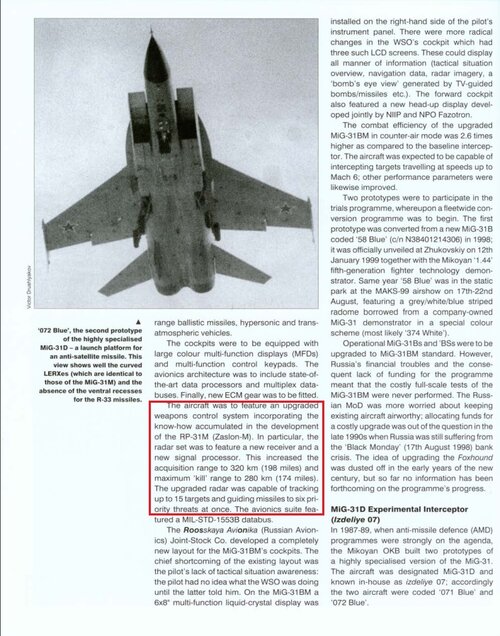
the detection range is 320 km, and the damage is 280 km. The number of simultaneously tracked targets has grown to 24 units, and the number of simultaneously hit to 8 units.
the detection range is 320 km, and the damage is 280 km. The number of simultaneously tracked targets has grown to 24 units, and the number of simultaneously hit to 8 units.
The energy capabilities of the Zaslon-AM radar have been increased by about 2 times in comparison with the usual Zaslon 8B: the target detection range with an RCS of 1m2 reached 200-230 km, the inconspicuous F-35A fighter reached about 140 km; the number of escorted targets reached 24 units, and the speed of the intercepted target reached 6,300 km/h. In addition, the new station can control air-to-air missiles of the R-77 family, including the 180-PD Product, due to which the MiG-31BM became capable of fighting highly maneuverable enemy aircraft, to which the conventional MiG-31B was not adapted. But this does not mean that the modernization potential of the MiG-31BM as a whole has been exhausted.
The energy capabilities of the Zaslon-AM radar have been increased by about 2 times in comparison with the usual Zaslon 8B: the target detection range with an RCS of 1m2 reached 200-230 km, the inconspicuous F-35A fighter reached about 140 km; the number of escorted targets reached 24 units, and the speed of the intercepted target reached 6,300 km/h. In addition, the new station can control air-to-air missiles of the R-77 family, including the 180-PD Product, due to which the MiG-31BM became capable of fighting highly maneuverable enemy aircraft, to which the conventional MiG-31B was not adapted. But this does not mean that the modernization potential of the MiG-31BM as a whole has been exhausted.
The energy capabilities of the Zaslon-AM radar have been increased by about 2 times in comparison with the usual Zaslon 8B: the target detection range with an RCS of 1m2 reached 200-230 km, the inconspicuous F-35A fighter reached about 140 km;
That's significant improvement over original Zaslon-A. Though why does it mention R-77 with ramjet, which went into nowhere and long-range engagements are bread and butter of R-37M and it's izd.810 derivative (assuming it an derivative and not entirely new project).
That's significant improvement over original Zaslon-A. Though why does it mention R-77 with ramjet, which went into nowhere and long-range engagements are bread and butter of R-37M and it's izd.810 derivative (assuming it an derivative and not entirely new project).
I think that site took the reference number from the "Mikoyan MiG-31: Famous Russian Aircraft" book written by Yefim Gordon and Dmitriy Komissarov. But the site added the "RCS = 1 m2" which is their guess and didn't came from the book.
This is data from the book:
Zaslon-A range:
Zaslon-M range:
Zaslon-AM range:
The reference RCS for 320 km detection range of Zaslon-AM should be 16 m2 (same standard they used for Zaslon-A).
Zaslon-AM is basically Zaslon A with new processor
The article is funny to translate due to extensive use of slang, unless you know what they are talking about.
1. They are saying the OEPS-27 is cooled by a compressed gas (it use to be a dryed nitrogen gas which cooles the IR sensor to -196deg of Celsius). It is called "kryogen" sometimes.
2. The RLPK-27 is cooled with the "antifriz", a toxic mixture. Note: Usually, radars/targeting systems are designed to run without cooling for some minutes,
Greetings, I've been doing a little research into the MiG-31 recently and I was wondering if anyone had any information on the operating modes of the Zaslon Radar an 8TK IRST System.
The Zaslon is often compared to the AWG-9 in terms of range and features.
Bar the phased array, the published figures seem to indicate that the AWG-9 was in fact superior, both in terms of range, modes, and Situational awareness ( 24 targets in TWS!)
Of course ,''published figures''. But what tell us real-practical figures from practical use of the radars known as 'RP-31,S-800,BRLS-8B,SBI-16' or N007 Zaslon in MiG-31/DZ, N007A Zaslon-A in MiG-31B/BS, N007M Zaslon-M in MiG-31M and N007AM Zaslon-AM in MiG-31BM.
Numbers,numbers,numbers....
Basic N007 had/have three main A2A modes:
PPS ( front hemisphere) is combat mode where max possible detection distance is 600km.
Combat mode PPS uses working mode of the main TWT known as High PRF with PRF of 200kHz.
AVT or Avtomat/Automatic is combat mode where modes PPS and ZPS are working in the same time and the working mode of the main TWT is combination of the High and Medium PRF where PRF in MPRF mode is 50kHz. Max possible detection distance is 400km.
ZPS ( rear hemisphere) is combat mode where max possible detection distance is 200km.
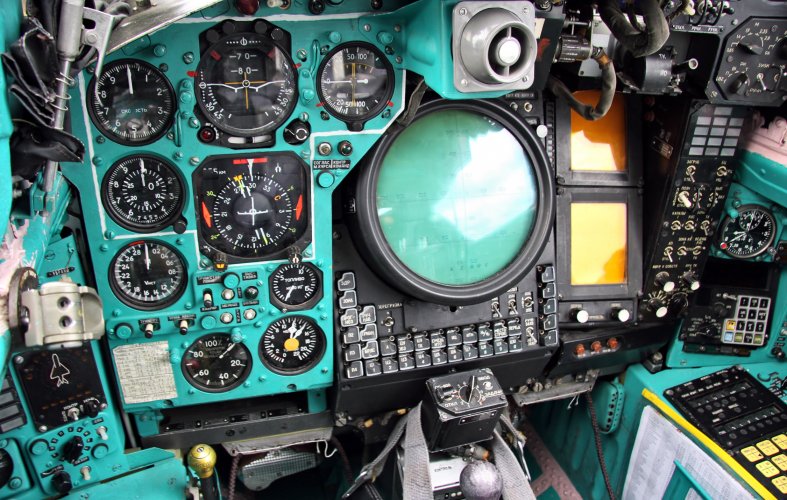
On this photo we can see some calibrated (instrumented) ongoing distance to target scales like 0-600km for the PPS mode,0-400km for the AVT mode and 0-200km for the ZPS mode.
During live/flight tests ,they used some 'standard' RC-aircraft for calibrating those detect/track distances like MiG-21( for small maneuverable aircraft/fighter) with 3 sqm of frontal RCS,Tu-16 ( for big non-maneuverable aircraft/bomber) with frontal RCS about 20sqm etc
Of course,detection distances depend on target angle aspects ,RCS ( frontal ,lateral etc)...
N007 has in fact four times larger max detection distances in all three combat modes in comparison with N001/N019 : 600km vs 150km=PPS/V, 400km vs 100km=AVT and 200km vs 50km=ZPS/D.
For other comparison, max possible detection distance of the AN/AWG-9 in F-14A Tomcat ( front aspect/incoming aircraft) is 200nmi (370km), so we have 600km vs 370km.Of course in the case of incoming big non-maneuverable aircraft,so with bigger frontal RCS.
About search/detection/lock-on distances. There is only 'detection distance' and 'lock-on distance'. Lock-on distance can be 70%-80% of the detection distance (also automatic tracking distance).
N007/A/AM had/has 1.1m wide antenna (B1.01/M) where N007/A had 1700 TRE working in the centimetric X-band and 64 decimetric L-band IFF interrogator antennas.
It is interesting that N007 had two TWT's ( AN/AWG-9 only one as dual-mode) ,where the main one have average power in the HPRF mode of 2.5kW and max output pulse power of 10kW. Second TWT has average power of 2kW and it was used only for the CWI mode. In the domain of 'power' ,both radars were equal.
Again that numbers... This citation is from Carlo Kopp:
''The Russian's snatched the leading position back with the early 1980s N007 Zaslon on the MiG-31 Foxhound, a massive phased array design twice the size of the US AWG-9 radar. Rated at 2.5 kiloWatts average power, with a 25% duty cycle peak power rating of 10 kiloWatts, this immense radar is claimed to be capable of detecting a 0.3 m2 RCS cruise missile at 35 nautical miles range.''
''The lock-on range of the upgraded Zaslon-AM against low-flying cruise missiles, such as the BGM-109 Tomahawk, is claimed to have been extended to about 22nm (40km), representing a 30% improvement in detection/tracking performance.''
https://www.key.aero/article/sharpening-foxhounds-claws
In fact ,N007 in real practice was capable to lock-on incoming low-flying cruise missile at about 100km.Cruise missile flying very low and with frontal RCS of only 0.3-0.5sqm.
I must mention here that max detect/track distance for incoming MiG-21 flying above 1000m is 100 km for the N001 Myech or Sword with its '1kW' TWT. Max (possible) detect/track distance for N007 with its '2.5kW' main TWT will be/is?
Forget this citation 'cause this has nothing to do with reality.
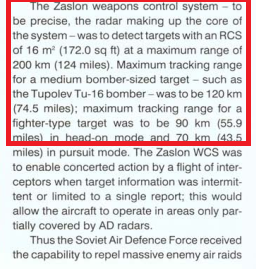
''The detection performance in the front hemisphere of the Zaslon radar is stated to be 120 km against a target-fighter with RCS 3m2 and 200 km against a target-bomber with a RCS of 16 m2''
Besides many books ( as civilian sources of data) ,there is Flight and also Technical Manual for the MiG-31, basic variant known as 'Izdeliye 01'.
Now about that max possible number of aircraft automatically tracked in TWS mode. 24 vs 10 for the AN/AWG-9. Meaning what? In the real practice,possible combat situation nothing, 'cause there would/will be no situation where one fighter/interceptor will track with its own radar 24 differ aircraft. It also means that computer of the AN/AWG-9 was much better,more capable (signal processor) with 24 signals that could be tracked in one narrow FoV .In practice again ,something like that would be impossible.
Something like this has more practical value:
''Угловая зона одновременного обстрела ракетами нескольких целей для МиГ-31 составляет 18200 квадратных градусов (для F-14 только 420 кв°).
Ракеты большой дальности могут наводится на цель в диапазоне чуть менее чем +/- 120 градусов (Ф-14 только +/- 20).''
''The angular zone of simultaneous missile fire on several targets for the MiG-31 is 18,200 square degrees (for the F-14 only 420 sq°).
Long-range missiles can be guided to a target in a range of slightly less than +/- 120 degrees (F-14 only +/- 20).''
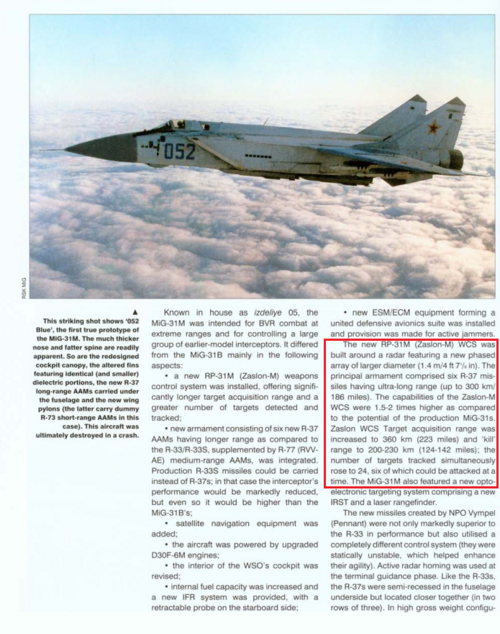
Now some details about 'famous' Adolf Tolkachev. As we know, CIA got many technical data and info about MiG-31 and its N007 Zaslon/R-33 from the late 70's and beginning of the 80's. Although 'West' was surprised by the public showing of the first ever phased antenna array/PESA on one fighter-interceptor on June 1991 on Paris LB, CIA/USAF already knew that for 10 years. But what about N007M Zaslon-M? First (converted) prototype of the MiG-31M,051 blue with N007M flew on Dec.21 1985. R&D work on it began from the late 70's and that modernised version got imense antenna with diameter of 1.4 m. CIA never got any data of the N007M Zaslon-M for the MiG-31M.
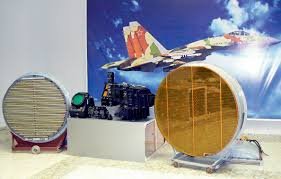
Left is the reflector of the antenna of the N007 ,right is from the N007M.
Larger antenna means greater detection distances ( just like comparison between N001 and N019 with the same TWT) ,besides that ,N007M had much better comp which was capable to track 24 aircraft and MiG-31M was able to engage 6 differ air targets with new very long-range 600kg heavy K-37/R-37. On April 1994, prototype of the MiG-31M '057 blue' engaged six differ targets with six K-37.One of them was launched from record-breaking launch distance of 304km. It is interesting that even after 40 years ,it is very hard to find some precise data/info about N007M.
On the other side,modernised N007A Zaslon-A for the modified MiG-31B( later BS) was in fact 'product' of A.T. spy actions but with accent to be answer against then new USAF stealth strategic bomber/missile carrier B-2A with its also new stealth strategic low flying subsonic cruise missile type AGM-129A ACM with frontal RCS in centimetric band of 0.01sqm.There was new long range AAM also ,it was R-33S.
After the cancellation of the MiG-31M with its mighty N007M and K-37 and after attempting to get multi-role MiG-31 ( version BM) in the second half of the 90's ,after 2000, they decided to modernise all operational MiG-31B and BS to standard BM as the new modified variant.After 113 of them were overhauled and modernised to version BM,many aircraft of the basic version ( Izdeliye 01) produced in the first half of the 80's were brought to BM level.MiG-31DZ were not use for this new version ( they were later used for the version MiG-31K as Kinzhal/Dagger carrier).
MiG-31BM got modernised radar N007AM Zaslon-AM. From what I could read in some interviews with Jury Beliy as gen. director of the NIIP named after V.V. Tikhomirov ,N007AM's main TWT works in the centimetric C-band ( f=6GHz,λ≈6cm) ?! Secondary TWT works in the X-band and is used for the CWI of eight engaged air targets with new AAM's like R-37M and R-77-1 ( both with ARH+SARH in the terminal phase). New digit comp Baget-55-06 enables tracking of 24 aircraft and engaging eight of them. N007AM can detect/track incoming aircraft flying at hypersonic speed in stratosphere up to 7000 km/h.One of the tactical-technical requests was to detect/track LO/VLO aircraft from as much as greater distance. N007AM has 30% greater detection distances then N007A.
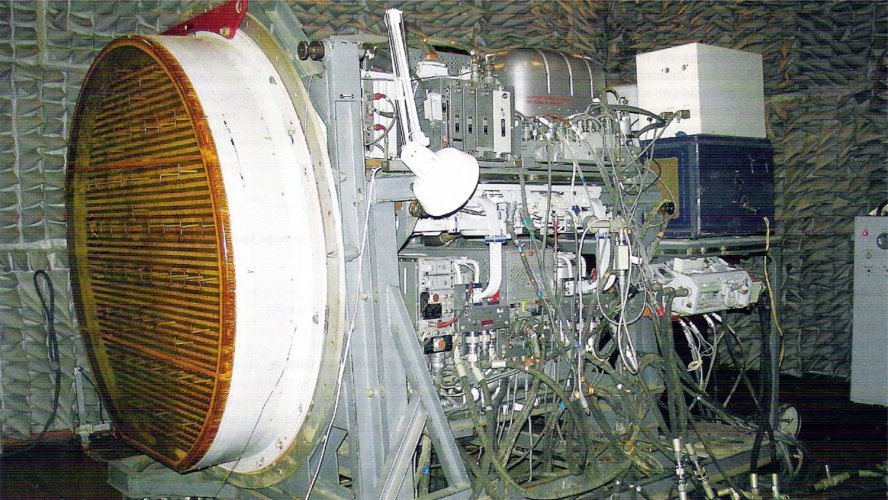
1000kg heavy monster N007 during static tests.
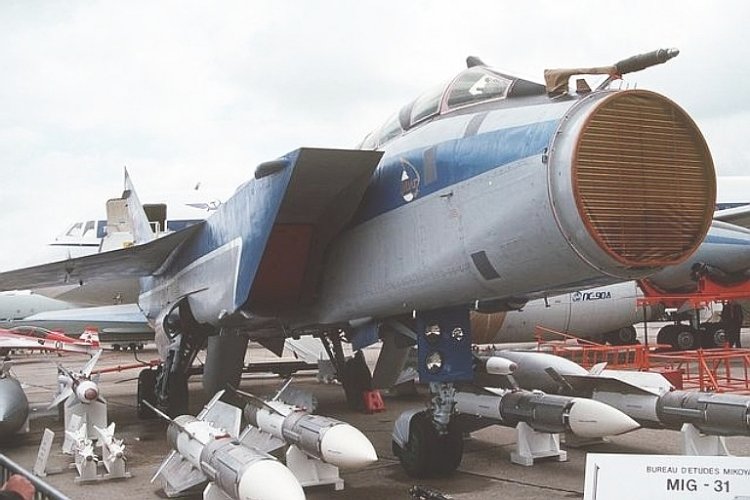
June 1991 ,Le Bourget-Paris. Surprise for the world public but not for everyone.From some Russian source ,I've found info that radar in the technological demonstrator MiG-31E number '374 white' was in fact N007A Zaslon-A.
As we can see ,it is huge.There is that yellowish dome cover so it works in MWIR band? MiG-31BM has the same 8TK as the old versions 'cause the 'heat channel' is not modernised like radar channel ( of course N007AM Zaslon-AM).
This is from the Su-27SK Flight Manual about OEPS-27E/OLS-27E as IRST.
''Дальность обнаружения истребителя на максимальном режиме работы двигателей на фоне чистого неба в ЗПС под ракурсом 0/4 – 2/4 составляет около 50 км, на фоне облачности,земли и водной поверхности 20 – 35 км, а на форсажном режиме работы двигателей в ППС под ракурсом 1/4 составляет 90 – 100 км. Дальность захвата цели составляет около 70 % от дальности обнаружения. Дальность захвата целей на максимальном режиме работы двигателей в ППС под ракурсом 5° - 15° составляет около 10 км. Для обеспечения большой дальности захвата высокоскоростных целей в ППС необходимо увеличить ракурс атаки более 15°.''
''The detection range of a fighter at maximum engine operation mode against a clear sky in the rear hemisphere at an angle aspect of 0/4 – 2/4 is about 50 km, against a background of clouds, land and water surface 20 – 35 km, and at afterburner engine operation mode in the front hemipshere at an angle of 1/4 is 90 – 100 km. The target acquisition range is about 70% of the detection range. The target acquisition range at maximum engine operation in the front hemisphere at an angle of 5° - 15° is about 10 km. To ensure a long range of high-speed target acquisition in the front hemisphere, it is necessary to increase the attack angle to more than 15°.''
So under the angle aspect '1/4' ,old OLS-27 ( working on the wavelenght of 3μm ) can detect incoming fighter flying on the Full AB mode at a distance of 100km.My opinion is that 8TK is more capable than OLS-27.
Now back to the YT video.What we can see is the radar channel screen on the left side and the heat channel screen on the right side. Incoming Ukr AF MiG-29 was detected /tracked at about 150 km and we can see its differ signals on both screens. Now as we know that detect/track distance was about 150 km ,we can see that those short lines on the left side of heat channel screen represents '50 km -distances' ( sequences 0:01- 0:03).
In total there is 7 those short lines so the max ( instrumental,calibrate) distance on that scale ( current distance to aircraft) is 350/400 km ? OLS-27 has that scale with max number '100' and e.g KOLS ( Product 13/13S) has max number on that scale only '25' , 'cause MiG-29's KOLS can only detect receding but not incoming aircraft.
Of course data between radar and the heat channel can be linked ,both of them can be leading or following channel.
It is interesting that censure of those lines began at the same time as lock-on. For me this is something more interesting. Launch distance of R-37M was about 100 km ( from 1:12) and we can see R-37M on its flight as green dot on the heat channel screen until 1:30. So the burn time/acceleration phase of the rocket engine/AAM lasted about 20 sec.
Some actual performance figures for basic Zaslon and 8TK from Mikoyan OKB (MiG, Flying Through Time Vol.2)
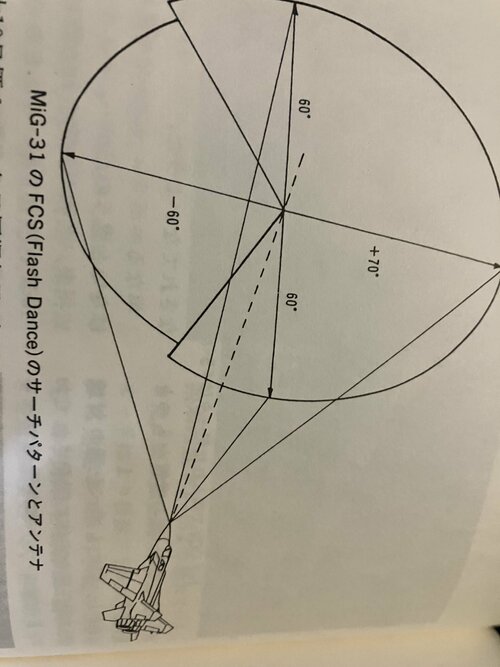
The MiG-31-33 complex could intercept targets flying at altitudes of up to 28,000 m at a speed of up to 3,700 km/h in the forward hemisphere and up to 2,600 km/h in the rear hemisphere. The RP-31 radar provided a target detection range* in free space and against the ground at a distance of up to 180 km, and the target acquisition range was 152 km. The phased array scanning angles were +70° in azimuth and from -60° to +70° in elevation. In turn, the thermal direction finder detected a Tu-16 bomber at a distance of up to 56 km in free space and up to 20 km against the ground. In this case, the target was tracked at distances of 45 km and 19 km, respectively.
*The specified ranges were provided for targets with an RCS of 19 sq m. For targets with an RCS of 3 sq m, the detection and acquisition ranges were 96.5 km and 44.2 km, respectively.
The Zaslon-AM retains the same angular coverage of its 1970s-vintage predecessor, scanning an area out to 70º on each side of the centreline and to 60º below and above the nose. However, with hugely increased processing power and refined software, the Zaslon-AM can now track up to 24 air targets simultaneously and provide data for engaging six of them with radar-guided AAMs such as the older-generation R-33S, as well as the new-generation R-37M and R-77-1. The lock-on range of the upgraded Zaslon-AM against low-flying cruise missiles, such as the BGM-109 Tomahawk, is claimed to have been extended to about 22nm (40km), representing a 30% improvement in detection/tracking performance.
In contrast, the original N0007 Zaslon set is only able to track up to ten targets and could simultaneously engage four of them with long-range AAMs. Its claimed detection range is up to 54nm (100km) against fighter-sized targets flying at medium and high altitudes, extending to 108nm (200km) against bomber-size targets in head-on encounters; in tail-on engagements the ranges are 22nm (40km) and 23-43nm (60-80km). When employed against low-flying bomber-size targets, Zaslon’s range is up to 65nm (120km) in head-on intercepts.
Just like its predecessor, the upgraded Zaslon-AM has extensive resistance to jamming allowing the MiG-31BM to operate effectively in an environment of dense electronic countermeasures. This ability is further enhanced by the use of targeting options provided by the enhanced digital datalink suite, which provides information on targets seen by the radars of other MiG-31s in the group intercept operations, as well as by airborne or ground-based early warning and control systems. The crew is also able to look up at some of the tracked targets while looking down on others, with relaxed restrictions to the missile acceptable launch region, so the weapons control system could enable missile launches against widely spaced targets.
The development of the new-generation S-155MP aviation interception system was initiated in accordance with Party-Government Resolution No. 397-152 of May 24, 1968. Such a system was required to counter the potential threat from foreign aircraft of various classes: from low-altitude FB-111 and AMSA (B-1) bombers, tactical attack aircraft and cruise missiles performing high-speed flight in terrain-following mode, to high-altitude (20 km or more) SR-71 Mach 3 reconnaissance aircraft. Within the framework of the new program, the creation of the MiG-25MP fighter-interceptor control system (developed on the basis of the serial MiG-25P aircraft and subsequently designated MiG-31) was entrusted to the Moscow Radio Engineering Design Bureau. However, the topic was soon transferred to the Research Institute of Instrument Engineering. This again returned the Research Institute to the aviation theme, subsequently making the institute in Zhukovsky a recognized domestic leader in this field.
Based on the need for a comprehensive implementation of combat modes, the developer of the radar station for the first time in domestic practice was responsible for the creation of the entire aircraft weapons control system. It should be noted that this approach fully justified itself, allowing the technical solutions incorporated into the complex to be optimized. The development of the Zaslon SUV began with the search for ways to implement modes of simultaneous space surveillance, as well as tracking and firing at several targets. The mechanically driven antennas that existed at that time did not provide such capabilities. In particular, the AWG-9 radar, developed in the USA for the F-14 Tomcat fighter, which was the most advanced in its class, could track and simultaneously fire at several targets only "on the flyby", in an extremely narrow tracking zone. Based on the capabilities of the MiG-25MP interceptor fighter (whose ammunition was limited to four long-range missiles with semi-active radar homing), it was necessary to ensure the ability to simultaneously fire at four targets. And since the most dangerous, "priority" objects had to be selected for attack, the number of simultaneously detected targets had to exceed this value. The upper limit - 10 targets - was determined by the sum of the time intervals required to track them, as well as the duration of the zone review. The size of the review zone had to ensure viewing of the space along the horizon for 200 km. In this case, a link of four interceptors could cover a front up to 800 km wide.
The detection range of targets with an RCS of 19 sq. m. (which corresponded to the high-altitude reconnaissance aircraft SR-71 - the most complex object for air defense) had to be 180-200 km - several times more than any other domestic fighter-interceptor of that time. Having analyzed all the available possibilities, in 1969 the Tikhomirovites made an extremely bold, revolutionary decision for their time: to create an antenna with electronic scanning. The task was extremely complex and was solved for the first time in world practice in relation to a fighter aircraft.
It should be noted that phased array antennas have been used since the 1980s on a number of foreign aircraft (in particular, on the Rockwell B-1B strategic bomber, the Lockheed Martin U-2 high-altitude reconnaissance aircraft, or the Northrop Grumman E-8 J-STARS radar reconnaissance and control aircraft). However, all of them were oriented to work on ground targets and were not installed on fighters. The first foreign serial fighters equipped with a radar with electronic scanning were the French Dassault Rafale and the Japanese Mitsubishi F-2, launched into serial production already in the 21st century. The radar complex installed on the French aircraft at that time never reached the specified characteristics, and with regard to the Japanese radar, it must be said that the maximum range of detection of an air target, actually achieved by 2004 during the F-2 tests, was only .... 10 nautical miles (18.5 km).
Scientific and technical management of the system development was carried out by V.K. Grishin, Deputy General Designer of the Fazotron Association, then General Director - General Designer of the Association. The solution of complex issues was carried out under the supervision of the Chief Designer of the development A.I. Fedotchenko. The development of the radar was entrusted to the research department under the supervision of the Chief Designer A.A. Rastov, the first head of the integrated radar brigade for the Zaslon SUV was Yu.I. Kozlov, then - Yu.A. Korablyov, T.O. Bekirbaev, A.V. Nesteruk and E.I. Sopilnyak. The development of the radar homing head of the R-33 missile was entrusted to the R&D department under the leadership of chief designer I.G. Akopyan. The work was carried out in the laboratory headed by B.N. Ermakov. In addition
In the early 1980s, a decision was made to develop a modernized MiG-31M aircraft. In the Zaslon-M SUV, due to the use of a larger-diameter phased array with reduced losses and a higher-power transmitter in the radar system, the detection range was increased by more than 1.5 times. The computing system based on the new A-15K on-board computer made it possible to increase the number of targets tracked and simultaneously fired upon. As part of the MiG-31M aircraft, the system passed the stage of flight design tests, during which in 1996 demonstrated unique characteristics: detection range of an air target - 320 km, missile launch range - 240 km.
ИСТОРИЯ ОТЕЧЕСТВЕННОИ РАДИОЛОКАЦИИ (History of Domestic Radar)
MINISTRY OF INDUSTRY AND TRADE OF THE RUSSIAN FEDERATION DEPARTMENT OF RADIOELECTRONIC INDUSTRY 2015
''The lock-on range of the upgraded Zaslon-AM against low-flying cruise missiles, such as the BGM-109 Tomahawk, is claimed to have been extended to about 22nm (40km), representing a 30% improvement in detection/tracking performance.''
In the real world ( it happened on May 2013 ,Pemboy-Siberia,military test range) , N007 locked-on incoming low-flying CM type Kh-55 from about 100km and both of them were engaged and destroyed by the old R-33. I already wrote that in the night of 24th of March 1999 ,one of the YuAF MiG-29B with its N019EB Rubin detected/tracked low flying CM type BGM-109 at a distance of 30km.That radar was partially inoperative 'cause it could only work in search not in lock-on mode.
ИСТОРИЯ ОТЕЧЕСТВЕННОИ РАДИОЛОКАЦИИ (History of Domestic Radar)
MINISTRY OF INDUSTRY AND TRADE OF THE RUSSIAN FEDERATION DEPARTMENT OF RADIOELECTRONIC INDUSTRY 2015
''As part of the MiG-31M aircraft, the system passed the stage of flight design tests, during which in 1996 demonstrated unique characteristics: detection range of an air target - 320 km, missile launch range - 240 km. Unfortunately, further work on the aircraft was stopped for well-known reasons.''
As mentioned before, during one excercise on April 1994 , MiG-31M number 057 blue engaged 6 differ air targets with 6 K-37M where one of them was launched from record-breaking launch distance of 304km.
''The detection range of targets with an RCS of 19 sq. m. (which corresponded to the high-altitude reconnaissance aircraft SR-71 - the most complex object for air defense) had to be 180-200 km - several times more than any other domestic fighter-interceptor of that time. Having analyzed all the available possibilities,''
Again ,old N001 Myech in the Su-27S/P/UB/UBP can detect/track incoming fighter type MiG-21 with its 3sqm of frontal RCS from a distance of 100km. N001V can do that from 150 km in the PPS-DO mode. N001 has 1kW -TWT ( average power in the HPRF mode), in comparison N007 has 2.5kW.
There is big difference beetwen 'paper' and the real capabilities of either radar or AAM's ....
Okay, so once again, I have to ask, WHAT IS THE SOURCE FOR ANY OF YOUR STATEMENTS?
"Trust me bro" is not a source.
Pilot anecdotes of "I locked a Tu-22M at 300km" do not disprove the developers of the radar providing a detection figure of 180-200km for a 19 sq m target in a sweep of +-70deg with a probability of detection of 90%. There's simply not enough context to judge. Maybe the RCS of the target was higher than 19 sqm due to the angle of intercept.
The section on NIIP radars from the History of Domestic Radar book is written by T.O.Bekirbaev, Yu.I.Bely, V.G Zagorodny, N.Kapustin, A.I.Sinani, VA. Tagantsev. Hopefully you can recognise the names of various NIIP radar designers there, one would imagine they know the history and performance of their own products.
The Zaslon history in this book extends over many more pages and includes many details I haven't seen before, including that the earliest Zaslon test radars had different antenna design - a reflective phased array. It certainly reads pretty authoritive.
Okay, so once again, I have to ask, WHAT IS THE SOURCE FOR ANY OF YOUR STATEMENTS?
"Trust me bro" is not a source.
Pilot anecdotes of "I locked a Tu-22M at 300km" do not disprove the developers of the radar providing a detection figure of 180-200km for a 19 sq m target in a sweep of +-70deg with a probability of detection of 90%. There's simply not enough context to judge. Maybe the RCS of the target was higher than 19 sqm due to the angle of intercept.
The section on NIIP radars from the History of Domestic Radar book is written by T.O.Bekirbaev, Yu.I.Bely, V.G Zagorodny, N.Kapustin, A.I.Sinani, VA. Tagantsev. Hopefully you can recognise the names of various NIIP radar designers there, one would imagine they know the history and performance of their own products.
The Zaslon history in this book extends over many more pages and includes many details I haven't seen before, including that the earliest Zaslon test radars had different antenna design - a reflective phased array. It certainly reads pretty authoritive.
Sorry Paul but I must write that I don't believe in all of that books written by civilians. It is OK for the men from NIIP named after V.V. Tikhomirov but as I wrote before in the practice N007 +R-33 ( N007A+R-33S ,or N007M+K-37 and N007AM +R-37M) gave practical results that are different in the comparison with many data from the open public sources.
When I began to read comments on the MiG-31 topic few years ago on the famous Serbian MCM forum, I was surprised and amazed how many data and info they have there. MiG-31 topic has almost 550 pages so far ,I'm only follower not a member of that forum.They even have many data from the Flight and Technical Manual called ''Руководство по летной эксплуатации'' and 'Руководство по технической эксплуатации' for the MiG-31, variants 'Izdeliye 01/01DZ'. If I rememeber well they wrote that books have more than 600MB.
Also about that exercise from May 2013 at Pemboy test range , they have video and I saw it. I hope we can find it on YT-channel.
''The lock-on range of the upgraded Zaslon-AM against low-flying cruise missiles, such as the BGM-109 Tomahawk, is claimed to have been extended to about 22nm (40km), representing a 30% improvement in detection/tracking performance.''
As I wrote ,one N019EB detected/tracked incoming low flying cruise missile ( possibly USN BGM-109) at 30km.Radar with antenna diameter 0.7m( of course inner antenna 'cause N019 has twisted Cassegrain antenna system ) and with 1kW -TWT. Now what we can expect from the radar with 1.1m of antenna diameter and with 2.5kW -TWT ?
If one N001 Myech with antenna diameter about 1m and with 1kW- TWT can detect incoming MiG-21 ( 3sqm of RCS in centimetric band) from about 100km ,what can we expect from N007 or actual N007AM with wider antenna and more powerful TWT ?
''The lock-on range of the upgraded Zaslon-AM against low-flying cruise missiles, such as the BGM-109 Tomahawk, is claimed to have been extended to about 22nm (40km), representing a 30% improvement in detection/tracking performance.''
In the real world ( it happened on May 2013 ,Pemboy-Siberia,military test range) , N007 locked-on incoming low-flying CM type Kh-55 from about 100km and both of them were engaged and destroyed by the old R-33. I already wrote that in the night of 24th of March 1999 ,one of the YuAF MiG-29B with its N019EB Rubin detected/tracked low flying CM type BGM-109 at a distance of 30km.That radar was partially inoperative 'cause it could only work in search not in lock-on mode.
To be fair though, Kh-55 has fully exposed engine so its RCS is likely much greater than Tomahawk, and the jet engine modulation probably make it easier to identify from clutter. Nevertheless, when talking about real world detection range, we need to remember that RCS is not a fixed value, it is multiple value that changed with direction, and radar detection range is also not a fixed value, there is probability of detection and probability of false alarm with each SNR
''As part of the MiG-31M aircraft, the system passed the stage of flight design tests, during which in 1996 demonstrated unique characteristics: detection range of an air target - 320 km, missile launch range - 240 km. Unfortunately, further work on the aircraft was stopped for well-known reasons.''
As mentioned before, during one excercise on April 1994 , MiG-31M number 057 blue engaged 6 differ air targets with 6 K-37M where one of them was launched from record-breaking launch distance of 304km.
''The detection range of targets with an RCS of 19 sq. m. (which corresponded to the high-altitude reconnaissance aircraft SR-71 - the most complex object for air defense) had to be 180-200 km - several times more than any other domestic fighter-interceptor of that time. Having analyzed all the available possibilities,''
Again ,old N001 Myech in the Su-27S/P/UB/UBP can detect/track incoming fighter type MiG-21 with its 3sqm of frontal RCS from a distance of 100km. N001V can do that from 150 km in the PPS-DO mode. N001 has 1kW -TWT ( average power in the HPRF mode), in comparison N007 has 2.5kW.
There is big difference beetwen 'paper' and the real capabilities of either radar or AAM's ....
I don't think that number is correct, because N001VEP on Su-30MK2 can only detect Mig-21 type from 100 km for look up case in PPS mode and I'm quite confident that my value is correct because I have access to the manual
To be fair though, Kh-55 has fully exposed engine so its RCS is likely much greater than Tomahawk, and the jet engine modulation probably make it easier to identify from clutter. Nevertheless, when talking about real world detection range, we need to remember that RCS is not a fixed value, it is multiple value that changed with direction, and radar detection range is also not a fixed value, there is probability of detection and probability of false alarm with each SNR View attachment 775640 View attachment 775641
I don't think that number is correct, because N001VEP on Su-30MK2 can only detect Mig-21 type from 100 km for look up case in PPS mode and I'm quite confident that my value is correct because I have access to the manual
Considering that interceptor will be higher than missile, it's irrelevant as the engine would be in the shadow of fuselage. And while no proof, a case when MiG-31 can see further than stated is somewhat believable, as RCS values for cruise missile are likely a frontal RCS. With altitude difference, RCS would increase, as angle would be different and area of fuselage and wings would be shown.
To be fair though, Kh-55 has fully exposed engine so its RCS is likely much greater than Tomahawk, and the jet engine modulation probably make it easier to identify from clutter. Nevertheless, when talking about real world detection range, we need to remember that RCS is not a fixed value, it is multiple value that changed with direction, and radar detection range is also not a fixed value, there is probability of detection and probability of false alarm with each SNR View attachment 775640 View attachment 775641
I don't think that number is correct, because N001VEP on Su-30MK2 can only detect Mig-21 type from 100 km for look up case in PPS mode and I'm quite confident that my value is correct because I have access to the manual
If you fly in MiG-31 ( or in some other fighter) at 5000 m or 10000m and have to intercept incoming CM that flies at 100-300m of alt ,will your radar can 'see' something like that engine on the bottom of the Kh-55's body ( or Kh-55SM as the variant on your pic ) ?
Believe me ,in the so called 'PPS-DO' combat mode ( front hemisphere-further detection,so narrow FoV) ,N001V that is integrated in the Su-27SM/SM3 after 2000 ,can detect incoming MiG-21 with the frontal RCS of 3sqm at a distance of 150km.
@Anduriel was right in his comment( my mistake) , frontal RCS will be greater if your fighter-interceptor would fly higher than incoming CM ( it's logical).
I think that site took the reference number from the "Mikoyan MiG-31: Famous Russian Aircraft" book written by Yefim Gordon and Dmitriy Komissarov. But the site added the "RCS = 1 m2" which is their guess and didn't came from the book.
This is data from the book:
Zaslon-A range: View attachment 693666
Zaslon-M range: View attachment 693667
The reference RCS for 320 km detection range of Zaslon-AM should be 16 m2 (same standard they used for Zaslon-A).
Zaslon-AM is basically Zaslon A with new processor
About all of this. In the Military Manuals, there is no word, no sign about the radar search range,also there is no word about that detection range/distance as something different than tracking range,in the reality, it's the same. There is only word about detection and lock-on distances.As I wrote before, sorry but I don't believe what Y. Gordon,D. Komissarov ,A.Mladenov, A.Fomin and others wrote about 'cause who are those authors? Pilots,engineers-constructors, technical/radar specialists etc ? No, they are not.
Believe me, I'm trying to find some precise and exact data( of course real military data/info) about that N007M Zaslon-M in the prototypes MiG-31M for decades now but there is no such data at all.So we can only imagine what the radar with PESA with 1.4m antenna diameter was capable of. Especially if N007M had more powerful main TWT and more sensitive receiver than basic N007.
P.S. I must find that video from May 2013 ,Pemboy test range when in fact a group of four MiG-31 ( DZ/BM) intercepted incoming CM's type Kh-55 .
If you fly in MiG-31 ( or in some other fighter) at 5000 m or 10000m and have to intercept incoming CM that flies at 100-300m of alt ,will your radar can 'see' something like that engine on the bottom of the Kh-55's body ( or Kh-55SM as the variant on your pic ) ?
Depend, if you are directly ahead at the center of the missile then the missile body will shield the engine from radar view when your aircraft at higher altitude. But if you slightly off to either side though then the missile fuselage won’t block the view
Believe me ,in the so called 'PPS-DO' combat mode ( front hemisphere-further detection,so narrow FoV) ,N001V that is integrated in the Su-27SM/SM3 after 2000 ,can detect incoming MiG-21 with the frontal RCS of 3sqm at a distance of 150km.
This site uses cookies to help personalise content, tailor your experience and to keep you logged in if you register.
By continuing to use this site, you are consenting to our use of cookies.