blackkite
Don't laugh, don't cry, don't even curse, but.....
- Joined
- 31 May 2007
- Messages
- 9,515
- Reaction score
- 9,661
Hi!
https://war-book.ru/messerschmitt-p-1079-istrebitel/
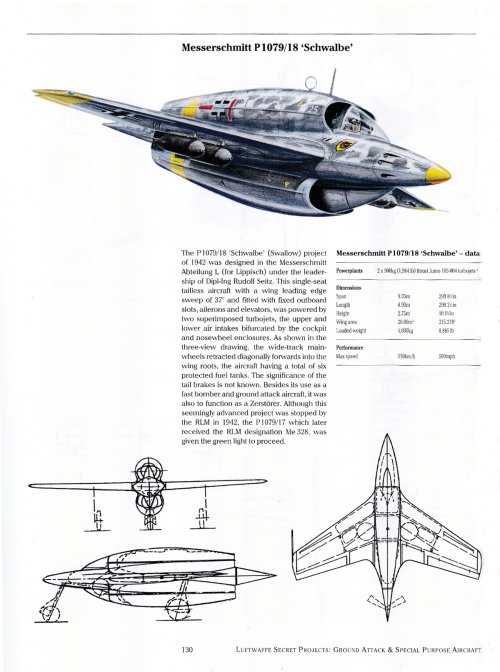
The Messerschmitt P.1079/18 "Swallow" aircraft model was created under the supervision of graduate engineer Rudolf Seitz at the production facilities of the Alexander Lippisch division at the Messerschmitt plant in 1942.
Messerschmitt P.1079/18 “Schwalbe” fighter-bomber
The Messerschmitt P.1079/18 "Swallow" aircraft model was created under the supervision of graduate engineer Rudolf Seitz at the production facilities of the Alexander Lippisch division at the Messerschmitt plant in 1942.
This all-metal flying wing aircraft featured a 37-degree leading edge sweepback and was equipped with outboard nozzles, ailerons, and elevators. The cockpit was designed for a single pilot. The aircraft was powered by two Jumo 004b turbojet engines mounted outboard of the landing gear, so that the upper and lower inlet flows were separated by the cockpit and the nose wheel contour.
The unusual diagonal retraction of the main wide-body landing gear was explained by the presence of six self-sealing fuel tanks under the wings and on the aircraft's fuselage. The landing gear retracted at the wing root.
The tail brakes were installed in accordance with the aircraft's multifunctional purpose: it could be used as an attack aircraft, a bomber, and a fighter.
Due to the complexity of the design, work on the P.1079/18 aircraft project was stopped by order of the German Air Ministry in 1942, and the P.1079/17 modification became the basis for the creation of the light wooden bomber Me-328 with Argus pulse jet engines. The name Schwalbe (Swallow) was finally assigned to the Me-262 aircraft.
The first Me-262 prototype without engine cowlings took to the air when the P.1079/18 was still in the development stage
Engines: Two Jumo 109-004B engines (total thrust 1984 kgf)
Wingspan: 9.05 m.
Length: 8.90 m.
Height: 2.75 m.
Wing area: 20.0 sq.m.
https://war-book.ru/messerschmitt-p-1079-istrebitel/
The Messerschmitt P.1079/18 "Swallow" aircraft model was created under the supervision of graduate engineer Rudolf Seitz at the production facilities of the Alexander Lippisch division at the Messerschmitt plant in 1942.
Messerschmitt P.1079/18 “Schwalbe” fighter-bomber
The Messerschmitt P.1079/18 "Swallow" aircraft model was created under the supervision of graduate engineer Rudolf Seitz at the production facilities of the Alexander Lippisch division at the Messerschmitt plant in 1942.
This all-metal flying wing aircraft featured a 37-degree leading edge sweepback and was equipped with outboard nozzles, ailerons, and elevators. The cockpit was designed for a single pilot. The aircraft was powered by two Jumo 004b turbojet engines mounted outboard of the landing gear, so that the upper and lower inlet flows were separated by the cockpit and the nose wheel contour.
The unusual diagonal retraction of the main wide-body landing gear was explained by the presence of six self-sealing fuel tanks under the wings and on the aircraft's fuselage. The landing gear retracted at the wing root.
The tail brakes were installed in accordance with the aircraft's multifunctional purpose: it could be used as an attack aircraft, a bomber, and a fighter.
Due to the complexity of the design, work on the P.1079/18 aircraft project was stopped by order of the German Air Ministry in 1942, and the P.1079/17 modification became the basis for the creation of the light wooden bomber Me-328 with Argus pulse jet engines. The name Schwalbe (Swallow) was finally assigned to the Me-262 aircraft.
The first Me-262 prototype without engine cowlings took to the air when the P.1079/18 was still in the development stage
Engines: Two Jumo 109-004B engines (total thrust 1984 kgf)
Wingspan: 9.05 m.
Length: 8.90 m.
Height: 2.75 m.
Wing area: 20.0 sq.m.